Full Walkthrough: An AI-Assisted Development Workflow from Requirements to Production
This workshop demonstrates a comprehensive AI coding workflow, emphasizing that software engineering fundamentals remain crucial when working with AI.
The key steps and concepts include:
- Understanding LLM Constraints: Recognizing the "smart zone" and "dumb zone" of LLMs and the "Memento effect" (LLMs forgetting context) highlights the need for small, focused tasks.

Smart Zone / Dumb Zone concept with 100K token limit for optimal LLM performance. [ 00:04:10 ] - Grilling for Alignment: Using a "grill me" skill to collaboratively define ambiguous requirements into a clear Product Requirements Document (PRD) through iterative questioning, ensuring shared understanding with the AI.

The prompt definition for the `/grill-me` skill, instructing the AI to interview the user relentlessly. [ 00:12:24 ] - Vertical Slicing with Kanban: Transforming the PRD into a Kanban board of "tracer bullet" (vertical slice) issues, which traverse all system layers to enable early feedback and parallel development by AI agents.

The "tracer bullet" approach advocates for vertical slices that cut across all system layers, enabling early integration and feedback. [ 00:43:57 ] - AFK Implementation with TDD: Running autonomous AI agents (AFK) to implement tasks using Test-Driven Development (TDD), ensuring robust code with continuous feedback loops from tests and type checks.
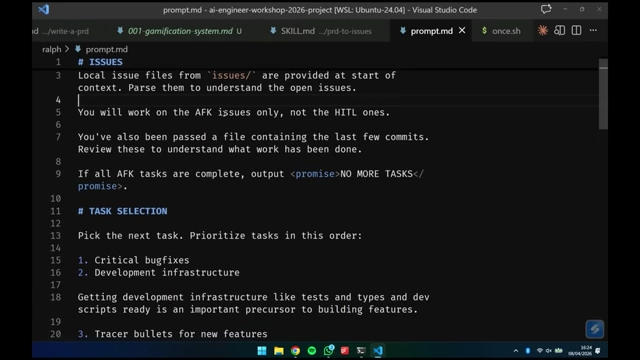
The prompt for the AFK (Away From Keyboard) agent, outlining task prioritization. [ 00:56:06 ] - Codebase Architecture for AI: Designing "deep modules" with simple interfaces and rich internal functionality to make the codebase more testable and easier for AI to work with, avoiding "shallow modules."
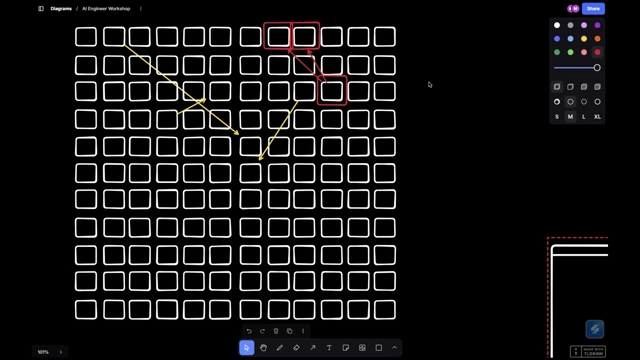
The concept of "deep modules," which have simple public interfaces but encapsulate complex internal functionality, making them easier for AI to manage and test. [ 01:18:06 ] - Human QA and Automated Review: Maintaining human-in-the-loop quality assurance and incorporating automated code reviews to maintain taste and coding standards.
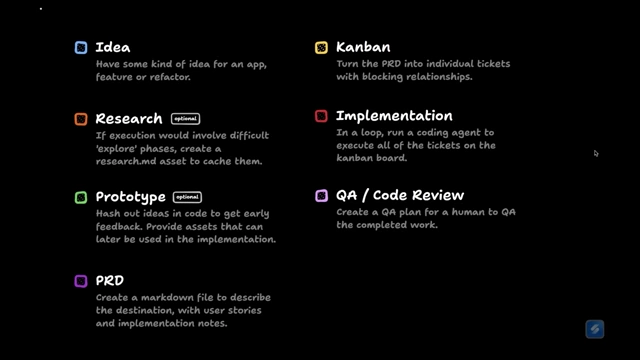
A comprehensive flow diagram illustrating the full lifecycle of AI-assisted development. [ 01:01:28 ]
Introduction to AI Coding Workflow [00:00:15]
Matt Pocock introduces the concept that while AI represents a new paradigm in software development, fundamental software engineering principles remain essential when working with AI. He emphasizes that practices crucial for human collaboration also apply to AI. The workshop aims to guide participants through an AI-assisted development lifecycle, from ambiguous requirements to production features, focusing on these enduring principles.
Understanding LLM Constraints [00:03:00]
The speaker highlights two main constraints when working with Large Language Models (LLMs):
- Smart Zone / Dumb Zone [00:03:06]
- LLMs perform optimally in a "smart zone" when a conversation begins, as attention relationships are least strained. [00:03:31]
- Performance degrades into a "dumb zone" as more tokens are added to the context window (scaling quadratically), making the LLM "dumber." [00:04:02] This typically occurs around 100K tokens, regardless of the maximum context window size.
Smart Zone / Dumb Zone concept with 100K token limit for optimal LLM performance. [ 00:04:10 ] - Implication: Tasks should be sized small to keep the AI within its "smart zone." [00:04:31]
- Addressing large tasks: Instead of continuously adding to one context (leading to the dumb zone), multi-phase plans break down large tasks into smaller, manageable units, each executed within its own "smart zone" session. [00:05:41] This can be conceptualized as a loop of individual smart zone tasks. [00:06:14]

Human-in-the-Loop (HITL) multi-phase plan, where large tasks are broken into smaller, individually executed "smart zone" phases. [ 00:05:57 ] 
The "Ralph" autonomous loop, where an agent improvises a plan to make small changes toward a Product Requirements Document (PRD). [ 00:07:07 ]
- LLMs Forget Context (Memento Effect) [00:07:27]
- LLMs constantly reset to a base state, forgetting previous interactions unless explicitly maintained. [00:07:31]
- Session Stages: An LLM session typically involves a tiny system prompt, an exploratory phase, implementation, and testing. [00:07:56]

Diagram illustrating "clearing" (resetting context) versus "compacting" (summarizing context) in LLM sessions. [ 00:08:12 ] - Clearing Context: Resets the LLM entirely, going back to just the system prompt. [00:08:42]
- Compacting Context: Summarizes previous conversations into fewer tokens to preserve context, but the speaker prefers clearing for a consistent, fresh state. [00:10:15] The exact token count is crucial for monitoring proximity to the "dumb zone." [00:09:40]

A VS Code terminal showing an active Claude Code session with a real-time token counter (24.4k tokens). [ 00:09:22 ]
Phase 1: Turning Ambiguous Requirements into a Product Requirements Document (PRD) [00:11:08]
This phase focuses on achieving a shared understanding with the AI before any coding begins. The demo uses the Cadence course management platform.

- The "Grill Me" Skill [00:12:17]
- The "Grill Me" skill (a small custom prompt) is invoked with a client brief to prevent misalignments between human and AI. [00:15:25]
The prompt definition for the `/grill-me` skill, instructing the AI to interview the user relentlessly. [ 00:12:24 ] 
An ambiguous client brief from "Sarah Chen" requesting gamification features for the Cadence platform. [ 00:14:50 ] - It forces the AI to interview the user relentlessly, asking clarifying questions one at a time, and offering recommendations based on its exploration of the codebase. [00:16:19]

The AI (Claude Code) exploring the codebase and initiating the grilling session by asking clarifying questions. [ 00:18:13 ] - Purpose: To reach a "design concept" or shared understanding, much like Frederick P. Brooks' concept, rather than just generating a plan. [01:17:12]
- Human-in-the-Loop (HITL): This is a HITL task, requiring human interaction to refine ideas and answer AI's questions. [01:26:43]
- The grilling session can be extensive (e.g., 22 questions answered by AI in the demo), creating a valuable conversation history. [00:20:50]

The AI's recommendation for the gamification UI, suggesting dashboard and lesson viewer touchpoints. [ 00:23:09 ]
- The "Grill Me" skill (a small custom prompt) is invoked with a client brief to prevent misalignments between human and AI. [00:15:25]
- Generating the PRD [00:30:24]
- After the grilling session, a
write-a-prdskill is used to summarize the refined design concept into a structured Product Requirements Document (PRD). [00:31:19]
Template for the Product Requirements Document (PRD). [ 00:31:59 ] - The PRD includes problem statements, solutions, extensive user stories (e.g., 18 in the demo), implementation decisions (data model, modules, services), level thresholds, and testing decisions. [00:34:51]

An excerpt from the AI-generated PRD, detailing the data model and proposed "Gamification Service." [ 00:38:56 ] - Reviewing the PRD: The speaker generally avoids reading the AI-generated PRD in detail, as the alignment was already established during the grilling. He trusts the AI's summarization. [00:35:23]
- Doc Rot: Keeping static documentation like PRDs in the repository can lead to "doc rot" (outdated documentation), negatively influencing future AI interactions. It's often better to discard them or mark them as closed issues. [01:24:40]

Matt Pocock's GitHub repository demonstrating how closed issues (PRDs and implementation tasks) are managed. [ 00:34:40 ] 
The "Out of Scope" section in the PRD template, crucial for defining the boundaries of the feature. [ 00:58:39 ]
- After the grilling session, a
Phase 2: Breaking Down PRDs into Actionable Tasks (Kanban Board) [00:39:38]
This phase focuses on structuring the work for efficient AI execution.
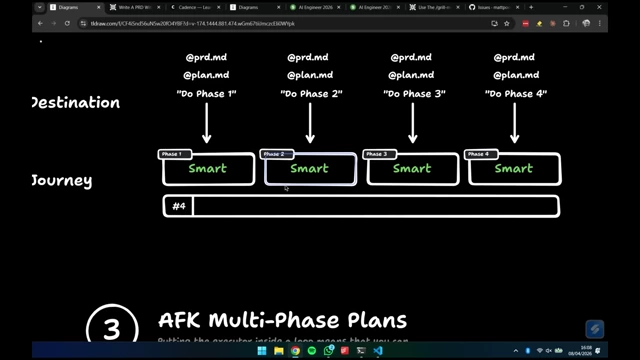
- Issue with Horizontal Slicing [00:42:50]
- AI often prefers to code "horizontally" (e.g., completing all database work, then all API work, then all frontend work). [00:43:00]

Diagram illustrating different layers within a system (Database, API, Frontend). [ 00:42:00 ] 
LLMs tend to code horizontally, building entire layers before moving to the next, which delays feedback. [ 00:42:58 ] - Problem: This delays feedback, as the full system isn't integrated or testable until later phases. [00:43:22]
- AI often prefers to code "horizontally" (e.g., completing all database work, then all API work, then all frontend work). [00:43:00]
- Vertical Slicing (Tracer Bullets) [00:43:45]
- The "tracer bullet" approach (from The Pragmatic Programmer) involves creating "thin slices of functionality" that cut across all system layers (e.g., database, API, frontend). [00:43:49]
The "tracer bullet" approach advocates for vertical slices that cut across all system layers, enabling early integration and feedback. [ 00:43:57 ] - Benefit: Provides early, integrated feedback at each phase, allowing the AI to test and validate its approach continuously. [00:44:00]
- The "tracer bullet" approach (from The Pragmatic Programmer) involves creating "thin slices of functionality" that cut across all system layers (e.g., database, API, frontend). [00:43:49]
- Kanban Board Generation [00:40:10]
- The
prd-to-issuesskill is used to break the PRD into "independently grabbable issues" that represent vertical slices, forming a Kanban board. [00:44:12]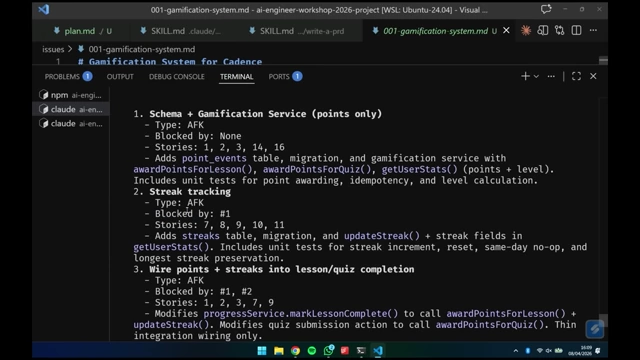
The AI's initial proposal for breaking down the PRD into "independently grabbable issues" for a Kanban board. [ 00:41:04 ] - Each issue specifies its type (AFK or HITL), blocking dependencies, and associated user stories. [00:40:41]
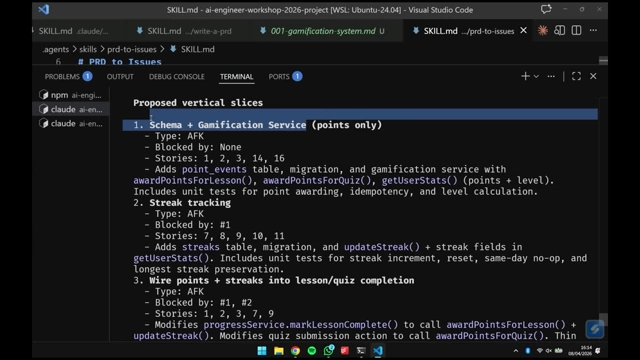
The AI's refined vertical slices for the Kanban board, incorporating feedback to ensure end-to-end demoability. [ 00:45:48 ] - Parallelization: The Kanban board structure, with explicit blocking relationships, allows multiple AI agents to work on independent tasks simultaneously. [00:50:09]

A Kanban board with tasks and their blocking dependencies. [ 00:50:07 ] 
A directed acyclic graph demonstrating how tasks with clear dependencies can be parallelized. [ 00:50:57 ] - The speaker manually reviews the generated slices to ensure they are genuinely vertical and not horizontal. [00:45:54]
- The
Phase 3: AI-Assisted Implementation (AFK Agent) [00:53:51]
This is the phase where the human largely steps back, and AI handles the coding.
- AFK Loop for Implementation ("Ralph Loop") [00:53:57]
- An autonomous coding agent runs in a loop, picking tasks from the Kanban board. [00:54:19]
- Task Prioritization: The agent prioritizes tasks in a specific order: [00:56:21]
- Critical bug fixes
- Development infrastructure (tests, types, dev scripts)
- Tracer bullets for new features (including "build a tiny, end-to-end slice of the feature first")
- Polishing and quick wins
- Refactors
The prompt for the AFK (Away From Keyboard) agent, outlining task prioritization. [ 00:56:06 ]
- Process: For each task, the agent explores the repo, implements using TDD, runs feedback loops (tests, type checkers), and commits. [00:57:21]
- Automation: The
ralph-once.shscript demonstrates a single iteration of this loop, passing in issues and recent commits. A more complexafk.shscript handles the full looped execution, often within a Docker sandbox. [00:54:24]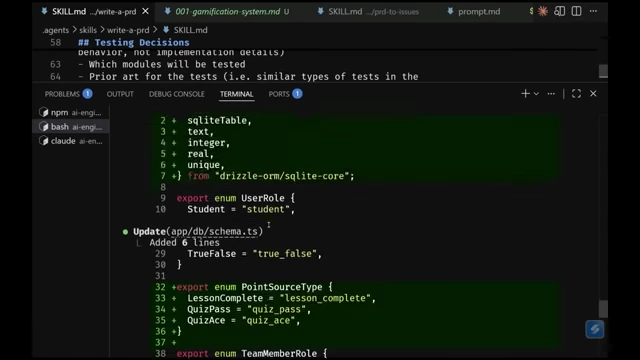
The AI agent making code changes in `db/schema.ts` to introduce new point source types for gamification. [ 01:06:36 ] 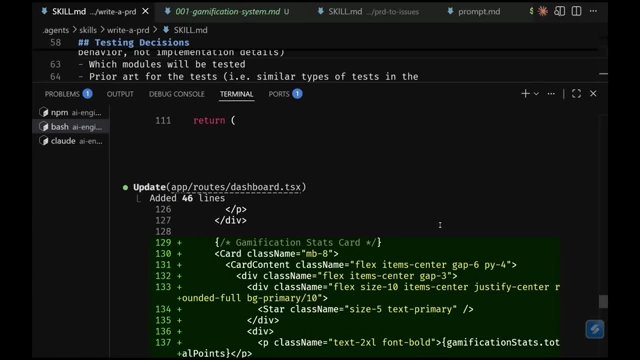
AI-generated code to add a "Gamification Stats Card" to the dashboard route (`app/routes/dashboard.tsx`). [ 01:09:42 ] 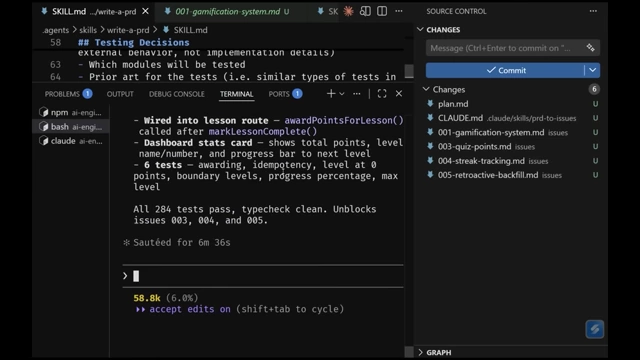
VS Code showing commit message and changed files after AFK agent run. [ 01:09:06 ]
- Test-Driven Development (TDD) with AI [01:06:48]
- Importance: TDD (red, green, refactor) is crucial for AI agents to produce high-quality, reliable code. [01:06:51]
- Process: The AI first writes a failing test ("red"), then implements the minimal code to make the test pass ("green"), and finally refactors ("refactor"). [01:07:00]
- Preventing "Cheating": TDD prevents AI from writing "cheating" tests or implementing an entire layer horizontally without proper validation. [01:07:59]
- Feedback Loops: Robust feedback loops (unit tests, integration tests, type checks, linters) are the "ceiling" for AI coding quality. Improving these loops directly improves the AI's output. [01:09:51]
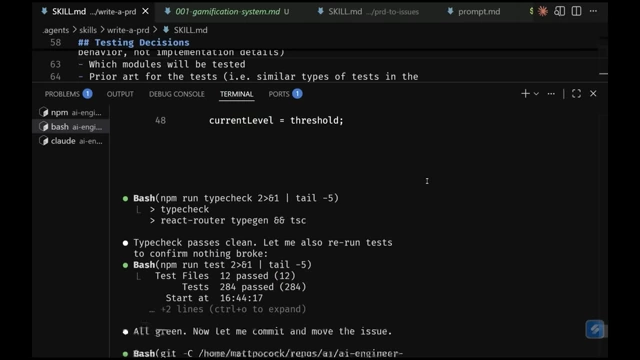
The AI successfully running type checks and tests to ensure code quality. [ 01:10:52 ]
Phase 4: Human Quality Assurance (QA) and Code Review [01:09:12]
Even with autonomous agents, human oversight is non-negotiable.
- Importance of Manual QA: [01:13:21]
- After an AFK agent completes tasks, humans perform manual QA and code review to inject "taste" and ensure the product meets quality standards. [01:12:47]
- Automating every step can lead to generic, low-quality "slop." [01:13:02]
- QA also provides an opportunity to create more issues for the Kanban board, feeding back into the implementation loop. [01:34:53]
- Automated Reviewer [01:05:33]
- An automated review step can be added after implementation (and before human QA) to check the AI-generated code against coding standards. [01:29:18]
- The reviewer agent is "pushed" (given) the coding standards and the code to be reviewed, ensuring it operates with a fresh context in its "smart zone." [01:29:23]

A diagram distinguishing "Push" (explicit instructions) and "Pull" (agent-initiated information retrieval) for AI guidance. [ 01:28:20 ] 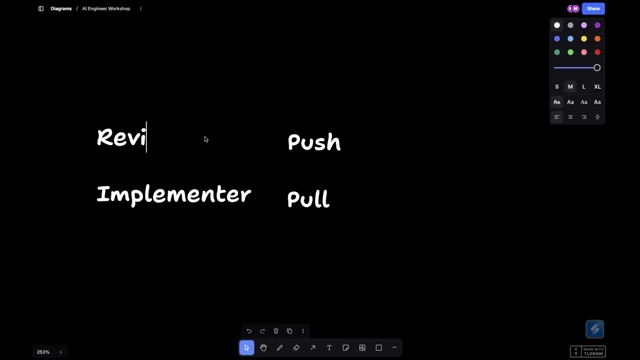
The recommended strategy: "Push" coding standards to Reviewer agents and allow Implementer agents to "Pull" them via skills. [ 01:29:24 ]
Codebase Design for AI Effectiveness [01:14:10]
The underlying codebase architecture significantly impacts AI's ability to perform well.
- Deep Modules vs. Shallow Modules [01:16:55]
- Shallow Modules: Characterized by many small files with complex, intertwined dependencies. They are difficult for AI to navigate, understand dependencies, and test effectively. [01:14:42]

A codebase composed of many small, highly interdependent files (shallow modules). [ 01:14:38 ] 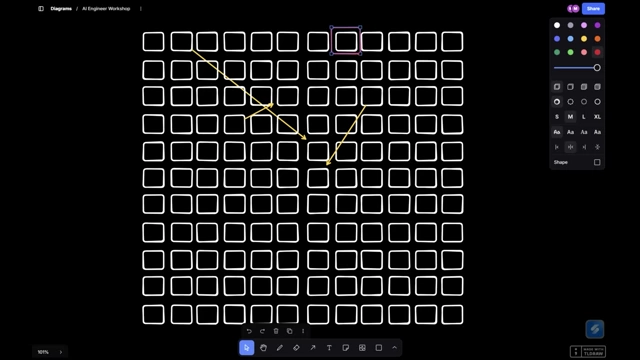
Diagram illustrating dependencies in shallow modules and testing challenges. [ 01:16:05 ] - Deep Modules: Modules with a small, simple public interface but a large amount of encapsulated, complex functionality inside. [01:17:05]
The concept of "deep modules," which have simple public interfaces but encapsulate complex internal functionality, making them easier for AI to manage and test. [ 01:18:06 ] - Benefit: Deep modules are easier to test (a single test boundary covers much functionality) and easier for AI to work with, leading to better code quality. [01:17:18]
- AI Tendency: Without explicit guidance, AI tends to produce shallow modules. [01:17:54]
- Shallow Modules: Characterized by many small files with complex, intertwined dependencies. They are difficult for AI to navigate, understand dependencies, and test effectively. [01:14:42]
- "Improve Codebase Architecture" Skill [01:21:28]
- A skill exists to help identify and refactor a codebase towards deep modules. [01:21:37]
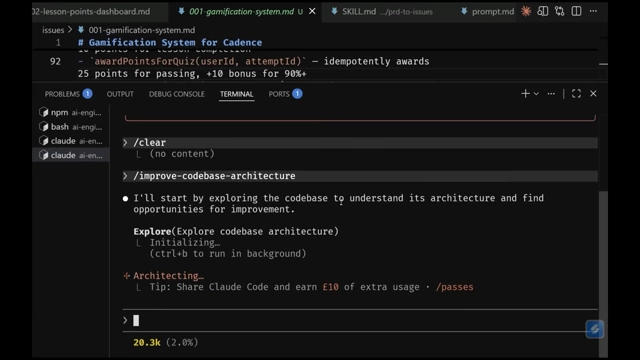
The AI running the `improve-codebase-architecture` skill to analyze and suggest improvements for module deepening. [ 01:21:48 ] - It scans the codebase, identifies architectural coupling and areas for improvement (e.g., services with zero tests, redundant logic), and suggests deepening modules. [01:33:01]
- Mental Trick: Designing modules with clear interfaces allows developers to delegate the internal implementation details to AI while retaining a high-level understanding of the codebase structure. [01:20:52]
- A skill exists to help identify and refactor a codebase towards deep modules. [01:21:37]
Parallelization with Sandcastle [01:29:50]
For scaling AI-assisted development, parallelization is key.
- Sandcastle Library: A TypeScript library designed to orchestrate AI coding agents in isolated Docker containers (sandboxes), enabling multiple agents to work concurrently. [01:30:07]

The README for the Sandcastle library, showing a programmatic API for running AI agents. [ 01:30:15 ] - Parallel Workflow:
- Planner Agent: Reads the Kanban board and selects a set of independent (non-blocking) issues that can be worked on in parallel. [01:31:01]
- Implementer Agents: Each selected issue is assigned to a separate implementer agent, running in its own sandbox (Git branch), following the TDD and feedback loop process. [01:31:32]
- Reviewer Agents: Optionally, automated reviewer agents can check the implemented code for compliance with coding standards. [01:31:47]
- Merger Agent: Once implementations are complete and reviewed, a merger agent integrates the changes from individual branches, resolving any conflicts. [01:31:55]
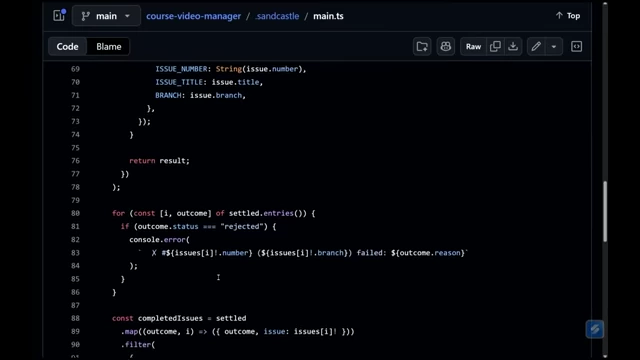
Example code from Sandcastle's `main.ts`, demonstrating the orchestration of a planner, implementers, and merger agents in parallel. [ 01:32:26 ]
- Push vs. Pull for Coding Standards: For implementers, coding standards can be "pulled" (accessed by the agent as needed via skills). For reviewers, coding standards should be "pushed" (explicitly provided in the prompt) to ensure thorough checking. [01:28:18]