The Personal Brand Blueprint: Content Strategy for Attracting Opportunities
This video presents a comprehensive blueprint for building a powerful personal brand in the digital age, emphasizing that it's a long-term asset that attracts opportunities. The core strategy involves understanding your audience, defining your Creator Vision (What, Who, Uniqueness), and mastering content formats.
The Power of a Personal Brand [0:00]
The speaker promises to share an equation that can transform lives by building a personal brand, which he identifies as the most powerful long-term asset in the digital age.
- A personal brand is essentially your public reputation and how the world perceives you.
- In the past, people relied on others to advocate for them; today, content allows individuals to share who they are, what they stand for, and what they offer to millions.
- Effectively building a personal brand means attracting opportunities rather than chasing them.
Jun's Personal Journey and Insights [0:52]
The speaker shares his personal story, illustrating how personal branding helped him achieve success despite humble beginnings.
- Early Struggles:
- Started with no creative or business background, as a full-time biomedical engineering student.

Jun Yuh's early Instagram profile with 4,516 followers, reflecting his non-creative background and student status [ 00:01:58 ] - Initially chased trends (fashion, fitness content) and experienced low view counts (around 200 views for the first 50 posts).
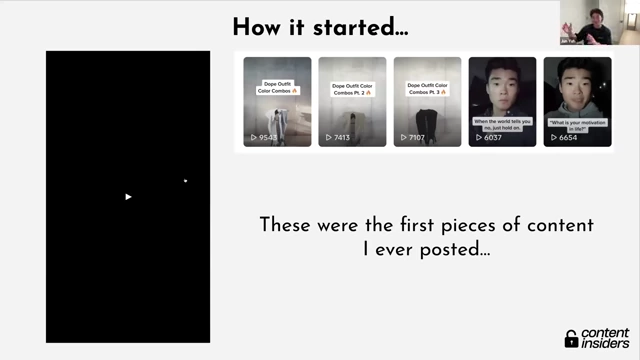
Examples of Jun Yuh's first pieces of content, featuring fashion color combos and motivational talking head videos [ 00:02:57 ]
- Started with no creative or business background, as a full-time biomedical engineering student.
- Shift to Meaningful Content:
- After reaching about 10,000 followers, he desired to create purposeful content that made an impact.

Jun Yuh's Instagram showing growth to 9,705 followers, signaling a shift towards meaningful content [ 00:04:27 ] - Developed a content system that made consistent posting easy, even with a demanding academic schedule.
- After reaching about 10,000 followers, he desired to create purposeful content that made an impact.
- Growth and Monetization:
- Grew to millions of followers across platforms.
- Successfully monetized his brand by selling one-off products, publishing a physical book (The Learning System, #1 on Amazon new releases), and starting a flagship mentorship program focused on human performance and neuroengineering.

Jun Yuh's monetization efforts, including digital products, a physical book, and judging a global competition [ 00:05:37 ] - Became a judge for a global entrepreneurship competition, demonstrating authority in personal branding.
- Achieved 8 million followers and over $4 million in sales.

Jun Yuh's current social media metrics, showcasing 8 million followers and over $4 million in sales [ 00:07:05 ]
- Challenging Traditional Niche Down Advice:
- Many creators are advised to "niche down" into one topic, which can lead to limited engagement when branching out.
- The speaker argues for a personal brand that has longevity and matches one's evolution, encompassing multiple interests.
- His method helps creatives tell personal stories through content formats and messaging.

Defining content formats and messaging as key components of storytelling [ 00:08:18 ]
1. How to Build the Right Audience [9:40]
The first step is to shift the mindset from chasing millions of followers to building a dedicated community.
- Quantity vs. Quality: Millions of "wrong" followers who don't engage or buy products are not beneficial.
- Community Building: Focus on attracting the right audience by understanding their needs and delivering content effectively.
- Message + Format = Right Audience:
- Message: What you are saying and the value you are giving.
- Format: How you are presenting it (e.g., b-roll, talking head, voiceover, hooks, visuals).

The equation for attracting the right audience: Message + Format [ 00:10:39 ]
2. What to Post: Defining Your Creator Vision [11:00]
The core of effective content lies in a well-defined Creator Vision, comprising three essential parts.
- 2.1. Your "What" (Your Message/Ethos) [12:10]
- This is your overarching philosophy or message to the world.
- Content Pillars: Three distinct areas of interest that stem from your core message.
- Content Ideas: Specific topics or themes that fit under each content pillar.

The "What" of the Creator Vision, showing the hierarchy of message, content pillars, and content ideas [ 00:12:19 ] - Example (Jun Yuh):
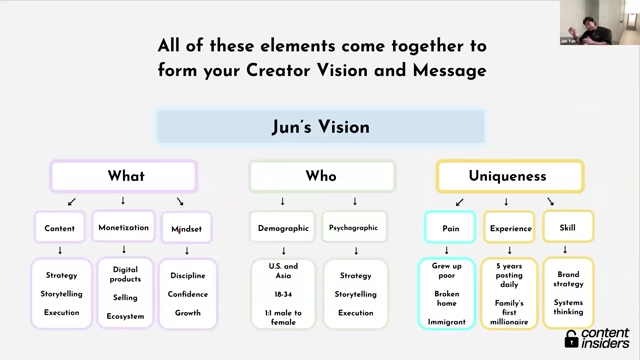
- Message: A personal brand is the most valuable long-term asset you can build.
- Pillars: Content (Strategy, Storytelling, Execution), Monetization (Digital products, Brand deals, Ecosystem), Mindset (Discipline, Confidence, Growth).

Jun Yuh's Creator Vision example, with "A personal brand is the most valuable long-term asset you can build" as his message, supported by Content, Monetization, and Mindset pillars [ 00:13:19 ]
- Example (Leana Deeb):
- Message: Empowering women to move with faith and confidence.
- Pillars: Health (Fitness/Running, Holistic Wellness, Meal Prepping), Faith (Prayer, Modest Fashion), Mindset (Journaling, Healthy Habits, Discipline).

Leana Deeb's Creator Vision example, focusing on "Empowering women to move with faith & confidence" through Health, Faith, and Mindset pillars [ 00:14:19 ]
- Finding Your Message (Prompts):
- What do you want your audience to learn, feel, or achieve by following you?
- What personal experiences shaped your core beliefs about life?
- What do your friends or family say about you?

Key questions to ask yourself to define your personal message or ethos [ 00:15:09 ]
- 2.2. Your "Who" (Your Audience) [15:20]
- It's crucial to understand the real people behind the numbers.
- Target Avatar: Define your audience through two components:
- Demographic: Age range, location, profession, gender breakdown (often found in analytics).
- Psychographic: What your audience struggles with and what they desire.

The "Target Avatar" framework, breaking down audience into Demographic and Psychographic components [ 00:16:19 ]
- Targeting with Psychographics: Tailor your message to address specific struggles and desires (e.g., "If you're a student struggling in classes, this is how you become disciplined" is more effective than a general statement about discipline).
- "Younger You" Principle: If unsure who to target, focus on the version of yourself 2-3 years younger, as you've experienced a transformation they desire.
- Example (Jun Yuh):
- Demographic: US and Asia, 18-34, 1:1 male to female.
- Psychographic: Low confidence, lack of clarity & focus, low earnings.

Jun Yuh's Target Avatar example, detailing his audience's demographic and psychographic characteristics [ 00:18:19 ]
- 2.3. Your "Uniqueness" (Your Story) [18:28]
- This is the most crucial element for standing out and connecting deeply with your audience.
- Components of Uniqueness:
- Pain: Your challenges, lowest points, core insecurities.
- Experience: Your qualifications, key milestones, who you've helped.
- Skill: What you can teach, mastered methods, go-to expertise.

The "Uniqueness" framework, defined by your Pain, Experience, and Skill [ 00:18:39 ] 
Detailed questions to help identify your unique pain, experience, and skills [ 00:18:59 ]
- The Power of Pain:
- Your most powerful content will always derive from your pain because people connect through your humanity, not your highlights.
- Sharing struggles creates universal connection and purpose.
- Turn personal pain into service, showing others they are not alone and empowering them.
- Important: When sharing your story, highlight your growth, not negatively criticize others. Share only what you're comfortable with and what aligns with your message.

A list of common pains to highlight for universal connection, such as breakups, financial hardship, and self-doubt [ 00:21:28 ]
- Jun's Uniqueness Example:
- Pain: Grew up poor, divorced parents, immigrant hardship.
- Experience: 5 years of daily posting, first millionaire in family.
- Skill: Brand strategy, systems thinking.
Jun's complete Creator Vision, combining his What, Who, and Uniqueness [ 00:23:08 ]
- Creator Vision Examples by Occupation: Templates are provided for a Trainer, Stylist (Fashion/Beauty), and Mindset Coach, showing how to apply the "What, Who, Uniqueness" framework.
- Trainer Example: Ethos ("Sustainable health is built through small daily habits"), Target Avatar (19-39, US, men, 9-5, overweight, unhealthy diet, low confidence), Uniqueness (Underweight, body image issues, coached 30+ people, lost 60 lbs, creating workout programs, individual nutrition plans, holistic rehab).
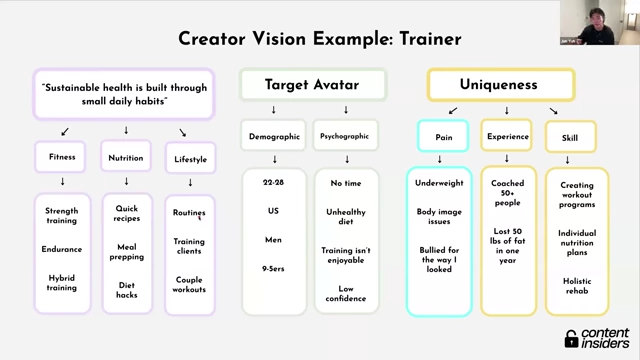
Creator Vision example for a Trainer, illustrating how to apply the framework [ 00:23:28 ] - Stylist Example: Ethos ("Helping women look good, feel powerful, and show up as their best selves"), Target Avatar (18-30, US & Europe, women, students & professionals, lack of confidence, don't know their style, care about sustainability), Uniqueness (Isolation, fear of being seen, body shaming, majored in fashion, worked on shoots, upcycling, color theory, wardrobe curation, makeup).

Creator Vision example for a Stylist (Fashion/Beauty), detailing their message, target avatar, and uniqueness [ 00:23:48 ] - Mindset Coach Example: Ethos ("Freedom comes when you trust yourself and live in alignment"), Target Avatar (18-40, US & Europe, digital nomads, women, burnt out, fear of being "too much", thin relationships, feeling "not enough", chronic stress), Uniqueness (Anxiety issues, feeling "not enough", chronic stress, healed themselves, helped 60+ women, qualified life coach, biohacks, mindfulness, integrative wellness).
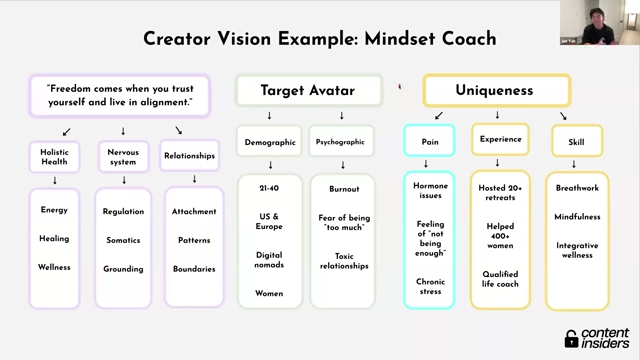
Creator Vision example for a Mindset Coach, outlining their holistic approach and target audience's struggles [ 00:24:08 ]
- Trainer Example: Ethos ("Sustainable health is built through small daily habits"), Target Avatar (19-39, US, men, 9-5, overweight, unhealthy diet, low confidence), Uniqueness (Underweight, body image issues, coached 30+ people, lost 60 lbs, creating workout programs, individual nutrition plans, holistic rehab).
3. Finding Winning Content Formats [24:42]
Studying and replicating proven content formats is key to consistent success.
- Why Study Content Formats:
- There is a proven formula in every successful video; you don't need to reinvent the wheel.
- Not studying formats is like cooking without recipes, building without blueprints, or traveling without a map.
- Your job is to analyze, understand, and replicate proven frameworks.
- Study the format, not the substance (you can learn from creators in any industry by observing their packaging).

Explanation of why studying content formats is crucial, emphasizing that there's a proven formula and no need to reinvent the wheel [ 00:24:58 ]
- Features of Formats to Study:
- Hook: Visual, text, sound.
- Visuals & Edit: Scenes, settings, dynamic vs. still.
- Cadence: How quickly it moves.
- Audio: Trending sounds, music, voiceover.
- Story Arc: Tension, curiosity, emotion.
- CTA (Call to Action): How it guides the viewer.
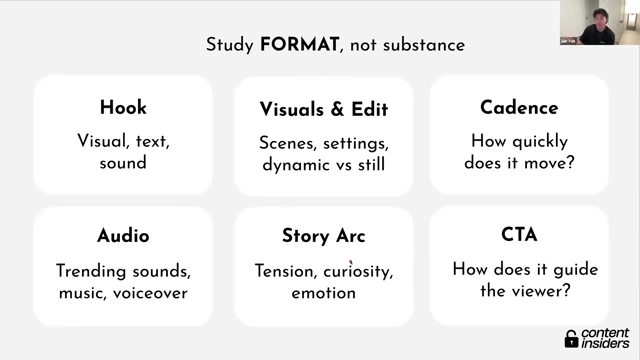
Features of content formats to study, including hook, visuals, cadence, audio, story arc, and call to action [ 00:26:48 ]
- Example: Silent Film Storytelling Format Breakdown (24.2M views) [27:18]
- Visual Hook: Highlights emotional pain (visual matches/emphasizes text).
- Text Hook: Details where the pain is from.
- Anchored in Time: Insignuates payoff, increases retention by showing a transformation.
- Readable Text: Cadence is tight but not jarring, allowing viewers to read text as it changes. Text has borders and is placed in clear areas.
- Anticipatory Music: Signals a transformation.
- CTA: Encourages more follows at the end.
- Story Arc: Pain → Pursuit → Success.

Detailed breakdown of the Silent Film Storytelling Format, explaining its hooks, text readability, music, CTA, and story arc [ 00:33:57 ]
- Student Transformations Through Format Study:
- Maggie (@maggieindata): Improved from 5,996 views to 88,800 views by studying and applying formats from other successful data science creators, leading to brand deals. This shows that knowing how to present information (formatting) is crucial, even for experts.
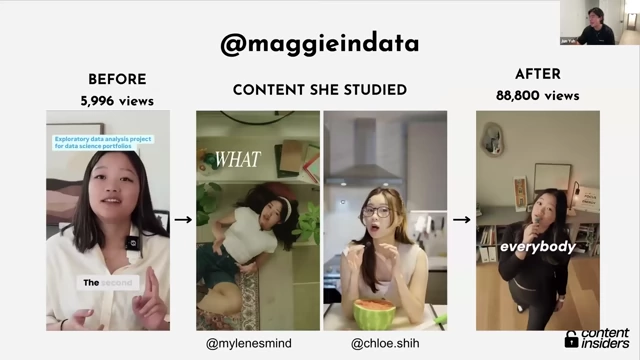
Before and after comparison of Maggie's content, showing a significant increase in views after applying format study [ 00:37:30 ] - Makenzie (@makenzieco): Transformed her content strategy, going from low engagement to high views (56,400 to 883,000 views) by studying successful formats, even if she didn't agree with the initial content.
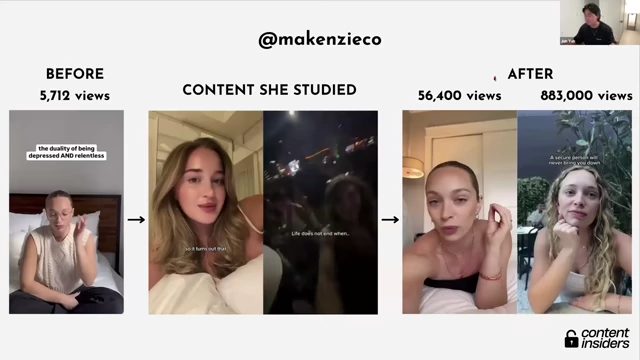
Before and after comparison of Makenzie's content, illustrating improved engagement and views through format adaptation [ 00:41:41 ]
- Maggie (@maggieindata): Improved from 5,996 views to 88,800 views by studying and applying formats from other successful data science creators, leading to brand deals. This shows that knowing how to present information (formatting) is crucial, even for experts.
- The 7x7 Practice:
- Identify 7 creators you admire.
- Analyze their 7 top-performing videos.
- This gives you 49 videos to study for recurring formats, hooks, cadence, story arcs, and CTAs.
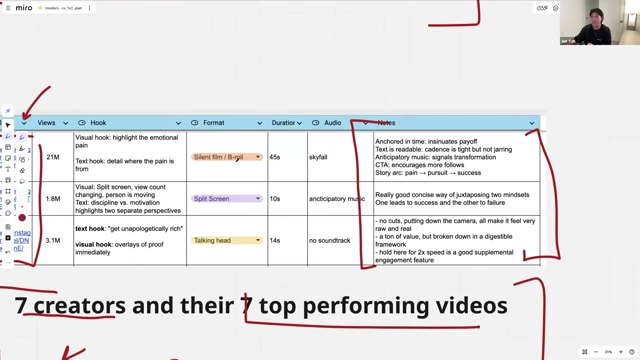
The 7x7 practice for studying content, analyzing 7 creators' top 7 videos for formats and key features [ 00:45:26 ]
- Content Planning Schedule:
- Combine ideas from your Creator Vision with formats learned from the 7x7 practice.
- This allows for efficient batch filming and consistent content creation.

An example of a weekly content planning schedule, integrating ideas from the Creator Vision with studied formats [ 00:46:56 ]
Bridging Problems to Desired Outcomes [47:17]
The blueprint aims to solve common creator problems and help achieve their goals.
- Common Problems: Stuck on what to post (too many ideas), not reaching non-followers, contradictory advice, feeling effort is not worth it.
- Desired Outcomes: Content that means something, building the right community, working with brands, selling products, being confident and bold about one's brand.
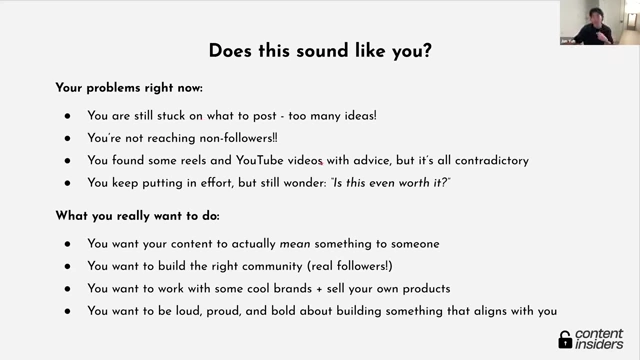
A list of common creator problems and desired outcomes, highlighting the gap the blueprint aims to bridge [ 00:48:01 ]