The Brutal Truth: Why Time Management is Really Self-Management and How to Optimize Your Productivity
Summary:
This video reveals that true "time management" is actually "self-management," emphasizing honesty about how time is spent. Key insights include:
- Many people mistakenly believe they lack time, but they actually lack honesty in how they use it, often procrastinating.
- Understanding why, where, and how time is wasted is crucial for effective time management.
- Focus on managing personal energy and attention, not just schedules, as energy leaks often precede time leaks.
- The smartphone is identified as a major distraction, stealing time and mental energy, leading to "fake productivity."

Scrolling on a smartphone, a major source of time waste [ 00:03:05 ] - Applying the 80/20 rule helps identify "needle-moving tasks" that yield 80% of results, encouraging a focus on these high-impact activities.
- Conducting a "life audit" is recommended to identify time-wasting activities and prioritize meaningful work.
- The ultimate truth is to be brutally honest about poor habits and distractions, guard energy, cut fake productivity, and reduce digital junk to become more intentional and achieve desired results with less effort.
Intro [0:00]
The video introduces the "brutal truth about time management" and promises to teach viewers how to become more efficient, work less, achieve more, and reclaim time.
The Lie We Tell Ourselves [1:02]
The speaker explains that most people don't have a time problem but an honesty problem.
- Excuses vs. Reality [0:37]
- People often say "I don't have enough time" or "I wish I had more hours," but everyone has the same 24 hours.
- These excuses are self-deception to cope with a lack of professionalism or unwillingness to do certain tasks.
- True understanding reveals that individuals can choose how they spend their time and what they build towards.
- Core Principles of Time Management [1:42]
- 1. Why do you waste time? [1:45] - This points to not valuing time, similar to how one wouldn't carelessly throw away money.
- 2. Where are you wasting time? [1:48] - Identifying specific activities that consume time unproductively (e.g., endless scrolling, procrastination).
- 3. How can you open up time and create space? [1:52] - Implementing effective systems to achieve clarity, freedom, and fulfillment.
- Dreamer vs. Doer [2:17]
- Most people are dreamers with ambitions but don't take action, preferring to talk and envision rather than do.
- To shift to being a doer, one must start valuing time as highly as money.
- Wasting time on trivial activities costs more than just the time itself; it costs leverage and progress towards goals.
It's Not Actually Time Management (It's Self-Management) [3:57]
The speaker shares a personal anecdote about wasting 4 hours on work that could have been done in 1.5 hours if focused.
- The Realization [4:16]
- The problem isn't needing more time blocks or techniques like Pomodoro, but needing a new level of self-control.
- Managing oneself is harder but more rewarding than just managing a schedule.
- This self-management stems from identity shifting – seeing oneself as a person who consistently takes action.
- Honesty in Time Allocation [4:47]
- People are often dishonest about how they allocate their time, spending hours on unproductive activities without realizing it.
- This leads to feeling a lack of time for important tasks like building a business or self-development.
- Example: Four hours spent scrolling Instagram reels could be used for productive work.
- Energy Leaks vs. Time Leaks [5:20]
- Most people suffer from an energy deficit and attention leaks, not a time deficit.
- They are busy but not doing enough of the right things.
- Just as a business tracks revenue and expenses for health, individuals need to track where their time and energy are going.
- The Phone as the Biggest Distraction [5:57]
- Smartphones are the primary culprits for stealing time and attention, leading to micro-moments of distraction that drain mental energy.
Scrolling on a smartphone, a major source of time waste [ 00:03:05 ] - This energy drain makes people feel like they "don't have time," when in reality, they're simply too drained to want to do the important tasks.
- Smartphones are the primary culprits for stealing time and attention, leading to micro-moments of distraction that drain mental energy.
The Blueprint [6:53]
This section offers practical strategies to address time and self-management issues.
- The 80% Rule (Pareto Principle) [6:58]
- 80% of activities yield only 20% of results, while 20% of activities ("needle-moving tasks") yield 80% of results.
- Many people spend most of their time on the 80% of low-impact tasks.
- The goal is to identify and prioritize the 20% of high-impact tasks that truly move the needle toward goals (financial, spiritual, physical).
- These needle-moving tasks are often uncomfortable but necessary for building a desired life.
- Do a Life Audit [7:40]
- Take a journal and honestly analyze how time is spent.
- Define "needle-moving tasks" – activities that genuinely contribute to goals and make a difference.
- Distractions pull individuals towards an easy, low-impact life, filled with useless actions and fake productivity.
- Most unproductive activities are a form of "coping" to avoid painful but useful tasks.
- Definition of Productivity [8:36] - Productivity is not about the hours worked, but the results achieved at the end of the month.
- Increased Output by Reducing Useless Input [8:47]
- The speaker shares his experience: initially, a 5-6 minute video took a week to produce due to distractions (e.g., checking phone 500 times during editing).
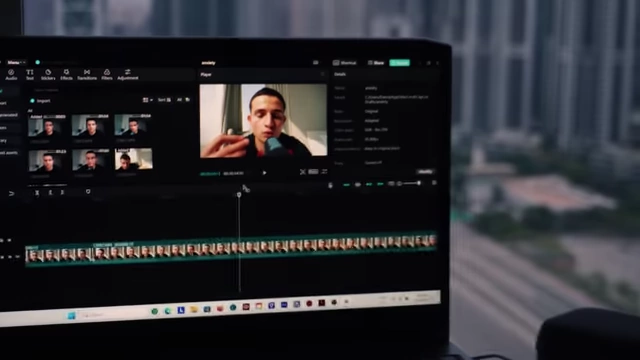
Video editing software on a laptop [ 00:08:49 ] - By cutting useless input (like phone distractions), he now produces longer videos (15-28 minutes) twice a week, demonstrating significantly increased efficiency and output.
- Useless input drains mental energy and leads to burnout. To achieve a dream life, one must value input and ensure output is valuable.
- The speaker shares his experience: initially, a 5-6 minute video took a week to produce due to distractions (e.g., checking phone 500 times during editing).
The Brutal Truth [9:50]
The fundamental truth is simple and direct.
- Time Allocation is a Choice [9:52]
- After accounting for essentials (sleep, eating, gym, chores), there are "free hours" each day.
- These hours can either be used to build the desired life or to waste time and complain about unachieved goals.
- Self-Honesty is Key [10:17]
- It's crucial to be brutally honest with oneself about real problems: low energy, poor habits, and fake productivity.
- The solution isn't more hours or less work, but more intention with current activities.
- Final Advice for Intentional Living [11:24]
- Guard your energy.
- Cut fake productivity.
- Reduce digital junk.
- Daily ask: "What is the one thing I can do today that will move me closer to my goals?"
- Once the self-deception about time stops, everything changes.