How Pocket Flow, an LLM Framework, Needs Only 100 Lines, Its Core Principles, and Applications
Summary:
Pocket Flow is a minimalist LLM framework built on just 100 lines of Python code, designed to simplify complex AI applications by focusing on core principles. It stands out from other frameworks due to its zero dependencies and tiny codebase. The framework leverages three core ideas:
- Nodes: Basic units of work with
prep(data fetching),exec(isolated computation), andpost(result writing and action definition) steps, including built-in fault tolerance. - Shared Store: A simple Python dictionary acting as a central communication hub for all Nodes, ensuring easy debugging.
- Flow: The orchestrator that connects Nodes, defines workflow logic using "action" strings for branching, and supports powerful nested workflows by treating flows as nodes.
The framework avoids vendor lock-in by not including LLM wrappers, allowing users to implement their own LLM calls (e.g., 10 lines for OpenAI API). This minimalist approach enables building sophisticated applications like chatbots (single self-looping Node), structured output parsers (using YAML for robust LLM responses), efficient batch processing (BatchNode), parallel execution (AsyncParallelBatchNode for concurrent tasks), and complex multi-step workflows for higher-quality output, including advanced agents that can dynamically decide their next actions. The video itself was generated by a PocketFlow agent, demonstrating its real-world capability.

Comparison of PocketFlow's minimalist advantage over other LLM frameworks [ 00:01:50 ]
Introduction to Pocket Flow: Minimalism in LLM Frameworks [0:00]
The video argues that building AI applications doesn't require massive, convoluted systems or extensive documentation, and that many existing LLM frameworks are unnecessarily complex.
- The Problem with Existing Frameworks:
- Require reading textbook-like documentation.
- Feature confusing "spiderweb diagrams."
- Lead to "dependency hell."

Example of complex LangChain documentation [ 00:00:05 ]
- The Solution: Pocket Flow [0:50]
- A minimalist LLM framework.
- Built on just 100 lines of code.
- Focuses on stripping away non-essential components to master fundamentals.
- Popularity indicated by rapidly growing GitHub stars.
- Core Philosophy: Zero dependencies and a tiny codebase (100 lines, 56KB) compared to hundreds of megabytes and tangled codebases of competitors (e.g., LangChain, CrewAI, SmolAgent, LangGraph, AutoGen).
Comparison of PocketFlow's minimalist advantage over other LLM frameworks [ 00:01:50 ] - Underlying Principle: All LLM applications are essentially simple graphs.
- Core abstractions (Node, Batch, Flow, Async, Branch, Looping, Nesting) can build complex patterns (Workflow, Chat, RAG, Map-Reduce, Chat Memory, Agent, Multi-Agents, Supervisor).

Diagram showing PocketFlow's core abstractions [ 00:02:10 ] 
Diagram showing how PocketFlow's abstractions build powerful patterns [ 00:02:20 ]
- Core abstractions (Node, Batch, Flow, Async, Branch, Looping, Nesting) can build complex patterns (Workflow, Chat, RAG, Map-Reduce, Chat Memory, Agent, Multi-Agents, Supervisor).
- Learning Approach: The video promises a masterclass in first principles, teaching how agents and RAG truly work from the ground up, requiring only basic Python knowledge.
The 3 Core Ideas of Pocket Flow [3:03]
The entire Pocket Flow framework is built upon three fundamental concepts: the Node, the Shared Store, and the Flow.
1. The Node: The Reliable Worker [3:26]
- Definition: The smallest, most basic unit of work. Analogous to a hyper-focused worker at a single station on an assembly line.
- Three-Step Routine:
- Prep: "Prepare" phase; reads specific data from the Shared Store needed for its job. [3:53]
- Exec: "Execute" phase; performs the core task in isolation, receiving only the data from
prep. This enforces a clean separation of data-fetching and computation logic, making code clean and testable (e.g., performing math, calling APIs, prompting LLMs). [4:14] - Post: "Clean up and serve" phase; writes results back to the Shared Store and returns an "action" string to guide the workflow (e.g., "normal," "error"). [4:45]

Diagram illustrating the Node's prep-exec-post cycle and interaction with the Shared Store [ 00:05:30 ]
- Built-in Fault Tolerance:
- Nodes include retry logic (
max_retries,wait) that wraps theexeccode in a loop. [5:59] - If execution fails after all retries,
exec_fallbackis called, allowing graceful error handling (e.g., logging, returning default values). - Example: SummarizeFile Node:
- Nodes include retry logic (
2. The Shared Store: The Central Whiteboard [8:50]
- Definition: A simple Python dictionary that all Nodes in the system can access. [9:03]
- Functionality:
- Facilitates communication between Nodes (Nodes do not talk directly).
prepfunctions read from it,postfunctions write to it.- Serves as the single source of truth for the entire workflow.
- Benefits: Beautifully simple, incredibly easy to debug (can print the dictionary state at any time).
3. The Flow: The Master Recipe [9:50]
- Definition: The orchestrator that tells each worker (Node) what to do and where to go next. [9:59]
- Connecting Nodes:
- Simple transitions:
node_a >> node_b(afternode_ais done, go tonode_b). [10:04] - Named transitions for branching logic:
review_node - "approved" >> payment_node(uses the "action" string returned by thepostmethod).
Diagram illustrating simple and branching flow transitions between nodes [ 00:10:30 ]
- Simple transitions:
- Implementation: Each Node has a
self.successorsaddress book; connecting nodes adds entries to this book. The Flow orchestrator uses the action string from a node'spostmethod to look up the next node in the address book. [10:38] - Flow is a Node: A Flow itself can be bundled and treated as a single Node. [11:09]
- Allows for powerful nested workflows, building complex applications from small, reusable parts without losing simplicity.
- Flows can connect to other nodes or other flows.

Diagram showing how a Flow can encapsulate other Nodes, demonstrating nested workflows [ 00:11:19 ]
LLM Integration: No Vendor Lock-in [11:43]
- Philosophy: Pocket Flow deliberately avoids built-in "wrappers" for specific LLM APIs (OpenAI, Anthropic, Google).
- Avoids vendor lock-in.
- Prevents maintenance nightmares (APIs change, wrappers become outdated).
- Approach: Users write their own simple utility functions (e.g., 10 lines of code) to call desired LLM APIs.
- Provides complete control and flexibility to switch models easily.
Building Applications with Pocket Flow
Chatbot: A Self-Looping Node [13:20]
- Structure: A chatbot is fundamentally one
ChatNodetalking to itself in an infinite loop, with the conversation ending when the user exits.
Diagram illustrating a Chatbot as a single ChatNode with a self-loop [ 00:13:39 ] - ChatNode Implementation:
prep: Initializesmessageshistory in the shared store (if first run), prompts user for input, adds user message to history, returns messages for LLM. [13:47]exec: Passes the message list tocall_llmfunction. [14:12]post: Prints LLM response, appends assistant's response tomessageshistory in shared store, returns "continue" action to self-loop. [14:27]
- Conversation Walkthrough:
- Initial state: Empty shared store.
prep: User input added toshared['messages'].exec: LLM processes messages (shared store unchanged).post: LLM response added toshared['messages'], ensures context for next turn.
Visualizing the conversation walkthrough, showing how shared memory (messages) evolves after the post step [ 00:16:59 ]
- Key takeaway: A chatbot is
1 Node + 1 Loop + 1 Dictionary. [17:15]
Simple equation: Chatbot = 1 Node + 1 Loop + 1 Dictionary [ 00:17:19 ]
Structured Output: Robust Data Extraction [17:35]
- Challenge: LLMs often provide rambling, unstructured text instead of clean, machine-readable data, making parsing brittle.
- Solution: Explicitly ask the AI for the desired format.
- Pro Tip: Use YAML, Not JSON. [18:54]
- JSON is fragile due to strict escaping requirements for quotes and newlines, which LLMs struggle with.
- YAML is more human-readable and robust, handling strings and newlines gracefully.

Comparison showing the fragility of JSON (requiring escaping) versus the robustness of YAML for LLM outputs [ 00:19:19 ]
- Building a Resume Parser Node:
- Prompt Design: Give the LLM a clear instruction ("Output ONLY the requested information in YAML format") and a perfect few-shot example of the desired YAML structure. [20:32]

Example prompt for the ResumeParserNode, emphasizing YAML format and few-shot examples [ 00:20:39 ] - Parsing and Validation: The
execmethod attempts to parse the LLM's YAML response. If invalid, the Node's retry logic triggers, giving the LLM another chance. - Output: The
poststep saves the clean, structured Python dictionary to the shared store.
Before and After comparison of unstructured text vs. clean, structured JSON output from the ResumeParserNode [ 00:21:49 ]
- Prompt Design: Give the LLM a clear instruction ("Output ONLY the requested information in YAML format") and a perfect few-shot example of the desired YAML structure. [20:32]
Batch Processing: Handling Bulk Data [22:23]
- Challenge: Processing thousands of items (e.g., resumes) one by one is inefficient.
- Solution: The BatchNode: A special Node designed for bulk operations.
- Differences from Standard Node:
prep: Returns an iterable (e.g., a list) of all items to be processed.exec: Called once for each item in the list sequentially.post: Receives a list of all individual results fromexeccalls.
Comparison of a Standard Node's single item processing versus a BatchNode's bulk processing [ 00:22:48 ]
- Differences from Standard Node:
- Implementation: The
BatchNode's_execmethod is simply aforloop that calls the standard_execmethod for each item. It's "dumb simple" but effective for organizing bulk data. [24:04] - Batch Node Walkthrough:
prepreads all resumes,_execloop processes each sequentially,postreceives all results.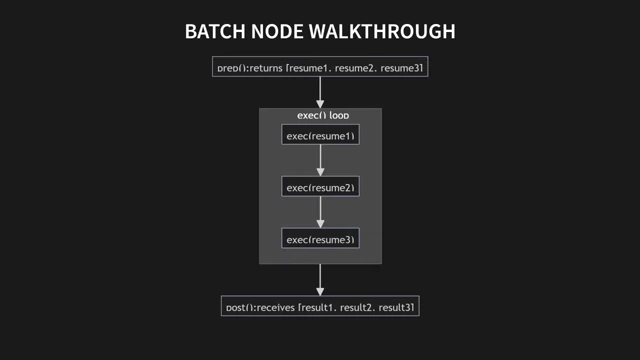
Diagram illustrating the sequential processing flow within a BatchNode for multiple resumes [ 00:25:28 ]
Parallel Processing: Unleashing Speed with Async [26:52]
- Problem with BatchNode: Still sequential (e.g., 10 resumes * 10 seconds each = 100 seconds). The "villain" is waiting during API calls.
- Solution: Asynchronous programming using Python's
asyncandawaitkeywords. - Asynchronous LLM Calls:
- Upgrading the Batch Node to Parallel:
- Change parent class from
BatchNodetoAsyncParallelBatchNode. [30:43] - Add
asynckeyword toprep,exec,postmethods (e.g.,prep_async). - Inside
exec_async, useawait call_llm_async.
Side-by-side comparison of BatchNode and AsyncParallelBatchNode code, highlighting the minimal changes for parallelization [ 00:30:48 ]
- Change parent class from
- Implementation: The
AsyncParallelBatchNode's_execmethod replaces the simpleforloop withawait asyncio.gather(*tasks). This allows all tasks to be fired off concurrently. [31:21]
Comparison of the _exec method for BatchNode (sequential) and AsyncParallelBatchNode (parallel using asyncio.gather) [ 00:31:28 ] - Performance Payoff: Processing 10 resumes (10 seconds each) drops from 100 seconds to just over 10 seconds (time of the longest task). [32:04]

Graph illustrating the performance payoff: 100 seconds for sequential processing vs. 10 seconds for parallel processing [ 00:32:08 ] - Caveats: Be mindful of API rate limits and ensure tasks are independent.


Multi-Step Workflows: Task Decomposition for Quality [32:55]
- Problem: Asking a single LLM call to perform a complex task (e.g., write a comprehensive blog post) often results in generic, low-quality output.
- Solution: Task Decomposition. Break down a big task into a series of smaller, focused steps (workflow).
- Example: Article Writing Workflow: A three-station assembly line.
- Outliner Node: Takes a topic, creates a structured list of section titles.
- BatchDrafter Node: Receives the list of titles and drafts all sections simultaneously (leveraging parallel processing).
- Combiner Node: Takes all drafted sections and assembles them into a polished, coherent article.

Diagram showing the three-step Article Writing Workflow: Outliner -> BatchDrafter -> Combiner [ 00:33:57 ]
- Workflow Walkthrough:
- Initial
shared:{"topic": "AI Safety"}. - Outliner runs:
sharednow includessection_titles(e.g., ["Introduction", "Key Risks", "Solutions"]). [35:40] - BatchDrafter runs:
sharednow includessection_drafts(drafted content for each section). [35:52] - Combiner runs:
sharednow includesfinal_article. [36:04]
Shared memory state after the Combiner node in the Article Writing Workflow, showing the final article [ 00:36:07 ]
- Initial
- Result: By breaking one complex request into three simple requests, the output quality is significantly higher. [36:17]
Agent: A Flow with a Loop and a Branch [36:44]
- Demystifying Agents: Agents are not magic or sentient; they are a design pattern, specifically a flow with a loop and a branch. [37:57]

Definition: An Agent is a Flow with a loop & a branch [ 00:38:07 ] - Agent Blueprint: A central "thinking" node (
DecideNode) that determines the next step based on a goal and current context, outputting a simple "action" command.
Diagram illustrating the agent's blueprint: a Decide Node branching to Search and Answer nodes, with a loop back to Decide [ 00:38:27 ] - Building a Search Agent:
- DecideAction Node (The Brain):
prep: Gathersquestionand existingcontext.exec: Prompts LLM to choose between 'search' or 'answer' based on context, returning a structured YAML decision.post: Parses LLM's decision; if 'search', setssearch_queryinsharedand returns 'search' action; if 'answer', returns 'answer' action. [38:47]
- SearchWeb Node (The Tool):
prep: Getssearch_query.exec: Performs web search (e.g., using Google Search API).post: Adds search results toshared['context'], returns 'decide' action to loop back toDecideActionnode. [39:32]
- DirectAnswer Node (The Exit):
prep: Gathersquestionand all collectedcontext.exec: Prompts LLM to synthesize a final answer using the research.post: Delivers the answer to the user, returns 'done' action to end the mission. [40:00]
- DecideAction Node (The Brain):
- Live Run Walkthrough (Who won 2024 Physics Nobel Prize?):
- Initialization:
sharedcontainsquestion. [40:33] - Round 1 (Decide):
DecideActionruns, LLM decides tosearch.sharedgetssearch_query. Flow goes toSearchWeb. [40:41] - Round 2 (Search):
SearchWebruns, finds results, adds summary toshared['context']. Flow returns 'decide' toDecideAction. [41:07] - Round 3 (Decide with Context):
DecideActionruns again, sees newcontext. LLM decides toanswer. Flow goes toDirectAnswer. [41:21] - Final Step (Answer):
DirectAnswergenerates and delivers the final answer. Flow completes. [41:54]
Shared memory state during the final answer step of the agent walkthrough, showing the complete context and generated answer [ 00:41:57 ]
- Initialization:
Conclusion: The Power of Simplicity [42:22]
- Summary of what was built: Chatbots, Batch Processing, Parallel Workflows, and Agents – all from a 100-line foundation.

Summary of LLM applications built using PocketFlow's 100-line foundation [ 00:42:37 ] - No Black Boxes: The framework reveals core concepts: the Node, the Shared Store, and the Flow.
- PocketFlow's Real-World Impact: Example project "Codebase Knowledge Builder" (built with PocketFlow) became more popular than the framework itself, demonstrating the power of the simple design.
- Final Reveal: The video's script, structure, and knowledge breakdown were also generated by a PocketFlow agent.