Overcoming Learned Helplessness and Achieving Goals with a 7-Step Strategic Thinking Framework
This video explains how to overcome learned helplessness and achieve significant life goals through strategic thinking. It begins by defining learned helplessness as a psychological condition where past failures lead to a belief in one's inability to change circumstances. The mind interprets reality through "stories" shaped by identity, which evolves through nine stages of ego development from conventional to post-conventional. The core message is that "mistakes are the only source of truth" for personal development, unlike theoretical advice. A 7-step strategic thinking framework is presented, emphasizing that strategy is an evolving idea rather than a static plan:
- Strategic Intent: Define clear goals and an ideal future.
- Self-Analysis: Conduct a SWOT analysis to understand strengths, weaknesses, opportunities, and threats.
- Strategic Preparation: Optimize your environment to align with your goals.
- Concentration of Force: Focus energy on high-leverage projects and priority tasks.
- Disciplined Execution: Implement new routines that fuel your work.
- Adaptability: Evolve strategy with feedback, as "experimentation is the only way to achieve what you want."
- Study General Principles: Master fundamentals and universal laws.
The video concludes with the "pre-mortem" technique, which involves visualizing spectacular failure and brainstorming solutions to anticipate and mitigate potential failures before they occur, enhancing follow-through.
Learned helplessness is a psychological condition where a person or animal learns to behave helplessly in a particular situation, even when the opportunity to avoid or escape it is available. [ 00:00:20 ]
You Aren't Helpless [0:00]
The video addresses why many people fail to achieve goals, attributing it to "learned helplessness"—a condition where individuals feel unable to control or change their circumstances after repeated negative experiences.
- Learned Helplessness Definition [0:10]
- A psychological condition where a person or animal learns to behave helplessly even when escape is available, occurring after repeated uncontrollable aversive stimuli (e.g., pain, failure).
- Leads to the belief that actions have no effect, causing individuals to give up trying to change their lives.
- This manifests as "selective skepticism," where the mind cannot envision a positive future, trapping thoughts in a limited bubble and hindering growth.
Learned helplessness is a psychological condition where a person or animal learns to behave helplessly in a particular situation, even when the opportunity to avoid or escape it is available. [ 00:00:20 ]
- The Root Cause of Failure [1:36]
- Most people haven't failed enough or gave up too soon, failing to see failure as the only path to success.
- Success is primarily an internal battle between the lower and higher self, won by cultivating a mind that thrives in any situation.
- The video aims to reprogram the mind, installing beliefs and ways of thinking that prevent immediate self-doubt.
Winning The Mind Game [2:54]
To achieve any goal or live an ideal life, one must understand how the mind works and develop a strategy to win the "mind game."
- Mind's Interpretation of Reality [4:09]
- Many pursue unconscious goals imposed by parents and society, acting as "useful workers" rather than fulfilled individuals.
- They attempt new endeavors with an outdated mindset, leading to failure.
- To reinvent oneself, it's essential to become the person who sees the possibility of a goal and possesses the skills to achieve it.
- The mind interprets the world through "stories" or "games," providing a frame for order and clarity, and fulfilling steps towards a goal.
The mind makes sense of the world in stories, a story or game provides the mind with a "frame" to maintain order and clarity. [ 00:04:49 ] - Identity (a web of ideas, goals, beliefs, values) acts as a mental filter, selectively allowing information.
- Information is noticed if it helps achieve goals, aligns with values, or confirms existing beliefs.
You notice information that helps you achieve your goals (or win the game) You notice information that aligns with what's important to you, or your values (the rules of the game) You notice information that confirms your beliefs (how you think the game should be played) [ 00:06:39 ] - Different individuals, even with the same input, derive different conclusions based on their identity, which in turn shapes their decisions and future.
- Failure to interpret reality in a way that provides necessary information is a key reason for not succeeding.
- Growth as a Lobster [8:00]
- Growth is painful, like a lobster outgrowing its shell. Removing the shell (identity) makes one vulnerable but is necessary for progression; otherwise, pain intensifies until death.
- Pain, insecurity, and lack of progress stem from being trapped in the lower self's shell, resisting change.
- Identity is not fixed; it's a living, evolving entity. Individuals are not helpless but have learned to be.
How To Reach A New Level Of Mind [8:48]
Reaching new levels of mind involves adopting new goals, values, and beliefs to perceive reality in an expanded way. This is explained through the nine stages of ego development by Susan Cook-Reuter.
- Nine Stages of Ego Development (Identity/Self) [9:08]
- Pre-Conventional (5% of population):
- Symbiotic, Impulsive, Opportunist. Most outgrow by age 10-12, dependent on others for basic needs, no self/other distinction.
- Conventional (75-80% of population):
- Conformist Stage [10:10]: Identity defined by group relationships (e.g., high school popularity, unquestioning religious followers). Decisions based on group norms, obedience to authority, inability to think for oneself.
- Expert Stage [10:33]: Skill-centric individuals (e.g., engineers, scientists) good at solving complex problems but struggle to identify if they're working on the right task or shifting focus due to adherence to past ideologies.
- Achiever Stage [11:01]: The "pinnacle" in Western self-help and business; focused on making money and achieving high status. Characterized by seeking external validation and status, though it's a necessary step for many.
- Individuals in conventional stages often regurgitate popular worldviews, lacking the ability to expand beyond them.
- Post-Conventional (15-20% of population):
- Pluralist Stage [12:53]: Questioning beliefs and values, adopting new perspectives (e.g., religious person becoming atheist, corporate exec finding work meaningless).
The Pluralist Stage - Where you question your beliefs and values, and begin to adopt new perspectives. [ 00:12:58 ] - Strategist Stage [13:09]: Realization that intuition surpasses logic; exploration, discovery, and self-actualization take priority over material goals. Develops a vision for humanity and understands generalized principles of reality.
The Strategist Stage - Where the realization that intuition is more powerful than logic and rationality occurs. [ 00:13:08 ] - Construct Aware Stage [13:26]: Taps into a "5th dimension of thinking," seeing how the mind constructs meaning, integrating more perspectives, and thinking from abstract layers.
The Construct Aware Stage - Where you tap into a 5th-dimension of thinking. [ 00:13:28 ]
- Pluralist Stage [12:53]: Questioning beliefs and values, adopting new perspectives (e.g., religious person becoming atheist, corporate exec finding work meaningless).
- Unitive Stage (1% of population): The final stage, recommended for self-research.
- Pre-Conventional (5% of population):
- Accelerating Development [14:55]
- Regular meditation (15 minutes daily or more) significantly accelerates progress through these stages.
- Vertical growth (transcending to a new level) is achieved through struggle, pain, and wrestling with beliefs, requiring a new perspective to overcome challenges.
Mistakes Are The Only Source Of Truth [15:23]
Growth comes in two forms: horizontal and vertical.
- Horizontal vs. Vertical Growth [15:34]
- Horizontal Growth: Expanding within the current level of development (learning skills, acquiring knowledge).
- Vertical Growth: Transcending to a new level after intense struggle and questioning beliefs, adopting new perspectives to overcome challenges.
Vertical growth is transcending to a new level after a period of struggle, pain, or wrestling with your own beliefs to the point of needing to adopt a new perspective to view the struggle from a new light so that you can overcome it. [ 00:15:45 ]
- The Role of Mistakes [16:23]
- The key to growth is continuous self-education, skill acquisition, and confronting pain and problems rather than numbing oneself.
- Increased development comes from making and realizing mistakes, leaning into them, and self-correcting towards evolving goals.
- Most people fail by trying to apply "someone else's map" (courses, books, advice) to their unique "territory," not realizing these are guides, not absolute truths.
- Mistakes are the only 100% tailored teacher and the only source of truth, providing invaluable feedback. Theory and advice from others are interpretations of their mistakes.
Failure is the only teacher that is absolutely 100% tailored to your situation. [ 00:17:17 ]
How To Change Your Life With Strategic Thinking [17:58]
Strategic thinking is essential for success, defined as the evolution of a central idea through changing circumstances. It's about consciously choosing the "game" of life and the path to play, rather than letting life happen.
- The 7 Principles of Strategic Thinking:
- Strategic Intent (Direction) [18:56]
- Identify what you dislike about your current life (job, body, routine, feelings).
- Envision potential future possibilities (starting a business, being fit, living an ideal day).
- Choose a macro game to play, creating an overarching filter for your mind to notice relevant information and frame what you learn.
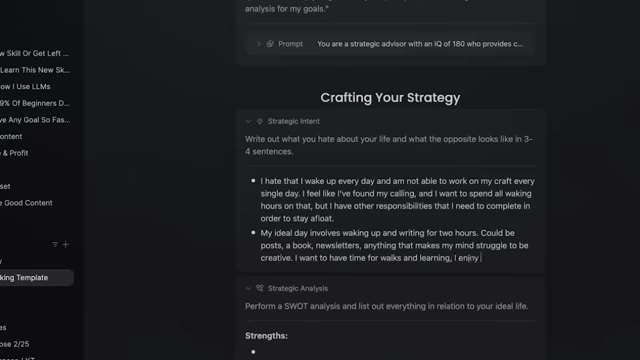
An example of Strategic Intent filled out in a digital note-taking template with an ideal day vision. [ 00:20:06 ]
- Self-Analysis (Understanding Yourself) [20:41]
- Perform a SWOT analysis (Strengths, Weaknesses, Opportunities, Threats) to work with your strengths and overcome weaknesses.
- Strengths: What comes easy to you, your talents? (Don't use "nothing" as a cop-out).
- Weaknesses: What are you notoriously bad at and how does it impact progress?
- Opportunities for Growth: What can help overcome weaknesses and leverage strengths (e.g., learning skills, courses, networking)?
- Threats: What hinders your progress (e.g., friends inviting you out, lack of time, fear of failure)?
- This analysis helps become aware of identity parts that aren't serving you.
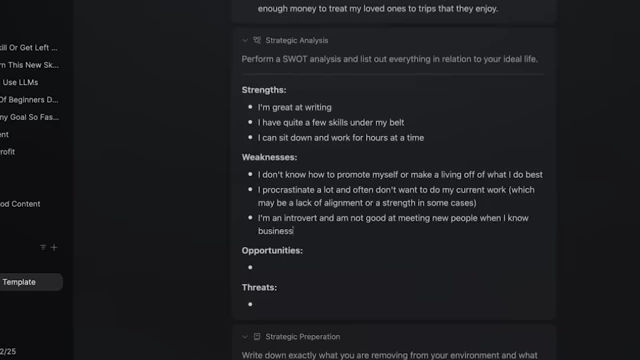
An example of Self-Analysis (SWOT) filled out in a digital note-taking template. [ 00:20:56 ]
- Strategic Preparation (Environment) [22:30]
- Change your identity to act on your strategy with ease by immersing yourself in a new environment.
- This means changing the books you read, information you consume, people you follow, and everything else to reflect your goals.
- Delete distracting apps, unfollow unhelpful accounts, read new books, listen to relevant podcasts, invest in learning resources.
- Anything not aligned with your goals is a distraction; create an environment solely conducive to your goal.
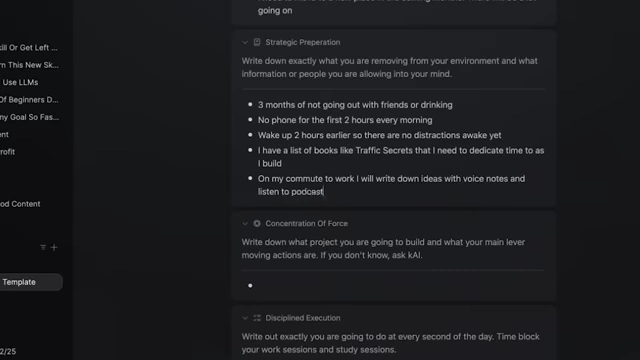
An example of Strategic Preparation filled out in a digital note-taking template, outlining changes to daily habits and consumption. [ 00:23:05 ]
- Concentration of Force (Focus) [23:19]
- Channel energy towards the goal by building a real-world project, which serves as a vessel for making and overcoming mistakes.
- List 3-5 potential projects to achieve your goal.
- Choose the highest leverage project with the most advantageous outcomes.
- Map out 3-5 daily priority tasks to make progress on the chosen project.
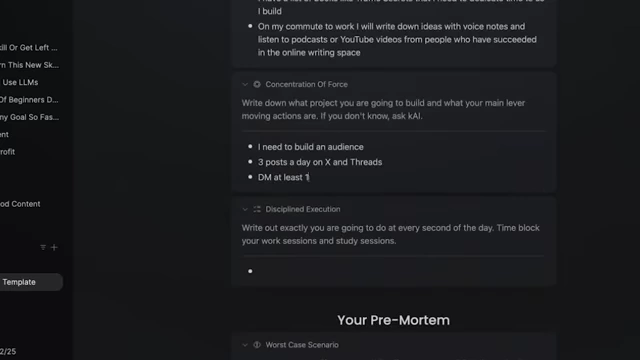
An example of Concentration of Force filled out in a digital note-taking template, showing a project to build an audience and daily tasks. [ 00:23:35 ]
- Disciplined Execution (Routine) [24:28]
- Replace old routines with new ones that align with your desired future.
- Execute 3-5 priority, "lever-moving" tasks for 1-2 hours in the morning (preferred over night due to circadian rhythm).
- Everything throughout the day should fuel your work: what you read, what you scroll, conversations, walks (instead of distractions), eating well.
- Your mind should constantly strategize to overcome obstacles.
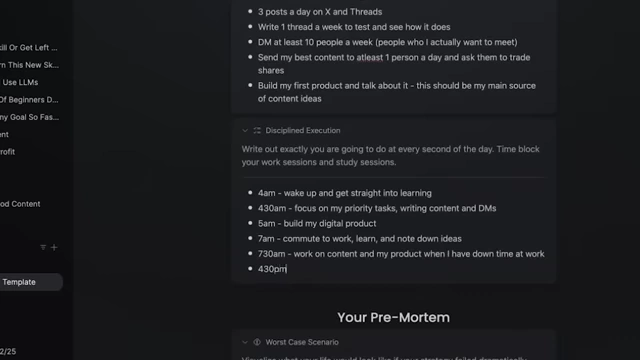
An example of Disciplined Execution filled out in a digital note-taking template, showing a daily schedule focused on learning and product building. [ 00:24:45 ]
- Adaptability (Mental Flexibility) [25:35]
- Strategy is not static; it evolves with feedback and experimentation.
- Identify when things aren't working, revisit your strategy, and experiment with new approaches.
- Mistakes are the only source of truth; experimentation is the only way to make mistakes and thus achieve what you want.
Experimentation is how you make mistakes; thus, experimentation is the only way to achieve what you want in life. [ 00:25:55 ]
- Study The General Principles Of Nature (Mastery) [26:10]
- Study the general principles of both the strategy you're executing and reality itself (e.g., philosophy of mind, Hermetic philosophy).
- Achieve mastery by repeating boring fundamentals, resisting the urge to numb the mind with cheap pleasures during plateaus.
- Continuously study, refine, and practice the basics (e.g., compelling hooks in writing) daily, integrating your unique voice into these principles.
- Strategic Intent (Direction) [18:56]
The Pre-Mortem: How To Fail Before You Even Start [27:45]
The pre-mortem technique helps identify potential failure points before a project begins, increasing the likelihood of follow-through.
- The Essence of Strategy [27:59]
- "The essence of strategy is choosing what not to do." - Michael Porter
The essence of strategy is choosing what not to do. [ 00:28:01 ] - Most people fail due to internal psychological thought processes that lead to the belief that success isn't possible, often narrowing focus and regressing to a lower state of self under stress.
- Common psychological barriers to success include paralysis by analysis, losing sight of the big vision due to others' opinions, lack of complementary skills, financial insecurity, burnout, boredom with mundane work, and desire for high-status over enjoyment.
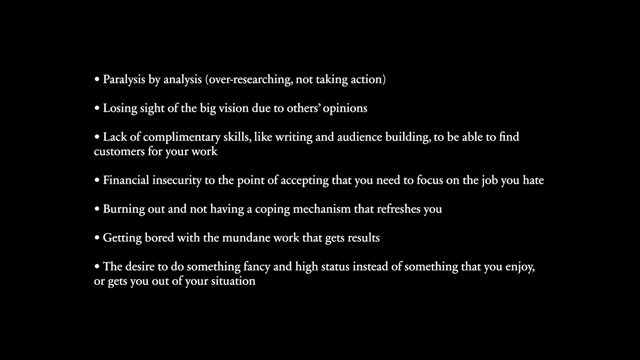
Common reasons for strategy failure including paralysis by analysis, losing sight of the big vision, lack of skills, financial insecurity, burnout, and seeking fancy high-status results instead of enjoyable or effective ones. [ 00:28:28 ]
- "The essence of strategy is choosing what not to do." - Michael Porter
- Pre-Mortem Steps [29:32]
- A pre-mortem is a strategic thinking tool that identifies failure points in any project before it even begins.
A Pre-Mortem is a strategic thinking tool that identifies failure points in any project before it even begins. [ 00:29:30 ]
- Imagine Spectacular Failure: Visualize your strategy failing horribly, picturing where your life ends up (an "anti-vision").
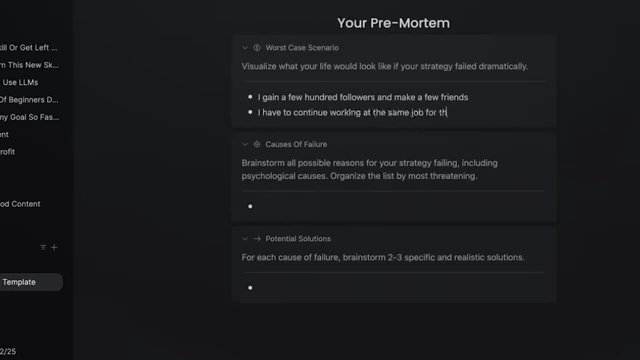
An example of visualizing a worst-case scenario where the strategy fails dramatically. [ 00:29:44 ] - List the Causes of Failure: Brainstorm all possible reasons, including psychological (personal weaknesses, self-sabotage, lack of skill) and external (lack of money).
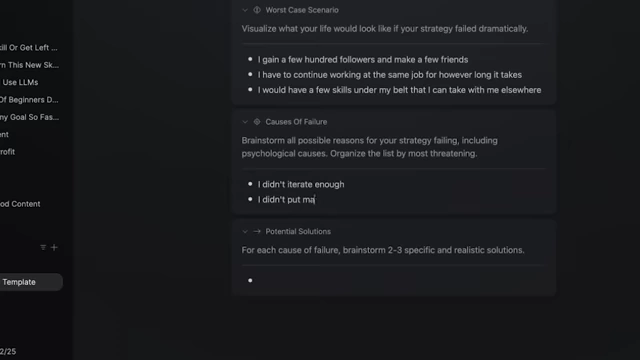
An example of causes of failure brainstormed in a digital note-taking template, including reasons like insufficient iteration or effort. [ 00:30:04 ] - Prioritize the List: Reorganize, placing the most threatening causes at the top.
- Brainstorm Solutions: For each prioritized cause, develop 2-3 specific and realistic solutions. By gaining this awareness and creating a clear action plan, success becomes entirely dependent on integrating these principles.
- A pre-mortem is a strategic thinking tool that identifies failure points in any project before it even begins.