Composing Photos Beyond the Rule of Thirds: Prioritizing Subject and Emotion
This video discusses how to move beyond basic compositional rules like the Rule of Thirds to create more impactful and emotionally resonant photographs by focusing on attention and emotion.
- While foundational rules offer visual comfort, truly memorable images often challenge these norms.
- The key is to compose for what matters: the subject, emotion, and story, rather than rigid guidelines.
- Examples demonstrate how images can evoke "discomfort" or tension through visual weight, such as heavy dark tones above a small subject, challenging natural perception.
- The video emphasizes making conscious decisions about what to include and exclude to convey a specific message or feeling.
- Practical tips include using surrounding elements for framing or context, distributing multiple subjects to guide attention, establishing a hierarchy of importance, and avoiding overlapping subjects.
- Ultimately, the goal is to develop visual literacy and compose intuitively from one's artistic vision, using rules as an aid only when necessary.
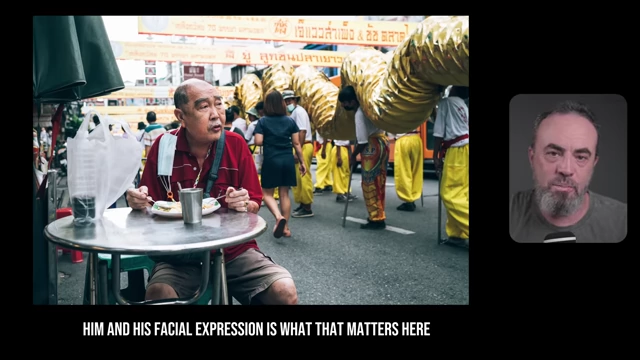
The speaker highlights that focusing on the subject's expression and story is paramount in photography. [ 00:02:53 ]
Introduction: Moving Beyond Basic Rules [0:00:00]
The video argues that while foundational photography rules like the Rule of Thirds are helpful for beginners in structuring images, advanced photographers should aim to move beyond them to create truly memorable work.
- Rules are effective for explaining photography but not necessarily for creating it [0:00:12].

A man in a dark interior, with the Rule of Thirds grid overlaid, illustrating a composition that adheres to basic rules. [ 00:00:07 ] 
A worker carving a statue, with the Rule of Thirds grid overlaid, demonstrating another rule-abiding composition. [ 00:00:10 ] - Photographs that defy rules often stand out because they feel different and unconventional [0:00:18].

A person walks past a textured wall casting long shadows, an example of a composition that feels different and out of the ordinary. [ 00:00:21 ]
Visual Comfort vs. Challenging Perception [0:00:28]
Most compositional rules are based on creating "visual comfort," where everything feels balanced and in its "right place."
- Rule of Thirds as Visual Comfort [0:00:30]
- An example of a man with limes demonstrates adherence to the rule of thirds, making the image feel comfortable.

A man sits amongst piles of limes in the back of a truck, composed according to the Rule of Thirds for visual comfort. [ 00:00:40 ] - An image of a man holding an umbrella further illustrates how subjects often align with the rule of thirds, contributing to visual comfort.

A man holding an umbrella by a river, positioned on the Rule of Thirds to create a comfortable composition. [ 00:00:48 ]
- An example of a man with limes demonstrates adherence to the rule of thirds, making the image feel comfortable.
- Evoking Discomfort to Challenge Perception [0:00:57]
- A truly uncomfortable feeling in a photograph suggests something is significantly "off," challenging the viewer's visual perception [0:01:00].
- Small Test of Comfort [0:01:08]
- Comfortable Image: A man standing stably on rocks against the sea feels natural and balanced, with dark ground at the bottom and sky at the top.

A man stands firmly on dark rocks by the sea under a light sky, illustrating a composition that feels natural and balanced. [ 00:01:11 ] - Uncomfortable Image: A girl sitting beneath large, dark religious paintings creates a feeling of unease.
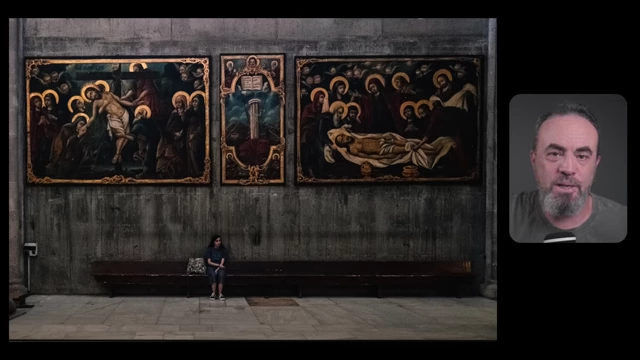
A small girl sits alone on a long bench beneath three large, dark religious paintings, creating a feeling of discomfort due to visual weight. [ 00:01:18 ] - Explanation of Discomfort: This feeling arises because the large, dark tonalities above the small subject create visual weight that feels unnatural, like a "mountain of darkness" about to crush the girl [0:01:46].
- The Importance of Visual Weight: This concept, though not a basic rule, is crucial for understanding how compositions affect perception and emotion [0:02:10].
- Comfortable Image: A man standing stably on rocks against the sea feels natural and balanced, with dark ground at the bottom and sky at the top.
Composing for What Matters: Attention and Emotion [0:02:47]
Instead of rigidly following rules, the core principle is to compose for what is important to you, focusing on the message, attention, and emotion you want to convey.
- Photography's Highest Currency: Attention and emotion – what the viewer looks at and how they feel [0:02:57].
A man eating street food is the main focus, with the text "HIM AND HIS FACIAL EXPRESSION IS WHAT THAT MATTERS HERE" emphasizing composing for the subject's importance. [ 00:02:53 ] - Conscious Composition: Actively decide what to include and exclude to craft the desired look, feel, and message of the photograph [0:03:20].

A dangling scale with a person silhouetted in the background against a bright sea, demonstrating how a photographer frames a subject and decides what to include and exclude. [ 00:03:10 ] - This process moves beyond merely responding to a scene to making deliberate artistic decisions [0:03:25].
- Such a personal approach allows for the creation of unique compositions based on individual logic and artistic vision [0:03:32].

A group of people sitting and standing on steps, with a small child jumping in the background, showing a complex scene composed with artistic vision. [ 00:03:38 ]
- Rules as Guides, Not Determinants: Rules can assist with balance and placement but do not dictate creativity or emotional impact [0:03:41].
- The photographer's intent is always more important than a rule [0:03:50].
Practical Examples of Subject-Focused Composition [0:03:53]
The video provides several examples of compositions that prioritize the subject and story over strict adherence to rules.
- Example 1: Man Getting Out of Water with Swimmers [0:03:53]
- The photographer focused on the main subject, excluding the sky which would not add to the narrative.
- Other swimmers are placed slightly higher, creating an "attention vacuum" that draws the eye to the main subject.

A man walks out of the water in the foreground, while other men wade in the background, demonstrating how to focus on a main subject. [ 00:04:00 ]
- Example 2: Man and Woman in Archways [0:04:23]
- Subjects are not on the center or thirds, yet the image works due to depth and implied symmetry.
- The man in the foreground and the woman deeper in the archway create depth, drawing the viewer's eye.
- Their off-balance placement creates tension, evoking curiosity about their relationship and storytelling.

A man with a cane sits in the foreground, while a woman sits deeper within an archway in the background, illustrating depth, implied symmetry, and storytelling tension. [ 00:04:25 ]
- Example 3: Performance Artist and Reflection [0:06:17]
- The entire story unfolds in the center of the frame, intentionally avoiding placement on the thirds to create intimacy.
- Proximity between the artist and her reflection fosters a sense of dialogue and closeness.
- Dark areas and the mirror's frame direct attention to the central figures, enhancing intimacy.
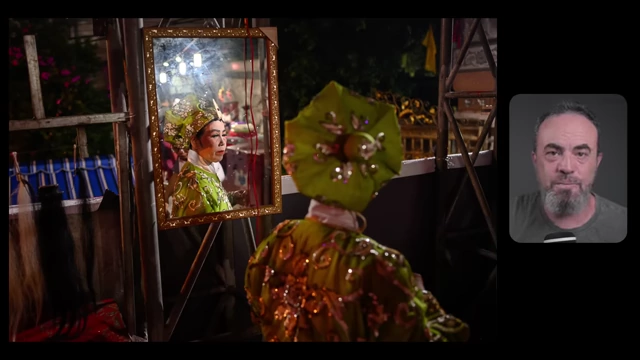
A performance artist in traditional attire looks at her reflection in a mirror, centered in the frame to create a sense of intimacy and dialogue. [ 00:06:19 ]
- Example 4: Fisherman and Birds [0:06:57]
- The fisherman is cleaning his basket in the ocean, surrounded by birds.
- The birds frame the fisherman, guiding the viewer's attention to him, using contextual elements to support the story.
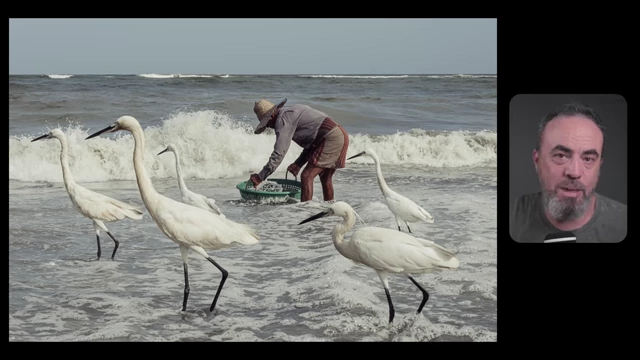
A fisherman cleans his catch in the ocean, surrounded by several white egrets, demonstrating how birds can frame the subject and provide context to the narrative. [ 00:06:59 ]
Practical Tips for Subject-Based Composition [0:07:31]
1. Identify Your Subject and Build Composition Around It [0:07:35]
- Mindful of Horizontal Frames: If a single subject is in a horizontal frame, be aware of ample space on both sides.
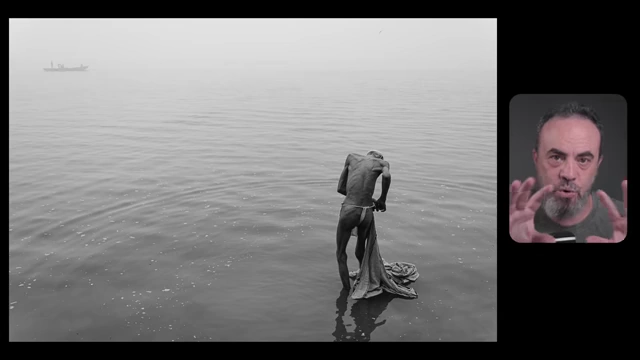
A lone person wades in a vast, misty body of water, illustrating how to compose a single subject within a wide horizontal frame while being mindful of empty space. [ 00:07:44 ] - Filling Space: Fill empty spaces with elements that frame the main subject or direct attention to it, rather than competing with it.
- Framing Elements: Use surrounding objects to push attention towards the main subject.

A child stands silhouetted in a doorway, framed by architectural elements that direct attention to the subject and the bright outdoor scene. [ 00:07:59 ]
- Framing Elements: Use surrounding objects to push attention towards the main subject.
2. Use Extra Elements as Context [0:08:05]
- Integrate additional elements to enrich the narrative and tell a more complete story.
- For example, the birds in the fisherman photograph provide crucial context, transforming the image's meaning.

A fisherman in the ocean with egrets around him, illustrating how the birds provide essential context to the story of the image. [ 00:08:14 ]
3. Distribute Multiple Objects Sequentially [0:08:17]
- When photographing multiple subjects, arrange them so attention flows sequentially from one to another.
- Hierarchy of Importance: Decide if all subjects carry equal narrative importance or if one is a "hero" supported by others.
- Equal Importance: An image of monks cleaning a stupa where all figures are of similar size, conveying collective importance.
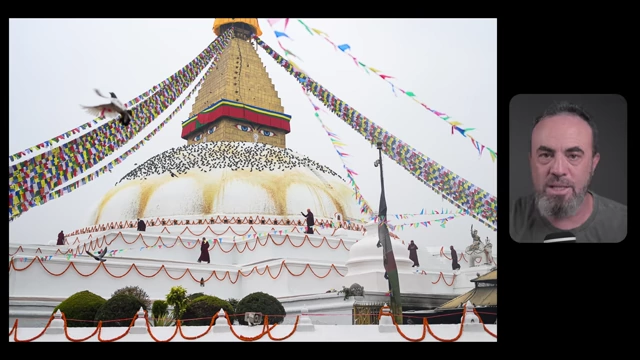
Monks are seen cleaning a large, ornate stupa, with all figures appearing of similar size and importance, conveying collective action. [ 00:08:39 ] - Hero Concept: Choose one main character for emphasis, with others supporting their narrative, which helps distribute attention effectively.

A central figure is being attended to by others, demonstrating the "Hero Concept" where one primary subject is emphasized within a group. [ 00:08:49 ]
- Equal Importance: An image of monks cleaning a stupa where all figures are of similar size, conveying collective importance.
- Avoid Overlapping: Prevent subjects from overlapping, as this makes them appear as a single object, hindering balance and readability.
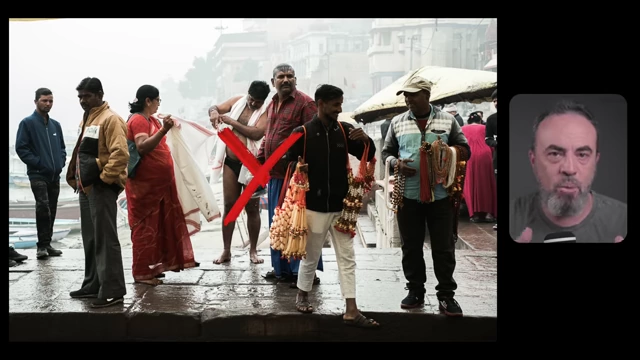
A red X marks two overlapping figures in a crowded scene, illustrating the compositional mistake of allowing subjects to overlap. [ 00:09:14 ]
4. Simplicity is Key [0:09:40]
- Resist the urge to include too many elements or excessive context, especially with wide framing.
- Remove Distractions: Any element that does not serve the narrative should be removed from the frame.
5. Utilize Rules When Stuck [0:10:05]
- If you're struggling with composition, traditional rules like symmetry, diagonals, or the Rule of Thirds can be used as an aid.
- The ultimate goal is to compose intuitively, driven by your artistic vision and the story you want to tell.
Conclusion [0:10:15]
With practice, composing from your gut will become intuitive, eliminating the need for rigid rules and allowing you to present a scene exactly as you envision it.