How to Make Over $1 Million by 26: The Shift from Topic-Based to Problem-Based Products
The speaker achieved over $1 million by age 26 after six years of struggle by shifting from selling "what they do" (topic-based products) to "what people want" (problem-based products). The key is to identify pre-existing desires that people already want solved, and then align these with your unique skill set. This framework is further enhanced by adding a "Unique Mechanism" to create a "turbo product" that sells effortlessly by overcoming common objections and offering a fresh solution.

The Six-Year Struggle and the Crucial Change [00:00]
The speaker recounts hitting his first million-dollar year at 26, after years (from 19 to 25) of struggling to build a successful business from his content. The turning point was a fundamental change in how he packaged and sold his products and offers online.
The Big Creator Mistake: Selling What You Do, Not What People Want [01:30]
- Contrasting Business Models:
- Normal Business: Develops a product, then finds an audience for it, creating a natural fit between product and problem.
- Creator Economy: Builds an audience first, then tries to find a product for that audience, often leading to a reverse and problematic approach.
- Common Creator Error:
- Creators frequently take their core skill or content topic (e.g., filmmaking, personal finance, fitness) and package it directly as a product without considering a specific problem it solves.
- This results in selling a solution to a problem that no one actively has or an outcome that no one genuinely desires.
- The illusion of success comes from sending large volumes of traffic to a landing page, where a small percentage converts due to sheer numbers, rather than strong product-market fit.
- Speaker's Past Experience: In 2020, the speaker created a Photoshop art program that taught his specific content style but failed to address a real problem for his audience.
Topic-Based Products vs. Problem-Based Products [03:15]
- The Speaker's Pivot: The significant shift was transitioning from being a "topic-based" business owner (selling a topic) to a "problem-based" business owner (solving existing problems).
- Simplicity in Theory, Complexity in Practice: While seemingly simple, many creators overlook this distinction, packaging a skill and hoping it sells.
- The Core Issue: Products fail to sell when they offer a solution to a problem that customers don't have or an outcome they don't desire.
- The Principle of Desire: It's incredibly difficult, almost an "uphill battle," to create desire in an audience. The goal should be to tap into desires that already exist.
How to Identify Problems People Already Want Solved [04:22]
- Focus on Existing Desires: Instead of packaging your direct skill (e.g., "how to make better videos"), identify a pre-existing problem that your unique skill set can solve.
- Filmmaker Examples:
- "How to create and publish your first 20 YouTube videos"
- "How to overcome the fear of talking to a camera"
- "How to build a budget-friendly home studio for filming content"
- "How to write viral scripts for short-form videos"
- "How to create a full week of content in under 3 hours"
- The Key Insight: A winning product addresses a problem people are already trying to solve.
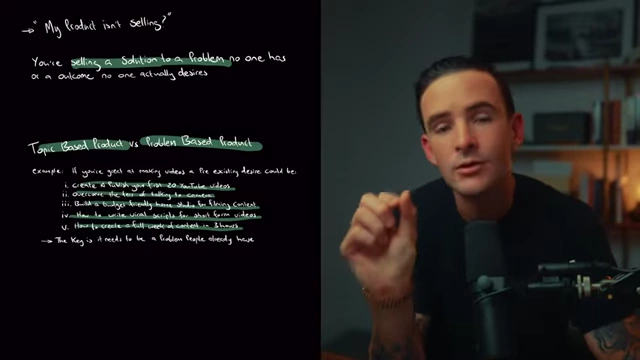
Notes on identifying problem-based products for filmmakers [ 00:05:09 ]
Real Creator Examples That Nailed It [06:03]
- Example 1: The Filmmaker's Home Studio Offer
- Creator's Skill: Proficient in filmmaking, lighting setups, and cinematography.
- Problem Solved: Helping people create professional home studio setups within various budgets.
- Program Mechanics: Clients submit a video of their space, and the creator's team assists with equipment purchase, setup, and configuration for a professional look (like the speaker's own setup, which involves multiple lights for key, fill, edge, and background lighting).
- Example 2: The iPhone Photographer's Luxury Lifestyle Course
- Creator's Skill: Expert iPhone photographer with a strong Instagram presence.
- Problem Solved (Pre-existing Desire): Tapping into people's desire for status and appearing to have a better life.
- Offer: A "luxury lifestyle iPhone photography course" that teaches users to take photos so good "people will start to question whether you have a hidden income source."
- Brilliance: This offer transcends mere photography skills, directly addressing the deeply ingrained human desire for social status.
- The Power of Specificity:
- Highly specific, problem-solving offers give people a clear opportunity to say "yes" if the problem resonates with them.
- While some might say "no" because it's not their problem, this specificity attracts a strong "yes" from the target demographic, leading to easier conversions.
The Two-Circle Framework: Skill Set × Pre-Existing Desire [08:41]
- Circle 1: Your Unique Skill Set [08:43]
- This is your core expertise, niche, or mission around which your personal brand and content are built (e.g., fitness, personal finance, photography, business coaching).
- Circle 2: Pre-Existing Desire [09:15]
- This represents something people already want, often outside your immediate niche.
- Finding these desires: They typically overlap with the three "eternal markets": Health, Wealth, and Relationships [09:30].
- Self-Reflection: Consider problems you have already solved using your unique skill set (e.g., a personal finance spreadsheet to make saving enjoyable, a photography technique for holiday photos that people want).
- The "Winning Product" Intersection: A winning product emerges where your unique skill set can effectively help solve a pre-existing desire or problem that people are actively seeking solutions for.

The Two-Circle Framework: Unique Skill Set intersecting with Pre-Existing Desire to create a Winning Product [ 00:10:38 ]
Add Your Unique Mechanism (The “Turbo Product” Formula) [11:00]
- Introducing the Third Element: To elevate your product, add a "unique mechanism."
- Definition: A unique mechanism is something distinct that you bring to the table, even if it's a repackaged existing idea. Its purpose is to make your offer feel fresh and your solution seem new.
- Overcoming Objections: This mechanism directly addresses the common customer objection: "I've tried that before, and it didn't work for me." By offering a novel approach, you bypass this hurdle.
- The "Turbo Product" Formula: When you combine your Unique Skill Set, a Pre-Existing Desire, and your Unique Mechanism, you create an "unbelievable product" that sells effortlessly.
The "Turbo Product" Formula: Unique Skill Set, Pre-Existing Desire, and Unique Mechanism [ 00:12:38 ] - Outcome: This formula leads to a real, compounding business that doesn't rely on massive, low-converting traffic volumes, but rather on high conversion rates from people who genuinely want your specific solution.