Understanding the Decline in Relationships Among Gen Z: Economic, Social, and Technological Factors
Summary:
This video explores the reasons behind the global decline in relationships and marriage rates among Gen Z.
- Globally, the percentage of young adults (25-35) who are married or cohabiting has been declining.

Trends in marriage and cohabitation rates among young adults (25-35) in Europe, US, Latin America, and East Asia, showing a general decline [ 00:00:08 ] - Historically, marriage was an economic and social necessity, offering financial stability and an acceptable avenue for intimacy.
- Post-WWII economic growth and technological advancements reduced the necessity of marriage, making it a choice rather than a requirement.
- Three modern trends contribute to Gen Z's struggle to find love: a growing labor market mismatch between genders, increasing housing unaffordability, and the pervasive impact of smartphone addiction and social media.
- The labor market mismatch sees more college-educated women and fewer non-college-educated men participating, leading to fewer suitable partners for both groups.

Gender disparity in tertiary education enrollment across various countries, showing a shift to more women attending university [ 00:05:39 ] - Rising housing costs, particularly in urban areas, create a barrier for young people to establish independent households, a prerequisite for marriage for many.
- Smartphone use is linked to increased solitary time and changes in personality traits (lower conscientiousness, agreeableness, and extroversion; higher neuroticism), hindering social skill development and partner-seeking efforts.

Trends in hours spent alone per day and percentage of people who don't socialize weekly for young adults across US, UK, and Europe [ 00:11:27 ] - Solutions include government intervention to support boys' education, ensure affordable housing, and limit excessive smartphone/social media use while encouraging in-person interactions.
Introduction [00:00]
- There is a global trend of fewer Gen Z individuals forming relationships, impacting birth rates and the global economy.
Trends in marriage and cohabitation rates among young adults (25-35) in Europe, US, Latin America, and East Asia, showing a general decline [ 00:00:08 ] - Gen Z's love crisis is causing birth rates to plummet even faster than they were already declining.

Declining birth rates per woman in the US and Europe [ 00:00:24 ] - Sociologists, psychologists, and economists are studying this phenomenon to understand its causes.
- The video identifies three main trends explaining why Gen Z struggles to find love.
A Brief History of Marriage and Relationships [01:00]
- Marriage as a Necessity:
- For previous generations (e.g., grandparents), marriage was a societal expectation linked to adulthood, respectability, and economic sense.
- Men needed wives for household management to support full-time work.
- Women needed husbands for financial stability, as paid work access was limited.
- Remaining single carried significant social stigma, especially for women (e.g., "spinster," "old maid").
- Limited contraception meant marriage was the primary safe way for an active sex life.
- Changing Dynamics Post-WWII:
- Economic Improvements: Inventions like dishwashers, vacuum cleaners, and washing machines reduced household labor demands.
- Increased Services: Greater household wealth and government services provided access to childcare, cleaning help, and other services.
- Contraception and Abortion: The introduction of contraception and the liberalization of abortion decoupled sex life from marriage, making it a choice rather than a necessity.
- Shift in Relationship Trends:
- Marriage rates began to fall in the United States.

Trends in men's marital status in the US from 1950 to 2024, showing a decline in marriage and an increase in never married [ 00:02:46 ] - Initially, this was offset by an increase in cohabitation without marriage, as people still desired stable relationships for happiness and health.
- More recently, young people are not just marrying less but also struggling to find partners in general, a trend that cannot be explained solely by historical economic and social changes.
- Marriage rates began to fall in the United States.
Labor Market Mismatch [04:54]
- Assortative Mating:
- Both men and women tend to prefer partners with similar educational and socioeconomic backgrounds.
- The "marriage market" is often split into college-educated and non-college-educated segments.

Diagram illustrating assortative mating patterns, showing college-educated and non-college-educated individuals seeking partners [ 00:05:22 ]
- Trends in College Education:
- Historically, there were more college-educated men (e.g., 1970).
- This trend has reversed globally, with significantly more college-educated women than men in countries like the UK, Korea, and Spain.
Gender disparity in tertiary education enrollment across various countries, showing a shift to more women attending university [ 00:05:39 ] - Theoretically, fewer college-educated men should lead to fewer couples among this group.
- However, marriage rates for college-educated women in the US have remained stable, suggesting a different dynamic.
- "Marrying Down" Trend:
- Research suggests college-educated women are increasingly willing to "marry down" educationally.

Illustration of the labor market mismatch where college-educated women marry non-college educated men, leaving other non-college men and non-college women single [ 00:05:53 ] - This means they are marrying the most successful non-college-educated men, who have seen increased earnings over time. Economically, this is not "marrying down."

Average annual earnings at age 45 for non-college educated men married to college women vs. all other non-college men [ 00:06:39 ] - This leaves a growing number of non-college-educated men, whose earnings are declining, with fewer prospects.
- Consequently, non-college-educated women are increasingly remaining single because they are less willing to "marry down" and seek economic stability in a partnership.

Percentage of women married by age 45, by education level, showing a decline for non-college women [ 00:06:04 ]
- Research suggests college-educated women are increasingly willing to "marry down" educationally.
- Labor Force Participation:
- While women have increasingly joined the labor force, non-college-educated men, especially those without a high school diploma, have increasingly dropped out.

Share of young adults (20-24) who are neither in education nor work, highlighting increasing rates for men [ 00:07:07 ] 
Male labor-force participation rates by education level from 1965, showing a significant decline for less educated men [ 00:07:18 ] - This phenomenon is attributed to the shift from manufacturing-based to service-based economies.
- Service and care jobs have benefited non-college-educated women.
- The disappearance of manufacturing jobs has negatively impacted non-college-educated men.
- This withdrawal of non-college-educated men from the labor market creates a group unattractive to non-college-educated women seeking economic stability.

Illustration of non-college educated men withdrawing from the labor market, becoming less attractive partners for non-college educated women [ 00:08:13 ]
- While women have increasingly joined the labor force, non-college-educated men, especially those without a high school diploma, have increasingly dropped out.
- Global Evidence:
- Data from the US confirms that non-college-educated men and women are driving the decline in marriages.
- Finnish research in 2024 shows that less educated individuals (both men and women) are less likely to be in relationships compared to their more educated counterparts.

Partnership status of 18-45 year old men and women in Finland by education level, showing lower relationship rates for less educated individuals [ 00:08:44 ]
- Core Takeaway: When boys struggle in school, find work difficult, and fail to adapt to a care-focused economy, both less educated men and women are more likely to remain single.
Housing Affordability [09:44]
- Impact in China:
- Despite a thriving manufacturing sector, China's marriage rates have dropped, hitting a low in 2024.
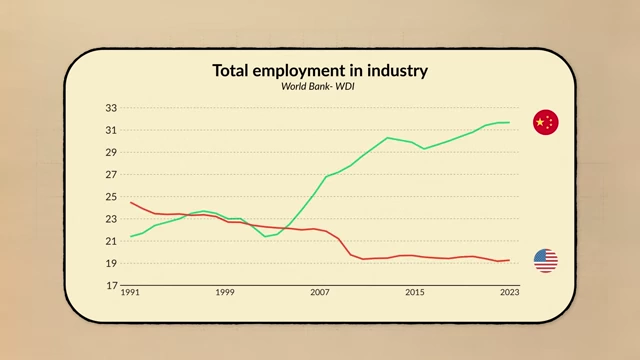
Comparison of total employment in industry for China and the US, highlighting China's thriving manufacturing sector [ 00:09:18 ] 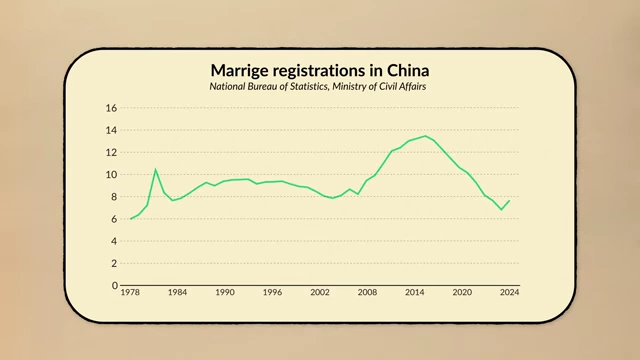
Marriage registrations in China from 1978 to 2024, showing a recent decline [ 00:09:31 ] - A 2011 survey found that approximately 70% of Chinese women consider homeownership a prerequisite for marriage.
- A 1% increase in Chinese house prices correlated with a 0.31% fall in marriage rates.
- This explains why marriage rates in China rapidly fell after 2013 when house prices surged, even as manufacturing jobs increased.

Trends in housing prices in China, showing a surge after 2013 [ 00:10:13 ]
- Despite a thriving manufacturing sector, China's marriage rates have dropped, hitting a low in 2024.
- Global Relevance:
- Similar negative effects of house prices on marriage rates have been observed in Spain and Korea, though these effects were generally small.
- Declining couple formation in rural China and the US, where housing is more affordable, suggests housing is only a partial explanation.
Smartphone Addiction and Digital Media [10:48]
- Gen Z and Digital Media:
- Gen Z is the first generation to grow up with smartphones and pervasive social media throughout high school and university.
- Increased Solitude:
- Research shows Gen Z spends significantly more time alone at a young age compared to previous generations, a trend observed in the US, UK, and Europe.
Trends in hours spent alone per day and percentage of people who don't socialize weekly for young adults across US, UK, and Europe [ 00:11:27 ]
- Research shows Gen Z spends significantly more time alone at a young age compared to previous generations, a trend observed in the US, UK, and Europe.
- Personality Changes:
- Gen Z's personality traits are changing more rapidly than older generations across four of the "Big Five" personality traits:
- Lower Conscientiousness: Since 2016, Gen Z is becoming less conscientious (self-discipline, reliability, follow-through), making it harder to signal stability and commitment in relationships.
- Higher Neuroticism: Gen Z is more neurotic, and increasingly so since 2017. This means greater anxiety, mood swings, and sensitivity to rejection, which hinders dating.
- Lower Agreeableness: Gen Z is less agreeable and has become significantly so since 2016. Lower agreeableness can lead to competitive, critical, or self-focused behavior, undermining trust and warmth in new relationships.
- Lower Extroversion: After starting similarly extroverted to other generations, Gen Z's extroversion rapidly declined since the pandemic. Less extroversion translates to less initiative in approaching others, impeding the formation of new partnerships.

Charts showing relative changes in four "Big Five" personality traits (Conscientiousness, Neuroticism, Agreeableness, Extroversion) for young adults compared to older age groups [ 00:12:02 ]
- Gen Z's personality traits are changing more rapidly than older generations across four of the "Big Five" personality traits:
- Impact on Relationships:
- Increased screen time leads to fewer opportunities to meet suitable partners in person.
- It also hinders the development of crucial social skills needed for lasting relationships.
- Evidence shows couples are meeting less in person, with a growing share meeting online.

Evolution of how couples meet in the US, showing the rise of online meetings and decline of traditional methods [ 00:14:07 ] - However, young people are increasingly abandoning dating apps due to frustration.

Trend in monthly users of major dating apps (Tinder, Bumble, Badoo, Hinge, Grindr) [ 00:14:15 ] - In regions with low internet use among women (e.g., South Asia), marriage rates remain high and stable, suggesting a link between digital media and relationship formation.

Mobile internet usage among women across different global regions [ 00:14:24 ]
- Scientific Debate:
- The scientific debate on social media's impact on mental health is ongoing, with correlation not equating to causation.
- While rising anxiety, depression, loneliness, and personality changes coincide with smartphone adoption and COVID-19 lockdowns, more evidence is needed to clarify mechanisms, magnitudes, and global versus country-specific patterns.
Conclusion [15:12]
- Social sciences do not offer a definitive answer for why Gen Z struggles to find love, but striking patterns have emerged.
- Key Factors in the Decline:
- Marriage ceased to be a social or economic necessity, leading to initial declines.
- This was first offset by cohabitation but worsened for Gen Z due to:
- Men falling behind in education and dropping out of the labor market.
- Rising house prices.
- The pervasive influence of smartphones and addictive social media.

Diagram illustrating the complete labor market mismatch leading to single non-college-educated men and women [ 00:16:07 ]
- Most Significant Factor: The speaker personally believes the most evidence points to the labor market mismatch, where less educated men and women are driving the trend, exacerbated by more women being educated and more men leaving the labor force.
- Societal Implications:
- This trend is a concern for governments globally, not only due to reduced happiness but also because fewer couples mean lower birth rates, contributing to the demographic crisis.
- Proposed Solutions:
- Governments should focus on keeping boys in the education system.
- Ensure housing remains affordable.
- Experiment with limiting smartphone and social media use in schools and at home while promoting face-to-face interactions for all ages.