The Dangers of Unregulated GLP-1s: A Retatrutide Overdose, Foundayo's Liver Report, and Tightening Access to Compounded Medications
Summary:
- A 32-year-old male suffered a severe overdose of 40mg of unregulated Retatrutide, leading to extreme diarrhea, dehydration, and a critical emergency room visit. This medical case, documented in literature, underscores the serious dangers of self-administering gray market GLP-1s due to unknown purity, dosage, and lack of medical supervision. [0:05:02]
- A liver failure report emerged shortly after Foundayo (Orforglipron) launched, prompting FDA scrutiny due to prior concerns about elevated liver enzymes in trials. While not directly linked to the drug by Lilly, this highlights the critical need for real-world monitoring of new medications. [0:13:00]
- The video emphasizes that the tightening of regulations on compounded GLP-1s by state medical boards and ongoing lawsuits inadvertently push patients towards riskier, unregulated online sources. This creates a dangerous scenario where individuals manage chronic conditions without professional oversight. [0:07:20, 0:19:06]
- The fundamental issue is that the demand for GLP-1 medications does not diminish; it merely shifts to less safe avenues when legitimate access is constrained, highlighting a severe gap in patient care and the importance of expert guidance beyond just drug access. [0:10:00, 0:20:02]

A phone displaying an email newsletter sign-up, emphasizing the need for reliable information amidst confusing regulatory changes. [ 00:02:00 ] - A new tool called the Pivot app is introduced to help GLP-1 patients track their dose, habits (like protein, fiber, water, activity, sleep), and weekly experiences, offering a comprehensive companion for their treatment journey. [0:21:55]
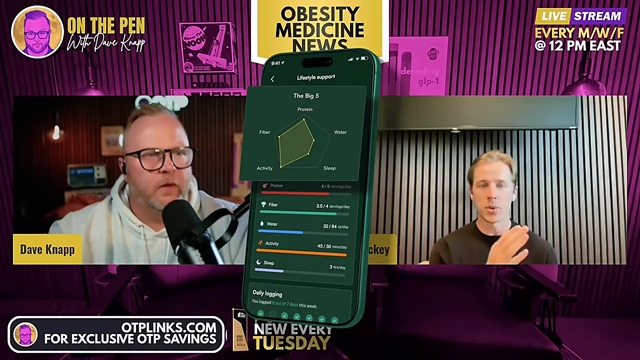
A phone displaying the "Pivot" app's "Lifestyle Support" feature, showing a radar chart for "The Big 5" (Fiber, Protein, Water, Activity, Sleep) and daily logging options for GLP-1 users. [ 00:26:48 ]
The Retatrutide Overdose Case and its Implications [0:00:02][0:05:02]
- Case Details:
- A 32-year-old male self-administered gray market Retatrutide, which he purchased online without a prescription or physician oversight for weight loss.
- He began with a weekly dose of 10mg, later increasing it to 20mg, despite the maximum dose in clinical trials being 12mg.
- He mistakenly injected a second 20mg dose within hours, forgetting he had already taken his dose the previous day, resulting in a dangerous 40mg intake.
- Health Consequences:
- This overdose led to severe diarrhea (every 20-30 minutes), significant dehydration, and a risk of kidney damage, necessitating an emergency room visit.
- This incident was formally documented in medical literature, published by the American College of Physicians, illustrating the frightening ease with which such a situation can occur due to the lack of regulation and medical supervision.
Risks of Gray Market GLP-1s [0:07:20]
- Uncertainty of Unregulated Products:
- When sourcing Retatrutide or any GLP-1 from unregulated online platforms, users cannot verify the actual dose, purity, or specific contents of the substance.
- There are documented cases where GLP-1 labeled products, often imported from sources like China through platforms like Telegram, have been found to contain no active ingredient at all.
- Driving Factors for Gray Market Use:
- Many patients turn to gray market alternatives when legitimate access to compounded or branded GLP-1 medications becomes restricted or unavailable.
- Absence of Medical Oversight:
- Reliance on unregulated products means patients lack the critical guidance and support of a physician, instead potentially turning to online forums like Reddit for advice.
- Managing a chronic condition like obesity with only internet advice, without professional medical care, is highly risky and unsustainable.
A phone displaying an email newsletter sign-up, emphasizing the need for reliable information amidst confusing regulatory changes. [ 00:02:00 ]
Concerns Regarding Foundayo (Orforglipron) and Liver Health [0:13:00]
- Post-Launch Liver Failure Report:
- Foundayo (Orforglipron), Lilly's new oral GLP-1, experienced a very rapid launch and approval process.
- Shortly after its launch around April 9th, a report of liver failure associated with the drug was submitted to the FDA's adverse event reporting system (FAERS).
- Lilly has indicated that they do not believe the liver failure was directly related to Foundayo due to the short exposure time and the absence of liver failures in their ATTAIN clinical trials.
- FDA Scrutiny and Safety Measures:
- The FDA had already mandated a Phase 4 study from Lilly to closely monitor for potential drug-induced liver injury, following observations of elevated liver enzymes in earlier Phase 2 trials.
- Historically, injectable GLP-1 medications have shown very rare instances of liver issues, approximately 1 in 100,000 patients.
- Lilly proactively reduced the maximum dose of Orforglipron from 45mg in Phase 2 to 36mg in Phase 3, presumably as a safety measure to mitigate liver toxicity risks, differentiating it from other oral GLP-1s like Pfizer's Danuglipron, which was abandoned due to liver issues.
The Connection Between Clinical Trials and Real-World Drug Use [0:16:31]
- Divergent Drug Usage Patterns:
- A key concern is that drugs are often used very differently in real-world scenarios compared to the controlled environments of clinical trials.
- This disparity can lead to unforeseen side effects or complications.
- Risks from Unregulated Promotion:
- The rise of "peptide influencers" promoting unregulated, "research-grade" versions of drugs like Orforglipron poses a significant risk.
- Such influencers might recommend unsafe practices, like taking these pills mid-fast, which can be particularly detrimental to liver health, as Orforglipron is metabolized by the liver.
Tightening Access to Compounded GLP-1s and the Shift to Gray Market [0:19:06]
- Regulatory Restrictions on Compounding:
- State medical boards in California, Rhode Island, and Kentucky are exerting pressure on clinicians to limit or stop prescribing compounded GLP-1s.
- FDA enforcement actions, including the removal of 503B regulated compounds from the market, further constrict access pathways.
- Consequences for Patients:
- The underlying demand for GLP-1 medications for chronic weight management remains strong, and patients, when faced with restricted legitimate access, often seek alternatives.
- This leads to a funneling of patients towards the gray market, where they risk acquiring products of unknown quality or efficacy.
- This shift compromises the overall patient care experience, as individuals are left to manage a complex chronic disease without professional medical guidance, relying instead on potentially unreliable internet information.
Introducing the Pivot App: A GLP-1 Tracking Tool for Patients [0:21:55]
- Addressing the Need for Tracking:
- There's a significant gap in tools for patients to track their GLP-1 journey, including dose management, understanding optimal zones, and monitoring responses.
- The GLP-1 journey is dynamic, affected by medication response, diet, and other tools used for chronic disease management.
- Pivot App Features:
- Shed, a company, has developed the Pivot app as a GLP-1 companion, allowing users to journal their experiences and log doses to understand how they felt on different dosages.
- It includes a "Daily Log" feature for simple tracking of key habits like protein, fiber, water intake, activity, and sleep, avoiding intense macro/calorie calculations.
- A "Weekly Report" feature helps users correlate medication titration with experiences such as cravings, food noise, and emotional states like stress.
- The app is designed to provide a 360-degree perspective, acknowledging the mind, body, and spirit in the obesity journey.
A phone displaying the "Pivot" app's "Lifestyle Support" feature, showing a radar chart for "The Big 5" (Fiber, Protein, Water, Activity, Sleep) and daily logging options for GLP-1 users. [ 00:26:48 ]
- Accessibility and Vision:
- The Pivot app is available for free for two weeks on Apple and Android marketplaces by searching "Pivot."
- It aims to be an inclusive tool beneficial to any GLP-1 patient, regardless of their provider, to offer support, guidance, and trustworthy expert information.