Understanding Deflationary Theories of Truth: A Philosophical Overview
Summary:
This video introduces deflationary theories of truth, contrasting them with traditional "inflationary" views that posit a substantive property shared by all truths. Key takeaways include:
- Deflationism asserts that truth is not a substantive property, and its role is fully captured by the equivalence principle ("p is true iff p").
- Motivations for this view include avoiding complex metaphysical commitments and addressing the diverse nature of "truths" across different domains.
- The Redundancy Theory argues "true" is redundant and can be eliminated, expressing the same proposition as the statement itself.
- The Performative Theory suggests using "true" is a speech act (e.g., endorsement) rather than expressing a proposition.
- Disquotationalism, a moderate form of deflationism, views "true" as a genuine predicate that allows semantic ascent/descent, enabling generalizations about sentences while keeping focus on the world.
- Objections highlight deflationism's struggle to explain why propositions are true because of facts, or to account for patterns of successful beliefs in terms of truth.
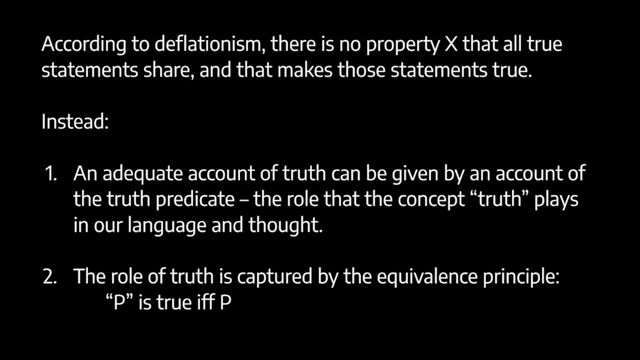
The two basic commitments of deflationism [ 00:01:20 ]
Introduction [0:00]
- Deflationism is a leading contemporary approach to truth, often seen as the primary alternative to the correspondence theory.
- Traditional theories (inflationary) seek a "substantive property X" that all truths share and which makes them true (e.g., correspondence to facts, coherence with other propositions).
- Deflationists challenge this, asserting there is no significant, underlying property of truth.
- Two basic commitments of deflationism: [1:40]
- An adequate account of truth focuses solely on the "truth predicate"—the role the word "true" plays in language and thought, not on external features of the world.
- The role of truth is fully captured by the "equivalence principle": "p is true if and only if P."
The two basic commitments of deflationism [ 00:01:20 ]
- Philosopher Gottlob Frege articulated this core idea, stating that the word "true" makes no essential contribution to the thought, meaning "seawater is salt" conveys the same assertion as "it is true that seawater is salt." [4:39]
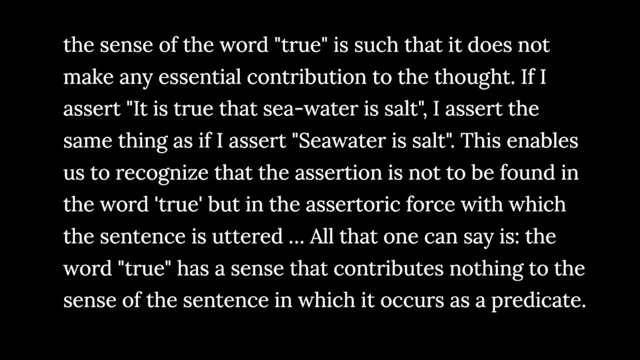
Gottlob Frege's quote on the redundancy of 'true' [ 00:04:40 ]
Is Truth a Property? [5:37]
- The claim that truth is "not a genuine property" is debated, with some preferring to say it's not an explanatory property.
- Many philosophers who embrace deflationism about truth will also tend to be attracted to deflationism about properties in general, suggesting "x has property F" is equivalent to "x is F."
- However, in a more substantive sense, when multiple things share a property (e.g., two blue objects), there's an underlying explanation for their "F-ness." Deflationists deny such a substantive explanation for truth; when P and Q are true, there may be nothing substantive they both share.

Deflationists argue truth is not an explanatory property [ 00:07:00 ]
Motivations [8:10]
- 1. Variety of Truth Domains: [8:27]
- Truth applies across diverse domains: everyday objects, scientific findings, moral statements, mathematical principles, historical facts, and metaphysics.
- Each domain involves different kinds of entities and distinct methods for establishing truth or falsehood.
- This variety leads to suspicion that a single, substantive property of truth could unify and explain all these diverse truths.
- Deflationism avoids the challenge of explaining how, for instance, mathematical or moral truths correspond to "facts" in the world.
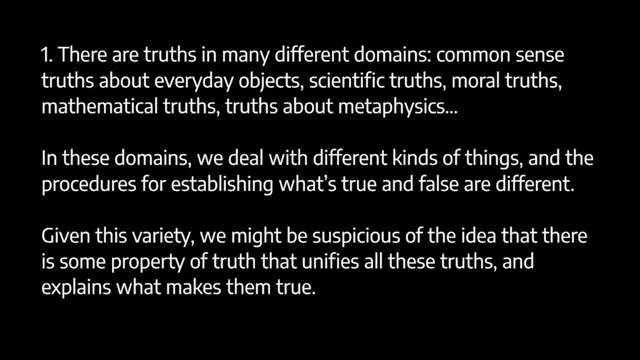
The variety of truth domains supports deflationism by avoiding the need for a single, unifying property of truth [ 00:08:20 ]
- 2. Avoids Metaphysics: [10:34]
- Deflationism provides an account of truth without requiring controversial metaphysical or epistemological commitments.
- Unlike the correspondence theory, which must explain the nature of "correspondence," "independent facts," and how they are accessed, deflationism relies only on the linguistic function of the truth predicate.
- This makes it appealing to philosophers skeptical of deep metaphysical inquiries (e.g., empiricists, pragmatists).
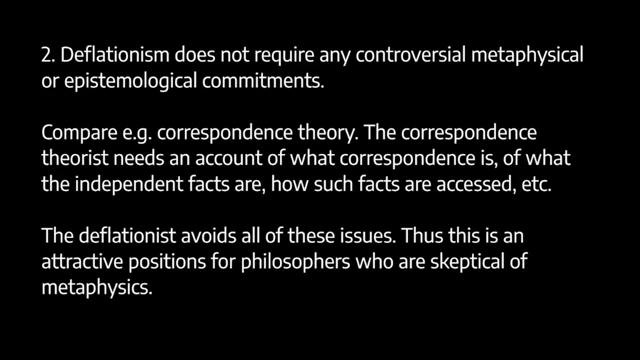
Deflationism avoids metaphysical and epistemological commitments by focusing on the truth predicate's linguistic role [ 00:10:40 ]
- 3. Indefinability of Truth (Frege's Argument): [11:45]
- Frege argued that any attempt to define truth in terms of other properties (e.g., property X) creates a circularity or an infinite regress.
- If a proposition's truth depends on it having property X, one must then ask if the statement "this proposition has property X" is true. This leads back to the question of truth, making it seem unique and indefinable by other characteristics.
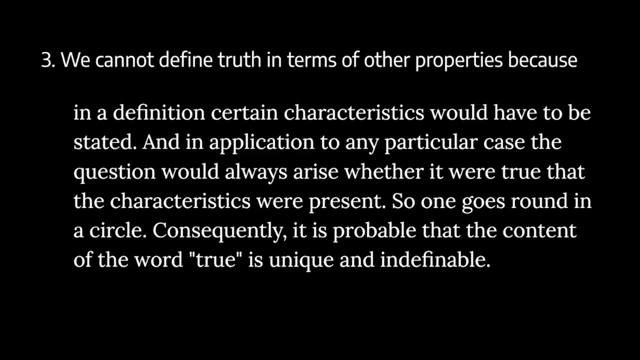
Frege's argument that truth cannot be defined in terms of other properties due to circularity [ 00:11:50 ]
Redundancy Theory [13:49]
- The redundancy theory is an early form of radical deflationism, proposing that the truth predicate is not a genuine predicate.
- Proponents like Frank Ramsey and A.J. Ayer argued that "p is true" or "it is true that p" expresses the exact same proposition as "p." The word "true" is redundant and can be eliminated without loss of meaning.
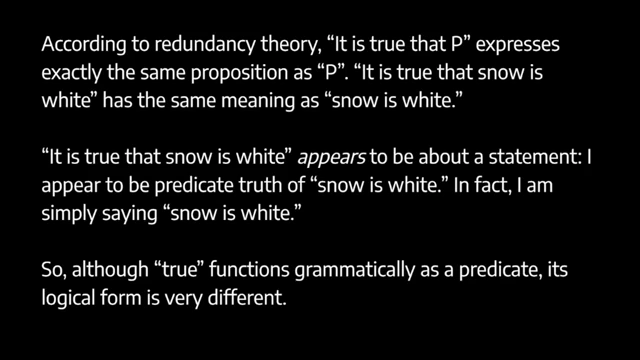
The redundancy theory states 'It is true that P' expresses the same proposition as 'P' [ 00:15:09 ] - Elimination in simple cases: [16:31]
- "It is true that Frank Zappa was a musician" is equivalent to "Frank Zappa was a musician."
- "Is it true that snow is white?" is equivalent to "Is snow white?"
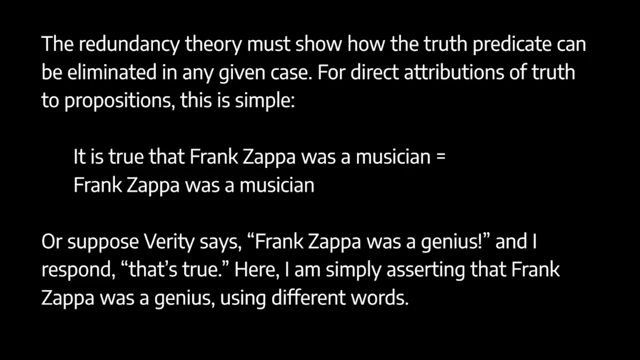
Simple cases of eliminating the truth predicate in direct attributions [ 00:16:29 ] 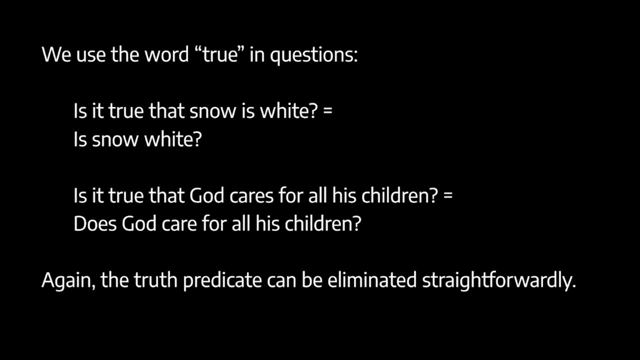
The redundancy theory shows how the word 'true' can be eliminated from questions [ 00:17:29 ]
- Challenging Case: General Statements [18:10]
- Consider "Everything Moses says is true." This cannot be simply eliminated if one does not know all of Moses's statements.
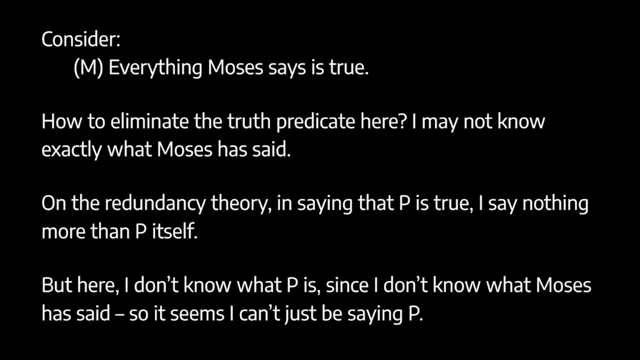
A challenging case for the redundancy theory: 'Everything Moses says is true' [ 00:18:09 ] - A proposed solution involves translating this into a formal language using logical quantifiers: "For all propositions P, if Moses says that P then P is true," which is then equivalent to "For all propositions P, if Moses says that P then P."
- This requires second-order logic (quantification over propositions), which has technical complexities (e.g., issues with completeness) that some philosophers prefer to avoid. It also suggests different ways of eliminating the truth predicate depending on the sentence structure, introducing theoretical complexity.
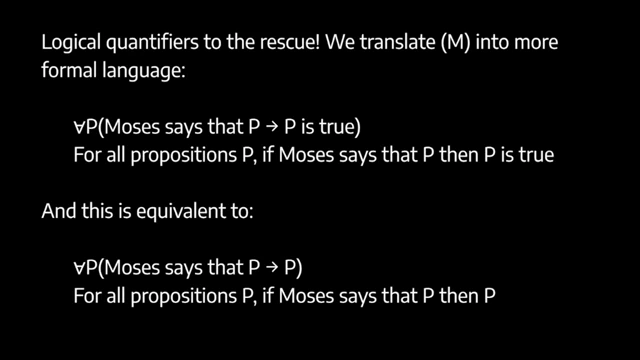
Using logical quantifiers to eliminate the truth predicate in general statements according to redundancy theory [ 00:20:59 ]
- Consider "Everything Moses says is true." This cannot be simply eliminated if one does not know all of Moses's statements.
Performative Theory [23:38]
- Peter Strawson's performative theory is another radical deflationary view.
- It claims that attributions of truth do not express propositions. Instead, saying "it is true that snow is white" is a speech act of endorsing or agreeing with the proposition "snow is white." It's like nodding one's head in agreement.
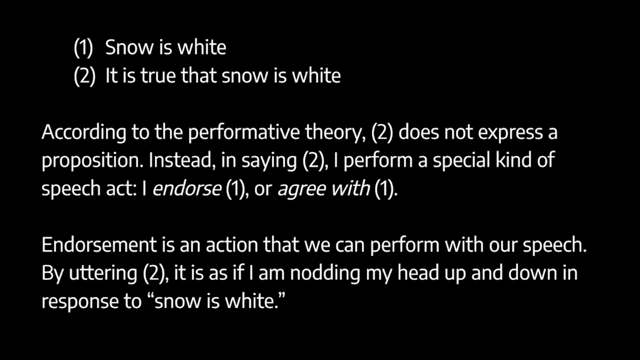
The performative theory posits that saying 'It is true that P' performs an act of endorsement [ 00:23:59 ] - Analogy to promising: Saying "I promise to pick you up from the airport" is an act of making a commitment, not describing a future event. Similarly, using "true" is an action.
- Issues for Performativism: [27:12]
- Multiple Performances: "True" is used in many ways (e.g., "it is not true" implies repudiation, "is it true?" implies querying). This requires postulating many different "performances" for a single word, suggesting not one theory of truth, but many.
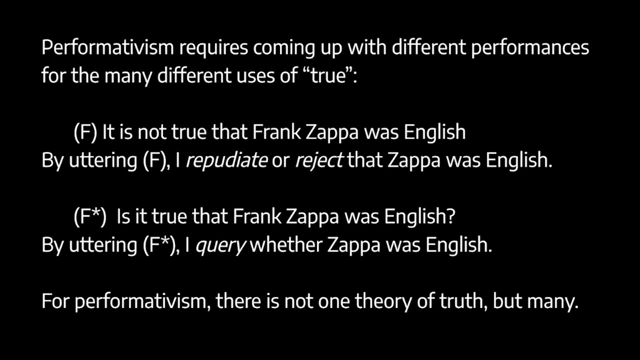
Performativism must account for various speech acts associated with 'true', leading to multiple theories of truth [ 00:28:01 ] - Frege-Geach Problem: In arguments like "If P is true, then Q; P is true; Therefore Q," the meaning of "P is true" appears to change between the conditional premise and the assertive premise. If "P is true" in the conditional isn't an endorsement (as one might not endorse the antecedent), but it is an endorsement in the second premise, the argument equivocates and becomes invalid.
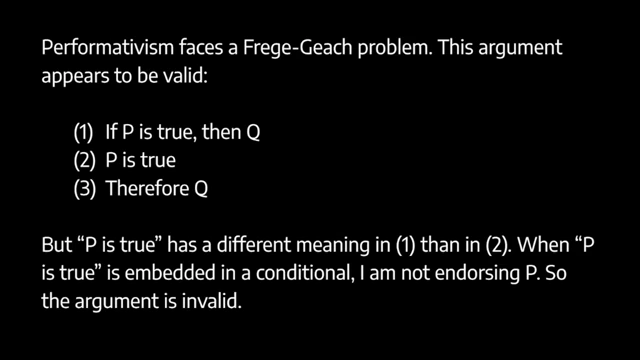
The Frege-Geach problem arises as 'P is true' would have different meanings in conditional vs. assertive contexts [ 00:29:18 ] - Defining Endorsement: If "endorsing P" simply means "affirming the proposition P," then the theory becomes circular, reintroducing propositions that it aimed to avoid.
- Multiple Performances: "True" is used in many ways (e.g., "it is not true" implies repudiation, "is it true?" implies querying). This requires postulating many different "performances" for a single word, suggesting not one theory of truth, but many.
Against Radical Deflationism [32:07]
- Richard Kirkham posed a general objection to radical deflationism: If "true" merely serves to reassert or endorse, why is it exclusively used for indicative statements (propositions) and not for questions or commands?
- For example, one cannot say "It is true that shut the window!" or "It is true that are there multiple universes?"
- This grammatical restriction suggests that the truth predicate has a specific role in our language that goes beyond simple restatement or endorsement, implying a more substantive function for truth.
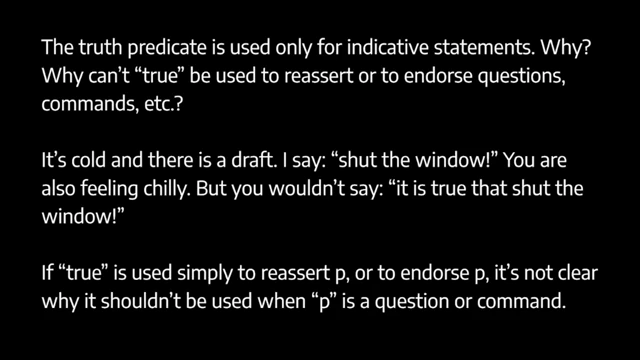
Objection to radical deflationism: the truth predicate only applies to indicative statements, not questions or commands [ 00:32:28 ]
Disquotationalism [34:46]
- Disquotationalism (favored by W.V.O. Quine) is a moderate form of deflationism. It grants that truth is a genuine predicate, accepting that when we say "'Snow is white' is true," we are indeed talking about the statement and predicating truth of it.
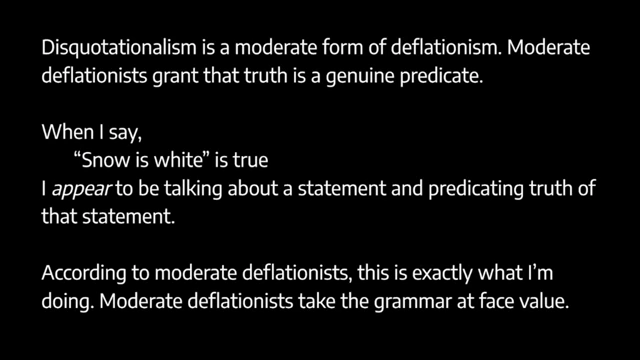
Disquotationalism, a moderate deflationary theory, accepts 'true' as a genuine predicate [ 00:34:58 ] - The essence of truth is captured by the disquotation schema: "'p' is true if and only if p."
- Quotation as a linguistic device: [36:06]
- Quotation marks turn a sentence (e.g., "snow is white") into a name for that sentence (e.g., "'snow is white'").
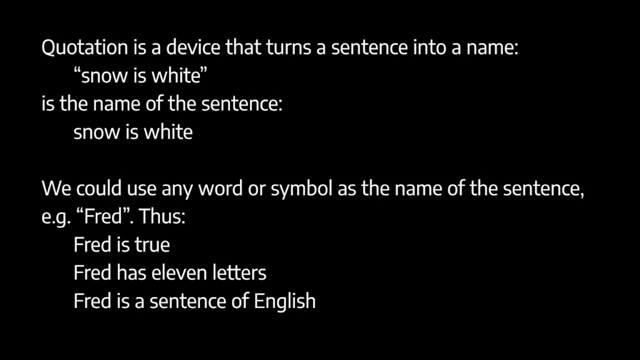
Quotation marks transform a sentence into its name, allowing us to talk about the sentence itself [ 00:36:08 ] - This allows for semantic ascent (shifting from talking about the world to talking about language) and semantic descent (shifting back).

Quotation facilitates semantic ascent, shifting from talking about the world to talking about language [ 00:37:38 ]
- Quotation marks turn a sentence (e.g., "snow is white") into a name for that sentence (e.g., "'snow is white'").
- Role of the truth predicate: The truth predicate effectively "cancels" the effect of quotation marks. When we say "'Snow is white' is true," we are using the name of the sentence to talk about the world again, specifically about the state of affairs described by the sentence.
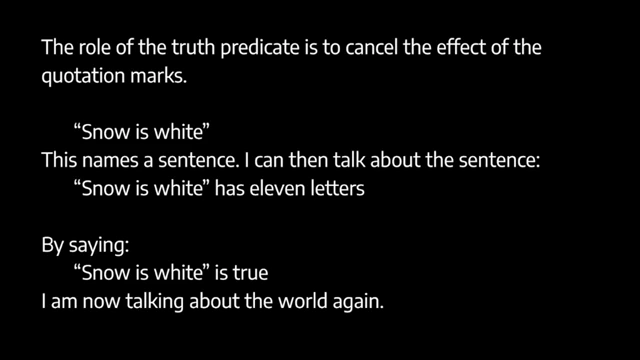
The truth predicate effectively cancels quotation marks, allowing us to talk about the world through sentences [ 00:38:48 ] - Utility for Generalizations: This mechanism is crucial for making generalizations that refer to sentences without having to list them all infinitely (e.g., "Every sentence of the form 'P or not-P' is true"). By affirming that every such sentence is true, we affirm the sentences themselves and their content.
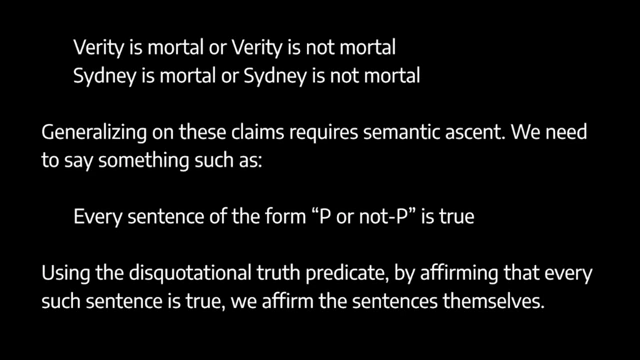
Disquotationalism provides a way to generalize about an infinite number of sentences using the truth predicate [ 00:40:08 ] - In Quine's words, the truth predicate serves as a "reminder that, despite a technical ascent to talk of sentences, our eye is on the world." It's a useful linguistic device, not redundant, and not eliminable without altering how we generalize or speak about language in relation to the world.
Objections to Deflationism: The "Because" Problem [42:24]
- A central objection is that deflationism cannot adequately accommodate the explanatory role of truth.
- It seems natural to say that "The sentence 'snow is white' is true because snow is white."
- Two things determine whether a sentence is true: [1] the meanings of its terms, and [2] the way the world is.
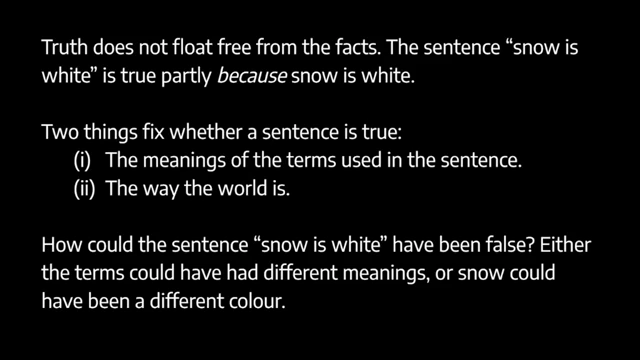
The 'Because' problem argues that truth does not float free from facts; a sentence is true partly because of how the world is [ 00:42:57 ] - The Problem: If, according to deflationism, "'Snow is white' is true" is logically equivalent to "Snow is white," then by substitution, the explanatory statement "The sentence 'snow is white' is true because snow is white" becomes "Snow is white because snow is white." This is an absurd self-explanation.
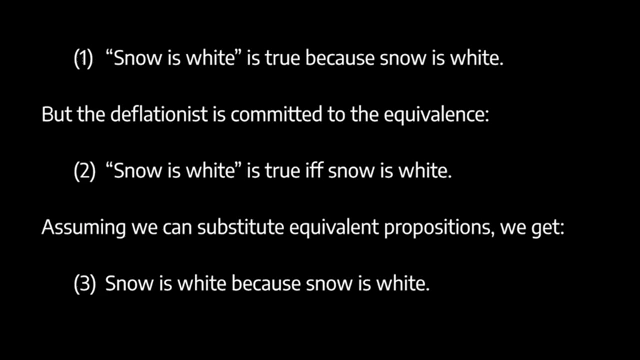
Deflationism's equivalence principle leads to a circular self-explanation when applied to 'because' statements [ 00:44:37 ] - Deflationists might deny that the original "because" statement is genuinely explanatory, but this highlights their challenge in explaining the relationship between truth and the world without resorting to such problematic circularities.
Objections to Deflationism: Truth and Success [46:55]
- Truth appears to play an explanatory role in the success of beliefs and actions. [47:01]
- Example: If someone believes "water quenches thirst," drinks water, and their thirst is quenched, their success is partly explained by the truth of their belief.
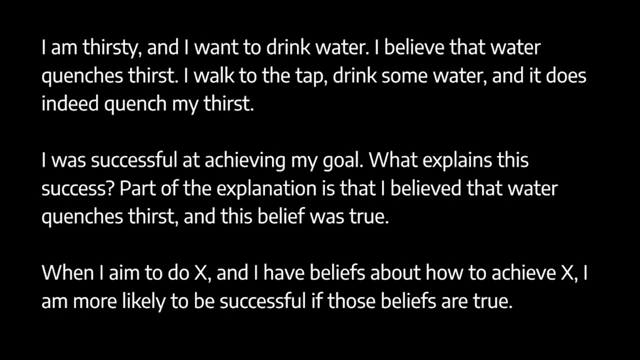
Truth plays an explanatory role in the success of beliefs and actions [ 00:47:07 ] - Deflationist Response: The success can be explained without the property of truth: "I believe that water quenches thirst, and water quenches thirst." The "true" predicate is merely a convenient linguistic device.
- Kitcher's Refinement (Patterns of Success): Philip Kitcher argues that while deflationism might explain specific instances of success, it fails to explain patterns of success. [49:19]
- Ophelia's Map: Ophelia successfully navigates a town repeatedly using an accurate map. Deflationists can explain each successful instance (e.g., "Ophelia believes the museum is on 53rd Street, and the museum is on 53rd Street").
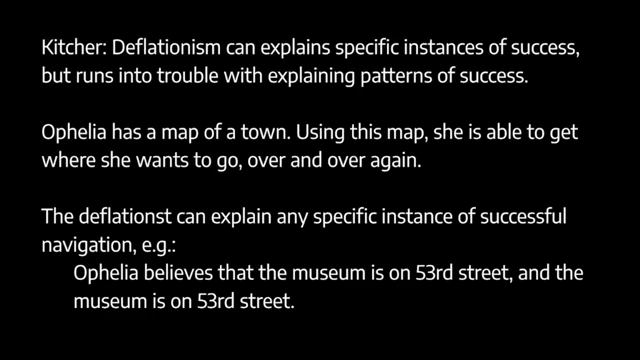
Kitcher argues that deflationism can explain specific successes but struggles with patterns of success [ 00:49:17 ] - However, these explanations don't explain the overall pattern of Ophelia's consistent success. The more general explanation is that she is using a map that is accurate and corresponds to the territory. This correspondence is a substantive property.
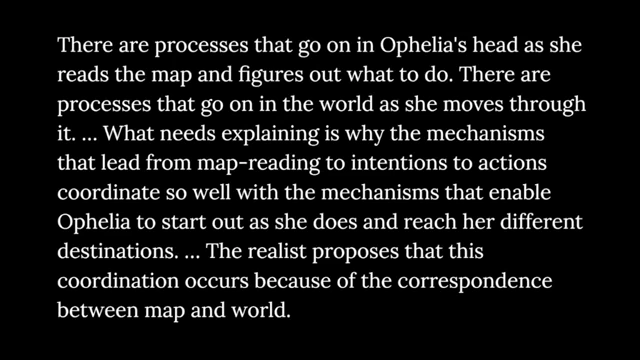
Kitcher's quote on the coordination between beliefs (map-reading) and actions in the world [ 00:51:46 ]
- Ophelia's Map: Ophelia successfully navigates a town repeatedly using an accurate map. Deflationists can explain each successful instance (e.g., "Ophelia believes the museum is on 53rd Street, and the museum is on 53rd Street").
- Putnam's Analogy (Peg and Holes): Explaining why a cubical peg fits a square hole (but not a circular one) by detailing the exact molecular placement misses the point. The better, more general explanation cites the geometrical properties. Kitcher argues that the deflationist's explanations for success are like the molecular one – they miss the higher-level, unifying property of truth/correspondence that explains patterns of successful interaction with the world. [53:23]

Putnam's peg and hole analogy illustrates the need for higher-level, general explanations over specific details [ 00:53:27 ] 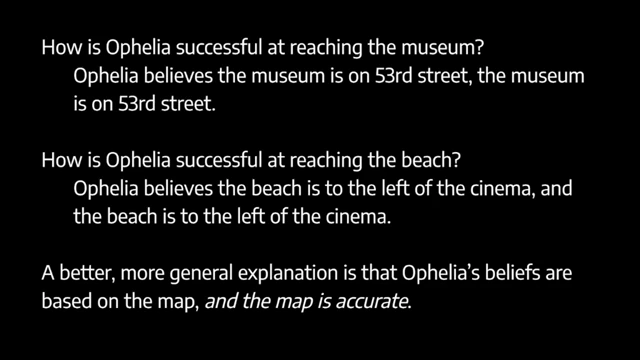
A general explanation of Ophelia's success attributes it to an accurate map, unlike specific deflationary accounts [ 00:55:37 ]