The Smarter Scrubber Experiment: A Four-Year Journey to Revitalize US Manufacturing and Confront Global Supply Chain Challenges
This video documents a four-year experiment to manufacture a grill scrubber, the "Smarter Scrubber," entirely in America. The project aimed to source and produce every component domestically but revealed significant challenges, including higher costs for U.S.-made parts, difficulties finding local suppliers, and a concerning loss of skilled tool and die makers in America. Despite hurdles, the project successfully produced the Smarter Scrubber.

Motivation for the Made-in-America Experiment [0:00]
The video documents a four-year experiment asking: Is it possible to manufacture a product competitively in America? This question stems from a four-year experiment undertaken by the host.
Personal Background and Inspiration [1:55]
- The host's parents were union auto workers in North Alabama, making steering components, which symbolized productivity and the American dream.

A group photo of the host's mother with her colleagues. [ 00:02:16 ] - Global economic shifts, particularly with trade agreements like NAFTA and CAFTA, led to manufacturing moving overseas for economic reasons, impacting local communities.

NAFTA and CAFTA trade agreements signed into law under different presidents. [ 00:02:26 ] - The host acknowledges the complexity of the global economy, emphasizing that these issues are not simple political talking points.
- The host's parents were union auto workers in North Alabama, making steering components, which symbolized productivity and the American dream.
Impact of the 2020 Global Pandemic [5:14]
- The pandemic exposed the anemic manufacturing capacity in America, specifically the inability to produce essential items like N95 masks and face shields domestically.

A headline about the N95 shortage in America. [ 00:05:31 ] - Local communities resorted to 3D printing masks, highlighting the slowness of this method compared to industrial manufacturing.

Volunteers producing 3D-printed masks. [ 00:06:01 ] - The host, working with Chris Robeson, an injection molder, was able to produce face shields locally, realizing the critical role of skilled mold makers.
- The pandemic exposed the anemic manufacturing capacity in America, specifically the inability to produce essential items like N95 masks and face shields domestically.
Partnership with John Youngblood [7:25]
- The host collaborated with John Youngblood, owner of JJ George, a small business selling grill products.
- John's motivation stemmed from issues with overseas manufacturing, including intellectual property theft where foreign manufacturers would produce knock-offs of his patented products at lower quality and price.

A listing of knock-off products on Amazon. [ 00:08:43 ] - The goal was to leverage the YouTube channel to market the "Smarter Scrubber" directly, bypassing problematic platforms like Amazon.
The Smarter Scrubber Product and Design Challenges [10:21]
The project centered on creating a superior, safe grill scrubber using chain mail.
Design Requirements [10:21]
- The scrubber needed a "squishy" component behind the chain mail to allow it to conform to grill grates and apply even pressure.
- An adapter was required to connect the squishy part to a handle without breaking the flexible material.
- Injection molding was identified as the key to rapid, high-volume production.

A visual representation of the injection molding process, showing molten plastic being injected into a mold cavity. [ 00:11:19 ]
Iterative Design Process [11:29]
- Initial designs included posts to hold the chain mail, which proved prone to breaking.
- The design evolved into multiple components: a cover, an adapter, and a separate squishy pad.
- Emphasis was placed on "clicking" parts together for faster assembly, inspired by Toyota's manufacturing principles.
- The scrubber head was designed to be removable for handheld use and ease of cleaning (dishwasher safe).
Squishy Component Material [13:29]
- Early prototypes used Santoprene, a thermoplastic polyurethane, but it melted at high grill temperatures.
- The switch was made to food-grade silicone, which offers higher heat resistance (though still not for blazing hot grills).
- Finding a U.S. supplier for silicone injection molding was challenging, requiring outreach to Commonwealth Manufacturing in Virginia.
Sourcing Components in the USA [14:18]
Chain Mail [14:18]
- Initial chain mail samples from China had radial patterns that didn't adapt well to grill grates and individual rings were prone to breaking.
- Testing revealed a preference for a welded, octagonal rectangular grid pattern for durability and effectiveness.
- Finding a U.S. supplier for this specific chain mail proved difficult due to quantity and cost limitations (2,000 units/month, very expensive).
- An Indian supplier was used to augment quantities, but a late discovery revealed some of this "Indian" chain mail was actually sourced from China.

The host shows an example of a chain mail that has Chinese writing. [ 00:37:38 ]
Bolts [16:35]
- Sourcing a simple 1-inch stainless steel 1/4-20 bolt domestically was surprisingly challenging.
- Foreign bolts cost $0.09 each, while U.S.-made bolts cost around $0.35-$0.42 each (approximately 4 times more expensive).
- It took months to find a U.S. supplier in Massachusetts, highlighting the difficulty in finding and verifying domestic sources for commodity items.

A side-by-side comparison of a foreign bolt and an American bolt, along with their cost differences. [ 00:17:28 ]
Other Components [31:10]
- The stainless steel wire for the scrubber head was confirmed to be made in Pennsylvania.
- The rope for hanging the scrubber could not be verified as U.S.-made.
- The knob, initially believed to be U.S.-made, was discovered to be from Costa Rica, necessitating plans to mold it in America using new technology.
The Importance of Tool and Die Manufacturing [18:00]
The Decline of Tooling Expertise [18:00]
- A significant challenge was the discovery that many U.S. injection molders send CAD files to China for mold production, then import the molds back for local injection molding.
- This practice implies a loss of intellectual property and a decline in advanced tooling skills within the U.S.
- Tim Cook (Apple CEO) notably stated in 2017 that China's competitive advantage is not low labor cost, but the depth of tooling skill and precision that is lacking in the U.S.

Apple CEO Tim Cook discusses the tooling skill in China during an interview. [ 00:20:18 ]
Insights from Jeremy Fielding [21:07]
- Jeremy Fielding, an engineer who speaks Chinese and has extensively explored Chinese manufacturing, confirms that the quality of manufacturing in China is surprisingly good and often equivalent to, or even surpassing, what can be made in the U.S. for certain specialized processes.
Mentorship and Learning Tool and Die [23:06]
- Chris Robeson, the injection molder, mentored the host, teaching him crucial design principles for injection molding (e.g., avoiding overly thick areas, using draft angles).
- They experimented with 3D printing mold cavities using Formlabs' Rigid 10K solution for prototyping, allowing for quick testing and design adjustments before creating production metal molds.

3D printed mold cavities using Formlabs' Rigid 10K solution. [ 00:23:52 ] - The host learned to CNC machine, acquiring used machines to produce metal parts for the molds.
The Apprenticeship Model and Roger's Legacy [29:17]
- T&C Metal Stamping, a company committed to investing in a tool and die apprenticeship program, became crucial for manufacturing the handle.
- Logan, a young apprentice, made the tooling for the scrubber's handle, marking a critical step in rebuilding domestic tooling expertise.
- The passing of Roger, an experienced tool and die expert who mentored Logan, underscored the critical loss of accumulated knowledge and wisdom when skilled trades retire without passing on their expertise.
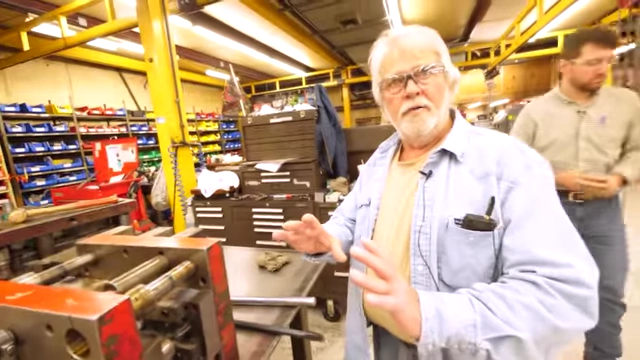
Roger, a tool and die expert, teaching and explaining concepts in a workshop. [ 00:28:26 ]
Mantle's Disruptive Technology [32:00]
- Mantle, a company that 3D prints metal molds using a hybrid additive-subtractive process, offers a promising solution for making complex mold geometries faster and with better surface finishes than traditional methods.
- This technology could help revitalize the U.S. tool and die industry by enabling more efficient and complex mold production domestically.
- Ted, the CEO of Mantle, agreed to help create a mold for the "Costa Rican" knob, aiming to make it 100% in America.

Ted from Mantle holding up a 3D-printed metal mold using a hybrid additive-subtractive process. [ 00:33:30 ]
The Smarter Scrubber Pitch and Lessons Learned [39:16]
Addressing the Problem with Traditional Grill Brushes [40:01]
- Traditional wire bristle grill brushes pose a significant health risk as bristles can detach, get into food, and be ingested, leading to serious medical issues (e.g., impalement in the throat, exploratory surgery for bowel perforation).

A medical paper showing an ingested grill brush bristle. [ 00:42:38 ] - The Smarter Scrubber's chain mail design eliminates this risk.
- Traditional wire bristle grill brushes pose a significant health risk as bristles can detach, get into food, and be ingested, leading to serious medical issues (e.g., impalement in the throat, exploratory surgery for bowel perforation).
Value Proposition: Quality and Longevity [42:58]
- The Smarter Scrubber is designed to be a durable, high-quality product, contrasting with cheap, disposable alternatives.
- The "Boots Theory of socioeconomic unfairness" illustrates that while the Smarter Scrubber may have a higher upfront cost, its longevity makes it more economical in the long run compared to frequently replacing cheaper, low-quality items.

A graph comparing the total cost over time for a cheap, low-quality product versus a high-quality product, demonstrating how buying cheap leads to higher long-term costs due to frequent replacement. [ 00:43:14 ] - The product is designed to "feel like a medieval weapon" due to its robust construction.
- Its modular design allows the head to be removed for hand-cleaning (e.g., cast iron) and the entire unit is dishwasher safe.
The Importance of Local Manufacturing [44:53]
- The host advocates for investing in local communities by choosing domestic manufacturing, even if it means less profit, to create jobs and maintain skilled labor.
- He emphasizes that he undertook this risk because he cares about the well-being and job opportunities for people in his community.
Future Outlook and Call to Action [46:42]
- The team has thousands of Smarter Scrubbers stockpiled. If initial sales surge, customers are asked to be patient with potential pre-orders.
- Profits from sales will be reinvested into improving manufacturing processes and tooling, such as automating the laser marking bottleneck with a conveyor belt system.
- The ongoing goal is to make all components 100% in America, ensuring top-notch quality regardless of current sourcing.
- The Smarter Scrubber is currently shipped to the U.S. and Canada, with plans for worldwide expansion.
- The video concludes with a strong recommendation against using wire bristle grill brushes due to safety concerns and a call to support local manufacturing by considering the Smarter Scrubber.