How I'm Changing My Habit Tracking in 2026: From Quantity to Intentional Quality
In 2026, the creator is overhauling his habit tracking method, moving away from tracking numerous habits daily to a more intentional, quality-focused approach.
- He realized his previous method, while achieving impressive results, led to tracking habits "for the sake of it," lacking deeper purpose.

Speaker holding up his old habit tracker, filled with entries. [ 00:00:20 ] - The new system involves hyper-focusing on just one habit each month, alongside a few essential "non-negotiable" baseline habits.

An overhead shot of an open journal, showing a monthly habit tracker spread with columns and graphs. [ 00:05:50 ] - This monthly focus habit is tracked with detailed graphs to understand its impact on mood, stress, and other related metrics.
- The process begins with "New Year Reset Exercises" in a custom journal, including writing a eulogy, identifying limiting beliefs, mapping priorities, setting goals, and writing a letter to one's future self.
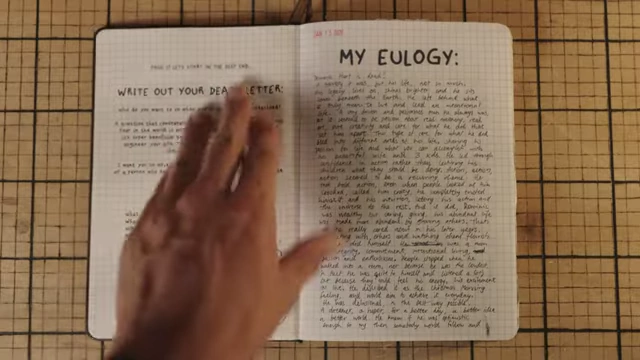
A journal opened to a page titled 'MY EULOGY', with prompts on the left page. [ 00:02:55 ] - The setup requires a gridded journal, a multi-colored pen, and a ruler, allowing for daily logging of a "memorable moment" and checking off baseline habits.

A gridded journal, a multi-colored pen, and a ruler laid out on a table. [ 00:07:40 ] - The goal is to design a life aligned with one's desired identity, emphasizing depth and enjoyment over mere optimization.
Reflecting on Past Habit Tracking [0:00]
The creator found his 2025 habit tracking method, which involved tracking numerous habits daily, to be effective for achieving goals like an ultramarathon and fundraising.
- While successful and impactful on others, he felt a lack of deeper intention by the end of the year.
- He admitted to "chucking in habits for the sake of habit tracking" rather than focusing on personal transformation.
Speaker holding up his old habit tracker, filled with entries. [ 00:00:20 ]
Embracing a New Intention for 2026 [1:10]
For 2026, the creator is shifting to a new philosophy for habit tracking, prioritizing quality and intentionality over quantity.
- The core intention is "not doing more things, but doing more of the right things."
- The new method involves hyper-focusing on a single habit each month to integrate it deeply into his desired identity.
- He aims to ask "who do I want to be?" and "what habits does that person do every day?" to live that lifestyle.
2026 Reset Exercises [2:03]
Before diving into the new habit tracking system, the creator outlines a series of introspective exercises in his journal designed for self-reflection and goal setting.
- My Eulogy [2:43]
- This activity encourages reflection on one's legacy and desired impact.
- Prompts guide the writing process:
- What were your core values?
- What did your family look like?
- What was your job?
- How did you show up every day?
- What were you known for?
- What is the legacy you leave behind?
A journal opened to a page titled 'MY EULOGY', with prompts on the left page. [ 00:02:55 ]
- Look at the Trends [3:08]
- After writing the eulogy, identify recurring positive themes or desired qualities.
- Examples from his own eulogy include passion, enthusiasm, and curiosity.
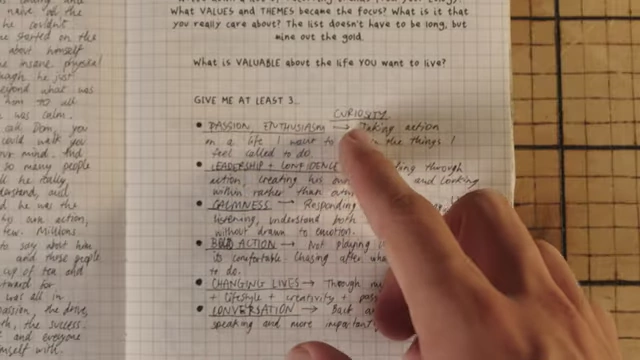
Qualities and themes identified in the eulogy. [ 00:03:22 ]
- Limiting Beliefs [3:37]
- Confront and articulate self-imposed limitations or negative thought patterns.
- He shared his own limiting belief: "it could all crumble apart through my fingertips."

A journal page showing the 'LIMITING BELIEFS' section. [ 00:03:50 ]
- Your Priorities [4:00]
- Visually represent current life priorities using a pie chart and then illustrate desired changes.
- Categories can be customized, but he suggests areas like learning and work.
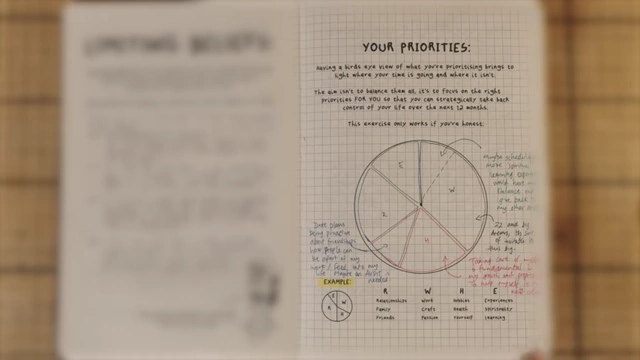
A journal page showing a pie chart for 'YOUR PRIORITIES', illustrating current and desired allocations. [ 00:04:10 ]
- Five Vulnerable Questions & 2026 Goals [4:20]
- Answer five hard-hitting questions for deep self-reflection during transitional times.
- Define clear goals for the year.
- Anti-Goals [4:37]: List things you explicitly don't want to give up or do.
- Examples: quality time with loved ones, not chasing what others want, creating what he wants.
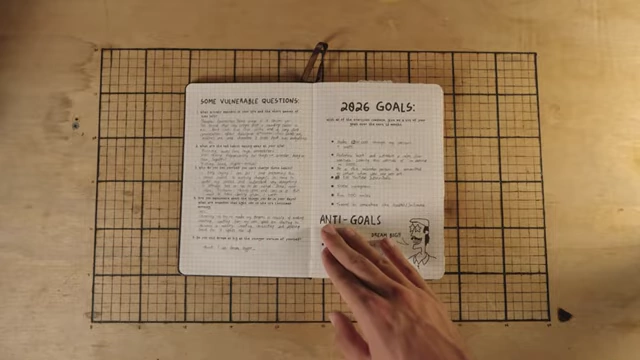
A journal page with sections for 'FIVE VULNERABLE QUESTIONS', '2026 GOALS', and 'ANTI-GOALS'. [ 00:04:40 ]
- Examples: quality time with loved ones, not chasing what others want, creating what he wants.
- Letter to Your Future Self & Vision Board [5:02]
- Write a personal letter to be opened at a later date, providing a future message or reward.
- Create a vision board, which is a collage of visual representations of goals.
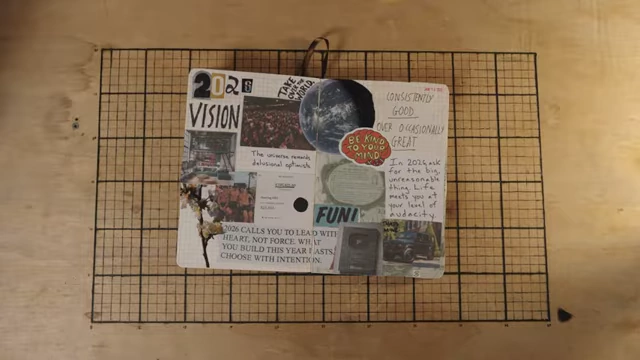
A colorful vision board, featuring images and text representing goals. [ 00:05:35 ]
My Habit Tracker Set Up [5:40]
The new habit tracker focuses on intentionality and understanding the impact of habits, rather than just checking them off.
- It moves away from the previous high-quantity tracking.
- The system combines daily reflections, core habits, and deep dives into one monthly focus habit.
An overhead shot of an open journal, showing a monthly habit tracker spread with columns and graphs. [ 00:05:50 ]
What You Need [7:26]
To set up this new habit tracker, you will need simple stationery.
- A multi-colored pen for distinguishing different graphs and data.
- A ruler for drawing straight lines and structured layouts.
- A gridded journal (a "must-have" for organization).
A gridded journal, a multi-colored pen, and a ruler laid out on a table. [ 00:07:40 ]
How to Set it Up [7:54]
A step-by-step guide to creating the monthly spread in the journal.
- Page 1: Daily Tracking
- Write the month title (e.g., "January").
- List the days of the month vertically.
- Include a "Memorable Moments" section for a single, one-line entry each day.
- Page 2: Baseline Habits & Focus Habit Graphs
- Create vertical columns for "baseline habits" – essential non-negotiables.
- Examples: Exercise, Creatine, Speak to a stranger.
- Implement multiple graphs for the month's single hyper-focused habit.
- The main focus habit is stated (e.g., "Reading 30 pages a day" or "Screen time").
- Additional graphs track related metrics and feelings.
- Example: For "reading," track "pages read," "mood," and "stress."
- Example: For "getting off social media," track "screen time," "phone pickups," and "deep work."
- This allows for a "science experiment" approach, observing how one variable (the focus habit) affects others (mood, stress, productivity).

A blank journal spread with drawn lines and labels for daily entries, baseline habits, and graphs. [ 00:10:50 ]
- Create vertical columns for "baseline habits" – essential non-negotiables.
- Daily Logging Example [10:02]
- Each morning, reflect on the previous day.
- Write down a memorable moment.
- Tick off completed baseline habits.
- Log data for the focus habit and its correlated metrics (e.g., screen time, mood, deep work hours).
2026 is Your Year! [11:05]
The creator encourages viewers to adopt this intentional approach to habit tracking.
- The goal is to avoid life becoming "one big optimization" that leads to exhaustion and stress.
- By being intentional and designing the life you want, personal transformation is well within reach.