The Ralph Wiggum Loop: First Principles of Autonomous Software Engineering and Specification-Driven Development
- The video introduces the "Ralph Wiggum loop," an orchestrator pattern for managing context windows in AI-driven software development to avoid compaction and context rot.
- It highlights a paradigm shift where AI can make software development incredibly cheap, costing as little as $0.042 per hour, enabling autonomous systems.
- The creator emphasizes understanding first principles of software engineering, comparing it to mastering a screwdriver before a jackhammer.
- The Loom platform is presented as an experimental environment for self-evolutionary software, where humans program the loop rather than being in the loop.
- A key aspect is generating software specifications automatically through conversation, then refining them manually, and using them to drive autonomous agents called "weavers."
- The process involves deterministically "mallocing" the context window (array) to provide precise, relevant information to the AI, thus improving outcomes and preventing lossy compaction.
- A demonstration shows generating a product analytics system specification and implementation plan, emphasizing iterative refinement and oversight over full automation.

Implementation plan for product analytics system with 12 phases [ 00:28:35 ]
The Shift to Autonomous Software Development Economics [00:00:58]
The speaker, the creator of "Ralph," discusses a significant shift in the economics of software development, driven by AI.
- New Economic Model:
- Running Ralph in a loop, utilizing Anthropic's Sonnet 4.5 API, reduces software development costs to approximately $0.042 USD per hour.
- This cost is remarkably low, even less than paying a fast-food retail worker.
- This allows for autonomous software development, dramatically increasing output (multiple days or weeks of work in 24 hours).
- The "Rift" in the Industry:
- The advent of autonomous development will create a divide between those who embrace and understand these new methods and those who do not.
- There's an urgent call for developers to "invest in yourselves, get curious," and master fundamental concepts (the "screwdriver") before jumping to advanced tools (the "jackhammer").
The Loom Platform and Self-Evolutionary Software [00:04:41]
Loom is introduced as an experimental platform designed for self-evolutionary software, fundamentally rethinking traditional software development paradigms.
- Design Philosophy:
- Traditional software development tools and practices are designed for humans; Loom aims to design for autonomous agents.
- The goal is for humans to be "on the loop" or "programming the loop," rather than "in the loop."
- This requires a heavy software engineering mindset, focusing on designing systems for automation.
- Loom's Capabilities:
- Code Hosting and Source Control: Functions as GitHub code hosting with its own source control using JJ.
- Remote Provisioning: Acts as GitHub CodeSpaces, enabling remote infrastructure provisioning.
- Coding Agent: Similar to other LLM-based coding agents (like Anthropic's Claude), but it alloys multiple LLM providers.
- Autonomous Deployment: The system is designed to autonomously deploy software without manual code review, using agents called "weavers."
- Future Vision:
- Building chains of agents and nested "Ralph loops" to automate not just development, but also feature design, product management, and A/B testing (e.g., autonomously creating feature flags, deploying, analyzing, and optimizing landing pages).
- Anticipating a future [2026] of fully autonomous systems.
The Ralph Wiggum Loop: Context Management and Optimization [00:10:12]
The core technical concept, the "Ralph Wiggum loop," is explained as an orchestrator pattern for efficient context window management in LLMs.
- Avoiding Context Rot and Compaction:
- Ralph is a "mallocing orchestrator" that deterministically allocates the context window (viewed as an array).
- Minimizing the amount of context used in the array reduces the need for the window to "slide," leading to better outcomes.
- This contrasts with approaches that continuously "pound the model" until compaction occurs, which is a "lossy function" resulting in "context rot."
- System-Wide Optimization:
- The entire system, including the operating system, external vendors, and APIs, is considered a single unit.
- Systems designed for humans need to be re-evaluated and redesigned for robots to optimize performance.
- Optimization opportunities include:
- Improving serialization formats (e.g., moving beyond inefficient JSON for tokenization).
- Re-evaluating fundamental computer science concepts like garbage collection, malloc, Erlang OTP principles, message passing, user space, and TTY.
- Goal: Operate cheaper and more efficiently than anyone else by controlling and optimizing the entire stack for AI agents.
Demonstration: Generating Product Analytics Specifications [00:12:07]
The speaker demonstrates how to generate and refine specifications for a new feature (product analytics) using Claude Code within Loom.
- The "Pin" (Frame of Reference):
- The
specs/readme.mdfile serves as a continuously updated "pin" or frame of reference for the LLM, containing lookup tables and generative words that improve the search tool's ability to find relevant context. - This reduces the LLM's tendency to "invent" functionality and keeps it aligned with existing system architecture.
- The
- Iterative Specification Building (The "Pottery Wheel"):
- The process starts with a high-level prompt (e.g., "add product analytics like PostHog into Loom").
- The LLM asks clarifying questions, and the human provides direct answers and guidance, "molding the context window."
- This involves defining aspects like:
- Privacy & Compliance: Whether to collect data, using specific "loom secret" crates for PII protection.
- Integration Points: Via web API, with Rust and TypeScript clients.
- SDKs: Needed for other applications on the Loom platform to run experiments.
- Event Model: Best practices from PostHog.
- Experiments/Feature Flags: Integration with existing
loom-flagssystem. - Data Storage: Initially in SQLite for fast iteration, with a future vision for actor-based, OTP principles.
- Identity Model: Researching PostHog's approach for anonymous and identified users, ensuring multi-tenancy support.
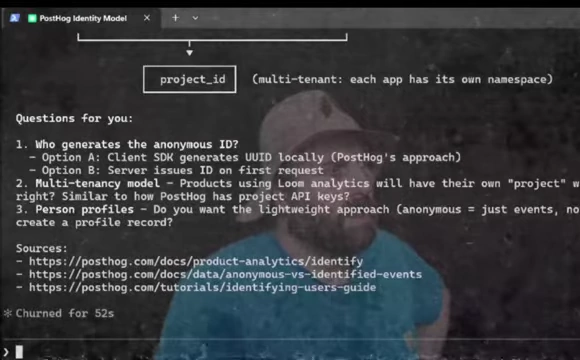
Discussion for Product Analytics Identity Model [ 00:19:07 ]
- The human's role is to apply engineering knowledge, steer the conversation, and ensure the LLM uses existing patterns (e.g., multi-tenancy already built into Loom).
Implementing with the Ralph Loop and Attended Execution [00:22:42]
After specification generation, the next step is to create an implementation plan and execute it using a "Ralph loop."
- Implementation Plan Generation:
- The LLM is instructed to generate an "Analytics System Implementation Plan" in markdown, outlining bullet points and citing specific sections of the spec and source code to be modified.
- This "strong linkage" helps the LLM accurately track and execute the plan.
- The plan breaks down the work into logical phases, e.g., core types, database schema, API handlers, SDKs, audit integration, authorization tests, and documentation.
Generated 12-Phase Implementation Plan for PostHog Integration [ 00:28:35 ]
- Executing the Ralph Loop (Attended Mode):
- A new terminal session is opened to execute the implementation loop, separate from the specification-generating session to avoid context rot.
- The prompt directs the LLM to "study" the
specs/readme.mdand theanalytics-implementation-plan.md, and "pick the most important thing to do." - Important instructions are given to the LLM:
- Use
loom-web-i18npatterns for TypeScript and Rust. - Author property-based tests or unit tests.
- Run tests after changes.
- Commit and push to deploy changes when tests pass.
- Update the implementation plan when a task is done (state checkpointing).
- Use
- The process is initially "attended" (human oversight):
- The human watches the LLM's output.
- If anything seems "weird," the human interrupts, adjusts the prompt, and restarts the loop.
- This allows for continuous refinement and ensures the LLM stays "on the rails."
- Autonomous Deployment:
- Loom handles automatic deployment, bypassing traditional CI/CD pipelines.
- It has
sudoaccess and uses NixOS for safe and introspectable bootstrapping. - If the AI generates suboptimal code (e.g., misses internationalization or security patterns), it's considered another "Ralph loop" to refactor and enforce conventions.
Conclusion: First Principles and Continuous Refinement [00:35:58]
The video concludes by reiterating the core message about the future of software engineering.
- The fundamental approach is to understand and apply first principles to AI-driven development.
- The "Ralph Wiggum loop" is essentially about "deterministically mallocing the array" (managing the context window efficiently) to enable intelligent and autonomous software creation.
- This iterative process of specification, implementation, and refinement, guided by human engineering judgment, is key to building complex systems with AI.