New summaries are now made in the free desktop app, which runs on your own computer and handles long YouTube videos and Twitch VODs.
Download TooLongLink Desktop
New Research Shows Vigorous Exercise is 4-9x More Effective Than Moderate Activity, Recommending Short Bursts for Significant Health Benefits
Summary:
- A new study utilizing wearable device data from the UK Biobank reveals that vigorous physical activity is 4 to 9 times more effective than moderate activity, significantly higher than the previously assumed 2x ratio.
- This implies that current exercise guidelines for moderate activity may need to be doubled or tripled to match the benefits of vigorous exercise.
- "VILPA" (Vigorous Intermittent Lifestyle Physical Activity), such as short bursts of stairs or carrying heavy items, offers substantial health benefits, even for non-exercisers.
- Just 3-5 daily 1-2 minute bouts of VILPA (around 6 minutes/day) can reduce all-cause and cancer mortality by 38-40%, and heart disease mortality by 48-49%.
- The largest health gains occur when transitioning from no activity to even a small amount of vigorous activity, emphasizing the power of "exercise snacks" for time-constrained individuals.
- For those with ample time, a combination of 1-2 vigorous workouts per week, along with up to 600 minutes of Zone 2 training (conversational pace), resistance, and power training, is recommended to maximize health outcomes.

Current exercise guidelines suggest 150-300 minutes of moderate or 75-150 minutes of vigorous activity per week. [ 00:00:10 ] 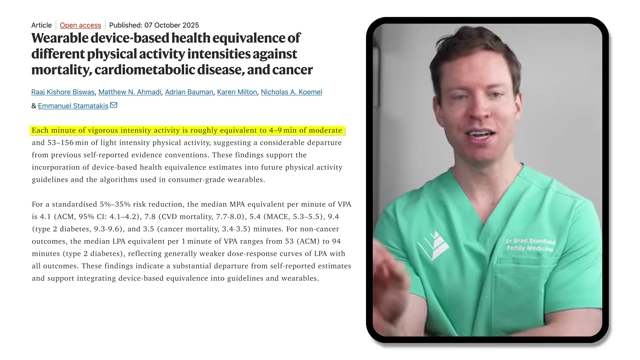
Research findings highlight that one minute of vigorous activity has 4-9 times the impact of moderate activity for various health outcomes. [ 00:01:40 ] 
The VILPA study found that even minimal vigorous intermittent lifestyle physical activity significantly reduces all-cause, cancer, and heart disease mortality risk. [ 00:05:42 ]
The New Exercise Study [00:00]
- Traditional exercise guidelines advise at least 150 minutes of moderate-intensity or 75 minutes of vigorous-intensity aerobic physical activity per week.
- This assumed vigorous exercise was roughly twice as effective as moderate exercise.
Current exercise guidelines suggest 150-300 minutes of moderate or 75-150 minutes of vigorous activity per week. [ 00:00:10 ]
- This assumed vigorous exercise was roughly twice as effective as moderate exercise.
- A new study, based on data from the UK Biobank and utilizing wearable device measurements, challenges this assumption.
- Previous studies relied on self-reported data, which is prone to bias.
- Wearable devices allowed for more accurate measurement of real activity levels.

Wearable devices enabled scientists to accurately measure real activity levels, revolutionizing exercise research. [ 00:04:08 ]
- Key finding: Vigorous physical activity was found to be 4 to 9 times more impactful than moderate activity, not just twice.
- The exact multiplier varied based on the health outcome:
- It was 4.1 times for all-cause mortality.
- It was 7.8 times for heart disease-related mortality.
- It was 9.4 times for type 2 diabetes risk.
Research findings highlight that one minute of vigorous activity has 4-9 times the impact of moderate activity for various health outcomes. [ 00:01:40 ]
- Light-intensity activity, like leisure walking, required a significantly greater volume to achieve similar benefits, for example, 94 minutes of light activity for the same benefit as 1 minute of vigorous activity for type 2 diabetes risk.
- The exact multiplier varied based on the health outcome:
- Implications: The old exercise guidelines suggesting 75 minutes of vigorous activity are equivalent to 150 minutes of moderate activity are likely incorrect.
- New data suggests at least 300 minutes of moderate activity might be needed to achieve the same benefits as vigorous physical activity for all-cause mortality.

A slide titled "The Old Exercise Guidelines Were Way Off", indicating that current recommendations underestimated the amount of moderate exercise needed. [ 00:02:47 ]
- New data suggests at least 300 minutes of moderate activity might be needed to achieve the same benefits as vigorous physical activity for all-cause mortality.
Patient Example: Simon (short on time) [02:57]
- For individuals with limited time, such as Simon, the focus should be on maximizing "bang for buck" by incorporating short bursts of vigorous activity.

Patient example Simon, who aims to maximize health benefits with minimal time through efficient exercise. [ 00:03:10 ] - Even short, high-intensity movements can deliver powerful health benefits.
The Concept of VILPA [04:11]
- Wearable technology has revolutionized tracking non-structured physical activity that people don't typically count as exercise.
- Examples include climbing stairs, carrying boxes, or jumping with kids.

Everyday activities like climbing stairs, carrying boxes, or jumping with kids are examples of "the exercise we never count". [ 00:03:42 ]
- Examples include climbing stairs, carrying boxes, or jumping with kids.
- Researchers coined the term "Vigorous Intermittent Lifestyle Physical Activity" (VILPA) to describe short bursts of vigorous activity performed in daily life.
- The study focused on non-exercisers from the UK Biobank cohort, people reporting no leisure-time exercise and no more than one recreational walk per week.
- Significant health benefits observed with minimal VILPA:
- The median VILPA engagement was approximately three bouts per day, lasting 1 to 2 minutes each, totaling about 6 minutes daily or 42 minutes per week.
- This minimal VILPA was associated with a 38-40% reduction in all-cause and cancer mortality risk.
- It also led to a 48-49% reduction in heart disease mortality risk.
- Even a minimum daily total of 3.4 to 4.1 minutes of VILPA showed a 22-28% average mortality risk drop.
The VILPA study found that even minimal vigorous intermittent lifestyle physical activity significantly reduces all-cause, cancer, and heart disease mortality risk. [ 00:05:42 ]
- Dose-response effect: The first small amounts of exercise yield the most significant health benefits, with gains tapering off as volume increases.
- Going from no VILPA to one bout a day drastically reduces mortality risk, while increases beyond 4-5 bouts a day show barely perceptible additional drops.
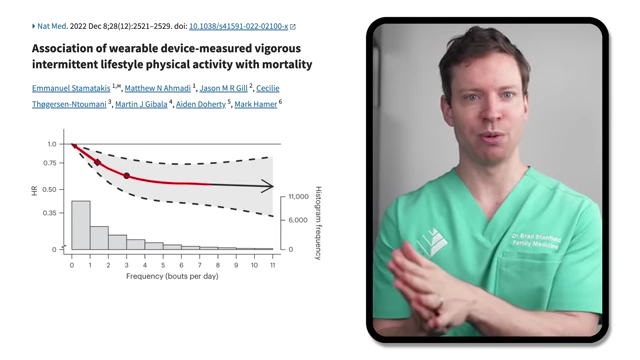
A dose-response graph showing a sharp initial drop in mortality risk with the first daily bouts of VILPA, with benefits tapering off with increased frequency. [ 00:06:24 ]
- Going from no VILPA to one bout a day drastically reduces mortality risk, while increases beyond 4-5 bouts a day show barely perceptible additional drops.
Exercise Snacks [06:43]
- "Exercise snacks" are practical applications of VILPA, easy to integrate into a busy schedule.
- Examples include:
- Taking the stairs instead of the elevator for 1-3 flights.
- Doing quick push-ups or wall squats during work breaks.
- Consistency in these 1-2 minute bouts, three to five times a day, can significantly transform health, reaping a large share of exercise benefits.

Practical "exercise snacks" like climbing stairs or doing quick push-ups can be integrated into busy schedules for significant health benefits. [ 00:06:55 ]
Patient Example: Henry (heaps of time) [07:43]
- For those with ample time for exercise, like Henry, the strategy shifts to building volume, variety, and recovery.

Patient example Henry, who has ample time to focus on building volume, variety, and recovery into his exercise routine. [ 00:07:44 ] - While vigorous activity is highly effective, it's advised not to exceed two high-intensity workouts per week to prevent overtraining and injury.
Zone 2 Training [08:04]
- Zone 2 training involves working out at an intensity where one can still comfortably hold a conversation.
- A long-term cohort study found health impacts from up to 600 minutes of moderate activity per week.
- For individuals with significant time, incorporating ample Zone 2 training, in addition to resistance and power training, is recommended to maximize overall fitness and health.
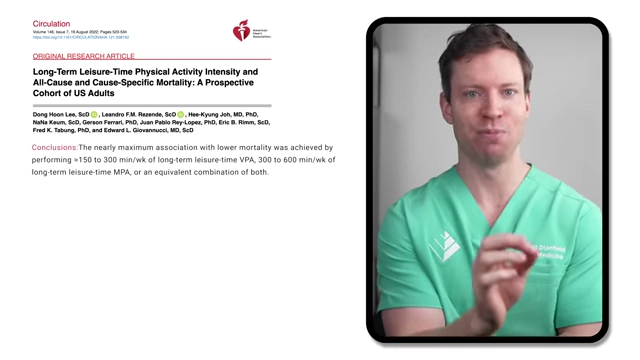
A research paper highlighting that maximum association with lower mortality was achieved with 300-600 minutes of long-term moderate leisure-time activity per week. [ 00:08:12 ]
Conclusion [08:32]
- Small efforts in exercise, especially vigorous ones, can lead to big results for overall health.
- Everyone can benefit from incorporating exercise snacks into their daily routine, regardless of how busy they are.
- For those with more time, a balanced approach including vigorous, Zone 2, resistance, and power training offers comprehensive health benefits.

A concluding slide emphasizing that even small efforts in high-intensity movement can deliver powerful health benefits for everyone. [ 00:08:31 ]