Advanced Salary Negotiation Strategies for Software Engineers: Information Control, Pitfall Avoidance, and Crafting a Winning Plan
This video offers advanced negotiation strategies for software engineers to maximize compensation. It begins by reinforcing basic negotiation principles, such as always negotiating, never stating a number first, and proactively managing offer timelines. Key takeaways include:
- Employing four heuristics: sharing information only if it helps, leveraging what you don't say, knowing compensation bands (or using 10-20% benchmarks), and establishing a personal "buy-it-now" price.
- Avoiding common mistakes like lacking a higher-level strategy, being uncreative, or losing leverage prematurely.
- Using "creative first pushes" without specific numbers to prompt higher offers.
- "Expanding the pie" by reallocating unused benefits (e.g., health insurance) to desired compensation components.
- Practicing "tactical empathy" by addressing the recruiter's fear of loss and using an "accusation audit" to disarm negative assumptions.
- Opting for odd numbers and ranges in counter-offers to appear more researched, and keeping emails concise.
- Knowing specific language for responding to initial offers (e.g., "It's lower than I was expecting") and handling "non-negotiable" claims by escalating to the hiring manager.
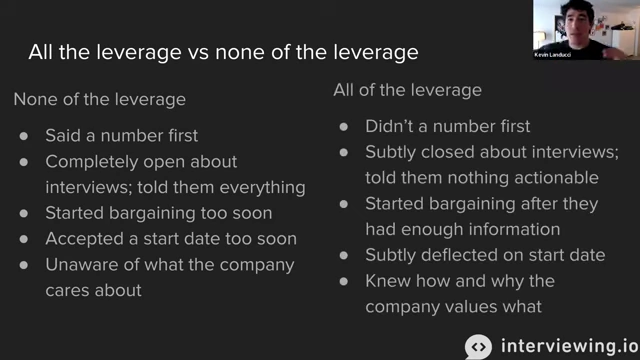
A comparison of having all the negotiation leverage versus none of it [ 00:28:58 ]
Introduction to Negotiation [0:00]
The presenter, Kevin Landucci, a developer advocate and negotiation expert at interviewing.io, shares insights based on coaching over 500 software engineers, training with former FBI hostage negotiator Chris Voss, and his experience at Triplebyte. The session focuses on advanced negotiation topics, with a Q&A segment at the end.
Refresher: Negotiation Fundamentals [0:00:51]
The video quickly reviews core principles from a previous "Negotiation 101" workshop:
- Always negotiate: It's a skill that pays dividends, potentially hundreds of thousands of dollars over a career. The worst outcome is typically a "no."
- Do not name a number first: Companies may be willing to offer significantly more than you would initially ask for.
- Aim for multiple offers: While not strictly necessary (many successful negotiations happen with one offer), having multiple offers can lead to higher compensation increases.
- Offers are rarely pulled for negotiating: Offers are usually rescinded due to egregious behavior or perceived risk, not simply for negotiating. Companies invest significant resources (e.g., $30,000) in candidates by the offer stage, making them highly invested in you accepting.
- Proactively control the timeline: Set clear expectations for when you will finish interviews, collect offers, and make a decision to avoid "exploding offers" (offers with tight deadlines). If an exploding offer is given, politely request an extension.
- Do not share details about other interviews: Until it's time to bargain with a specific offer, keep details vague to avoid giving recruiters leverage. Disclosing early can lead to lowball offers or tight deadlines if other opportunities fall through.
- Worst-case scenario for exploding offers: If a company issues an exploding offer and refuses to extend the deadline, it is acceptable to sign the offer to buy time, and then renege if a better opportunity arises later. There are generally no legal consequences for large companies.

List of negotiation principles covered in the previous workshop [ 00:02:00 ]
Defining Negotiation and Bargaining [0:10:12]
The video clarifies the distinction between negotiation and bargaining:
- Negotiation: A broader term referring to any exchange where time is a dynamic factor, and you can potentially gain more value through your actions, even without explicit haggling (e.g., a barista giving you a free shot of espresso due to your consistent pleasant demeanor).
- Bargaining: A subset of negotiation specifically referring to the back-and-forth process of discussing and adjusting price or specific compensation components after an initial offer has been made and discovery (information gathering) has occurred.
Four Heuristics for Advanced Negotiation [0:12:45]
Advanced negotiation relies on making good decisions with new information. Here are four key rules of thumb:
Heuristic #1: Strategic Information Sharing [0:12:51]
- If it doesn't help, don't share it: This applies to interview details, your first desired number, and specific components of competing offers.
- Frame the data strategically: If you have two offers, one with a higher salary and another with higher total compensation (including non-salary benefits), selectively highlight the advantageous component to each company. For example, if a startup (Company Red) has lower salary but higher total comp than a public company (Company Blue), you would use Company Red's total comp to negotiate with Company Blue, and Company Blue's salary to negotiate with Company Red, without necessarily revealing all details about the other company (e.g., not mentioning it's a private startup to a public company if that would scare them off).
- Withholding specific offer letters: If a company (like Google) demands to see another offer letter, you can state the total compensation figure without providing the document, saying, "Here's my offer, it's for $470,000 total comp, and that's what I'm comfortable sharing."
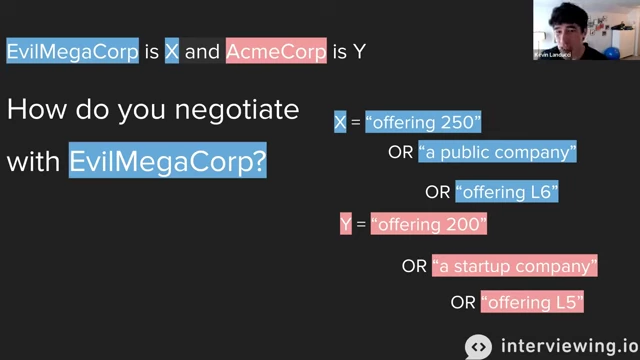
Diagram illustrating how to selectively share information from two different offers (EvilMegaCorp and AcmeCorp) to gain leverage [ 00:14:09 ]
Heuristic #2: The Power of What You Don't Say [0:16:31]
Often, negotiation is more about what you don't say than what you do.
- Deflecting recruiter questions: When recruiters ask, "How do you feel about the offer?" or "Does a start date of X work?", avoid committing or revealing too much. Your lack of a firm answer maintains your leverage.
- Creative first push without numbers: A highly effective tactic is to get the company to increase their offer without you ever stating a specific number. This allows them to "bid against themselves."

Three scenarios illustrating the power of unsaid information in negotiation [ 00:17:39 ]
Heuristic #3: Know the Maximum or Use Benchmarks [0:18:01]
- Find out the compensation bands (the "max"): If possible, discreetly learn the company's compensation ranges for your level. This gives you an "answer key" for negotiation.
- Follow "old faithful" advice if bands are unknown:
- Most counter-offers aim for 10-20% higher than the initial offer.
- Typical signing bonuses are around 20% of the base salary.
- It's standard to ask for 1.5-2X the equity offered.
- Don't be afraid to ask for more: If you don't know the exact maximum, asking for 20% more for salary, and double the equity/signing bonus, is a reasonable starting point.

List of "old faithful" negotiation benchmarks for counter-offers, signing bonuses, and equity [ 00:18:29 ]
Heuristic #4: Always Know Your "Buy-It-Now" Price [0:19:22]
- Never be surprised by "What would it take for you to sign today?": Recruiters or hiring managers may ask this at any point. Always have a mental answer ready.
- Your response should be known to you, but not necessarily shared: You don't have to state this price immediately, especially if you're not ready to commit. However, knowing your "exit price" empowers you.
- The "buy-it-now" price is dynamic: It can (and should) change as you gather more information and progress through the job search.

Heuristic #4: Always know your 'buy-it-now' price [ 00:19:29 ]
Common Negotiation Mistakes and Tips [0:20:31]
Many candidates undermine their negotiation efforts through common missteps.
Designing a Higher-Level Strategy [0:22:28]
- Avoid "swinging for the fences" immediately: Instead of making one aggressive demand, plan multiple "pushes" (like batting for singles in baseball) to incrementally increase your compensation.
- Simple three-push strategy:
- Creative first push (no numbers): Get them to move the offer up without you giving a specific figure.
- Second push (specific number): State a desired range (e.g., "I would really like to see an offer closer to blank").
- Third push ("buy-it-now" price): If they meet your price, commit: "If you can do blank, I'll sign today."
- It's your job to be "pushy": Many hiring managers expect candidates to negotiate at the offer stage.
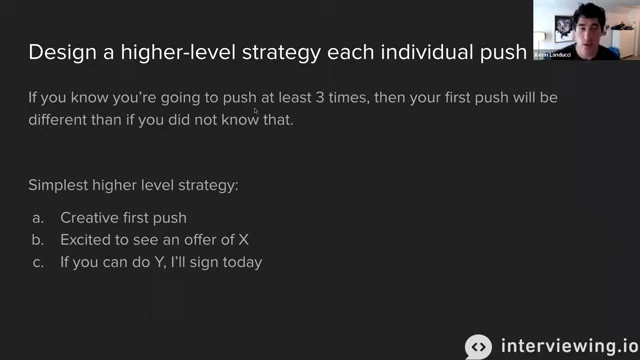
Suggested three-push strategy for negotiation [ 00:23:29 ]
Creative First Push (No Numbers) [0:25:08]
- Power of implication: Instead of asking, "Can you up the salary to 200K?", ask, "Would it be impossible to meaningfully increase the [component, e.g., base, total comp, equity]?" This prompts them to increase without revealing your target.
- Combine with data points: You can introduce external data (e.g., "I have another offer of blank," or "Engineers like me make blank online") before asking the "impossible" question.

Comparison of "bad" and "good" ways to ask for a first push, highlighting the power of implication [ 00:25:19 ]
Expanding the Pie of Benefits [0:26:30]
- Identify unused benefits: Companies offer many benefits that cost them money, but you might not value (e.g., health insurance if your spouse's plan is better).
- Reallocate funds: Ask if the funds allocated for a benefit you don't need can be diverted to a component you do want (e.g., salary or a signing bonus). This expands the total value without costing the company new money, only reallocating existing budget.

Illustration of how to expand the negotiation "pie" by reallocating benefits you don't need [ 00:26:39 ]
Leverage: How to Gain and Lose It [0:28:27]
- None of the leverage (avoid): Occurs when you name a number first, reveal all interview details, start bargaining too early, accept a start date before agreeing on compensation, or are unaware of what the company values.
- All the leverage (aim for): Achieved by not naming a number first, being subtly vague about other interviews, bargaining only after sufficient information gathering, deflecting early start date discussions, and understanding what and why the company values your skills.
A comparison of having all the negotiation leverage versus none of it [ 00:28:58 ]
Tactical Empathy: Deactivating Fear [0:30:17]
- Your counterpart is scared: Recruiters and hiring managers fear losing a good candidate. Unaddressed fear can sabotage negotiations.
- Deactivate their fear: Use language that shows empathy. Replace "I" with "you," "we," and "let's."
- Accusation Audit: Preemptively state the worst negative thought they might have about you, with sympathy. For example, if an offer is non-negotiable, say, "You probably think I'm being greedy/difficult/unreasonable because you said this isn't negotiable." This diffuses the negative and builds trust. The "accused" person has nothing left to say.
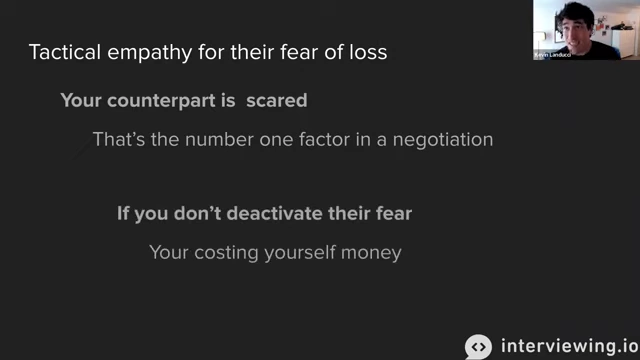
Slide defining tactical empathy for their fear of loss [ 00:30:48 ] 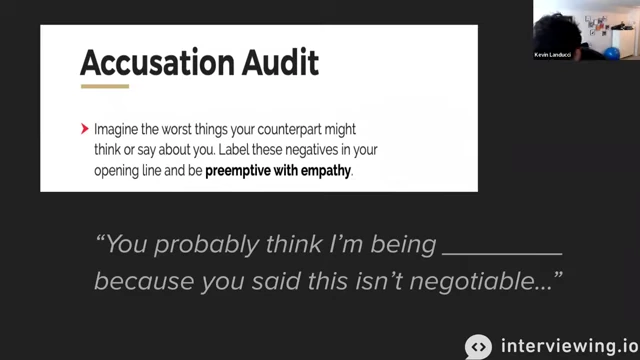
Example of using an accusation audit to preemptively address negative perceptions [ 00:37:28 ]
Unsolicited vs. Solicited Rationale [0:31:26]
- Avoid over-explaining your worth: Don't provide lengthy justifications for your desired salary (e.g., "I'm asking for 250K because I've been writing stuff for 10 years...").
- State your target confidently: Act as if you have many options. Simply say, "For _____, I'm targeting 250K." Your confidence implies strong market value.
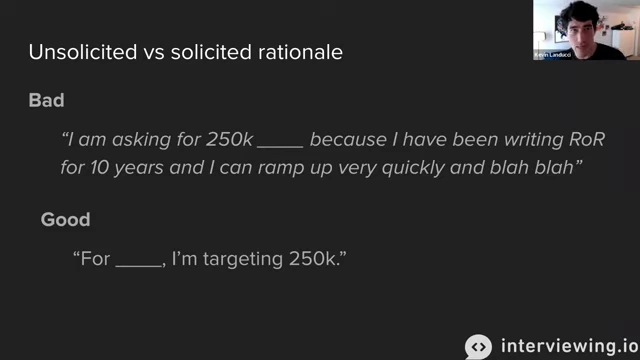
Examples of "bad" (unsolicited rationale) and "good" (confident statement) ways to communicate salary targets [ 00:31:58 ]
Using Odd Numbers and Ranges [0:32:20]
- Avoid round numbers: Asking for "$250K" encourages the company to split the difference, giving you less.
- Use odd, specific numbers and ranges: Asking for, say, "$253,475 - $259,999" makes your request seem thoroughly researched and less arbitrary, increasing the likelihood of a higher offer, even if they split the difference within the range. Amazon is known for using odd numbers in their offers.
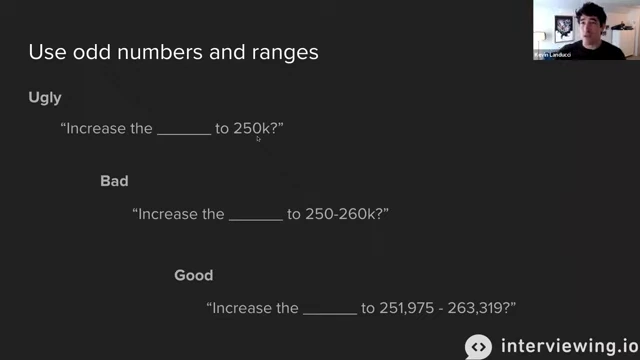
Examples of "ugly," "bad," and "good" ways to ask for a salary increase using round vs. odd numbers and ranges [ 00:32:28 ]
Length of Counter-Offer Emails [0:33:51]
- Keep it concise: Aim for counter-offer emails between 150-200 words. Long emails can be overwhelming and less effective.
Optimal Timing for Communication [0:34:05]
- Send emails during business hours: Avoid sending important negotiation emails in the evening or late at night. Research suggests people are more agreeable when rested and fed. Schedule emails to hit their inbox the next morning.

Bad versus good timing for sending important emails during negotiations [ 00:34:38 ]
Specific Negotiation Scenarios [0:34:57]
Responding to an Offer [0:35:06]
- Initial response: After hearing the offer, build up the non-monetary aspects of the opportunity (team, tech, product, culture) for 95% of the call.
- The crucial line: Then, when they ask what you think, say, "It's lower than I was expecting," or "It's lower than I was expecting, but it's in the ballpark of a good starting point." This can prompt the company to increase the offer without you even having to make a counter-offer.
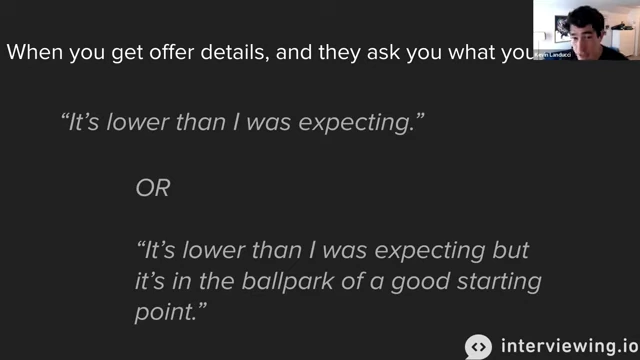
Recommended phrases to use when a recruiter asks for your thoughts on an initial offer [ 00:35:18 ]
Handling "Not Negotiable" Claims (Pre-Negotiation) [0:36:39]
- Use the Accusation Audit: If a company states the offer is "not negotiable" upfront (a new trend, possibly copied from Amazon), preemptively address their potential negative thoughts.
- Example phrase: "You probably think I'm being [greedy/difficult/unreasonable] because you said this isn't negotiable." This disarms them and creates an opening.
Example phrase for an Accusation Audit when an offer is stated as non-negotiable [ 00:37:28 ]
Handling "Not Negotiable" Claims (Post-Negotiation) [0:39:57]
- Bands are guidelines, not laws: Understand that compensation bands are flexible. Recruiters often claim it's hard to get an "exception" to go above band, but it's a simple 5-minute process for them. The difficulty is convincing them to do it.
- Escalate to the hiring manager: If a recruiter says an offer is "not moveable" after you've already started negotiating, you might be talking to the wrong person. Directly ask the hiring manager, "Hey Hiring Manager, do you ever talk to candidates about money?" If they say yes, negotiate directly with them.
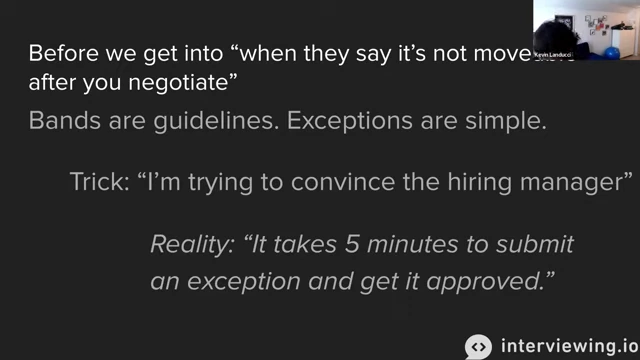
Fact check on recruiter's claim that exceeding salary bands is difficult [ 00:40:48 ]
Q&A Highlights [0:42:58]
- Likelihood of offer rescission: Extremely low (e.g., 0.001%) for negotiating, unless behavior is egregious.
- Recruiter insists on first number: Do not walk away. Hold your position by deflecting (e.g., "I trust you'll make a competitive offer") and eventually state your target.
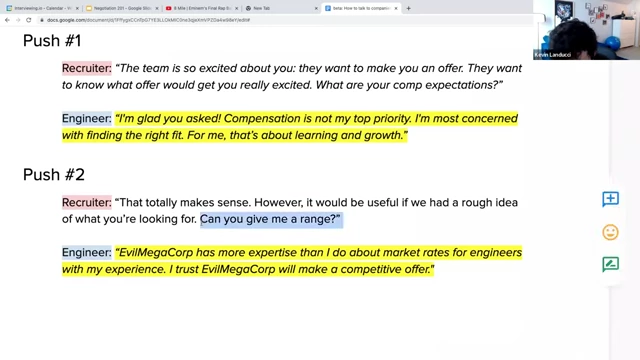
Example dialogue for deflecting recruiter's questions about salary expectations [ 00:47:47 ] - Market conditions (layoffs, freezes): Negotiations are not different for senior engineers, who are still in high demand. Macroeconomic factors don't change core negotiation principles for high-value talent.
- Negotiating with only one offer: Yes, you can. Leverage your BATNA (Best Alternative To a Negotiated Agreement), such as going to grad school, or using online salary data as a "data point" to justify your request, even without another job offer.
- Offer lower than current salary: Express disappointment: "To be frank, this offer is a bit disappointing; it's lower than I was expecting."
- Exploding offers: Often a bluff, especially from large companies. Proactively setting your decision timeline at the onsite interview is the best defense. If unavoidable, use reneging as a last resort.
- Negotiating vacation/personal time: Yes, this is negotiable and should be part of your "discovery" phase to expand the pie.
- Early-stage company negotiation: Be strategic with framing counter-offers. If you have an offer from a large company, avoid naming it directly to an early-stage company (e.g., "a tech company" instead of "Google") to avoid scaring them off. Focus on specific components like salary rather than total comp.
- Demonstrating value: Provide metrics and impact from your past work to justify higher compensation.
- Recruiter bluffing: A tight deadline is almost always a bluff, especially from large companies, unless there's limited headcount at smaller companies.