Declining Belief in the American Dream: An Analysis of Wall Street Journal Poll Findings and Economic Factors
A recent Wall Street Journal poll reveals a record-high disbelief in the American Dream, with nearly 70% of Americans no longer believing hard work guarantees success. This widespread pessimism spans across political affiliations, age groups, education levels, and income brackets. The "American Dream" is perceived differently based on income, with lower earners seeking stability and higher earners pursuing opportunity; both groups are now losing faith in their respective definitions. A key factor is the significant generational decline in the likelihood of earning more than one's parents. This shift also reflects a diminishing belief in progress and American exceptionalism, fueled by rising costs of living, inflation, a challenging job market, and housing unaffordability. Moreover, a generation has experienced successive crises (2008 financial crisis, COVID-19, AI's impact on jobs) without sufficient recovery time, contributing to a pervasive sense that things will get rougher before they get better, a sentiment echoed in other wealthy Western nations.

The Fading American Dream: Record Disbelief [00:00:00]
A recent poll released by the Wall Street Journal indicates a significant decline in the belief in the American Dream among the general American public.
- Record High Disillusionment [00:00:24]
- Nearly 70% of respondents believe the American Dream – the idea that hard work leads to success – no longer holds true or never did.

Nearly 70% of Americans believe the American Dream no longer holds true or never did. [ 00:00:37 ] - This represents the highest level of disbelief recorded in 15 years of surveys.
- The comedian George Carlin's joke, "It's called the American dream 'cuz you have to be asleep to believe it," is cited, suggesting many have "woken up."
- Nearly 70% of respondents believe the American Dream – the idea that hard work leads to success – no longer holds true or never did.
Widespread Pessimism Across Demographics [00:00:41]
The survey highlights a broad discontent that transcends traditional demographic and political lines, indicating a systemic issue rather than a partisan one.
Political Divide and Beyond [00:00:48]
- 90% of Democratic voters hold a negative view of future prospects for themselves and their children, while 55% of Republican voters share this negative outlook.

Political split on negative views of future prospects for themselves and their children. [ 00:00:58 ] - This pessimism extends across various groups:
- Both women and men.
- Younger and older adults.
- Individuals with and without a college degree.
- Respondents with household incomes above and below $100,000.
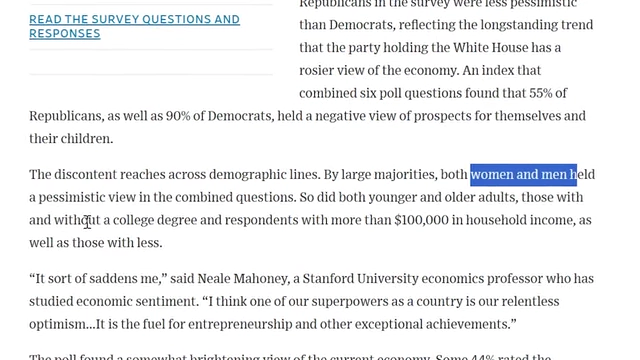
Pessimism regarding the American Dream is widespread across all demographic lines. [ 00:01:24 ]
- More than three-quarters of Americans lack confidence that the next generation will have a better life than their own.
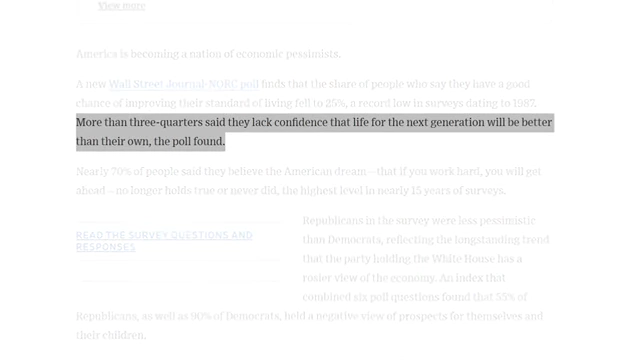
More than three-quarters of Americans lack confidence that life for the next generation will be better than their own. [ 00:01:54 ]
- 90% of Democratic voters hold a negative view of future prospects for themselves and their children, while 55% of Republican voters share this negative outlook.
Economic Sentiment and Political Affiliation [00:01:00]
- Historically, public opinion on the economy often aligns with the political party in power, leading to aggressive shifts around election times.
- The current discontent, however, signals a deeper, non-partisan issue.
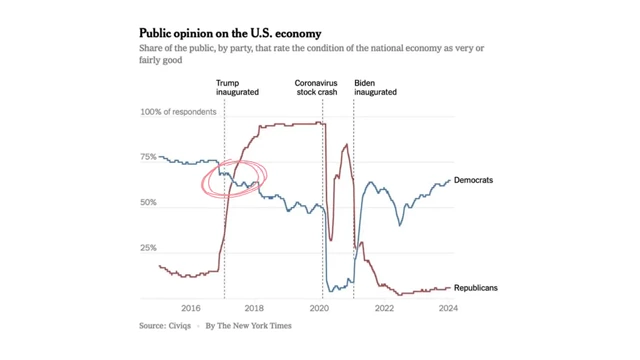
Public opinion on the U.S. economy, showing how sentiment shifts based on the party in power. [ 00:01:10 ]
The Declining Odds of Upward Mobility [00:01:59]
A key driver of this pessimism is the diminishing likelihood for individuals to surpass their parents' economic status.
- Generational Income Trends [00:02:03]
- In 1940, there was almost a 90% chance of earning more than one's parents.
- By the 1950s, this ranged from 75-90%.
- Even in the 1960s, it was still above a 50% chance.
- The odds significantly worsened by 1980, and are projected to be even lower for later generations.
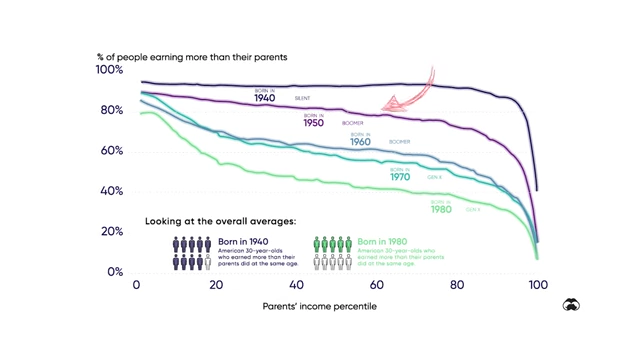
Graph showing the declining percentage of people earning more than their parents across different birth cohorts, from 1940 to 1980. [ 00:02:16 ]
Redefining and Losing Faith in the American Dream [00:02:47]
The meaning of the American Dream varies by income, but both interpretations are seeing a collapse in belief.
Two Core Definitions [00:02:56]
- Stability: For lower-income earners (e.g., less than $50,000 household income), the dream means confidently covering bills, saving for retirement and children, and providing for basic family needs.
- Opportunity: For higher-income earners (e.g., $250,000 and over), the dream represents the ability to strive for more and achieve greater success.
- The data shows that the perception of the American Dream as "stability" decreases as income rises, while "opportunity" increases.
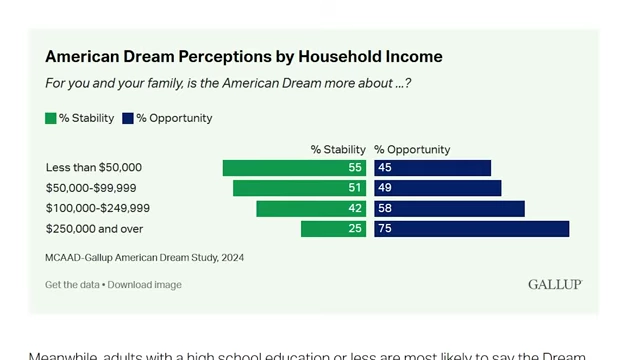
Bar chart illustrating American Dream perceptions by household income, showing the differing emphasis on "stability" versus "opportunity." [ 00:03:05 ]
Loss of Belief in Both Aspects [00:03:28]
- People across all income brackets are losing faith, indicating a crisis in both the prospect of stability and upward opportunity.
- Individuals who have their basic needs met no longer believe they can reach the next level.
- Those struggling to meet basic needs fear they won't even achieve essential provision for their families.
Testimonials Reinforcing Disillusionment [00:03:50]
- Bill Sanchez, criminal defense attorney ($72,000/year) [00:03:57]: Believes there are "limits to what hard work can actually bring people these days."
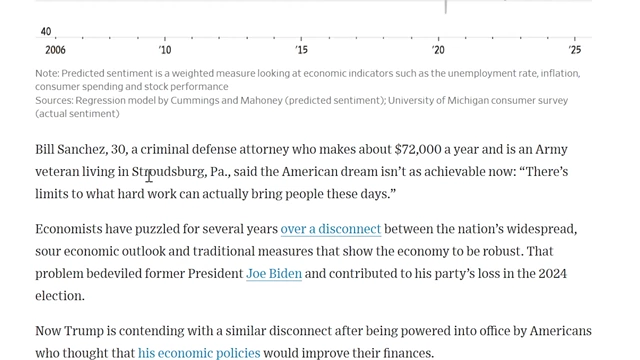
Criminal defense attorney Bill Sanchez states there are "limits to what hard work can actually bring people these days." [ 00:04:05 ] - Christopher Kishel (earns $350,000/year with wife) [00:04:21]: Despite high income, they cannot afford a larger home to expand their family due to housing unaffordability.
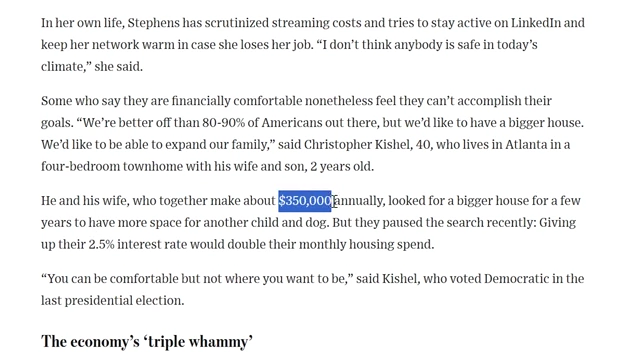
Christopher Kishel, earning $350,000 annually with his wife, highlights their inability to afford a larger home for their family due to housing costs. [ 00:04:25 ] - Housing unaffordability is a widespread issue, with 5 of the 10 most 'impossibly unaffordable' housing markets in the world being in the U.S.
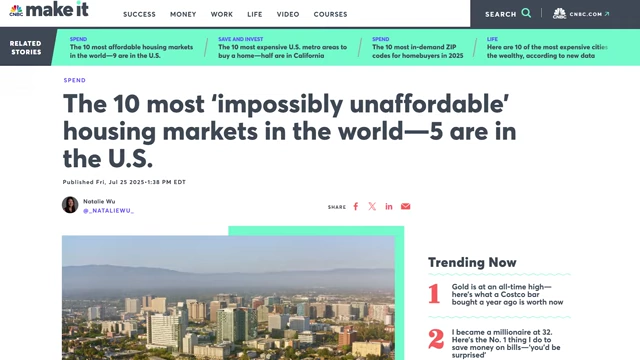
The 10 most 'impossibly unaffordable' housing markets in the world—5 are in the U.S. [ 00:04:31 ] - The inability to afford larger homes contributes to a falling birth rate, which raises the prospect of a sharp decline in living standards.
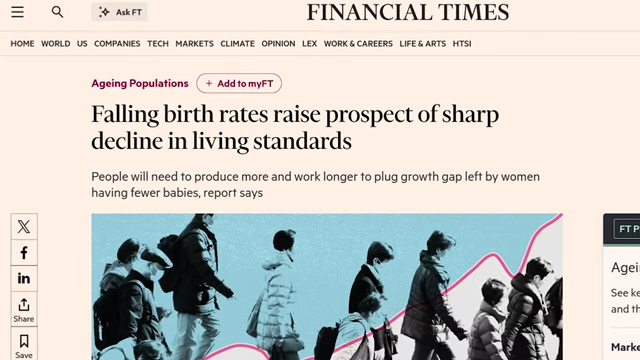
Falling birth rates raise prospect of sharp decline in living standards. [ 00:04:46 ]
- Bill Sanchez, criminal defense attorney ($72,000/year) [00:03:57]: Believes there are "limits to what hard work can actually bring people these days."
Erosion of American Exceptionalism [00:06:06]
The long-held belief in America's unique economic and social advantages is diminishing.
Decline in Global Economic Confidence [00:06:44]
- Only 17% of survey respondents believe the U.S. economy is superior to all others globally.
- Nearly 40% (a 15-point rise from 2021) believe other nations have better economies.
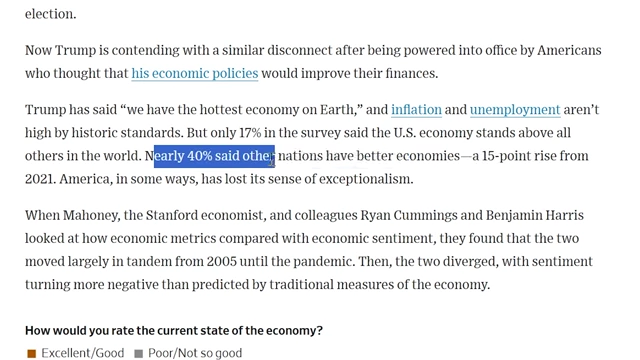
Nearly 40% of Americans believe other nations have better economies, a 15-point rise from 2021. [ 00:06:54 ] - This reflects a loss of the sense of "American exceptionalism," the idea that the U.S. is distinctive, unique, or exemplary.
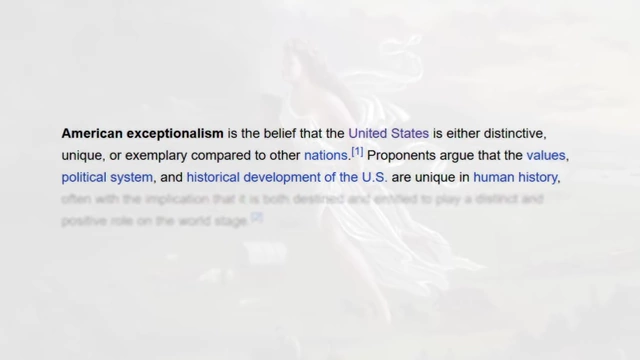
Definition of American exceptionalism, explaining it as the belief that the U.S. is distinctive, unique, or exemplary. [ 00:06:27 ]
Disconnect Between Numbers and Lived Experience [00:06:57]
- While the U.S. still boasts the largest economy, this fact is not translating into improved daily lives for many citizens.
- People are realizing that other countries offer better provisions for their citizens in many aspects.
Key Factors Contributing to Disbelief [00:07:27]
Several tangible economic and social issues are cited as reasons for the decline in faith.
Economic Hardships [00:07:28]
- Cost of living and inflation: This is the most acutely felt issue in daily life, as average people spend most of their income and notice price increases directly.
- Many Americans cannot afford a $1,000 emergency expense.
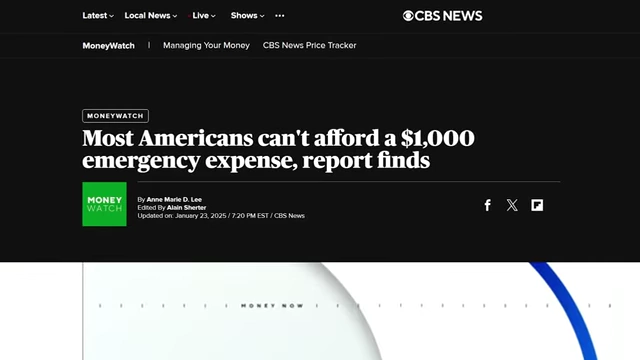
Most Americans can't afford a $1,000 emergency expense, report finds. [ 00:07:37 ] - Job market fears: Concerns about the future of employment and job security.
- Housing unaffordability: Rising rents and home prices make it difficult to secure stable housing or expand families.
- Christina Stephens, a tech worker, notes, "Rents are sky-high; inflation is killing us," and many "kids are having to go back home."
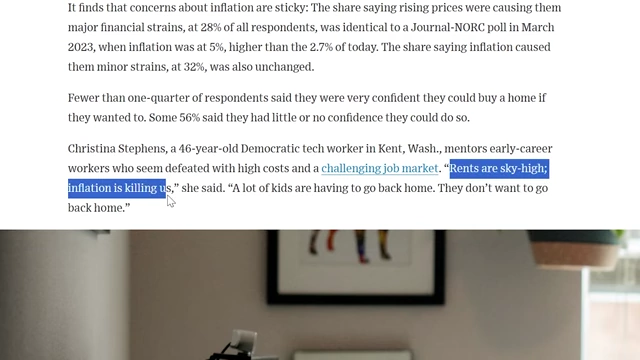
Christina Stephens comments on high rents and inflation affecting people's ability to live independently. [ 00:08:03 ] - She also expresses, "I don't think anybody is safe in today's climate," referring to job security.
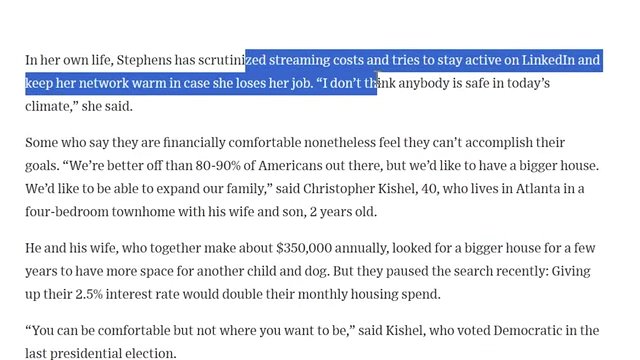
Christina Stephens expresses concerns about job security, stating, "I don't think anybody is safe in today's climate." [ 00:08:14 ] - Personal Financial Challenges [00:10:13]
- Many lack confidence in being able to retire, keep up with expenses, pay unexpected medical bills, buy homes or cars, or take vacations.

Table showing Americans' confidence in various financial aspects, such as retirement, expenses, and buying a home. [ 00:10:14 ]
- Many lack confidence in being able to retire, keep up with expenses, pay unexpected medical bills, buy homes or cars, or take vacations.
Generational Crises [00:09:06]
- A generation born around 1990 has faced a series of continuous crises:
- Entering adulthood during the 2008 financial crisis.
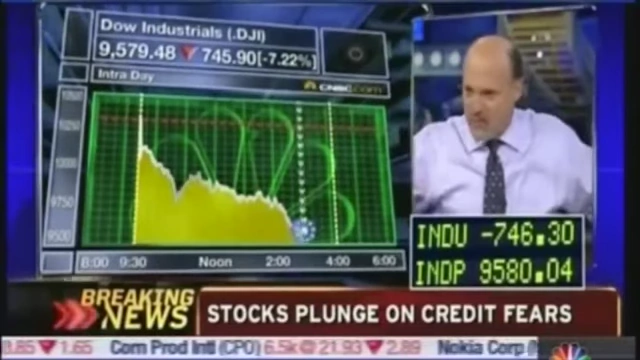
News footage showing a stock market plunge during the 2008 financial crisis. [ 00:09:15 ] - Reaching their 30s during the COVID-19 pandemic.

News footage reporting "Three New Cases of Coronavirus in U.S." during the COVID-19 pandemic. [ 00:09:20 ] - Entering the prime of their careers amidst the growing impact of AI on jobs.
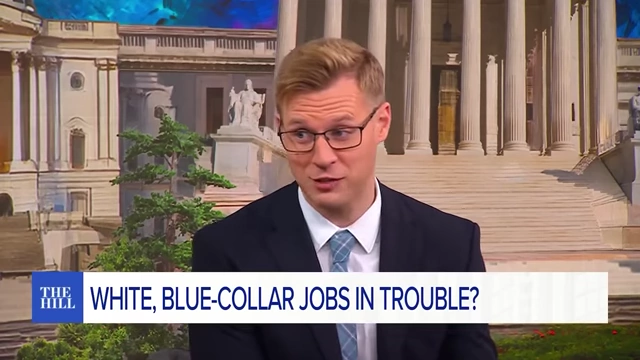
News segment discussing "White, Blue-Collar Jobs in Trouble?" due to AI. [ 00:09:26 ]
- Entering adulthood during the 2008 financial crisis.
- This succession of crises has left many without enough time to regain their footing and feel optimistic about the future.
- A generation born around 1990 has faced a series of continuous crises:
Perception of Progress [00:05:31]
- Before the pandemic, a significant majority believed they had a good chance of improving their standard of living.
- Post-pandemic, this belief has plummeted, with only about a quarter of the population holding this view.

Graph showing the percentage of people who agree they have a good chance of improving their standard of living, with a sharp decline post-2020. [ 00:05:39 ] - The most popular response regarding the American Dream is that "it once held true but not anymore," indicating a perceived loss of a formerly feasible future.
Bar chart showing how Americans view the "American Dream" in 2025, with "It once held true but not anymore" as the most common response. [ 00:08:39 ]
Global Context and Broader Implications [00:09:39]
This trend of declining optimism is not unique to the U.S. and highlights a larger crisis of faith in progress.
- International Parallels [00:09:40]
- Similar data and sentiments can be found in most wealthy Western countries, such as the UK, which has experienced austerity and declining public services.
- Distrust in Institutions and Future [00:10:01]
- People express distrust in wage growth, the ability of leaders to solve economic problems, and the equitable distribution of economic growth.
- Concerns also exist about AI damaging job prospects and earning potential.
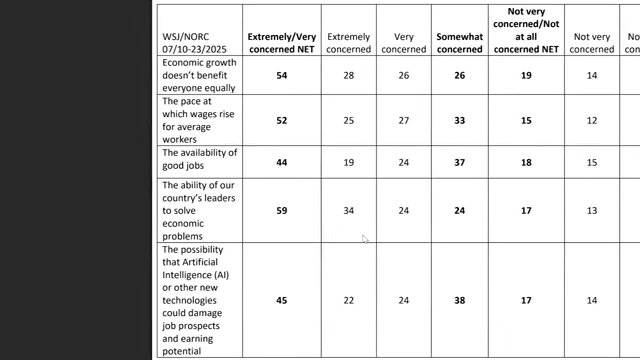
Table showing public concern levels across various economic and social issues, including economic growth, wages, job availability, leaders' ability to solve problems, and AI impact. [ 00:10:07 ] - This overall sentiment points to a widespread loss of belief in the idea of progress itself.