Japan's Deep Economic Troubles: An Analysis of Population Decline, Debt, and Inflation
This video analyzes Japan's current economic struggles, highlighting several key issues:
- Japan's Prime Minister resigned due to economic challenges, public discontent, and political pressure, marking the fourth leader in five years.

News headline on Japan PM's resignation [ 00:00:08 ] - Japan faces a rapidly declining and aging population, with birth rates significantly below replacement levels and minimal immigration, leading to a shrinking workforce and increased social security burdens.

Japan Population Trend (1950-2025) [ 00:02:00 ] - GDP growth is stagnant, consistently below 2% for years, placing Japan near the bottom of G20 economies.

Japan Full Year GDP Growth [ 00:05:00 ] - Japan is a net importer, especially for energy, resulting in a persistent trade deficit, which contributes to high debt levels.

Japan Balance of Trade [ 00:07:40 ] - Inflation has returned, with food prices rising disproportionately, causing public dissatisfaction.

Japan Food Inflation [ 00:10:29 ] - Japan has the world's second-highest net debt-to-GDP ratio (237%), with 85% held domestically, and rising bond yields mean increasing debt servicing costs.

Japan Government Net Debt-to-GDP Ratio (2015-2025) [ 00:11:39 ]
Prime Minister Resignation [0:32]
The recent resignation of Japan's Prime Minister is a symptom of deeper economic issues, making him the fourth leader in five years.
- Reasons for Resignation [0:36]
- Electoral defeats: The government lost control of both the upper and lower houses of parliament, making it difficult to pass legislation.
- Internal party pressure: Calls for new leadership emerged from within the ruling party.
- Economic challenges and public discontent: The struggling economy and rising cost of living fueled widespread public dissatisfaction.
- Impending no-confidence vote: The PM likely resigned to avoid losing a no-confidence vote.
- Preventing party split: The resignation was also an attempt to maintain party unity amid growing divisions.
- Japan's Economic Standing [0:19]
- Japan is the world's fourth-largest economy, behind the USA, China, and Germany, making its economic struggles significant globally.
Population Issues [1:53]
Japan is experiencing a severe population crisis marked by decline and aging, posing long-term economic challenges.
- Declining Population [1:53]
- Population peaked around 2010 and has been declining, currently at 123 million, with forecasts predicting a rapid continued decline over the next 50 years.
Japan Population Trend (1950-2025) [ 00:02:00 ] - The birth rate is significantly below the 2.1 rate needed for a stable population.
- Population peaked around 2010 and has been declining, currently at 123 million, with forecasts predicting a rapid continued decline over the next 50 years.
- Aging Population [2:21]
- Japan has a classic aging population, where older age categories are larger than younger ones.
![Japan Population Pyramid [<a href="https://youtube.com/watch?v=5RWUAJ5z29k&t=2025">2025</a>]](https://storage.googleapis.com/summarizer-images/images/5RWUAJ5z29k/sb0015_t00.02.30.webp)
Japan Population Pyramid [<a href="https://youtube.com/watch?v=5RWUAJ5z29k&t=2025">2025</a>] [ 00:02:30 ] - The largest age group is 50-54, and there is a tapering down of younger age categories, indicating fewer young people to replace the retiring workforce.
- Japan has a classic aging population, where older age categories are larger than younger ones.
- Limited Immigration [4:05]
- Unlike countries such as the USA, Japan has low levels of immigration, which typically helps supplement low birth rates and maintain a younger workforce.
- Economic Impact [4:23]
- An aging and declining population leads to a shrinking workforce, reduced productivity, and increased strain on social security and healthcare systems as more people retire and require care.
Gross Domestic Product (GDP) [4:54]
Japan's GDP growth is low, reflecting underlying economic stagnation and low productivity.
- Low GDP Growth [5:00]
- Comparison with G20 Economies [5:50]
- Japan's GDP growth rate of 0.1% places it near the bottom of the G20 countries.

Full Year GDP Growth by Country (G20) [ 00:05:50 ] - For example, India's growth was 6.5%, the United States was 2.8%, and the United Kingdom was 1.1%.
- Only Germany (-0.2%) and Argentina (-1.7%) performed worse.
- Japan's GDP growth rate of 0.1% places it near the bottom of the G20 countries.
Balance of Trade [7:37]
Japan consistently runs a trade deficit, spending more on imports than it earns from exports.
- Net Importer Status [7:33]
- Japan is a net importer, largely due to its lack of sufficient domestic energy resources.
Japan Balance of Trade [ 00:07:40 ] - Over the last 12 months, the balance of trade has been negative in most months, with a particularly large deficit of -2.8 trillion Japanese yen in January 2025.
- Japan is a net importer, largely due to its lack of sufficient domestic energy resources.
- Import Breakdown [8:39]
- Mineral fuels (including oil) account for approximately 23% of all imports.

Japan Import Categories (FY2025) [ 00:08:40 ] - Electrical machinery and equipment (14%) and other machinery (10%) collectively make up over 25% of imports.
- Mineral fuels (including oil) account for approximately 23% of all imports.
Inflation [9:41]
After a long period of low inflation and even deflation, Japan is now experiencing rising prices, particularly for food.
- Return of Inflation [9:48]
- Historically, Japan struggled with deflation, but inflation has returned and remained above the 2% target rate for the past 12 months.
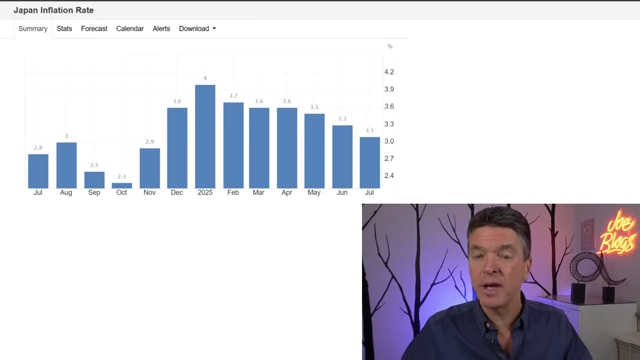
Japan Inflation Rate [ 00:09:49 ] - While general inflation has shown a downward trend since January, it is still above target.
- Historically, Japan struggled with deflation, but inflation has returned and remained above the 2% target rate for the past 12 months.
- Food Inflation [10:26]
- Food inflation is significantly higher than general inflation, with a 7.5% increase in July, compared to 3.1% general inflation.
Japan Food Inflation [ 00:10:29 ] - This disproportionate rise in food prices heavily impacts lower-income households and contributes to public dissatisfaction.
- Food inflation is significantly higher than general inflation, with a 7.5% increase in July, compared to 3.1% general inflation.
Net Debt-to-GDP Ratio [11:38]
Japan carries an exceptionally high national debt burden.
- Highest Debt Ratio [11:29]
- Japan has the highest net debt-to-GDP ratio among developed countries and the second highest globally.
Japan Government Net Debt-to-GDP Ratio (2015-2025) [ 00:11:39 ] - The ratio has increased from around 156-157% in 2015 to approximately 238% by 2024, largely due to increased spending during and after the pandemic, particularly on fuel imports.
- Japan has the highest net debt-to-GDP ratio among developed countries and the second highest globally.
- International Comparison [12:52]
- Japan's 237% ratio is significantly higher than other G20 nations, with Singapore being the next highest at 173%, followed by Italy (135%) and the USA (124%).

Country List Government Debt to GDP G20 [ 00:12:59 ]
- Japan's 237% ratio is significantly higher than other G20 nations, with Singapore being the next highest at 173%, followed by Italy (135%) and the USA (124%).
Debt Holders [14:02]
A large portion of Japan's government debt is held domestically, primarily by the Bank of Japan.
- Domestic Holdings [14:06]
- The Bank of Japan holds approximately 45% of all government debt, effectively creating a circular system where the central bank prints money for the government to spend.
![Japan Government Debt by Holder [<a href="https://youtube.com/watch?v=5RWUAJ5z29k&t=2025">2025</a>]](https://storage.googleapis.com/summarizer-images/images/5RWUAJ5z29k/sb0085_t00.14.09.webp)
Japan Government Debt by Holder [<a href="https://youtube.com/watch?v=5RWUAJ5z29k&t=2025">2025</a>] [ 00:14:09 ] - Domestic financial institutions hold around 30% of the debt.
- Japanese households and corporations hold about 10% of the debt.
- The Bank of Japan holds approximately 45% of all government debt, effectively creating a circular system where the central bank prints money for the government to spend.
- Low Foreign Investment [15:16]
- Only 15% of Japan's government debt is held by foreign investors.
- This is due to historically low interest rates (poor yield), high leverage (increased risk), and the depreciation of the Japanese yen.
Debt Costs (Bond Yields) [16:23]
The cost of issuing new government bonds is rising significantly, increasing Japan's debt servicing burden.
- 30-Year Bond Yields [16:26]
- The 30-year bond yield has risen from about 1.3% ten years ago and less than 1% between 2016 and 2022, to over 3.2% currently.

Japan 30 Year Bond Yield (2015-2025) [ 00:16:29 ] - This means future bond refinancing will be at double or triple the historical cost.
- The 30-year bond yield has risen from about 1.3% ten years ago and less than 1% between 2016 and 2022, to over 3.2% currently.
- 10-Year Bond Yields [17:30]
- Similarly, 10-year bond yields were as low as 0.3% (and even negative) in previous years, making them unattractive to foreign investors.

Japan 10 Year Bond Yield (2015-2025) [ 00:17:39 ] - The yield has now risen to just under 1.6%, implying a substantial increase in interest payments for refinanced bonds.
- Similarly, 10-year bond yields were as low as 0.3% (and even negative) in previous years, making them unattractive to foreign investors.
Debt Maturity [18:31]
A significant portion of Japan's government debt is set to mature in the near to medium term.
- Refinancing Needs [18:31]
- Approximately 15% of government debt matures in less than 2 years.
![Japan Government Debt by Maturity [<a href="https://youtube.com/watch?v=5RWUAJ5z29k&t=2025">2025</a>]](https://storage.googleapis.com/summarizer-images/images/5RWUAJ5z29k/sb0112_t00.18.38.webp)
Japan Government Debt by Maturity [<a href="https://youtube.com/watch?v=5RWUAJ5z29k&t=2025">2025</a>] [ 00:18:38 ] - A substantial 55% of the debt will mature in 2 to 10 years.
- This means Japan will need to refinance a large portion of its debt over the next decade at significantly higher interest rates.
- Approximately 15% of government debt matures in less than 2 years.
Government Spending [19:13]
Japan's government budget is heavily weighted towards social security and debt servicing, limiting investment in growth-oriented areas.
- Key Expenditure Categories [19:13]
- Social security (pensions, healthcare, child allowances) accounts for 34% of the budget and is expected to rise due to the aging population.

Japan Government Spending - FY2025 Budget [ 00:19:18 ] - Debt servicing (interest and bond redemptions) currently consumes 25% of the budget. This figure is projected to increase to over 30% in the next 5 years due to rising interest rates.
- Defense spending is 8% of the budget, reflecting military build-up and regional tensions.
- Education accounts for 5% of the budget.
- Social security (pensions, healthcare, child allowances) accounts for 34% of the budget and is expected to rise due to the aging population.
- Allocation Concerns [20:49]
- The government spends more than double on debt servicing compared to the combined spending on defense and education, limiting investments that could drive future economic growth.
Summary & Conclusion [21:18]
Japan faces a complex and difficult economic outlook due to interconnected fundamental problems that will be challenging to resolve.
- Persistent Challenges [21:33]
- The declining and aging population makes it difficult to stimulate economic growth, as the workforce shrinks and the number of retirees increases.
- Low immigration rates exacerbate demographic challenges.
- Japan's reliance on energy imports contributes to a consistent trade deficit.
- The massive and growing national debt, with increasing servicing costs, is a significant burden.
- Future Outlook [24:24]
- Without a rapid shift to domestic renewable energy sources, Japan will continue to be a net importer, perpetuating its trade deficit and debt accumulation.
- The rising cost of refinancing debt will further squeeze the government's budget, limiting funds for investment and essential services.
- The economic situation is likened to a credit card debt spiral, where most money goes to interest payments, hindering the ability to invest in long-term solutions.
- These issues are expected to dog Japan for at least the next 5 to 10 years, if not the foreseeable future.