Understanding Germanium Transistor Testing for Guitar Pedals: Leakage, Gain (hFE), and Tester Differences
This video explains how to test and select germanium transistors for guitar pedals, focusing on BJT (bipolar junction transistor) types.
- It covers what BJTs are and why germanium transistors need specific testing due to "leakage" (current flow when supposed to be off) and temperature sensitivity.
- Three testing methods are demonstrated and compared:
- The DIY R.G. Keen tester (breadboard setup, most accurate for pedal use).
- The inexpensive "M-tester."
- The professional Peak Atlas DCA75.
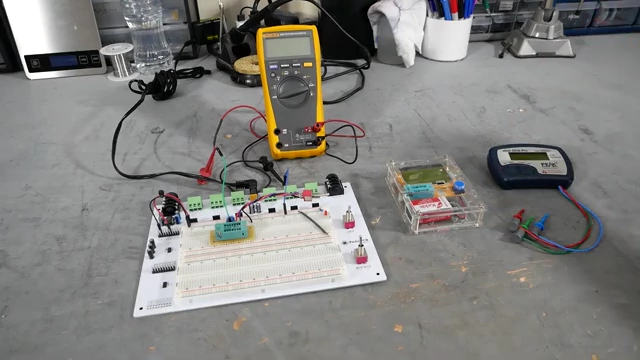
Overview of the three germanium transistor testers: a DIY breadboard circuit, a compact M-tester, and a professional Peak Atlas DCA75. [ 00:07:30 ]
- The video highlights that test results (especially for hFE or gain) differ between testers due to varying test conditions (e.g., collector current).
- The R.G. Keen tester is recommended for pedal builders as its conditions closely match real-world pedal usage.
- Ultimately, while testing provides valuable data, experimenting with transistors in a build is crucial for finding desired tones, as numbers don't always predict sound.
Introduction to Germanium Transistors and Testing [0:00]
The video provides a comprehensive guide to testing and selecting germanium transistors, primarily for guitar pedal applications. It covers the basics of bipolar junction transistors (BJTs), the unique characteristics of germanium transistors, various testing methods, and how to interpret different test results.
What are Bipolar Junction Transistors (BJTs)? [0:51]
BJTs are a common type of transistor, distinct from Field Effect Transistors (FETs) or MOSFETs.
- Prevalence in Germanium: Almost all germanium transistors encountered by pedal builders are BJTs.
- Current-Controlled Devices: BJTs are current-controlled, meaning a small base current regulates a larger current flow between the collector and emitter. This principle is fundamental to their operation as amplifiers, especially in common-emitter configurations common in guitar pedals.
- Audio Applications: In guitar pedals, germanium transistors are often used not for linear amplification but for their unique clipping and distortion characteristics when driven hard.
Special Considerations for Germanium Transistors [3:12]
Germanium transistors require specific attention compared to their more abundant silicon counterparts, mainly due to leakage and temperature sensitivity.
Leakage [3:17]
- Definition: Leakage occurs when a transistor cannot completely turn off, allowing a small current to flow from collector to emitter even without base current.
- Comparison with Silicon: Silicon transistors typically have leakage in the nanoamps or picoamps, which is often negligible. Germanium transistors, however, commonly exhibit leakage in the microamps (sometimes tens or hundreds), making it a significant factor.
- Impact on Performance: High leakage can lead to noisier and less dependable circuits.
- Rule of Thumb: Germanium transistors with leakage above 300 microamps are generally considered rejects for production pedals, unless a specific design explicitly requires it (e.g., the Maestro Fuzz Tone, which is leakage-biased).
- Importance of Testing: Due to higher leakage, testing is essential to ensure circuit stability and to estimate transistor noise.
Gain (hFE) [5:07]
- Definition: Gain, often denoted as hFE or beta (β), is the ratio of collector current (IC) to base current (IB).
- Equation: β = IC / IB
- Accounting for Leakage: To determine the true gain of a germanium transistor, the leakage current (ICBO) must be subtracted from the total collector current (IC) before dividing by the base current (IB): β = (IC - ICBO) / IB.
Temperature Sensitivity [16:04]
- Effect: Germanium transistors are highly sensitive to temperature; even body heat can alter readings during testing.
- Practical Implication: It's crucial to allow transistors to stabilize to room temperature during testing to obtain accurate and consistent results. Using tweezers to handle them helps minimize temperature fluctuations.
Three Germanium Transistor Testing Methods [7:23]
The video demonstrates three common methods for testing germanium transistors, excluding digital multimeters due to their unknown test conditions and lack of leakage measurement.
1. R.G. Keen Tester (DIY Breadboard Circuit) [8:42]
- Description: This custom breadboard circuit, based on an R.G. Keen article, consists of resistors, a transistor, a 9V battery, and a multimeter.
- Testing Procedure:
- Leakage Test: Measure voltage drop across the collector resistor with no base current applied. Use Ohm's Law (I = V/R) to calculate leakage current.
- Gain Test: Connect a base resistor to introduce a small base current, then measure the new voltage drop across the collector resistor. Subtract the initial leakage voltage drop to find the true gain.
- Pros:
- High Accuracy: Provides results closely correlated to how the transistor performs in a guitar pedal circuit.
- Constant Measurement: Offers continuous, real-time measurements via the multimeter.
- Customizable: Allows precise control over test conditions (e.g., resistor values).
- Cons:
- Complex Setup: Requires assembling discrete parts on a breadboard.
- Manual Calculations: Involves manual math using Ohm's Law.
- Time-Consuming: Requires waiting for the transistor to stabilize for accurate readings.
- Example 1 (RCA 2N217):
- Example 2 (Sylvania 2N1372):
2. "M-Tester" (Inexpensive Digital Tester) [10:48]
- Description: Affordable, portable testers available online (e.g., Amazon, eBay) that typically come as a kit.
- Measurements Provided: Displays hFE (gain) and forward voltage (VF) of the base-emitter junction.
- Pros:
- Quick and Easy: Provides results almost instantly.
- Cheap: Very affordable.
- Flexible Lead Orientation: No need to worry about specific lead placement.
- Cons:
- No Leakage Measurement: Does not explicitly show leakage, and it's unclear if it accounts for it accurately in gain calculations.
- Unknown Test Conditions: The specific test conditions (e.g., collector current) are not publicly available.
- Example 1 (RCA 2N217):
- hFE: 94 [25:36]
- Example 2 (Sylvania 2N1372):
- hFE: 78 [26:35]
3. Peak Atlas DCA75 (Professional Unit) [11:54]
- Description: A more professional and expensive unit that offers advanced features like curve tracing.
- Measurements Provided: Displays hFE, leakage, pinout, forward voltage, and saturation voltage.
- Pros:
- Comprehensive Data: Provides a wide array of detailed transistor characteristics.
- Explicit Leakage Account: Accurately measures and accounts for leakage.
- Flexible Lead Orientation: Similar to the M-tester, leads can be connected in any order.
- Cons:
- High Cost: Significantly more expensive than the other options.
- High Collector Current: Tests transistors at a relatively high collector current (e.g., 5 milliamps) as a safety measure. This can lead to higher hFE readings than those found in lower-current pedal circuits.
- Example 1 (RCA 2N217):
- Example 2 (Sylvania 2N1372):
Understanding Differences in Test Results [29:39]
The video emphasizes that different testers provide accurate readings based on their specific test conditions.
- Consistency: The R.G. Keen tester and M-tester provided similar hFE readings, while the DCA75 yielded significantly higher hFE values.
- Reason for Differences: The DCA75 tests at a higher collector current (5mA), which typically results in a higher hFE reading for a given transistor, as hFE can rise with both temperature and collector current at small signals.
- Importance of Context: It is crucial to understand the test conditions of any measurement to correctly interpret and communicate transistor characteristics.
- Recommendation for Pedal Builders: The R.G. Keen tester is recommended as the standard for pedal builders because its test conditions (e.g., 4 microamps base current) closely mimic the operational environment of transistors in guitar pedals.
Beyond the Numbers: Experimentation is Key [34:21]
While testing provides valuable data, the video stresses that it should not be the sole determinant for transistor selection.
- Limitations of Tests: Gain and leakage tests do not account for other critical factors like transistor self-noise (snapping, crackling, popping).
- Encouraging Experimentation: Builders should not be afraid to try transistors that fall outside recommended "ideal" specifications.
- Personal Preference: The speaker shares a personal preference for lower-gain transistors in fuzz pedals (e.g., 50-70 hFE instead of 80/120) because they "clean up" better with guitar volume adjustments, offering more nuanced overdrive tones.
- DIY Spirit: Experimentation allows builders to discover unique sounds and potentially develop new pedal designs, fostering the creative aspect of DIY electronics.