How to Improve Communication with Harvard Business School's TALK Framework
Summary:
This video, featuring Dr. Alison Wood Brooks from Harvard Business School, provides a comprehensive framework to enhance communication skills and improve all aspects of life.
The core teaching is the "TALK" framework:
- T is for Topics: Prepare discussion points in advance, even for 30 seconds, to reduce anxiety and ensure smoother, more engaging conversations. This applies to all relationships, and AI tools like ChatGPT can help generate relevant topics.
- A is for Asking: Become a better question-asker by genuinely listening and following up on what others say. This builds connection and understanding, countering our natural egocentrism. Effective listening involves hearing, processing, and verbally demonstrating comprehension through paraphrasing and validating feelings.
- L is for Levity: Incorporate humor and warmth to combat boredom and disengagement in conversations. Self-deprecating humor, especially for those in positions of authority, can build rapport and increase perceived status.
- K is for Kindness: Practice respectful language and responsive listening. In difficult conversations, acknowledge others' feelings, find common ground, and avoid dogmatic language.
The video also offers strategies for small talk (climbing the "Topic Pyramid" from shallow to deep talk), managing conversational dominators (redirecting attention), and responding to belittling comments (affirming their underlying intent while stating your boundaries).

TALK: 4-Part Framework for Better Communication [ 00:15:20 ] 
Topic Pyramid: Small Talk, Tailored Talk, Deep Talk [ 00:50:53 ]
Meeting Dr. Alison Wood Brooks: The Harvard Communication Expert [00:00]
The video introduces Dr. Alison Wood Brooks, a Harvard Business School professor, researcher, and author, renowned for her wildly popular communication course, "Talk: How to Talk Goodter in Business and Life." She emphasizes that improving communication can enhance every relationship and aspect of life, from personal to professional.

- Dr. Brooks's background [00:05:47]
- She was recruited to Harvard to teach negotiation but realized students needed more fundamental communication skills beyond strategy.
- Her research focused on emotions in difficult situations and how feelings influence behavior in negotiations.
- Why the course is called "Talk Goodter" [00:04:04]
- The unusual grammar is intentional, signaling a balance between gravity and levity, taking work seriously while maintaining a spirit of play and fun.
- "Goodter" also implies a striving for kindness, aiming to be good people in interactions.

Harvard Business School course title highlighting "How to Talk Goodter" [ 00:03:48 ]
- The inherent challenges of communication [00:08:13]
- Communication is complex, involving countless micro-decisions in every conversation.
- The biggest barrier is human egocentrism (self-centeredness), which makes it difficult to understand others' perspectives.

Definition of Egocentrism [ 00:11:05 ] - Conversation is a "coordination game" where people make independent decisions, which can lead to frustration and avoidance.

Definition of Coordination Game [ 00:12:21 ] - Research indicates that a failure in perspective-taking is the greatest barrier to conflict resolution and connection.
- Better communication isn't just about speaking differently; it's about connecting and stepping into others' shoes.

Research on perspective-taking as a key ability for relationships and problem-solving [ 00:13:31 ]
- Better communication isn't just about speaking differently; it's about connecting and stepping into others' shoes.
The Harvard Blueprint for Better Communication: The TALK Framework [03:23]
Dr. Brooks introduces her 4-part framework, "TALK," designed to simplify the complexities of conversation.
- The four elements of TALK [00:15:11]
- T stands for Topics
- A stands for Asking
- L is for Levity
- K is for Kindness
T: Topics - How to Always Have Something Interesting to Say [15:33]
- Importance of topic preparation [00:16:48]
- Most people don't prepare topics, leading to mundane conversations (weather, work, kids).
- Research shows that even 30 seconds of topic brainstorming improves conversation fluency, makes it more enjoyable, and reduces anxiety, even if the prepped topics aren't explicitly used.
- Prepared topics act as a "backup plan" for awkward silences or dull moments.

Definition of Topics as things we talk about [ 00:15:43 ] - It is an action step to prepare topics ahead of time and make them specific to each person you are seeing.
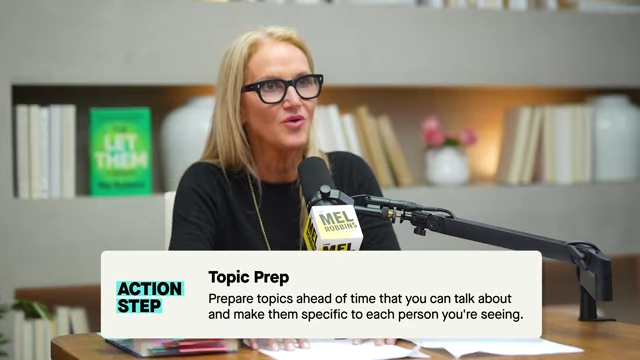
Action Step: Topic Prep [ 00:17:10 ] 
Research highlighting benefits of preparing topics in advance for better conversations [ 00:18:14 ]
- Prepared topics act as a "backup plan" for awkward silences or dull moments.
- Personalizing topics [00:20:02]
- Think about who you're seeing and what might be interesting or relevant to them (e.g., kids' school activities, colleagues' projects, parents' hobbies).
- Use AI tools like ChatGPT to generate tailored questions for specific demographics or relationship dynamics.
A: Asking - The Secret to Getting Better at Talking to People [22:22]
- Asking more and better questions [00:25:09]
- Question-asking is a "superpower" that doesn't require prior preparation; it relies on listening and genuine curiosity.
- The exercise "never-ending follow-up questions" helps practice deep listening.
- Being interested in others makes you interesting.

A is for Asking: Ask more questions, ask better questions [ 00:22:25 ]
- Addressing "Zero Questioners" (ZQs) [00:26:02]
- Some people don't ask questions due to self-centeredness or fear (of being intrusive, looking incompetent).
- While you can't control others, you can subtly shift topics or recognize it as a red flag in new relationships.
- The 3 Steps to Be a Better Listener [00:31:03]
- 1. Hearing & seeing your partner: Pay attention to verbal and non-verbal cues (words, tone, body language).
- Turning your back or not making eye contact signals disinterest, even if you are mentally processing.
- 2. Elaborate on it in your mind: Process and think about what is being said.
- 3. Show back that you heard and thought about it:
- Use verbal cues: repeating back, paraphrasing ("What I heard you say is..."), and validating feelings ("It makes sense that you feel X because of Y").
- This "spoken listening" is crucial for making others feel heard and understood, which boosts your influence and respect.
- Linguists call this "grounding"—ensuring shared understanding and providing opportunities for repair if there's a misunderstanding.
- 1. Hearing & seeing your partner: Pay attention to verbal and non-verbal cues (words, tone, body language).
L: Levity - How to Make Conversations More Fun and Less Awkward [36:03]
- Levity as an antidote to boredom [00:36:11]
- Boredom and disengagement are quiet killers of conversations, more common than overt conflict.
- Fleeting moments of humor and warmth "sparkle and fizz" to re-engage participants.

L is for Levity: Humor and warmth [ 00:36:14 ]
- Using humor to raise status [00:37:20]
- Self-deprecating humor or sharing failures is especially effective for high-status individuals (leaders, respected figures) to appear more relatable and human.
- For low-status individuals, this can be riskier as it might be perceived as incompetence.
- Defining and leveraging "status" [00:38:50]
- Status is about liking, respect, and prestige in the eyes of others.
- Status hierarchies exist in every group but are fluid and change with context and topic.
- When feeling low status on a topic, confidently asking clarifying questions ("What do you mean by this?") can raise your status by showing you value understanding and are willing to ensure others are also tracking.
- The power of making people laugh [00:42:03]
- Making people laugh, even once, significantly increases the likelihood of being seen as a leader and earning/maintaining status.
K: Kindness - Why Being Kind Makes You a Better Communicator [42:44]
- Concrete aspects of kindness in communication [00:43:25]
- Addressing bad equilibrium in relationships [00:45:30]
- "Bad equilibrium" refers to negative communication habits developed over time in a relationship (e.g., defensiveness, lashing out).
- It requires both parties to acknowledge the issue and commit to changing habits through open dialogue and apologies.

Definition of Bad Equilibrium [ 00:45:31 ]


Handling Specific Communication Challenges
How to Master Small Talk and Talk to Anyone [46:41]
- The necessity of small talk [00:47:06]
- Small talk is an unavoidable social ritual and a necessary warm-up for more meaningful conversations.
- The Topic Pyramid [00:47:54]
- Bottom Layer: Small Talk Topics: General, easy topics (weather, weekend plans) suitable for anyone. They serve as launchpads.
- Middle Layer: Tailored Talk: More personalized, possibly involving self-disclosure or topics specific to the other person's interests (where topic prep and asking questions are crucial).
- Top Layer: Deep Talk: Highly personal and meaningful conversations, often with emotional depth. Not every conversation needs to reach this level, and context is key.
- Open-ended questions (e.g., "What are you good at that you don't like doing?") can quickly transition from small talk to tailored or deep talk.
Topic Pyramid: Small Talk, Tailored Talk, Deep Talk [ 00:50:53 ]
- Open-ended questions (e.g., "What are you good at that you don't like doing?") can quickly transition from small talk to tailored or deep talk.
What to Do When Someone Talks Over You [52:01]
- Differentiating interruptions [00:56:14]
- On-topic interruptions: Enthusiastic, collaborative, finishing each other's sentences. Generally positive.
- Off-topic interruptions: Rude, dismissive, shifts the conversation away from what you were saying. Makes you feel devalued.

Two Different Types of Interruptions: On-topic and Off-topic [ 00:56:35 ]
- Strategies for off-topic interruptions in groups [00:53:50]
- Direct the attention: Verbally and non-verbally shift the group's focus to another person or topic (e.g., "Sarah, I wanted to hear about your basketball team. What can you tell us?").

Demonstration of redirecting conversation in a group [ 00:54:17 ] - Equitable eye gaze: Leaders should consciously make eye contact with all group members, especially those of lower status, to invite participation and make them feel seen. This subtly encourages them to speak without direct "cold calling," which can be mortifying.

Research findings on eye gaze impacting psychological safety and participation [ 00:54:57 ] - Leverage allies: Confide in a trusted friend or colleague beforehand, asking them to gently redirect the conversation if you get interrupted (e.g., "I'd actually really love to hear Allison finish what she was saying.").
- Direct the attention: Verbally and non-verbally shift the group's focus to another person or topic (e.g., "Sarah, I wanted to hear about your basketball team. What can you tell us?").
How to Handle Hurtful Comments and Difficult Conversations [59:03]
- Understanding belittlement [00:59:36]
- Hurtful comments often come from a place of insecurity or misplaced love from the speaker, rather than being solely about the comment's content.
- Strategies for "receptiveness" in disagreements [01:00:36]
- Acknowledgement: Verbally confirm you've heard their message, even if you disagree ("I think I heard you say...").

Research on a smarter way to disagree through acknowledgement [ 01:01:21 ] - Affirmation: Validate their underlying feelings ("It makes sense that you feel that way").
- Positive framing: Frame your response to maintain respect and cooperation.
- Avoid dogmatic language: Words like "because" and "therefore" can escalate conflict by expressing too much certainty and righteousness.
- "Dividing yourself into multiple parts": Express both understanding and your feelings. For example, "As your daughter, I'm grateful you want me to be happy, but saying X isn't helpful." This acknowledges their intent while setting boundaries.
- Acknowledgement: Verbally confirm you've heard their message, even if you disagree ("I think I heard you say...").
- Disengaging from unproductive arguments [01:04:43]
- If feedback doesn't work or discussions become circular, it's okay to redirect the conversation to a mutually rewarding topic or simply not engage further.
- Managing high-arousal emotions [01:05:50]
- If a conversation escalates to anger or yelling, suggest a "time out" to allow emotions to de-escalate.
- This can involve taking a break, changing the environment (going for a walk, moving rooms), and returning to the conversation later, or deciding not to revisit it if it's consistently unproductive.
Final Takeaways [01:09:03]
- The most impactful takeaway is topic preparation: Give forethought to the people you're going to meet and what they might find interesting.
Action Step: Before your next conversation, prep some topics ahead of time [ 01:09:35 ] - Give yourself and others grace: Communication is imperfect. Embrace awkwardness and understand that people will make mistakes, often not out of malice but human nature.