How to Build a $1 Million Business: A 5-Step Framework for Entrepreneurs
Summary:
- The speaker, Daniel Priestley, shares a 5-step framework to build a multi-million dollar business, drawing from his experience of building six companies to $1M and three to over $10M.
- The initial stage, "Apprenticeship," involves 1-2 years working for an experienced entrepreneur to gain commercial awareness, self-awareness, and access to resources.
- Following this, the "Side Hustle" phase encourages 90-day, open-and-shut projects to test entrepreneurial skills and build confidence without focusing on profit.
- The "CAOS Method" (Concept, Audience, Offer, Sales) focuses on fast, cheap experiments with a 2-person scout team, using MVPs like waiting lists and one-to-one sales meetings (minimum 30 interactions) to achieve product-market fit and validate ideas based on founder opportunity fit (pain, paid, passion).
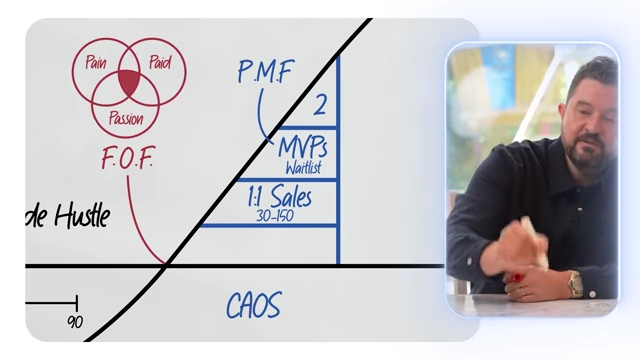
The Founder Opportunity Fit (FOF) Venn diagram showing the overlap of Pain, Paid, and Passion as ideal areas for a business idea. [ 00:09:39 ] - To reach a 6-figure business, expand to a 4-person team, develop two product types (product for prospects and core offer with gold, silver, bronze versions), and establish a "Perfect Repeatable Week" for consistent lead generation, sales, and team meetings.
- For a 7-figure business, scale to an 8-12 person team with specialized roles (GM, marketing, sales, product, customer success, IT, assistant, social media), expand to four product types (gift, product for prospects, core, product for clients), and plan your year with a "Three-Part Year" strategy combining repeatable weeks, spotlight campaigns, and an annual big message.
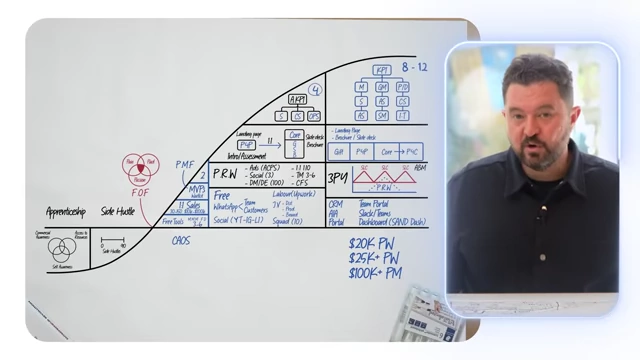
The complete 5-step framework for building a multi-million dollar business, from apprenticeship to a 7-figure enterprise, detailing teams, products, strategies, and revenue milestones. [ 00:28:53 ]
Introduction to the 5-Step Business Growth Framework [0:00]
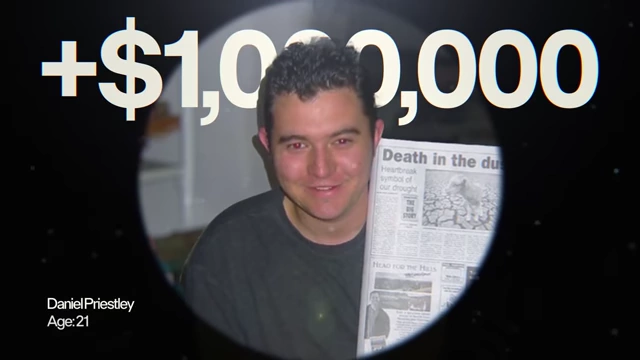
- Daniel Priestley introduces himself as an entrepreneur who built his first multi-million dollar business by age 25 and has since scaled six businesses to $1 million and three to over $10 million in valuation.
- The video will outline a 5-step methodical process to go from zero to a seven-figure revenue, emphasizing that no prior experience or large investment is required.
- The framework is divided into stages: "below the line" (preparation) and "above the line" (active business building).
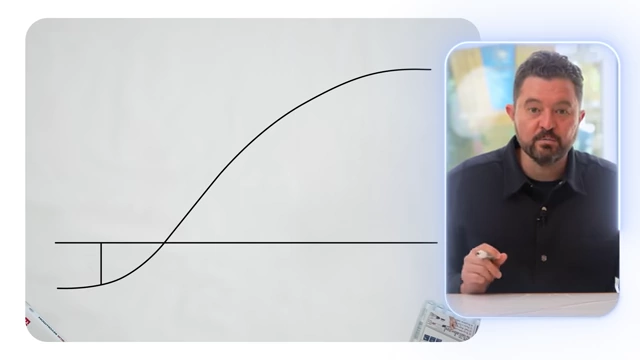
Initial diagram illustrating the "below the line" preparation phase and the "above the line" active business building phase. [ 00:00:43 ]
Stage 1: Entrepreneur Apprenticeship [0:49]
- Purpose: To gain essential skills and insights before launching your own venture.
- Duration: 1 to 2 years working for an experienced entrepreneur.
- Three Key Outcomes:
- Commercial Awareness: Understanding how businesses operate, generate sales, and manage customers.
- Self-Awareness: Identifying personal strengths, weaknesses, and how you function in a business environment.
- Access to Resources: Learning how to acquire capital, run ads, or hire staff.
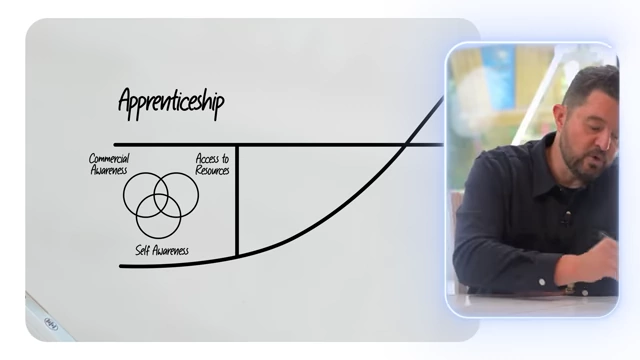
Diagram showing the "Apprenticeship" stage with three overlapping circles representing Commercial Awareness, Self-Awareness, and Access to Resources. [ 00:01:31 ]
- Goal: To build confidence and experience, making entrepreneurial concepts clear and tangible.
Stage 2: Your First Side Hustle [2:22]
- Purpose: To test entrepreneurial skills in a low-risk environment.
- Structure: 90-day, open-and-shut side hustles.
- Temporary Nature: Crucial to avoid getting permanently stuck; the goal is testing, not long-term commitment.
- Activity Examples:
- Pop-up agency client: Working for a client on a short-term basis.
- Interest-based projects: Pursuing something you're genuinely interested in, but keeping it as a side project.
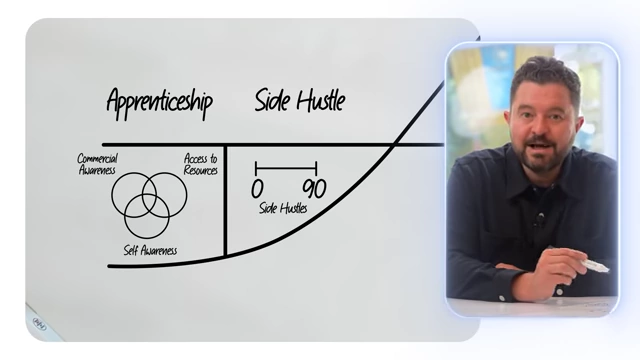
Diagram of the "Side Hustle" stage, indicating a 0-90 day timeline for temporary projects. [ 00:02:46 ]
- Personal Example: Daniel Priestley ran nightclub parties and delivered sales training for 90-day periods before launching his first major business.
- Structure: 90-day, open-and-shut side hustles.
Stage 3: The CAOS Method (Concept, Audience, Offer, Sales) [3:50]
- Objective: Rapid, cheap experimentation to validate business ideas and achieve product-market fit.
- Entrepreneurial Approach: Act like a scientist, running fast and cheap experiments.
- Key Elements to Experiment With:
- Concept: Is the core idea viable?
- Audience: Are there people who value this and are willing to pay?
- Offer: Can the product/service be offered at an acceptable price?
- Sales: Can the product/service be effectively sold?
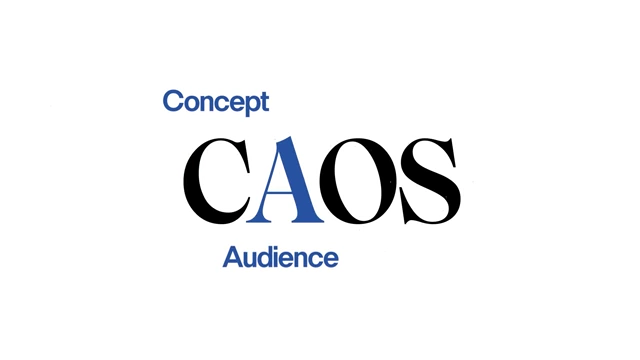
The "CAOS" method acronym, breaking down into Concept, Audience, Offer, and Sales. [ 00:03:57 ]
- Team Structure: A 2-person "scout team" is ideal for early-stage idea refinement.
- Roles: Mentor, co-founder, or early-stage employee/assistant.
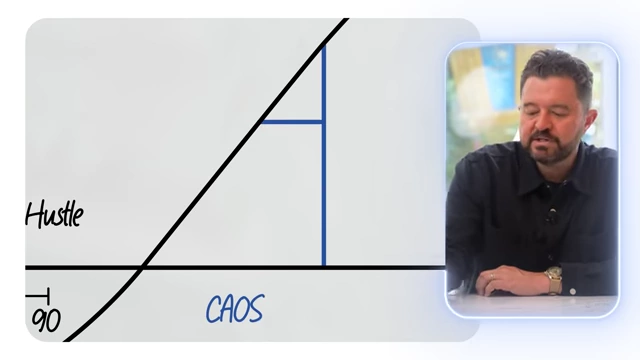
The "CAOS" section of the business growth diagram, showing the 2-person team at the core of early-stage experimentation. [ 00:04:24 ]
- Roles: Mentor, co-founder, or early-stage employee/assistant.
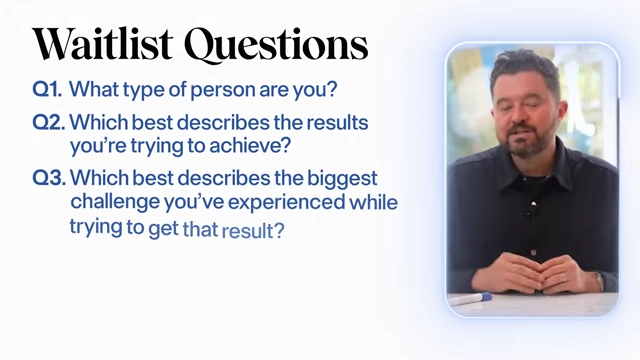
- Minimum Viable Products (MVPs) [5:00]: Testing market viability with minimal development.
- One-to-One Sales Meetings [6:57]: Crucial for direct feedback.
- Format: Zoom, Google Meet, face-to-face, or small focus group.
- Goal: Present the product/service and ask for commitment or pre-commitment.
- Feedback Focus: Don't aim for sales initially; aim for feedback to improve product-market fit.
- Handle "No": Treat rejections as "free consulting" to understand objections.
- Minimum Meetings: Conduct at least 30 sales meetings for statistically significant data; ideally 30-150.
- Founder Opportunity Fit (FOF) [8:50]: Identifying business ideas that align with your personal strengths and history.
- Based on: Your backstory, past experiences.
- Three Pillars:
- Pain: An area where you've previously solved a pain point or frustration.
- Paid: Something you've been paid for in the past.
- Passion: Something you are deeply passionate about.
- Optimal Fit: The overlap of all three areas.
The Founder Opportunity Fit (FOF) Venn diagram showing the overlap of Pain, Paid, and Passion as ideal areas for a business idea. [ 00:09:39 ]
- Idea Generation: Start with ~10 ideas, narrow to 3-4, then test with MVPs.
- Revenue at this stage: Typically $10K to $100K, signaling good concept-audience-offer-sales fit.
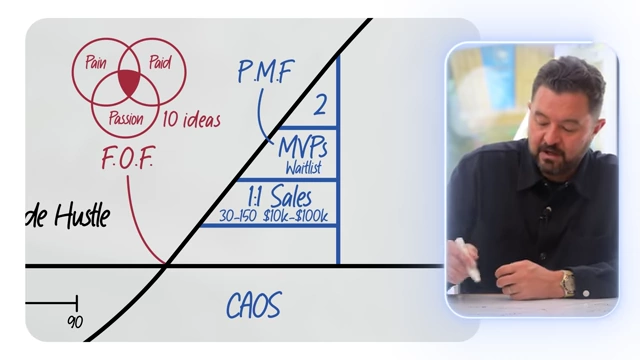
The CAOS section of the diagram, including Founder Opportunity Fit (FOF) and Product Market Fit (PMF), with details on 1:1 sales meetings (30-150) and initial revenue targets ($10K-$100K). [ 00:10:28 ] - Tools and Technologies [10:39]:
- Free Tools: Google Suite, Apple suite, spreadsheets (avoid complex databases and automation initially).
Icons for Google Sheets and Google Meet, representing free tools useful in the CAOS stage. [ 00:10:47 ] - Meetings: Monday morning meeting to set 3-6 high-value tasks for the week, and Friday debrief to check progress, ideally with a mentor or co-founder.
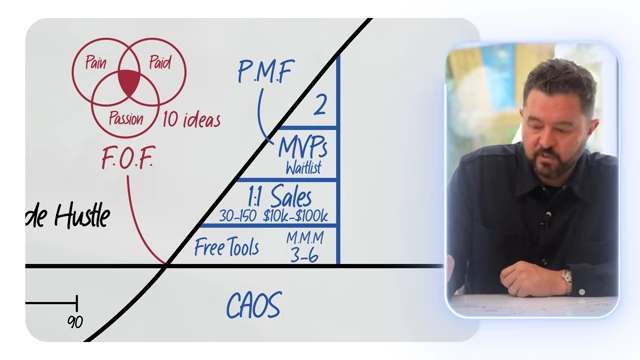
The CAOS section, showing "Free Tools" and the "Monday Morning Meeting" (MMM) and "Friday Debrief" (FD) for tracking 3-6 high-value tasks. [ 00:11:25 ]
- Free Tools: Google Suite, Apple suite, spreadsheets (avoid complex databases and automation initially).
Stage 4: Building a 6-Figure Business [11:48]
- Goal: Scale revenue, team, and profitability to $500K-$1M annually.
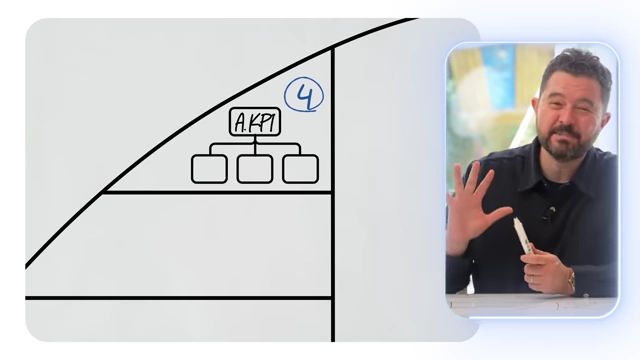
- Team Expansion: Move to a 4-person team.
- Structure:
- Associate Key Person of Influence (AKPI): Someone with a larger brand/reputation to leverage for "oomph." (e.g., board member, advisor)
- Sales/Marketing: Often the founder.
- Customer Success/Delivery.
- Operations: (e.g., social media, marketing assistant).
- Structure:
- Team Expansion: Move to a 4-person team.
- Product Strategy: Two types of products.
- Product for Prospects (P4P) [13:20]: Low-commitment, easy first step to explore your offerings.
- Examples: Introduction workshop, assessment.
- Benefit: Less intimidating than promoting the core offer directly.
- Implementation: Landing page for registration.
- Core Offer: The main product/service.
- Tiers: Gold, Silver, Bronze versions.
- Implementation: Slide deck or digital PDF brochure.
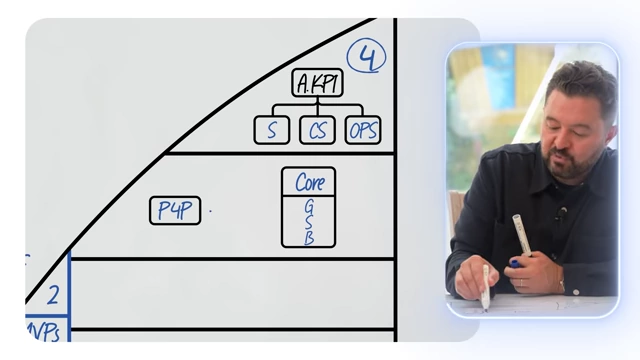
Product strategy for a 6-figure business, showing Product for Prospects (P4P) leading to a Core Offer with Gold, Silver, and Bronze tiers, managed by a landing page and slide deck/brochure respectively. [ 00:13:41 ]
- Flow: P4P leads to a one-to-one sales meeting, which leads to the Core Offer.
- Product for Prospects (P4P) [13:20]: Low-commitment, easy first step to explore your offerings.
- The Perfect Repeatable Week (PRW) [15:43]: A weekly plan to consistently generate $50K-$100K per month.
- Activities:
- Ads: Start with small testing budgets, scaling up with an allowable cost per sale.
- Social Media: Daily posting on at least three platforms.
- Direct Messages/Emails: Sending ~100 DMs/emails daily to potential customers, inviting them to P4P (e.g., assessments, intro workshops).
- Sales: One-to-one selling, potentially group presentations (1-10 people).
- Team Meetings: Monday morning (3-6 high-value tasks), Friday debrief.
- Customer Feedback Sessions (CFS): Regularly gather input from customers.
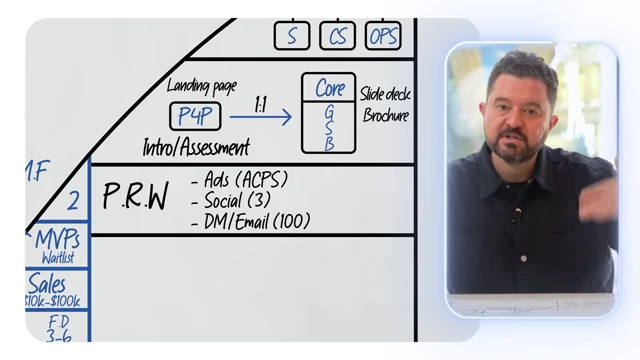
The "Perfect Repeatable Week" (PRW) strategy for a 6-figure business, detailing daily activities such as ads, social media, DMs/emails, 1:1 sales, team meetings, and customer feedback sessions. [ 00:17:46 ]
- Activities:
- Tools and Technologies [19:00]:
- Free Tools: Continue using Google, Apple, Microsoft free tools.
- Communication: WhatsApp for team and customer communities.
- Social Media: Leverage YouTube, Instagram, LinkedIn, and their free editing suites.
- Labor Suppliers: Use platforms like Upwork for affordable design, support, customer service ($20/hour).
- Joint Venture (JV) Partners [20:00]:
- Distribution: Partners with large email lists or famous personalities to amplify your message.
- Product: Complementary products (e.g., gym with a fitness trainer).
- Brand: Influencers or recommendations to boost brand perception.
- Squads (10 similar businesses) [20:55]: Non-competitive businesses in a WhatsApp group, cross-promoting each other's social media content to boost algorithms.
Stage 5: Building a 7-Figure Business [21:34]
- Goal: Achieve "Fun, Freedom, Flexibility" with a profitable, high-revenue business ($1M+ annually).
- Team Scaling: Expand to an 8-12 person team.
- Founder's Role (KPI): You become the "Key Person of Influence" – your name, face, and reputation drive the business.
- Key Team Roles [22:03]:
- General Manager (GM): Oversees daily operations (someone with experience running small businesses).
- Head of Marketing (M): Generates leads.
- Salesperson (S): Works with marketing to convert leads.
- Appointment Setter (AS): Ensures no opportunities are missed.
- Head of Product/Delivery (P/D): Focuses on product excellence and service delivery.
- Head of Customer Success (CS): Ensures customer satisfaction and retention.
- Head of IT (IT): Automates processes, leverages AI and technology.
- Company Assistant (AS): General support ("Swiss Army knife").
- Social Media Marketing (SM): Manages social presence.
- Team Scaling: Expand to an 8-12 person team.
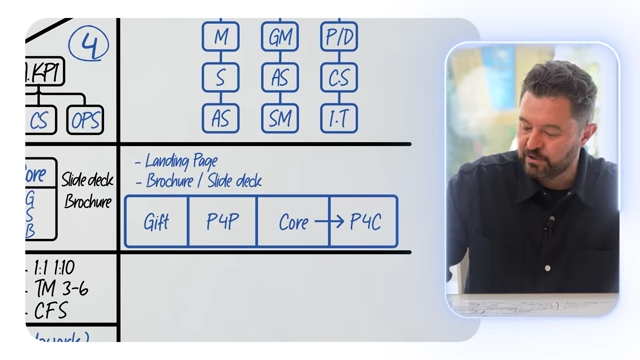
- Product Expansion: Four types of products.
- Gift: Free content/resources.
- Product for Prospects (P4P): Low-risk entry points (e.g., assessments, intro workshops).
- Core Offer: Main product/service (Gold, Silver, Bronze tiers).
- Product for Clients (P4C): Extends the core offering, often a subscription or maintenance service after a "transformation" (e.g., setup followed by subscription).
- Requirement: Each product needs a clear landing page or detailed brochure/slide deck.
- Strategic Planning: The "Three-Part Year" (3PY) [25:33].
- Perfect Repeatable Week (PRW): Continuous weekly activities for lead generation and sales.
- Spotlight Campaigns (SLC): 3-4 special campaigns per year (every 3-4 months) – special offers, events, promotions to re-engage leads that didn't convert from PRW.
- Annual Big Message (ABM): A consistent, overarching message for the year, reinforced across all social media content to establish brand recognition and expertise.
- Advanced Tools and Technologies [27:17]:
- CRM System: For managing customer relationships.
- AI Automations: Extensive use of AI to streamline operations.
- Portals: Customer portal (for self-service) and Team portal (for internal collaboration).
- Communication: Slack or Microsoft Teams for team communication.
- Dashboards: Essential for tracking progress and ensuring targets are met (e.g., "Sleep At Night Dashboard" to monitor key metrics).
- Revenue Targets:
- Minimum weekly: $20K-$25K+
- Monthly: $100K+
- Annual: $1M+
- Outcome: This setup can lead to several million dollars per year, allowing the entrepreneur to enjoy fun, freedom, and flexibility.
The complete 5-step framework for building a multi-million dollar business, from apprenticeship to a 7-figure enterprise, detailing teams, products, strategies, and revenue milestones. [ 00:28:53 ]