Rupert Spira on Non-Duality: Exploring Awareness, Time, Peace, Happiness, and Love
Summary:
- Rupert Spira defines awareness as an open, empty, and luminous presence that unconditionally embraces all experiences of mind, body, and world.
- He argues that what we perceive as mind, body, and world are merely "modulations" of this underlying awareness, not separate entities.
- Time is presented as a conceptual framework, not a directly experienced reality, as all experience occurs solely in the eternal "now."
- The pervasive sense of continuity that we experience stems from the ever-present nature of awareness, which is mistakenly attributed to the intermittent phenomena of mind, body, and world.
- Peace is described not as a state of mind to be achieved, but as the inherent, imperturbable nature of awareness itself.
- Happiness is defined as the absolute absence of resistance to the present moment, rather than a fleeting emotion.
- Love is portrayed as the ultimate intimacy and dissolution of separation, where the perceived "self" merges with the totality of experience.
- These intrinsic qualities of love, peace, and happiness are obscured by the illusion of a separate self, leading to an endless search for what is already our fundamental being.
Defining Awareness: Open, Empty, Luminous Presence [0:28]
Rupert Spira begins by defining the nature of awareness as an "open, empty, luminous presence."
- Open [0:52]
- Awareness says "yes unconditionally and indiscriminately" to all appearances of the mind, body, and world.
- Empty [1:11]
- It has "no mechanism inherent within you that can resist any appearance."
- Awareness is not composed of thoughts, sensations, or perceptions, but rather of "pure knowing or awareness."
- Luminous [2:28]
- Similar to how the sun makes objects visible, this "open empty presence renders all experience knowable."
- We don't truly see objects illumined by the sun; we see "reflections or modulations of the sun's light."
- Similarly, we don't know the objects of mind, body, and world, but rather "our knowing of them."
- All that is known is a "modulation of our own knowing presence" appearing as thinking, sensing, and perceiving.
- We never truly know a mind, body, or world as they are conventionally conceived; we only know our knowing of them.
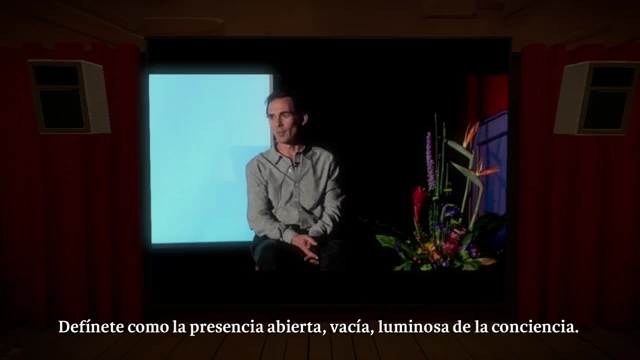
Rupert Spira speaks about awareness being an open, empty, and luminous presence, emphasizing its fundamental nature beyond transient experiences. [ 00:00:40 ]
The Illusion of Time [6:13]
Spira challenges the direct experience of time, asserting that only the "now" is ever truly known.
- Non-Experiential Past and Future [6:26]
- Attempt to experience the past or future directly.
- Thoughts can conceive of the past or future, but the actual past or future is never experienced.
- Thoughts about the past and future always occur in the "now."
- Time as a Theory [7:52]
- Time is a "movement between a non-existent past towards a non-existent future."
- It is a "necessary and valid theory," but it "doesn't refer to the reality of our experience."
- "Nobody has ever or could ever experience time," meaning awareness itself.
- Personal Anecdote: The Flight Experience [8:52]
- During a flight from London to Washington D.C., the speaker recounts experiencing only the "now" of the journey.
- London didn't leave him; London "had left me."
- He never got on an airplane; a "flow of sensations and perceptions that thought abstracts and calls a body in an airplane flowed through me."
- He never arrived in Washington D.C.; Washington D.C. "arrived in me" as a "cluster of perceptions."
- No Movement in Awareness [10:34]
- No one truly "walked into this room," sat on a chair, or listened to a talk.
- A "colorful flow of sensations and perceptions appears in Awareness, but awareness never goes anywhere or does anything."
- Awareness is "always here and now," not as a place or a time, but as a "dimensionless now," a "timeless presence of our own being."
Continuity and the Manufacturing of Time by the Mind [11:32]
The mind's perception of continuity is addressed, and its origin is traced back to awareness.
- Intermittent Nature of Mind, Body, and World [12:12]
- The "current thought or image" is all we know of the mind, and these are "intermittent."
- Sensations define the body, and "all sensations are intermittent."
- Perceptions (sights, sounds, tastes, textures, smells) constitute our knowledge of the world, and "all perception is intermittent."
- The True Source of Continuity [13:03]
- The "felt sense of continuity" does not come from the intermittent mind, body, or world.
- It originates from the "only thing...that is truly continuous or in fact not continuous but ever present now in our experience": "our own being, the presence of awareness."
- The mind, unable to perceive awareness directly (as it only knows apparent objects), "manufactures a substance called time" to account for experience's continuity.
- Eternity and Infinity through the Mind's Lens [14:10]
- "Continuity in time is what eternity looks like when viewed through the narrow slit of the mind."
- "Permanence in space is what the infinite unlimited nature of awareness looks like when viewed through the narrow slit of the mind."
- Continuity and permanence are "pale reflections at the level of the mind of the true Eternal and infinite nature of awareness."
Peace as Our Undisturbable Self [15:22]
Spira elaborates on other inherent qualities of our true self, starting with peace.
- Awareness is Imperturbable [15:52]
- He asks, "Can I this open empty knowing presence can I be agitated?"
- Thoughts, sensations, body, and world can be agitated, but "you, the one that knows the apparent mind body and world," are not.
- Awareness is compared to "an open empty space such as the space of this room" where nothing appearing within it can agitate it.
- "You I the presence of awareness are undisturbed, imperturbable."
- This imperturbability "is not dependent upon the condition of the mind."
- Peace is Our Self [17:43]
- "Another name for ourself is peace."
- Peace is not a quality our self has; it is "what our self is."
- This is not "peace of mind," as "minds are more or less agitated."
- This is the "peace that passeth understanding that is not of the mind."
- This peace is not hidden but "shining in full View at the heart of all experience."
Happiness as Non-Resistance to the Now [18:50]
Happiness is defined as a fundamental state of our being, intricately linked to the present moment.
- Absence of Lack and Resistance [18:56]
- He asks, "Can I this presence of awareness ever lack something?"
- Thoughts and feelings may suggest something is missing, but "in yourself this presence of awareness there is not the slightest impulse or possibility to avoid the now."
- Happiness Defined [19:56]
- This "absolute absence of resistance to the now," or "absolute absence of resisting what is and seeking what is not," is called "happiness."
- "When we are happy we are by definition not resisting the now and seeking in the past or the future."
- Happiness is "this absolute impossibility of our self ever to resist or seek...to resist what is and to seek what is not."
- Happiness, like peace, is "just another name for our self"; it is "what our self is."
Love as Absolute Intimacy and Non-Duality [21:24]
Love is revealed as the ultimate experience of intimacy and the core of non-duality.
- Objects in Consciousness are Closer [21:43]
- Referring to the inscription on a car mirror, "Objects in the mirror are closer than you think," Spira states this is "a statement of pure non-duality."
- "Objects that appear in the mirror of Consciousness are closer than we think."
- He questions if there are "two things: one the objects that appear in the mirror and two the mirror," or if it is "all just mirror."
- Experience as Modulation of Self [23:11]
- The apparent mind is the "experience of thinking," which is a "modulation of yourself a modulation of knowing or awareness."
- The apparent body is the "experience of sensing," a "modulation of yourself awareness."
- The apparent world is the "experience of seeing, hearing, touching, tasting and smelling," all "modulations of knowing, modulations of our self."
- We "never truly know a mind or a body or a world"; these are "abstractions that thought superimposes on the intimacy of our experience."
- "Experience is much closer, much more intimate," so close that it "does not admit the possibility of two things: one myself awareness and to the object that I know."
- Love Defined [28:01]
- The "common name we give to the absolute intimacy of all experience" is "love."
- Love is "the most familiar experience that we all know: the collapse or dissolution of the sense of a self in here and an object other or world out there."
- It's the "collapse of this sense of separateness, distance, otherness, not meanness."
- Love is "just another name for non Duality."
- If called "love, peace, or happiness," all seven billion people are interested in it, unlike the term "non-duality."
The Veiling of Love, Peace, and Happiness by the Separate Self [29:24]
Spira concludes by explaining why these inherent qualities often seem absent in our experience.
- The Imaginary Collapse [29:49]
- Love, peace, and happiness seem "not to be experienced" due to "a single thought that rises in Awareness, made only of awareness," which "imagines that awareness shares the limits of the thoughts feelings and Sensations that appear within it."
- This is like "imagining that a mirror shares the limits of the objects that appear in it."
- This thought causes the "everpresent unlimited awareness" to "seem to acquire or take on the apparent limits of the body and the mind."
- This is an "imaginary collapse or contraction of our self unlimited Eternal awareness into a body and a mind."
- The Separate Self's Futile Search [31:10]
- As a result of this imaginary collapse, "these qualities of love peace and happiness are seemingly veiled."
- The "separate self that thought imagines us to be is always by definition on a search in the imaginary outside world for the apparently lost love peace and happiness."
- This imaginary inside self "cannot by definition find the love that it seeks because its very presence its apparent presence is the veiling of that love."
- The Moth and the Flame Analogy [32:08]
- The separate self seeking love is "like a moth that seeks a flame."
- The flame is all the moth wants, but it "cannot have" it because "as the moth touches the flame it dies."
- This death is "its way of knowing the flame," of "becom[ing] the flame."
- Similarly, the "death or dissolution of the separate self is the experience of love."
- Being Knowingly Awareness [33:56]
- We should "simply be knowingly this open empty luminous presence of awareness whose nature whose inherent nature is love peace and happiness."
- This is "not a love peace and happiness that is in the background of experience that has to be sought, but that is shining in full View at the heart of all experience."
- "Experience is made out of this substance called peace or happiness."