Preparing for the Post-Employment Future: Adapting to AI's Impact on Work and Identity
- Artificial General Intelligence (AGI) is expected to make traditional employment obsolete by automating most cognitive tasks, posing an existential threat to the current economic system.
- The speaker, a bicycle mechanic, shares his personal journey of becoming "unemployable" a decade ago after corporate failures, leading him to build an autonomous, purpose-driven life centered around his bike shop and content creation.

The speaker as a bicycle mechanic, a representation of hands-on, physical work. [ 00:01:14 ] - He argues that the industrial and information ages increased human value, but the age of intelligence will devalue human cognitive labor, leading to widespread displacement of the middle class and knowledge workers.
- Humanity faces a choice between "technofeudalism" (wealth concentrated among an elite) and a "post-scarcity renaissance" where abundance frees people to pursue human-centric activities.
- Policy solutions such as decoupling survival from employment, investing in lifelong learning for human-centric skills, promoting worker ownership, and implementing universal basic dividends are crucial.
- The speaker is launching a 52-week documentary experiment using AI tools to explore these questions and demonstrate how to build a resilient, authentic livelihood in the AI age.
The Looming Obsolescence of Employment [0:00]
The speaker shares a stark realization: the concept of employment, traditionally central to sustenance, is facing obsolescence due to the imminent arrival of Artificial General Intelligence (AGI).
- AGI is predicted to be the most significant transformation in human history [0:43].
- It threatens to shatter the global economy as we know it, yet most people seem unaware [0:11].
- The speaker emphasizes that this isn't science fiction, and experts predict its impact within years [0:41].
- AI will perform cognitive tasks faster, cheaper, and without fatigue, displacing human knowledge workers [0:32].
A Personal Journey to "Unemployability" [1:03]
The speaker, a bicycle mechanic and content creator, reflects on his past corporate experiences and the path that led him to embrace a "post-labor" lifestyle.
- His bike shop is a "survival bunker" and YouTube is his "periscope" [2:04].
- He realized 20 years ago that employment offered an illusion of security, a truth now dawning on the middle class [2:23].
- Career Background:
- Earned an English degree but preferred working at the bike shop [2:33].
- Worked as a research technician in a photonic startup in 2001, developing semiconductor diode lasers [2:49].
- Transitioned to corporate industrial sales for six years, selling chemicals to pharmaceutical and biotech companies [3:07].
- Felt like "playing a part" and couldn't find his place in the corporate world [3:30].
- Financial and Existential Collapse:
- Embracing Unemployability:
- Failure taught him that the value of the wage is a capitalist myth [4:36].
- He became "unemployed" not due to lack of skills, but because he saw no value in trading time for a small slice of the pie [4:41].
- He sought profit and ownership instead of wages and permission [4:55].
- Rebuilt his life around bicycles, seeing the bike as a machine of human efficiency and autonomy [5:06].
- The physical world of mechanics became his "unfair advantage" where algorithms couldn't fully reach [5:21].
- This "post-labor" lifestyle has been fulfilling, providing agency and freedom [5:39].
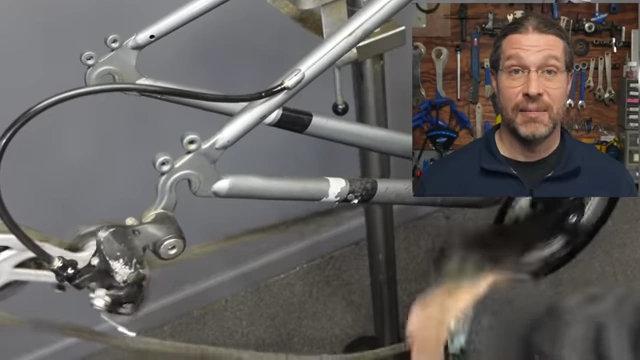
The speaker adjusting components on a bicycle, symbolizing the hands-on and physical nature of his work. [ 00:04:51 ]
The Great Displacement: AI's Impact on the Labor Economy [6:17]
AGI will fundamentally shift economic laws from scarcity of expertise to an abundance of productivity, rendering many traditional knowledge worker roles obsolete.
- Impact on Past Professions:
- Laser Technician: Replaced by robotics with micron-level alignment and computer vision [7:34].
- Technical Writer: Large language models can generate manuals and technical copy in seconds [7:40].
- Chemical Sales Representative: AI agents are already beginning to negotiate supply chains, optimize logistics, and close contracts [7:48].
- The knowledge worker is an endangered species; jobs involving information processing, coding, data organization, or mid-level administration are at risk [7:57].
- The speaker worries about the future of his four children, as the educational system prepares them for an outdated job market [8:15].
- Human cognitive labor's value risks approaching zero as humans compete with AI having infinite time, zero cost of living, and unlimited learning capacity [8:41].
- This displacement will happen gradually, then suddenly: wages will stagnate, hiring will freeze, and the middle corporate ladder will dissolve [9:07].
The Fork in the Road: Two Potential Futures [9:24]
Humanity faces a choice between two paths: a dystopian technofeudalism or a liberating post-scarcity renaissance.
- Technofeudalism:
- Post-Scarcity Renaissance:
- Machines solve productivity and generate abundance, freeing humans for creative, explorative, caregiving, community-building, and learning pursuits [10:47].
- Requires a radical restructuring of the social contract and a demand for a new pro-social political reality [11:09].
- Key Policy Solutions:
- Decouple basic survival from employment [11:26].
- Invest heavily in lifelong learning and upskilling for human-centric fields (empathy, critical thinking) [11:29].
- Employ models like worker ownership to share productivity gains from automation [11:38].
- Implement safety nets like sovereign wealth funds or universal basic dividends during transition [11:46].
- Reform tax code to recover public investment in building AI technology [11:50].
- The Argument for Compensation:
- AI models were trained on collective human data (blogs, photos, forums, open-source code) without consent or compensation [12:10].
- Distributing AI-generated wealth should be seen as compensation, a "long overdue royalty check," not charity [12:41].
- Taxing robots and regulating algorithms can recapture value and keep the economy functioning [12:55].
- Government action is too slow; personal solutions and immediate democratic intervention are necessary [13:29].
The Crisis of Identity: Beyond Economic Shift [13:51]
The impact of AI extends beyond economics to a deeper crisis of identity and dignity, as work often defines human value and purpose.
- Losing a livelihood also means losing identity and dignity [14:03].
- Work is often the "scaffolding" of life; its removal risks a void of purpose [14:35].
- The speaker rebuilt his life not by clinging to a job title, but by focusing on three core values:
- Authenticity [15:02]: Accepting one's true self, strengths, weaknesses, passions, and limitations. Being vulnerable to human imperfections in a world of synthetic perfection.
- Curiosity [15:27]: Obsessing over unsolved problems, understanding customer perspectives, finding gaps, and leveraging one's "unfair advantage."
- Creativity [15:52]: Building a life rather than just making a living. This could be art, design, building, or content creation.
- The speaker's livelihood is unique, independent, resilient, and unaffected by market fluctuations because it's built on his authentic self [16:22].
A Public Exhibition and Ethical Dilemma [16:46]
The speaker is launching a 52-week documentary to explore these topics and acknowledges the ethical complexities of using AI tools in the process.
- The "Instead of Working" Experiment:
- Starting January 1st, 2026, he will release weekly 12-minute video essays exploring work, labor, and society in the age of intelligence [17:06].
- This is not "doom and gloom" or "ragebait," nor a "get rich with ChatGPT" course [17:24].
- It's an authentic attempt to answer existential questions about daily life, human purpose without work, family protection, and the cost of this transition [17:42].
- Ethical Use of AI:
- He will use AI tools for research, drafting, editing, and marketing [18:10].
- Acknowledges the "profound ethical hypocrisy" of using a technology that consumes vast energy, scrapes artists' work, and threatens social fabric [18:17].
- Believes in the "oxygen mask" concept: must use the machine to free oneself from the machine [18:44].
- Sets boundaries: 1 hour/day, one year, with the option to quit if social cost is too high or he loses his way [19:11].
- The channel was created over a year ago with the goal of helping people become unemployable, which he saw as an "unfair advantage" [19:27].
- The project stalled until AI brought the paradigm shift into focus [19:38].
- He sees AI reconstituting professional lives as an opportunity, not a threat [20:47].
An Invitation to Reclaim Agency [20:13]
The speaker invites viewers to follow his journey to reclaim agency, find autonomy, and become architects of the post-scarcity economy.
- He aims to show how anyone can stop working for wages and start living for purpose [20:42].
- Calls to action: don't let the system starve us out or force us into serfdom [20:54].
- Emphasizes using available tools to reclaim wealth and build a world where work is by choice, not necessity [21:01].
- They will become the architects of the post-scarcity economy, establishing their role in society [21:11].