Meta's ambitious metaverse project, announced in October 2021 by Mark Zuckerberg, aimed to create a virtual world for human interaction and commerce. Despite initial hype and predictions of billions of users and trillions in value from consultants, the product, Horizon Worlds, was plagued by poor graphics, legless avatars, and extremely low user adoption, peaking at merely a few hundred thousand monthly users and eventually falling to around 900 daily active users.
Mark Zuckerberg's goal for the metaverse was to reach one billion people and host hundreds of billions of dollars in digital commerce.
[
00:00:20
]
Early metaverse avatars were depicted as floating torsos without legs, raising questions about the virtual world's design.
[
00:06:19
]
Meta's Reality Labs division incurred staggering operating losses, totaling approximately $88 billion over seven years. The virtual real estate market within the metaverse also collapsed, with properties purchased for hundreds of thousands now valued at fractions of their original price.
CoinGecko study showing metaverse land prices plummeted by nearly 95% from peak values.
[
00:14:07
]
Internal documents revealed Meta employees themselves disliked Horizon Worlds, and a key engineer, John Carmack, departed citing inefficiency. Faced with these failures, Meta has aggressively pivoted to AI, cutting metaverse investments and laying off staff, leading to stock market recovery driven by this shift.
The Verge article highlighting that Meta's flagship metaverse app was barely used by its own employees.
[
00:16:06
]
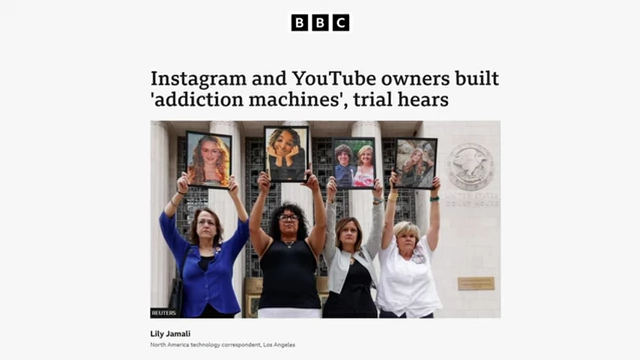
Concurrently, Meta's core social media platforms (Facebook, Instagram, WhatsApp) faced legal challenges, with juries finding them designed to be addictive to children and failing to ensure safety, resulting in significant damages and market cap loss. Zuckerberg personally overruled experts to keep beauty filters on Instagram despite warnings of body dysmorphia. The irony is that Meta spent billions on a product nobody wanted, while its successful core products are under fire for being too addictive and harmful.
BBC article reporting on trial findings that Instagram and YouTube were built as 'addiction machines'.
[
00:26:24
]
Metaverse Grand Vision and Initial Doubts [00:00:00]
Mark Zuckerberg announced Facebook's rebranding to Meta in October 2021, heralding the metaverse as the future of human interaction. [00:00:00]
He envisioned the metaverse reaching a billion people within a decade, facilitating hundreds of billions in digital commerce, work, socialization, and concerts. [00:00:16]
Mark Zuckerberg's goal for the metaverse was to reach one billion people and host hundreds of billions of dollars in digital commerce.
[
00:00:20
]
A staged hologram of a woman appears at a concert, illustrating the metaverse's vision for immersive social interaction.
[
00:00:29
]
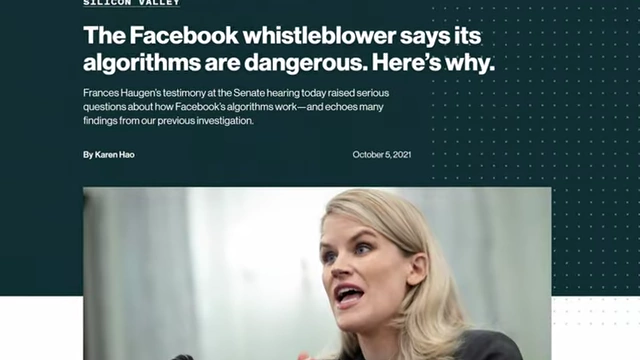
The announcement coincided with Facebook's negative press cycle, including whistleblower testimony about prioritizing profits over safety. [00:00:56]
An article reporting on the Facebook whistleblower's testimony regarding dangerous algorithms.
[
00:01:05
]
An article announcing Facebook whistleblower Frances Haugen's evidence to the UK Parliament.
[
00:01:13
]
The name "metaverse" originated from the science fiction novel "Snow Crash" where the main character delivers pizza for the mafia. [00:01:19]
The cover of Neal Stephenson's science fiction novel, Snow Crash, which popularized the term 'metaverse'.
[
00:01:24
]
Zuckerberg's Leadership Style and Past Successes [00:01:26]
Zuckerberg's business success largely stemmed from executing and acquiring existing ideas rather than originating them. [00:01:44]
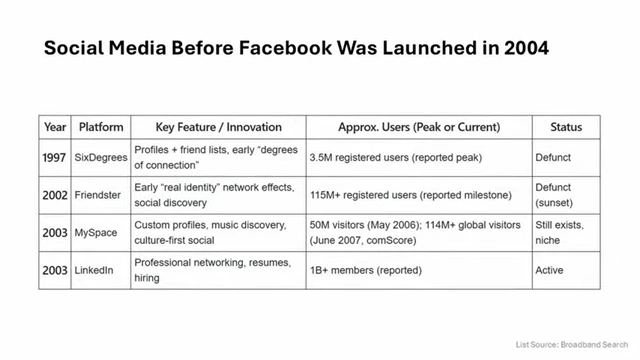
Facebook capitalized on the existing social network concept. [00:01:29]
A table listing social media platforms that existed before Facebook launched in 2004.
[
00:01:34
]
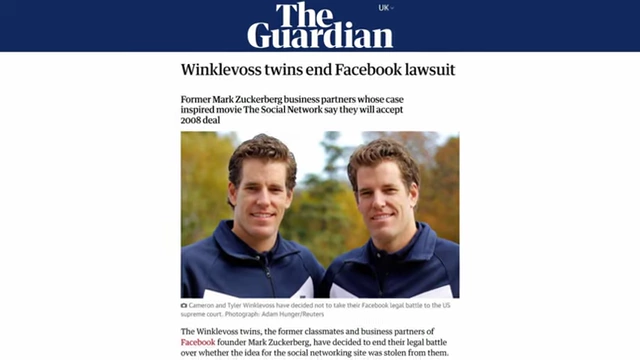
He famously lost a lawsuit to the Winklevoss twins for stealing their idea, which they hadn't really come up with either. [00:01:37]
A Guardian article announcing the end of the Facebook lawsuit with the Winklevoss twins.
[
00:01:43
]
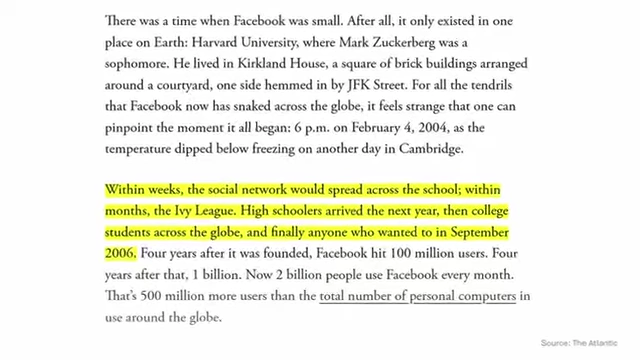
Facebook was launched through elite universities before opening to the rest of the world, making it a status symbol. [00:01:51]
An article excerpt describing Facebook's growth strategy, starting with elite universities and gradually expanding.
[
00:01:56
]
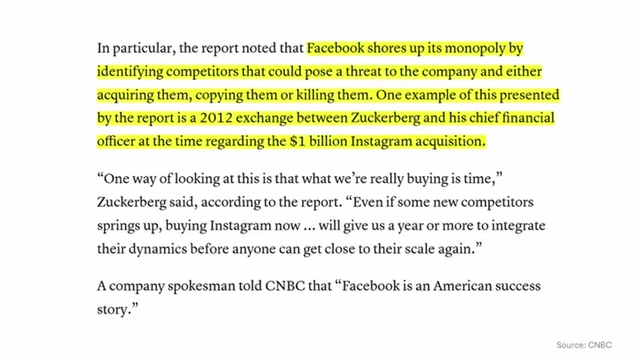
Key acquisitions included Instagram in 2012 for $1 billion and WhatsApp in 2014 for $19 billion. [00:02:01]
An article detailing how Facebook shored up its monopoly by acquiring competitors, citing the $1 billion Instagram acquisition.
[
00:02:05
]
His public image has faced scrutiny, such as his viral sunscreen incident where he attempted a disguise from paparazzi. [00:02:58]
Mark Zuckerberg's photo from a surfing incident where he applied too much sunscreen as a 'disguise'.
[
00:03:00
]
An article explaining that Zuckerberg thought the sunscreen would act as a disguise from a paparazzi photographer.
[
00:03:10
]
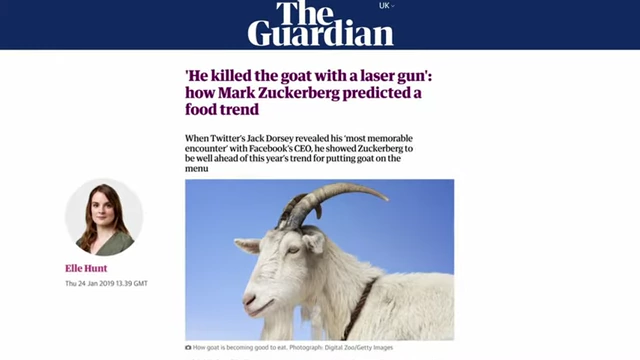
Jack Dorsey, Twitter's founder, recounted a strange dinner with Zuckerberg involving self-hunted goat meat, casting doubt on Zuckerberg's grasp of reality. [00:09:15]
A Guardian article reporting on Jack Dorsey's account of Mark Zuckerberg claiming to have killed a goat with a laser gun for dinner.
[
00:09:25
]
Rolling Stone article on Jack Dorsey's interview, where he mentioned Zuckerberg's goat story.
[
00:09:28
]
The Flawed Metaverse Presentation and Product Reality [00:03:27]
Meta's 75-minute presentation video promoting the metaverse was criticized for misrepresenting the user experience. [00:03:27]
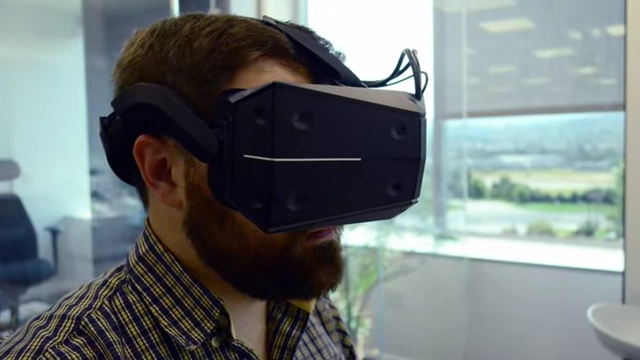
The video avoided showing users wearing VR headsets, which appear "ridiculous and unnatural" in reality. [00:03:40]
A man is shown wearing a virtual reality headset, illustrating the physical appearance of users.
[
00:03:56
]
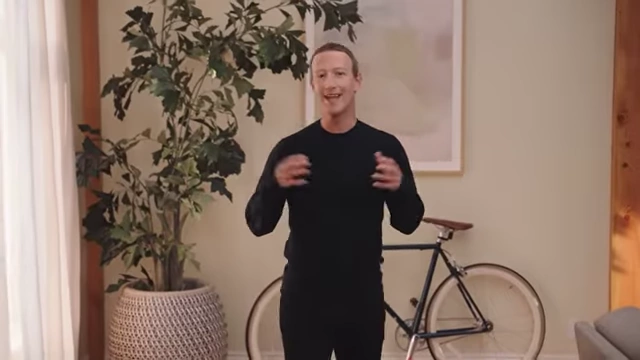
Zuckerberg's staged transition from his physical home to the metaverse was highlighted, implying a seamless experience not representative of real VR usage. [00:04:05]
Mark Zuckerberg in his physical home, setting the scene for a staged transition into the virtual world.
[
00:04:08
]
The staged transition shows Mark Zuckerberg moving from his physical home into a wireframe digital environment.
[
00:04:19
]
It showcased a Pixar-quality cartoon vision of the metaverse, not actual product footage or a real-time demo, including scenes with avatars playing cards on a space station. [00:04:34]
Mark Zuckerberg in the presented metaverse, showing high-quality animated graphics that were not representative of the actual product.
[
00:04:39
]
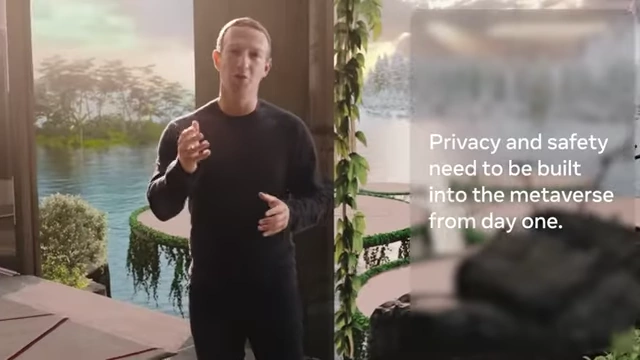
A statement on privacy and safety being essential from day one of the metaverse.
[
00:04:40
]
Mark Zuckerberg's metaverse avatar, which appeared to have low-resolution graphics similar to a Nintendo Wii game.
[
00:04:48
]
Metaverse avatars gather to play cards in a futuristic space station.
[
00:04:57
]
Key issues with the metaverse's virtual reality platform, Horizon Worlds:
Avatars initially lacked legs, appearing as "floating torsos." [00:06:18]
Early metaverse avatars were depicted as floating torsos without legs, raising questions about the virtual world's design.
[
00:06:19
]
A later announcement celebrating the addition of legs was revealed to be faked using motion capture technology, not actual VR rendering. [00:06:48]
Futurism article reporting that Mark Zuckerberg's metaverse legs demonstration was apparently staged.
[
00:06:59
]
The vision included implausible technologies, such as instantaneous photorealistic hologram teleportation, as shown by a woman in Kyoto instantly appearing at a concert in Los Angeles. [00:07:15]
A woman relaxing at home on her phone, setting up a scene for virtual interaction.
[
00:07:21
]
A woman appears as a photorealistic hologram at a concert, demonstrating the metaverse's vision of instant teleportation.
[
00:07:26
]
Other conceptual scenarios included virtual pingpong and street art that disappears unless paid for. [00:07:55]
People play virtual pingpong in a metaverse-style street scene.
[
00:07:57
]
Virtual street art is shown in the metaverse, with elements beginning to disappear, hinting at a paywall.
[
00:08:00
]
The actual Horizon Worlds product featured low-quality graphics, resembling early 2000s video games. [00:15:00]
Screenshot of Horizon Worlds, displaying its actual low-quality graphics that did not match the presentation's Pixar-quality cartoons.
[
00:15:07
]
Mark Zuckerberg's avatar, representing the presented vision of the metaverse with full legs.
[
00:14:59
]
User experience was poor, with reports of verbal and sexual harassment within seconds of joining. [00:15:25]
Independent article detailing reports of sexual violence and racist abuse in the metaverse.
[
00:15:35
]
Meta's own employees expressed dissatisfaction, describing VR meetings as "exhausting and borderline unusable," with internal memos questioning why staff didn't love the product they built. [00:15:56]
The Verge article highlighting that Meta's flagship metaverse app was barely used by its own employees.
[
00:16:06
]
Internal memo from a Meta executive asking why employees do not spend much time in Horizon Worlds.
[
00:16:26
]
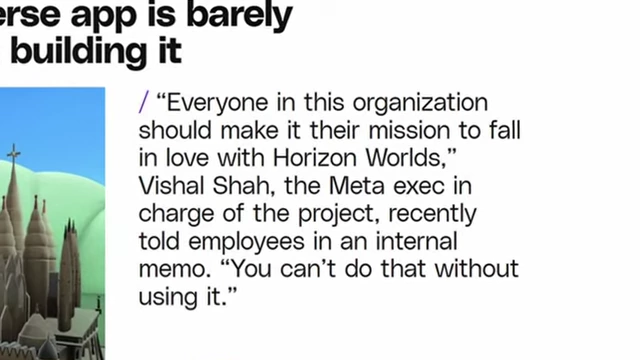
An excerpt from a Meta internal memo, asking employees to make it their mission to 'fall in love with Horizon Worlds'.
[
00:17:04
]
John Carmack, a legendary engineer, left Meta in 2022, calling their VR efforts "inefficient and bloated." [00:17:16]
A news article announcing John Carmack's departure from Meta, citing inefficiency and self-sabotage in the company's VR efforts.
[
00:17:26
]
Employees could not agree on the metaverse's purpose, leading to an undefined concept for the company's future. [00:17:31]
Widespread Hype and Financial Speculation [00:09:50]
Many serious institutions initially embraced the metaverse, leading to a period of intense hype in late 2021. [00:09:50]
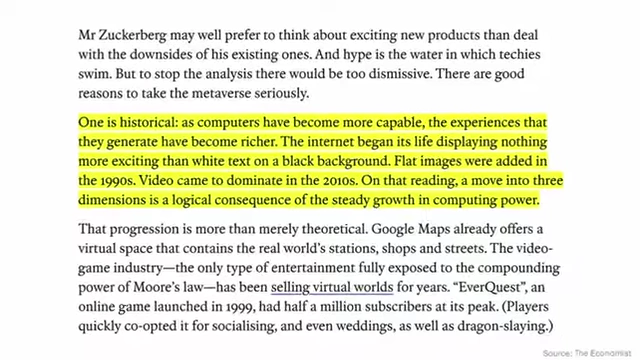
The Economist argued the metaverse was a "logical extension of computing" and warned against mockery. [00:09:57]
The Economist article highlights the historical progression of computing from text to 3D, positioning the metaverse as a logical next step.
[
00:10:02
]
The Economist article advises against mocking the metaverse, stating it's a logical progression in computing.
[
00:10:08
]
Wall Street analysts, including Bernstein, McKenzie, City, and Jeffrey, made highly optimistic predictions. [00:10:25]
McKinsey projected the metaverse could generate up to $5 trillion in value by 2030 and was "too big for companies to ignore." [00:10:44]
McKinsey's report cover and claim that the metaverse could generate up to $5 trillion by 2030.
[
00:10:48
]
City predicted 5 billion metaverse users, more than half the world's population. [00:10:55]
Corporations like Disney appointed "heads of metaverse strategy," and three-quarters of CEOs surveyed in 2022 planned to hire dedicated metaverse talent. [00:11:19]
BBC article reporting on Disney appointing an executive to oversee its metaverse strategy.
[
00:11:23
]
Virtual real estate experienced a bubble:
Someone paid $450,000 to be Snoop Dogg's neighbor in The Sandbox platform; that plot is now reportedly worth $100. [00:13:02]
Fortune article reporting on an individual who paid $450,000 to become Snoop Dogg's virtual neighbor in the metaverse.
[
00:13:07
]
Metaverse Group bought virtual land in Decentraland for $2.4 million, now valued at about $9,000 (a 99.6% decline). [00:13:38]
Reuters article discussing a record-breaking $2.4 million sale of virtual real estate.
[
00:13:37
]
CoinGecko study showing metaverse land prices plummeted by nearly 95% from peak values.
[
00:14:07
]
A virtual Gucci bag sold on Roblox for over $4,000, exceeding the cost of its physical counterpart. [00:14:26]
Hypebeast article reporting on a virtual Gucci bag selling for more on Roblox than the actual physical bag.
[
00:14:27
]
The metaverse hype coincided with near-zero interest rates and free capital, similar to the NFT and crypto booms. [00:25:32]
Paris Hilton and Jimmy Fallon holding a Bored Ape Yacht Club NFT, symbolizing the NFT boom.
[
00:25:45
]
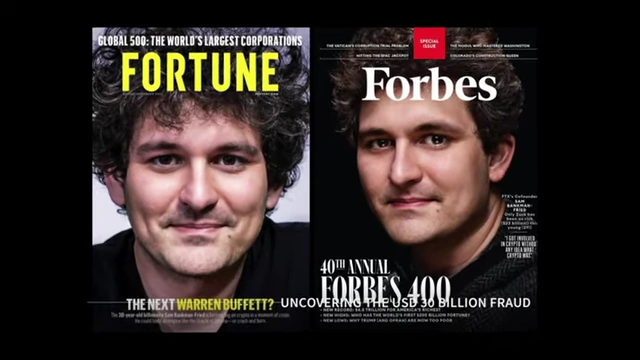
Fortune and Forbes magazine covers featuring Sam Bankman-Fried, illustrating the peak and fall of crypto investment.
[
00:25:47
]
Catastrophic Financial Losses and User Exodus [00:17:52]
User numbers fell far short of projections. [00:17:52]
Horizon Worlds peaked at a few hundred thousand monthly active users, eventually falling to around 900 daily active users by some estimates. [00:17:56]
A screenshot showing that Horizon Worlds was down to just 900 daily active users a year after launch.
[
00:17:56
]
Decentraland once reported as few as 38 active users, later adjusted to 8,000, which is still very low. [00:18:23]
Yahoo Finance article highlighting the extremely low daily active user count for Decentraland.
[
00:18:26
]
Total operating losses over seven years reached approximately $88 billion, comparable to building the International Space Station or funding the entire Apollo program (inflation-adjusted). [00:19:24]
Meta's Strategic Pivot to AI and Industry Retreat [00:20:01]
Meta's stock initially fell 64% in 2022 due to metaverse spending concerns but recovered in 2023-2024, driven by its core advertising business, not the metaverse. [00:20:01]
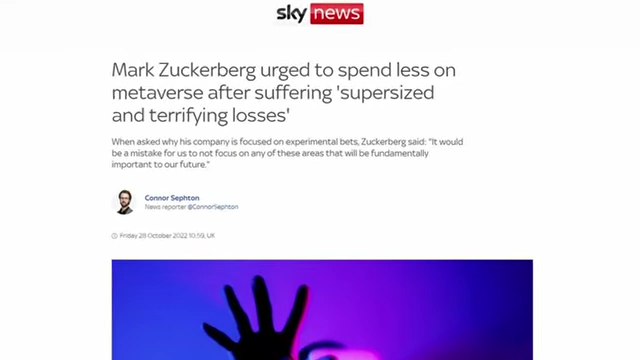
Sky News article discussing Mark Zuckerberg being urged to reduce metaverse spending due to 'supersized and terrifying losses'.
[
00:20:05
]
Meta began scaling back metaverse investments:
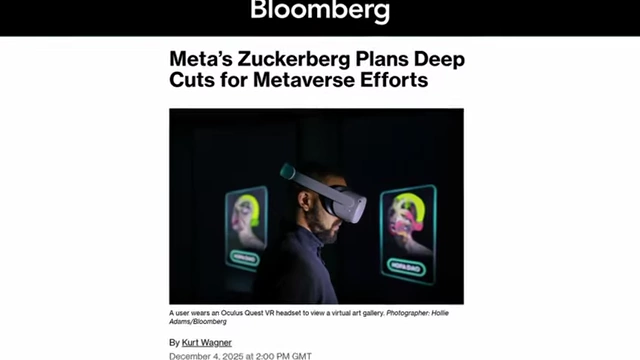
Bloomberg reported plans to cut the metaverse budget by 30% in late 2023, which caused Meta's stock to rise by $60 billion in market value in a single day. [00:20:51]
A Bloomberg article discussing Mark Zuckerberg's plans for deep cuts to metaverse efforts.
[
00:20:56
]
In January, Meta laid off over a thousand Reality Labs employees and closed several VR game studios. [00:21:16]
Zuckerberg stated that Reality Labs losses for 2026 would be similar to last year, expecting this to be the peak of losses. [00:21:25]
Engadget article on Mark Zuckerberg's statement about Reality Labs eventually stopping to lose so much money.
[
00:21:25
]
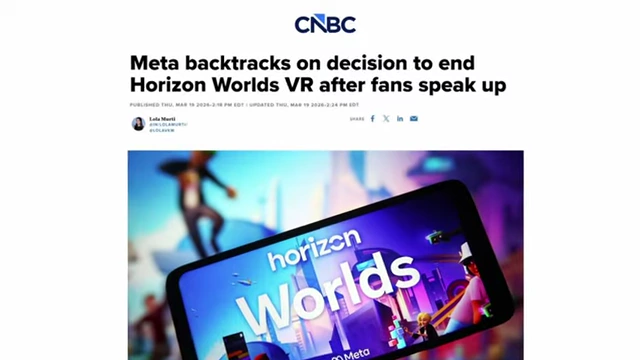
A brief, then reversed, decision in March to remove VR headset access for Horizon Worlds indicated confusion within Meta regarding its metaverse strategy. [00:21:45]
A CNBC article reporting Meta's backtrack on ending Horizon Worlds VR after user feedback.
[
00:22:17
]
Meta's VP framed the situation as "doubling down on the VR developer ecosystem" while shifting "Worlds" to be "almost exclusively mobile," which is often a euphemism for shrinking a project. [00:22:25]
Meta's blog post detailing the company's shifting focus from VR to a mobile-first approach for Worlds.
[
00:22:25
]
Meta pivoted aggressively towards Artificial Intelligence (AI). [00:23:07]
At the September 2025 Connect conference, Zuckerberg mentioned "metaverse" only twice but "AI" 23 times. [00:23:17]
An article stating that Mark Zuckerberg mentioned AI 23 times and metaverse only twice in his presentation.
[
00:23:25
]
The company's new focus is on AI-powered smart glasses, a product that exists and is selling. [00:23:35]
Other companies also retreated from metaverse initiatives. [00:23:48]
Disney eliminated its metaverse division in 2023. [00:23:59]
Walmart quietly ended its metaverse experiences on Roblox. [00:24:05]
Microsoft shut down its mixed reality feature in Teams. [00:24:11]
Apple launched its Vision Pro headset in 2024 at $3,500, but many buyers returned it within the 14-day window. [00:24:25]
The Guardian article with a sarcastic title about Apple Vision Pro headsets.
[
00:24:24
]
People wearing Apple Vision Pro headsets, demonstrating their use in public.
[
00:24:34
]
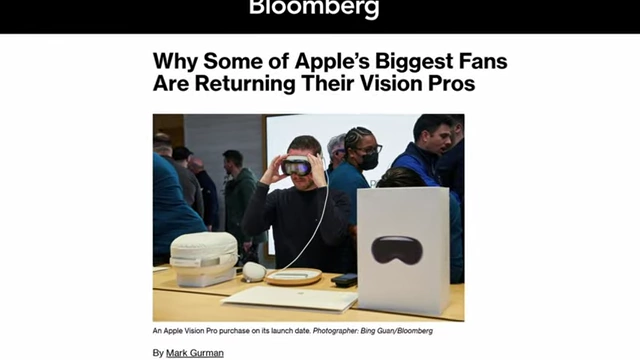
A Bloomberg article explaining why some Apple Vision Pro buyers are returning their headsets.
[
00:24:43
]
Deep-Rooted Issues: Social Media's "Tobacco Moment" [00:26:09]
While the metaverse failed, Meta's core business faced its own crisis, dubbed social media's "tobacco moment." [00:26:09]
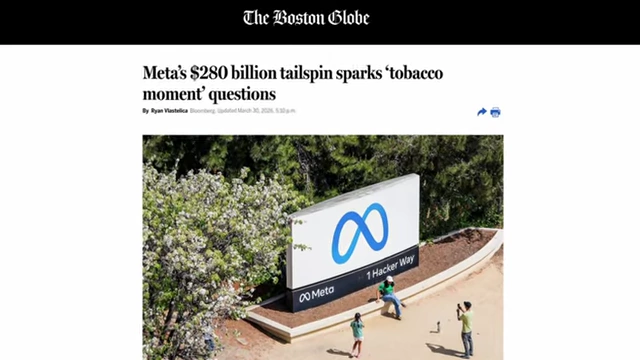
The Boston Globe article questioning Meta's future amid a 'tobacco moment' analogy and significant market losses.
[
00:26:21
]
A Los Angeles jury found Meta's platforms, particularly Instagram, and Google's YouTube, were designed to be addictive to children and failed to warn users of dangers, awarding $6 million in damages (Meta liable for 70%). [00:26:20]
BBC article reporting on trial findings that Instagram and YouTube were built as 'addiction machines'.
[
00:26:24
]
A New Mexico jury found Meta liable for failing to protect children from explicit content, ordering $375 million in civil penalties. [00:26:45]
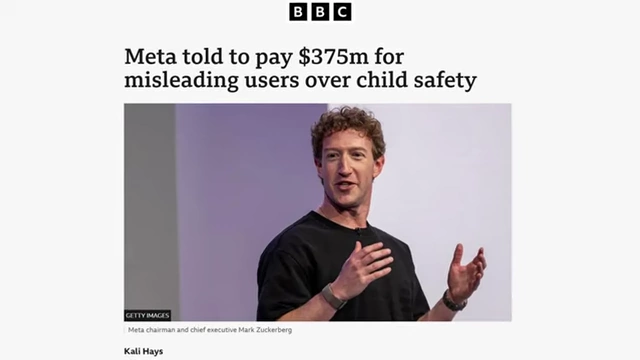
BBC article stating Meta was ordered to pay $375 million for misleading users over child safety.
[
00:26:53
]
Internal documents and Zuckerberg's testimony revealed troubling practices. [00:27:56]
Zuckerberg personally overruled 18 experts to keep beauty filters on Instagram, despite warnings of their contribution to body dysmorphia in teenage girls, citing "free expression" as the reason. [00:28:02]
Financial Times article about Mark Zuckerberg overruling 18 wellbeing experts to keep beauty filters on Instagram.
[
00:28:03
]
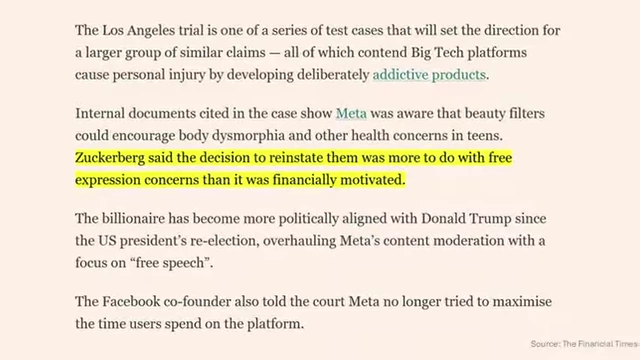
An excerpt from the Financial Times article detailing Zuckerberg's decision to reinstate beauty filters citing free expression concerns.
[
00:28:20
]
Internal emails referred to Instagram as a "drug" and employees as "pushers." [00:28:20]
A screenshot of an Instagram feed, illustrating the platform's visual content.
[
00:27:33
]
Boosting time spent on the platform, including by teenagers, was an explicit company goal. [00:28:37]
The Irony of Meta's Billion-Dollar Blunder and Core Business Crisis [00:29:17]
Meta spent $88 billion trying to make people addicted to a virtual reality product that almost no one used. [00:29:17]
Simultaneously, its highly profitable core products (Facebook, Instagram, WhatsApp, Messenger) were found to be addictive and harmful, leading to significant litigation. [00:29:28]
The company now faces both problems: a hugely expensive failed product and a successful core business facing legal action for its negative impact. [00:29:59]
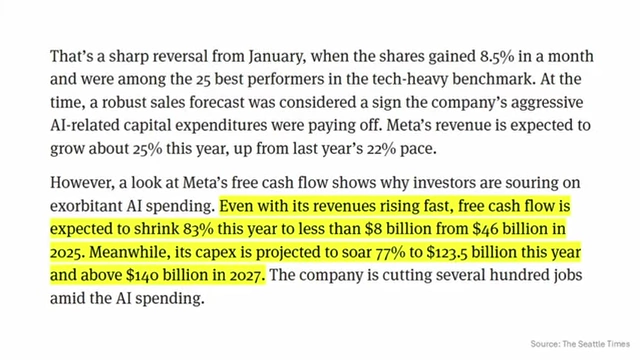
Meta's free cash flow is expected to shrink by 83% in 2026, even with growing revenues, as it funds AI ambitions through layoffs. [00:30:22]
A Seattle Times article discussing Meta's free cash flow shrinking by 83% despite rising revenues due to AI spending.
[
00:30:25
]
The company will likely remain named "Meta," permanently branded after a product that lasted about four years, symbolizing a monumental strategic misstep. [00:30:34]