Charles Schwab 2026 Market Outlook: Expert Analysis on Global Investing, US Equities, Fixed Income, and Trading Strategies
Trader Talks: Schwab Coaching Webcasts
- Global Investing: Experts foresee constructive moderate growth in 2026, driven by easing monetary policy, fiscal support, increased productivity, and AI investments. Risks include geopolitical tensions, trade policies, inflation, and credit strains from a K-shaped consumer economy.
- Domestic Economy & Equities: The US economy continues to exhibit bifurcations, but market leadership is expected to broaden beyond mega-cap technology names into cyclical sectors, supported by accelerating earnings growth across a wider range of the S&P 500.
- Global Markets: International stocks are anticipated to perform well, fueled by accelerating global economic growth, favorable valuations, and a potentially weaker dollar. Europe is benefiting from rate cuts and fiscal stimulus, while emerging markets offer AI-driven opportunities despite some regulatory concerns in China.
- Fixed Income: While 2025 saw strong bond returns, moderation is expected in 2026, with positive returns sustained by attractive coupon yields. The Federal Reserve is likely to implement limited rate cuts, contributing to a steepening yield curve and elevated long-term rates. Intermediate-term investment-grade corporate bonds and Treasury Inflation-Protected Securities (TIPS) are highlighted as attractive.
- Trading Outlook: The market is on solid ground with improving breadth and sector rotation. Traders are advised to look for opportunities in broadening sectors like financials and healthcare, and consider derivative strategies like debit spreads for diversified participation. Profitable small caps show promising growth.
- Key Risks: Potential labor market deterioration leading to a broader recession, and any threats to the Federal Reserve's independence. Investors are advised to remain diversified and disciplined.
Introduction and Agenda Overview [00:00:56]
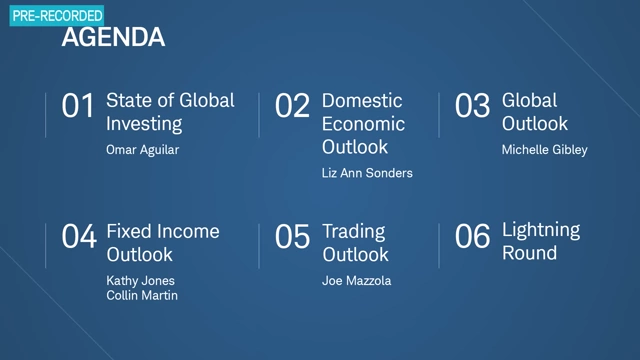
The session kicks off with Marley Kayden welcoming viewers to Schwab's 2026 Market Outlook, highlighting the market's resilience in 2025 despite significant uncertainties like inflation, global trade policy shifts, tightening financial conditions, and geopolitical tensions. The agenda for the event includes discussions on:
- State of Global Investing (Omar Aguilar)
- Domestic Economic Outlook (Liz Ann Sonders)
- Global Outlook (Michelle Gibley)
- Fixed Income Outlook (Kathy Jones, Collin Martin)
- Trading Outlook (Joe Mazzola)
- Lightning Round featuring a panel of experts.
Global Investing Outlook for 2026 [00:02:03]
Omar Aguilar, CEO and CIO of Schwab Asset Management, provides a constructive outlook for 2026, emphasizing a balance of tailwinds and headwinds.
- Tailwinds supporting growth:
- Easing monetary policy from the Federal Reserve.
- Accommodating fiscal policy.
- Increases in productivity.
- High levels of capital expenditures in artificial intelligence.
- A rebound in resilient consumer and investor confidence.
- Overall, this suggests constructed moderate growth in the US economy.
- Headwinds and Risks:
- Geopolitical risks and trade policy risks remain.
- The biggest risk is the dynamic between inflation (stable but with upward potential) and the "K-shaped" consumer.
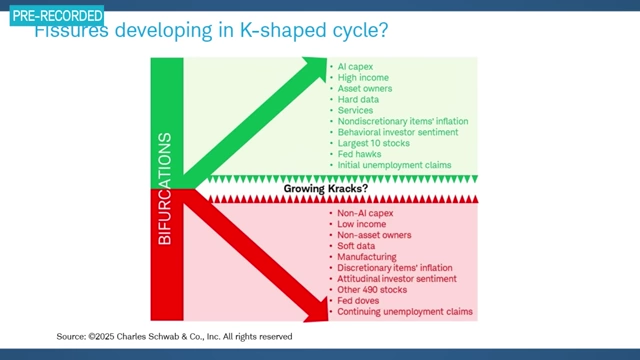
- How K-Shaped Economy Impacts Markets [00:03:59]: * The "top part of the K" (high-income earners) enjoys the wealth effect from market gains, possesses strong balance sheets, and maintains sustainable consumption, largely overshadowing inflation concerns. * The "lower end of the K" (lower-income consumers) is highly sensitive to inflation (oil, food prices) and vulnerable to labor market dynamics. * A potential deterioration in the credit component (more defaults, credit card issues, less liquidity) could strain the overall economic outlook.
- AI Infrastructure Spending and Equity Market Themes [00:05:11]:
- The AI cycle is in its early stages, expanding beyond hyperscalers to impact various parts of the economy and corporate structures.
- Close to $100 billion in financing for AI infrastructure (data warehousing, utilities, power) was reached this year, with both public and private markets contributing to extreme capital expenditures for hyperscalers.
- A new dynamic will be monitoring the quality of debt creation by companies entering the debt market for AI-related capital expenditures.
- A significant driver for 2026 markets will be the continued adoption and investment in AI across industries.
- A key trade-off will be the profitability derived from these large capital expenditures, expected to come to a head in the next 18 months.
- Equity Market Leadership Broadening [00:07:41]:
- The market concentration and leadership by mega-cap technology names are expected to continue in the first part of 2026 but then broaden into other areas.
- Easing monetary cycles typically provide tailwinds to more cyclical sectors and companies, such as small caps and financials.
- While mega-cap earnings stability will continue, the overall market is expected to be more broad in participation and contribution than in 2025.
- Investment Advice for Individual Investors [00:08:58]:
- Investors should heed behavioral economics and finance principles.
- Key advice for 2026:
- Stay invested: Avoid market timing, as it rarely succeeds.
- Stay disciplined: Define investment rules for positive and negative market conditions.
- Stay diversified: Avoid "endowment effects" or "home bias" that prevent selling winners; diversify portfolios.
- Stay systematic: Implement a systematic approach to minimize behavioral biases.
Domestic Economic and Equity Outlook for 2026 [00:11:18]
Liz Ann Sonders, Chief Investment Strategist at Schwab Center for Financial Research, discusses the state of the US economy and equity markets.
- K-Shaped Economic Dynamics and Market Bifurcations [00:11:46]:
- The economy shows significant bifurcations: high vs. low income, asset owners vs. non-asset owners, AI-related vs. non-AI-related sectors, and goods vs. services inflation.
- These bifurcations translated into market behavior, though market leadership started to break down and become less concentrated around mid-2025.
- Historically, only 16% of S&P 500 constituents outperformed the index, but this has risen to 50% in recent months, indicating a broadening.
- Some economic bifurcations (consumer, capital spending) will likely persist, but equity market bifurcations may see a breakdown.
- Current Market Concentration and Future Expectations [00:13:12]:
- The market previously had a mega-cap bias, focusing on the "Magnificent 7".
- However, only two of the Magnificent 7 are outperforming the S&P 500 this year.
- Nvidia, the top contributor to S&P returns, is number one due to its cap size, not price performance (ranked ~80th).
- A broadening out is occurring, with areas like healthcare showing leadership. Equal-weight strategies are performing better relative to cap-weight.
- The 2026 environment may offer a more level playing field for active vs. passive, and equal-weight vs. cap-weight strategies, with opportunities down the cap spectrum, emphasizing quality in small caps.
- Expectations for the AI Trade in 2026 [00:14:25]:
- Concerns exist regarding the "circularity of financing" or "vendor financing" in AI, where chip makers invest in customers, ensuring future purchases.
- Initially, the AI boom was cash-flow, equity, and balance-sheet financed. Increasingly, debt financing is used, which introduces new risks.
- The focus is shifting from "picks and shovels" (hyperscalers) to companies adopting AI for cost-cutting, productivity enhancement, and labor cost reduction.
- These questions will be more important for investors in 2026 and will provide a better macro sense of AI's productivity impact.
- Broadening of Market Leadership and Forward EPS Trends [00:16:26]:
- The earnings backdrop supports broadening leadership.
- Earnings growth rates for tech, Mag 7, and AI baskets are decelerating from 40-60% year-over-year but remain decent.
- Other S&P 500 sectors are expected to see an accelerating pace of earnings, providing a supportive backdrop for broader market participation.
- The direction and rate of change in earnings growth (better or worse) matter more than absolute levels (good or bad).
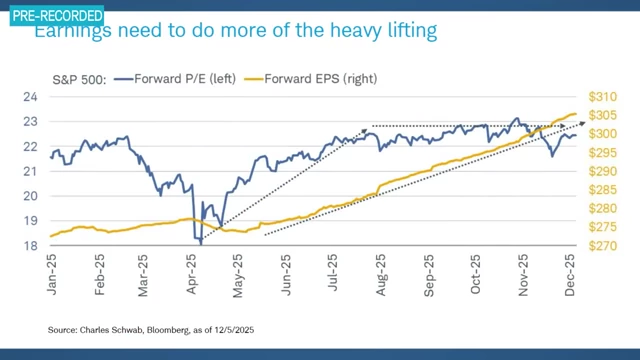
S&P 500 Forward P/E and Forward EPS trends show earnings needing to drive future growth. [ 00:17:19 ]
- Biggest Risks Underestimated in 2026 [00:18:12]:
- Further deterioration in the broad economy, especially the labor market. The Fed's rate cut decisions are influenced by labor market concerns, and a significant move up in unemployment could bring an actual recession (not just "rolling recessions") which is not priced into market expectations.
- Any serious threat to the independence of the Federal Reserve, the world's most powerful central bank, represents a significant, though potentially low-likelihood, risk.
Global Markets in Focus [00:19:59]
Michelle Gibli, Director of International Equity Research and Strategy, discusses the outlook for global markets.
- International Stocks in 2026 [00:20:31]:
- International stocks could have another strong year.
- Global economic growth is expected to accelerate.
- International stocks are cyclically oriented, meaning earnings could accelerate.
- Stocks are still attractively valued, and the US dollar could weaken further.
- International Stocks vs. US Stocks: Valuations [00:20:51]:
- International equities are trading at a steep discount to the S&P 500.
- Every sector within EPHA (MSCI Europe, Australasia, Far East) outperformed in 2025, except tech and communication services.
- Despite this, every EPHA sector trades at a substantial discount to its S&P 500 counterpart, with eight sectors trading at a 30% discount.
- Expectations are for double-digit earnings growth for international stocks, similar to the S&P 500, offering similar growth at a discount.
- Financials and Industrials are expected to have the highest earnings growth rates, benefiting from Germany's fiscal stimulus and accelerating economic growth. Healthcare stocks in Europe are also expected to post solid earnings growth.
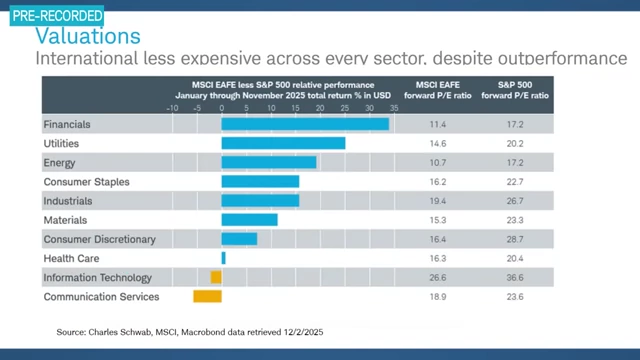
International stocks show lower valuations across almost all sectors compared to the S&P 500. [ 00:21:28 ]
- European Stock Valuations and Impact of ECB Cuts [00:22:01]:
- The European Central Bank (ECB) cut rates by 235 basis points from June 2024 to June 2025, one of the largest and fastest rate-cutting cycles in the developed world.
- Benefits are starting to be seen, with bank lending accelerating, which can fuel economic activity.
- Germany announced a trillion euros of fiscal stimulus to be spent over the next decade on defense and infrastructure, which is just beginning.
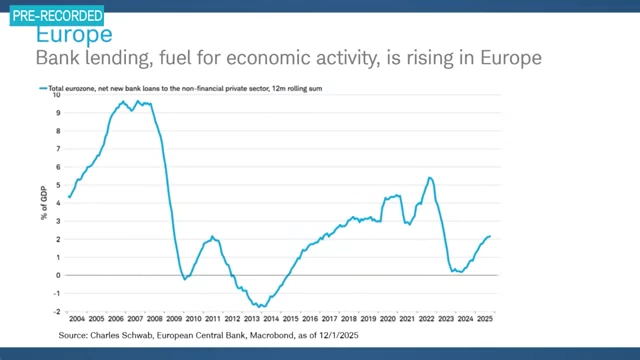
Bank lending in the Eurozone is accelerating, signaling increased economic activity. [ 00:22:28 ]
- Gaining International Exposure to the AI Trade [00:23:14]:
- The "Deepseek moment" highlighted Chinese companies' innovation in AI.
- Chinese stocks have benefited from optimism about AI innovation and adoption.
- Large names in the EM index are based in Taiwan and Korea.
- China benefits from plentiful low-cost electricity, a key AI input, which could help them even if US AI capital expenditures slow.
- EM stocks expect accelerating earnings, have non-extended valuations, and would benefit from a weaker dollar. EM deserves a small place in investor portfolios.
- Caution: The more EM acts like a tech stock, the less diversification benefit it offers US investors.
- Outlook for Chinese Stocks in 2026 [00:24:44]:
- Chinese stock valuations are still inexpensive (MSCI China index at 12.5x next 12 months earnings, up from 9x last year).
- China has a long history of innovation, filing more patents per year than the US for over a decade.
- Cautionary tale: In the past, government subsidies and excessive investment led to oversupply, putting downward pressure on prices and margins.
- US valuations benefit from rule of law, strong bankruptcy protections, transparency for public companies, and less government interference.
- The AI capital expenditure race and evolving investor perceptions of China and the US will continue to shape the outlook.
Fixed Income Outlook [00:26:39]
Kathy Jones, Chief Fixed Income Strategist, and Collin Martin, Head of Fixed Income Research and Strategy, provide their insights on fixed income markets.
- Strong Bond Performance in 2025 and 2026 Outlook [00:26:52]:
- 2025 was a very strong year for fixed income, with all tracked asset classes posting positive returns, including double-digit returns for international developed market bonds (partly due to a weaker dollar).
- The Bloomberg Aggregate Bond Index was up nearly 7% year-to-date, driven by high starting yields (coupon payments) and Fed rate cuts.
- For 2026, moderation is expected, but returns should remain positive due to still attractive coupon yields, though not as high as 2025's starting yields. The Fed's bias remains towards easing, and inflation hopes are for further decline.
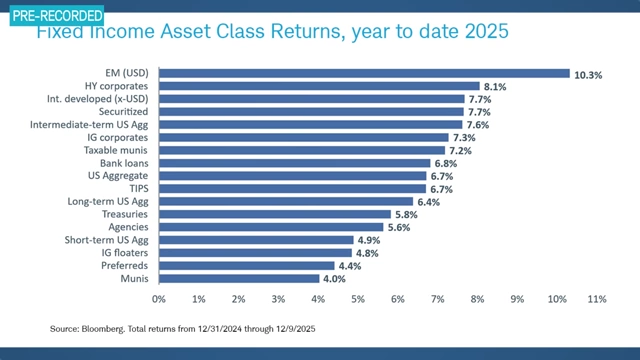
Fixed Income Asset Class Returns year-to-date 2025, with EM (USD) leading. [ 00:27:37 ]
- Fed's Rate Path and Impact on Bonds [00:28:36]:
- The Fed believes it's nearing the neutral rate (3-3.5%), with the Fed funds rate at the upper end (3.5%).
- Neutral rate means it neither boosts nor hinders the economy or inflation/unemployment.
- Limited room for Fed easing unless inflation (currently around 3%) drops closer to the 2% target.
- Only 1-2 more rate cuts are anticipated in 2026, which will limit the boost to bond market total returns from Fed easing.
- Yield Curve Expectations (Steepening) [00:30:08]:
- Long-term yields are expected to remain elevated even with short-term rate cuts.
- Long-term rates are influenced by inflation expectations, economic growth, risk, and supply/demand.
- The "term premium" (extra yield demanded for longer-term bonds) has risen from negative to positive territory and is expected to increase further, keeping long-term rates elevated relative to short-term rates.
- This means 10-year yields may not fall much below 4%.
- Factors like sticky inflation, rising fiscal deficits, and high corporate bond issuance will contribute to significant supply that the market needs to absorb, requiring elevated yields to attract buyers.
- A continued steepening of the yield curve is expected, with 10-year, 20-year, and 30-year yields remaining elevated.
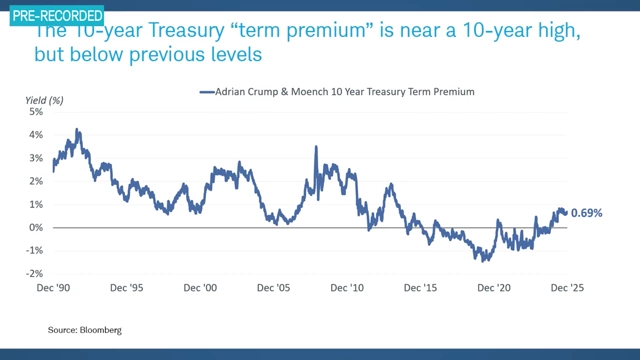
The 10-year Treasury term premium has risen into positive territory but remains below historical averages. [ 00:30:57 ]
- Positioning and Investment-Grade Corporate Bonds [00:32:24]:
- The "sweet spot" for positioning is the intermediate-term part of the yield curve (4 to 10-year average maturity) to balance reinvestment risk (short end) and interest rate risk (long end).
- The US aggregate index, with an average duration of around six, is a good way to get exposure.
- Investment-grade corporate bonds [00:34:38]: These are attractive due to strong credit quality, improving fundamentals (corporate profits near all-time highs), and attractive yields (4.25-5.25% in the intermediate term). The yield curve for investment-grade corporate bonds is positively sloped, rewarding longer maturities with higher yields.
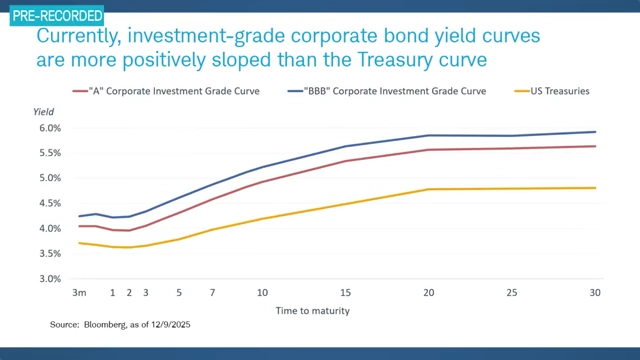
Investment-grade corporate bond yield curves are more positively sloped than the Treasury curve, offering attractive yields for longer maturities. [ 00:34:07 ]
- Municipal Bond Outlook [00:35:28]:
- The municipal bond market saw high issuance in 2025.
- Credit quality in the investment-grade municipal bond market is very solid, with historically very low default risk.
- Added value can be found by extending duration further out on the curve, which offers a steeper yield slope and extra yield while maintaining high credit quality.
- This is particularly attractive for high-tax bracket investors looking to add duration.
- TIPS (Treasury Inflation-Protected Securities) Outlook [00:49:39]:
- TIPS are favored due to sticky inflation.
- They offer positive real yields (1-2% after inflation adjustment), allowing investors to lock in outperformance over inflation if held to maturity.
- Break-even rates (the inflation rate needed for TIPS to outperform nominal treasuries) are currently 2.3-2.4%, which is below current inflation levels (around 3%), suggesting potential for outperformance in the short run if inflation remains sticky.
Trading Outlook for 2026 [00:36:59]
Joe Mazzola, Head of Trading and Derivative Strategist at Charles Schwab, provides a trading perspective.
- Market on Solid Ground [00:37:12]:
- The market is on solid ground due to recent shifts in leadership: financials, cyclicals, and discretionary sectors are now leading, moving beyond a sole focus on AI.
- The market can move in the right direction even if some AI names underperform.
- A current consolidation phase is healthy given market moves and a P/E ratio around 22.
- Sustaining Gains and Sector Rotation [00:38:08]:
- Confidence in sustaining gains, even with valuations above historical averages, comes from anticipated double-digit earnings growth in sectors like materials, financials, and healthcare, alongside tech and communication services.
- Stability in the bond market, particularly the 10-year yield, is crucial for equity market stability.
- Traders should look for market breadth and money flow to identify sector rotation.
- Gauging Market Breadth and Derivative Strategies [00:39:31]:
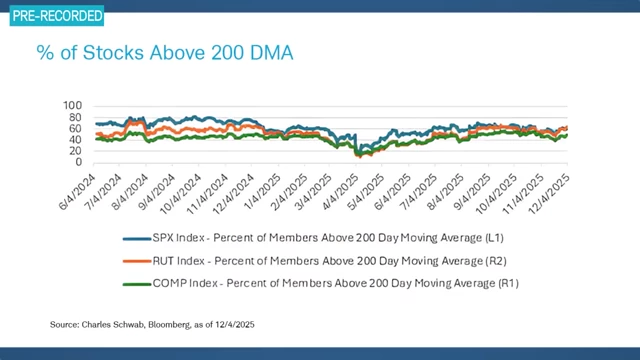
- Market breadth (e.g., percentage of stocks above their 200-day moving average) is improving, with small caps (Russell 2000) showing strength, driven by recent Fed rate cuts and expectations for more.
- Broader market participation creates more support and makes the market less susceptible to single catalyst changes.
- Derivative Strategies:
- Institutional traders show less hedging in S&P 500 options, indicating a constructive outlook.
- Retail traders maintain a "buy the dip" mentality, consistently buying market bottoms.
- For those concerned about high valuations or nominal stock prices, debit spreads or stock replacement strategies (buying an in-the-money call and selling another call) offer ways to participate in the market.
- Many top performers year-to-date (e.g., SanDisk, Micron) are outside the "Magnificent 7" and can be accessed through options strategies.
- Outlook for Small Caps [00:48:49]:
- Profitable small caps, particularly regional banks and some biotech firms within the Russell 2000, are positioned for continued growth after an all-time breakout.
- Caution is advised for non-profitable small caps.
Lightning Round: Panel Discussion [00:44:52]
- Will the "Magnificent 7" carry the mantle into 2026? [00:45:01]
- Joe Mazzola believes there will be dispersion within the Mag 7, and not all seven will maintain top performance.
- Are we in an AI bubble? [00:45:25]
- Liz Ann Sonders suggests we are likely in an AI bubble, but it might be analogous to 1997 rather than 1999 (early stages). Investors should manage risk through diversification, a reasonable time horizon, avoiding concentration, periodic rebalancing, and widening their investment net.
- Does excessive regulation slow down growth in Europe? [00:46:27]
- Michelle Gibli confirms that regulation has hindered European growth, particularly the lack of a capital markets union. However, this also indicates significant opportunity for improvement, and even small positive changes ("better or worse matters more than good or bad") could boost European stocks given low investor expectations.
- Should we be concerned about "credit cockroaches"? [00:47:30]
- Collin Martin does not anticipate a widespread "infestation" of credit defaults. While defaults have occurred, many are distressed exchanges (renegotiations). This caution supports a preference for high-quality investment-grade bonds over high-yield bonds, as potential credit losses reduce the total return outlook for riskier assets.
- What is the outlook for small caps in 2026? [00:48:49]
- Joe Mazzola sees room for growth in profitable small caps, especially regional banks and certain biotech firms, following an all-time breakout.
- What is the outlook for Treasury Inflation-Protected Securities (TIPS)? [00:49:39]
- Collin Martin has a positive outlook for TIPS. They offer positive real yields (1-2% above inflation) and their break-even rates (2.3-2.4%) are currently below the sticky inflation rate (around 3%), suggesting potential for outperformance.