How to Implement Systems, Not Just Goals, for Inevitable Success
This video explains how to build effective systems to achieve goals consistently, without relying on fleeting motivation or willpower. Successful individuals focus on repeatable systems, especially a "bad day protocol" to maintain consistency even when motivation is low. The framework for building a system involves defining a minimum viable action (MVA), reducing friction in your environment, and adding system triggers through habit stacking. Creating a scoreboard to track daily wins and progress is crucial for maintaining interest and providing positive reinforcement. Regularly review and iterate your systems weekly to adapt and optimize them as you evolve.
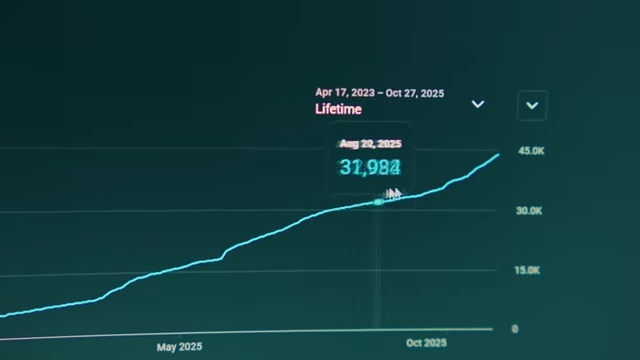
The Problem With Goals [1:30]
The video highlights that many people fail to achieve their goals because they rely on motivation and willpower, which are inconsistent.
- Goals vs. Systems: Goals set direction, but systems are for making progress. Goals create expectations, while systems create behavior, with identity locking everything in.
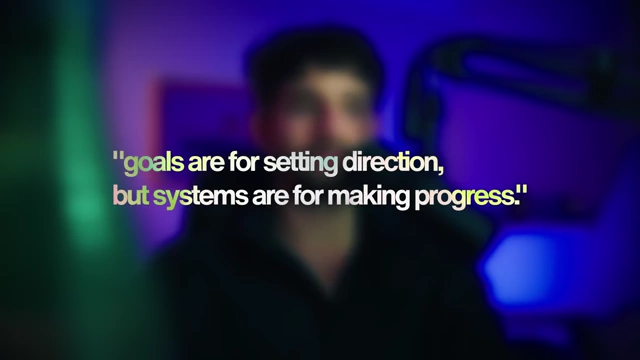
Goals are for setting direction, but systems are for making progress [ 00:01:43 ] - Relying on motivation leads to inconsistency and failure when motivation wanes.
- Shift in Approach: The speaker shares his personal shift from waiting for external validation and dopamine hits to creating self-validation through meaningful work and knowing he's on the right path. This internal validation is part of building a strong identity, which is crucial for consistency.
- Consequence of Goal Reliance: Relying solely on goals often leads to initial hype followed by a lack of sustained action and ultimately, no change.
Systems Make Success Inevitable [2:58]
To achieve consistent success, one must establish robust systems.
- The Role of Goals and Systems: While systems create success, a goal is still necessary to provide direction.
- A goal is the destination, and the system is the vehicle to get there. Both are essential; without a destination, you get lost, and without a vehicle, you can't reach your destination.
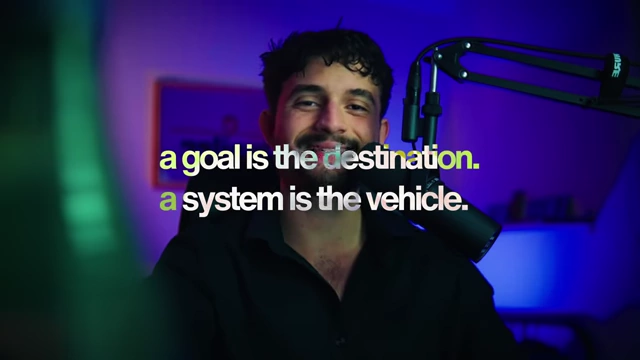
A goal is the destination. A system is the vehicle [ 00:03:55 ]
- A goal is the destination, and the system is the vehicle to get there. Both are essential; without a destination, you get lost, and without a vehicle, you can't reach your destination.
- Embracing the "Boring": Long-term results stem from repetition, clear systems, and clarity, not from the constant chase of motivation, hype, and dopamine.
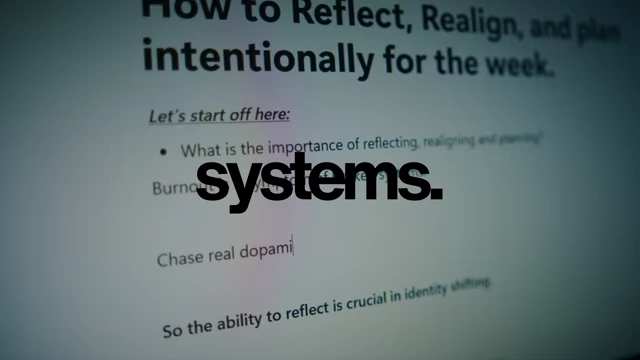
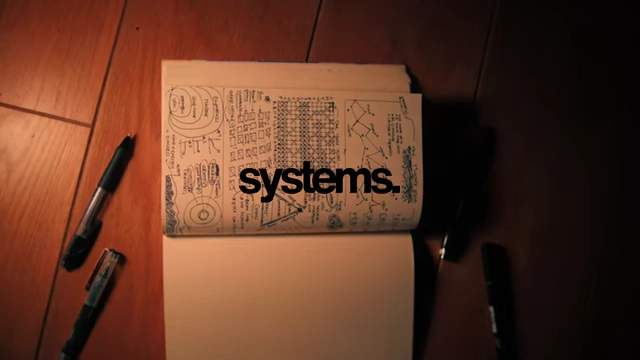
Planning document showing "systems" as a key element [ 00:04:20 ] - The "Bad Day Protocol" [4:35]: Most people prepare for their best days, but designing for your worst days is critical.
- Having systems in place for when things go wrong prevents burnout and keeps you from abandoning progress.

A perfect plan that only works when you feel great is a plan that was destined to fail [ 00:04:49 ] - A truly effective system functions even during difficult times.
- Consistency Over Perfection: Aim for 80% consistency rather than 100% perfection, as even 65-70% consistency puts you above average. The goal is to gradually raise your "average" output.
- Having systems in place for when things go wrong prevents burnout and keeps you from abandoning progress.
- The 2 Versions of You [6:49]: There's an "old" version (old habits, inconsistent, no system) and a "new" version (systems-reliant, good habits, destined for success).
- You are constantly battling between these two versions, with the new version pulling you towards your desired reality.
- Setting Standards, Not Just Goals: Instead of traditional goals, set standards that implicitly force you to level up and remove distractions (e.g., "Two videos a week, three reels per day, no distractions").

A stack of self-improvement books, including "Atomic Habits" [ 00:07:50 ] - Utilizing a Mantra [7:58]: A personal slogan or quote that serves as a constant reminder of your direction, centering you and shifting your mindset when needed.
- Example: "There is always a better way to do this," which promotes innovation and continuous improvement.
- Leverage: Hold yourself to the standard of being leveraged, focusing only on actions that significantly impact your life and avoiding time-wasting activities.
Building Your Own System [9:20]
This section outlines practical steps to construct a personal system for success.
Initial Steps [9:23]
- Write Down Your Top 10 Goals [9:24]: Clarify what you want to achieve.

Speaker writing down his top 10 goals [ 00:09:26 ] - Pick the Most Impactful Goal [9:28]: Choose the one that "moves the needle" the most.

Pick the one that moves the needle the most [ 00:09:28 ] - List Daily/Weekly Actions [9:31]: On a new page, detail the consistent daily or weekly actions required to achieve that chosen goal.
- This transforms a dream into a measurable and executable plan.
The Advanced Section: Creating Systems (Ten Steps) [10:10]
This framework simplifies system creation into a clear process.
1. Define The Minimum Viable Action (MVA) [10:16]
- Smallest Achievable Step: Determine the absolute smallest version of your system that you can complete on your worst day.
Step I: Define The Minimum Viable Action (MVA) [ 00:10:18 ] - This MVA acts as a safety net, ensuring your system remains active even when motivation is absent.
2. Reduce Friction [10:29]
- Eliminate Barriers: Remove anything that makes taking action difficult or slow.
- Identify Friction Points:
- What slows you down?
- What stops you?
- What distracts you?
- Implement Solutions: Either eliminate these friction points entirely or automate them.
- Example: For filming videos, keep camera mounted and lights pre-set to minimize setup time, making it easier to start even when feeling unmotivated.

Video editing software open with a camera nearby, illustrating friction reduction [ 00:10:56 ]
- Example: For filming videos, keep camera mounted and lights pre-set to minimize setup time, making it easier to start even when feeling unmotivated.
- Core Principle: Friction kills systems; remove it, and action becomes the default.
3. Add System Triggers [11:50]
- Automate Actions: The goal is to make your system automatic, not reliant on willpower.
- Triggers for Identity: Triggers are key to integrating habits into your identity.

This is just what I do when this happens [ 00:12:17 ] 
Triggers are what turn habits into identity [ 00:12:21 ] - Essential Components of a Trigger: Every system should incorporate:
- A cue (what initiates the action)
- An environment (where the action takes place)
- A time (when the action takes place)
- A place (the specific location)
- Habit Stacking: Connect new desired habits to existing ones.
Title card: Triggers for good behaviors [ 00:12:57 ] - Examples:
- Finishing morning coffee -> write for 15 minutes.
- After showering -> pray.
- Waking up -> meditate -> read -> pray -> deep work.
- Healthy meal -> exercise -> better sleep -> eat healthier.

A healthy meal, part of a positive habit-stacking cycle [ 00:13:19 ]
- Examples:
- Leverage Existing Triggers: Just as there are cues for negative behaviors (e.g., boredom leading to phone scrolling), you can create positive triggers to initiate good behaviors.
4. Create a Scoreboard [13:37]
- Measure Progress: "What gets measured improves. What isn't measured is forgotten."

What gets measured improves, and what isn't measured is forgotten [ 00:13:43 ] - Combat Brain's Disinterest: If you can't see progress, your brain loses interest.
- Daily Tracking: Track your wins, progress, and outcomes daily to provide positive reinforcement and dopamine hits.
- Examples:
- Habit trackers where you tick a box after completing a run or reading.
- A whiteboard to track daily output numbers (words written, videos produced, reps in the gym), time spent, and goals completed.
Lifetime progress graph showing numerical achievements over time [ 00:13:56 ] 
Whiteboard tracking daily workout reps and completion [ 00:14:46 ]
- Examples:
- Reinforce Identity: Even checking a single box reinforces your identity as someone who takes action, building momentum over time.
5. Review and Iterate Weekly [15:09]
- Continuous Improvement: Systems evolve as you evolve; a system effective at one level may be weak at another.
Step X: Review and Iterate Weekly [ 00:15:09 ] - Weekly Reflection Questions:
- What worked and what failed?
- How can I make desired actions easier to execute (remove friction)?
- How can I make undesired actions harder to do (add friction)?
- Adaptation is Key: Constant adaptation and optimization are necessary to strengthen your systems and eliminate weak points.

Notebooks open to pages filled with habit trackers and weekly reviews [ 00:15:26 ] - Summary of Systems:
- Written System: Top goals, chosen priority goal, and daily/weekly actions.
- Visual System: Scoreboard, habit tracker, whiteboard to track progress.
Detailed notebook entries outlining systems and progress tracking [ 00:12:14 ] - Mental System: Your identity, self-talk, journaling, and the mental friction you choose to remove.
- By locking these three systems in place and consistently optimizing them, success becomes an automatic outcome rather than an emotional struggle.