Understanding the US $38 Trillion National Debt, Fiscal Year 2025 Deficit, and the Government's Spending Dilemma
The US national debt has surged past $38 trillion, with an additional $1 trillion accumulated in just two and a half months. For fiscal year 2025, the federal government ran a $1.78 trillion deficit, stemming from $7.01 trillion in outlays exceeding $5.23 trillion in receipts. Key expenditures include Social Security, Medicare, and a significant $970 billion in net interest payments, which now surpass national defense spending. The challenge of cutting these major spending categories due to political implications and vital services perpetuates overspending, leading to increased money creation and inflation, disproportionately affecting lower and middle-income households. The national debt has shown a consistent and accelerating upward trend across multiple presidential administrations, regardless of political party.
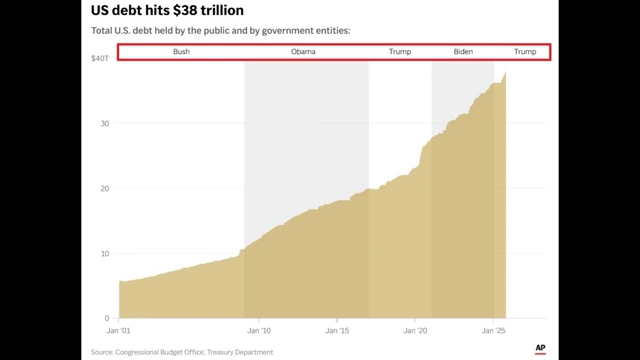
The Escalating US National Debt [0:00:00]
The US government has reached a significant milestone in its debt crisis, with the national debt exceeding $38 trillion.
- The national debt, as reported by the US Treasury, stands at $38,108,930,250,279 [0:00:06].
- An additional $1 trillion in debt was accumulated in just two and a half months [0:00:11].
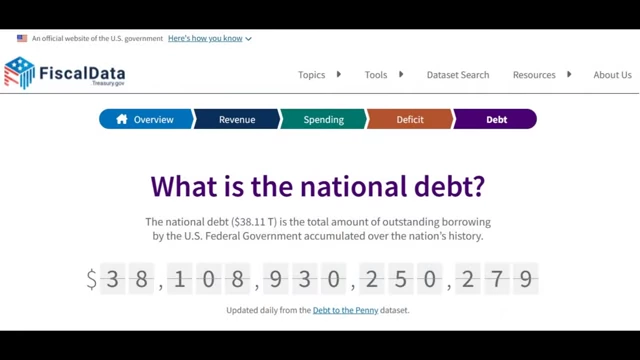
The US national debt displayed on the FiscalData website, showing the current figure of over $38 trillion. [ 00:00:10 ]
Federal Deficit Trends [0:00:17]
The US government operates on a fiscal year ending on September 30th, not a calendar year [0:00:23].
- For fiscal year 2025, the US government overspent by $1.78 trillion [0:00:34].
- This deficit is slightly better than fiscal year 2024's deficit of $1.83 trillion [0:00:42].
- The federal government ran a deficit in nine of the twelve months of FY25 [0:01:17].
- Surpluses occur in months like April (tax filing deadline) and June/September (estimated tax payments due) [0:01:28].
- For the majority of the year, the government consistently overspends [0:02:08].
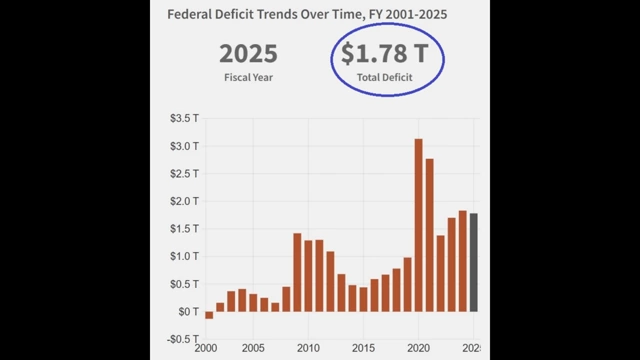
A bar chart illustrating the federal deficit trends from fiscal year 2001 to 2025, with the 2025 deficit highlighted at $1.78 trillion. [ 00:00:38 ] 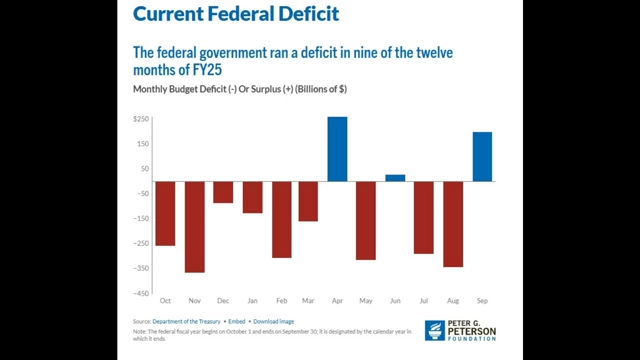
A bar chart showing the monthly federal budget deficit or surplus for fiscal year 2025, with most months in deficit (red bars) and a few in surplus (blue bars) corresponding to tax payment deadlines. [ 00:01:36 ]
Fiscal Year 2025 Budget: Receipts and Outlays [0:02:14]
For the full fiscal year 2025, the government's financial activities resulted in a deficit due to higher outlays than receipts.
- Total Receipts: The government collected $5.23 trillion in taxes [0:02:27].
- Individual Income Taxes contributed $2.65 trillion, making up approximately half of total receipts [0:02:55].
- Social Insurance & Retirement (FICA) contributed $1.86 trillion, covering Social Security and Medicare taxes deducted from paychecks or paid by self-employed individuals [0:03:00].
- Corporate Income Taxes amounted to $452 billion [0:03:20].
- Other Sources: Customs duties, excise taxes, estate, and gift taxes contributed smaller amounts [0:03:26].
- Total Outlays: The government spent $7.01 trillion [0:03:37].
- The difference between outlays and receipts accounts for the $1.78 trillion deficit, which must be borrowed [0:03:41].
- Major Spending Categories (Outlays by Function):
- Social Security was the largest expense at $1.5 trillion [0:03:54].
- Medicare spending reached $967 billion [0:03:59].
- Other health programs amounted to $875 billion [0:04:00].
- Net Interest payments on the national debt totaled $970 billion [0:04:05].
- National Defense spending was $917 billion [0:04:28].
- Income Security accounted for $72 billion, covering SNAP benefits, low-income housing, and assistance for individuals with disabilities and infants [0:08:11].
- Other smaller categories, including Veterans Benefits & Services, Transportation, and Natural Resources & Environment, collectively make up a smaller portion of spending [0:08:35].
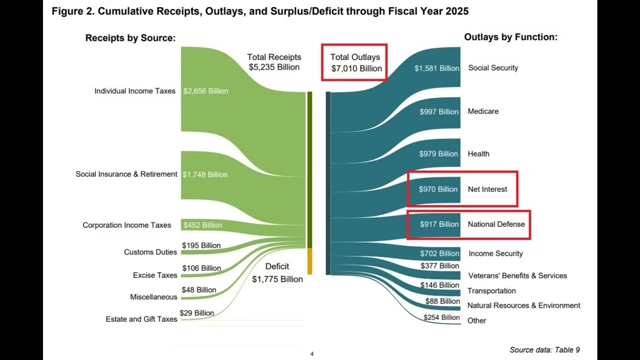
A Sankey diagram illustrating the cumulative receipts by source and outlays by function for the US federal government through Fiscal Year 2025, highlighting total outlays, net interest, and national defense. [ 00:04:27 ] 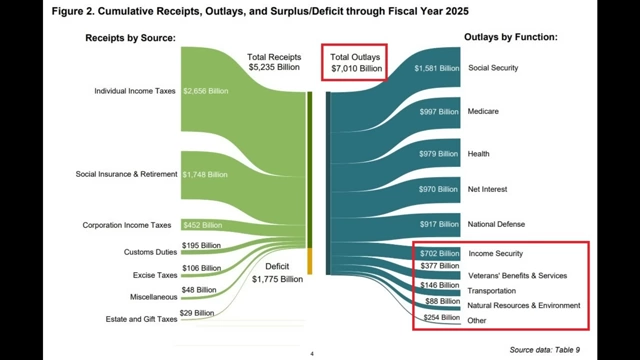
A Sankey diagram detailing US federal government outlays by function for Fiscal Year 2025, highlighting smaller spending categories like Income Security, Veterans' Benefits, Transportation, and Natural Resources & Environment. [ 00:08:39 ]
The Government's Fiscal Dilemma and Its Consequences [0:04:48]
The government faces an immense challenge in balancing its budget, as cutting major expenditures carries significant political and economic risks.
- Difficulty in Cutting Major Programs:
- Social Security and Health programs (Medicare/Medicaid) are politically sensitive to cut due to the vast number of beneficiaries (e.g., 72 million Americans receive Social Security benefits) [0:05:31].
- Any reduction in benefits would lead to strong voter backlash [0:05:43].
- Income Security and VA benefits also support large and vulnerable populations, making cuts highly unpopular [0:08:16].
- Social Security and Health programs (Medicare/Medicaid) are politically sensitive to cut due to the vast number of beneficiaries (e.g., 72 million Americans receive Social Security benefits) [0:05:31].
- Interest Payments Challenge:
- Halting interest payments on the national debt would lead to default, a crash of the US dollar, and loss of its reserve currency status [0:05:57].
- While the Federal Reserve can lower interest rates to reduce borrowing costs, these lower rates only apply to newly issued debts [0:06:23].
- Even with near-zero interest rates, the government would still pay hundreds of billions in interest payments due to the sheer size of the debt [0:06:53].
- Lowering interest rates to 0% could massively spike inflation [0:07:11].
- The national debt continues to grow rapidly, further increasing the amount allocated to interest payments [0:07:26].
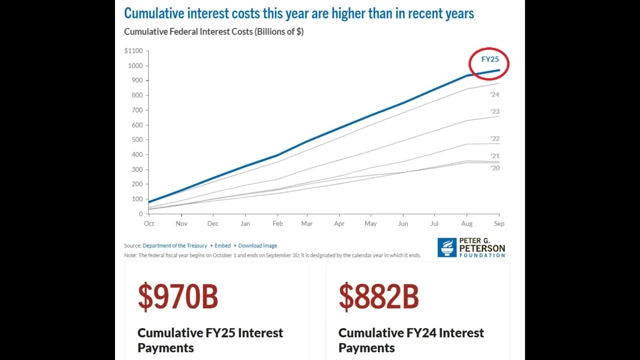
A line graph showing cumulative federal interest costs over several years, with FY25 indicating the highest costs at $970 billion compared to $882 billion in FY24. [ 00:06:44 ]
- Political Inertia and Inflation:
- Politicians are reluctant to make deep spending cuts to avoid upsetting voters [0:08:57].
- This often results in continued overspending and the printing of more money, which directly contributes to inflation [0:09:04].
- Inflation disproportionately harms middle-class and lower-income earners by eroding their purchasing power [0:09:08].
Historical Context of Debt Growth [0:09:12]
The accumulation of national debt is a continuous trend across different political administrations.
- The national debt has consistently grown under both Republican and Democratic presidents [0:09:14].
- Each successive administration, from Bush to Obama, Trump, and Biden, has added more debt than its predecessor [0:09:33].
- This indicates a systemic issue where both major political parties contribute to the increasing national debt [0:09:21].
A cumulative area chart showing the US national debt growth over time, segmented by presidential administrations (Bush, Obama, Trump, Biden), illustrating a consistent upward trend toward $38 trillion. [ 00:09:37 ]