US Housing Market Outlook 2025-2026: An Analysis of Home Prices, Sales, Mortgage Rates, and Federal Reserve Policy
Summary:
- National home prices were up 1.5% year-over-year in 2025, indicating no crash, though regional variations show drops in the South and increases in the North/Northeast.
- Housing market activity reached historic lows in August 2025, with 460,000 homes sold, a 31% decrease from five years prior.
- Current high home prices and elevated mortgage interest rates (above 6%) are the primary drivers of low home affordability and a sluggish market.
- The Federal Reserve cut the Fed funds rate by 0.25% in September 2025 and projects gradual cuts to 3.0%-3.25% by 2028, suggesting a slow easing cycle.
- The speaker predicts that if the economy degrades in 2026, the Fed will be forced to react with aggressive monetary policies like quantitative easing (QE) and more significant rate cuts, potentially preventing a housing market crash.
- Such intervention would likely lead to home prices remaining flat or increasing.
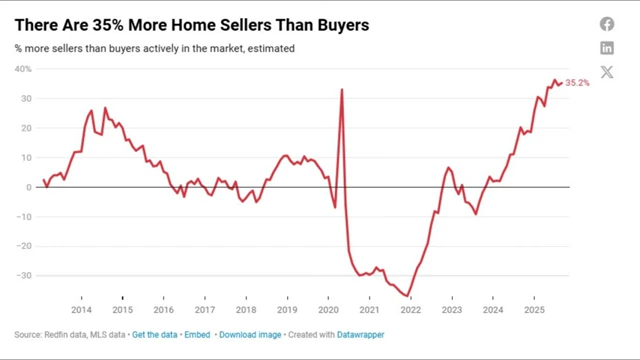
- Currently, the market favors buyers with 35% more sellers than buyers, but this downward pressure is offset by ongoing inflation and record-high M2 money supply.
- Mainstream experts largely agree, predicting home prices in 2026 will either remain flat or see modest increases (0.3% to 4%).
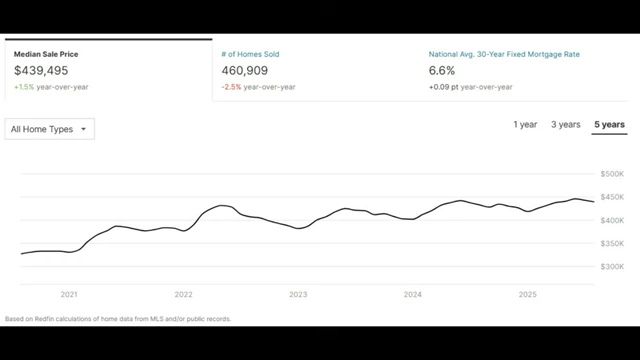
Overview of US median sale price, homes sold, and average 30-year fixed mortgage rate trends over 5 years [ 00:00:20 ]
Current Housing Market Conditions [0:00]
- National Home Prices
- Home prices are not crashing nationally, showing a 1.5% increase year-over-year [0:18].
- This national average masks significant regional differences [0:31].
- The South has experienced the biggest price drops [7:01].
- Certain parts of California show moderate declines, while others have increased [7:05].
- Most parts of the North and Northeast continue to see higher home prices [7:10].
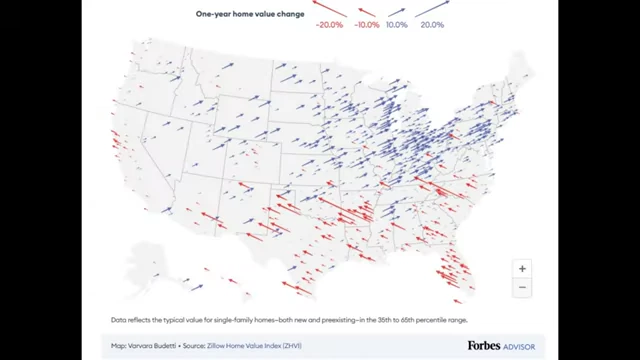
Map showing one-year home value changes across the US, with red indicating declines and blue indicating increases [ 00:06:45 ]
- Home Affordability and Sales Activity
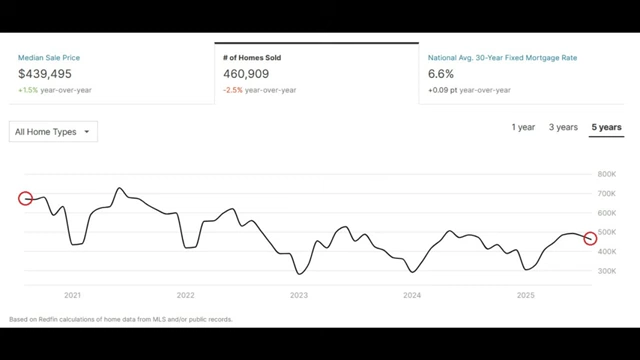
Factors Influencing the Market [1:13]
- High Home Prices: Current home prices remain very expensive [1:20].
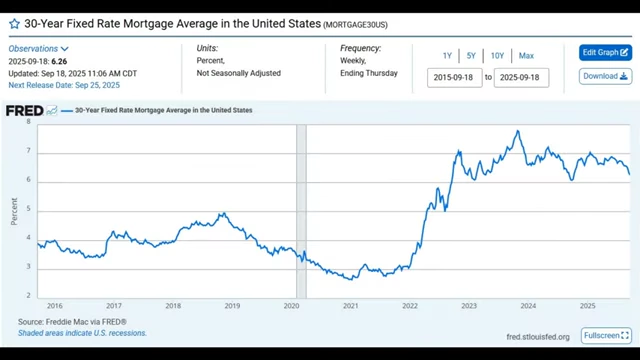
- Elevated Mortgage Interest Rates: Mortgage rates are still above 6%, significantly higher than the 3% or sub-3% rates seen previously [1:25].
Federal Reserve's Policy and Projections [1:51]
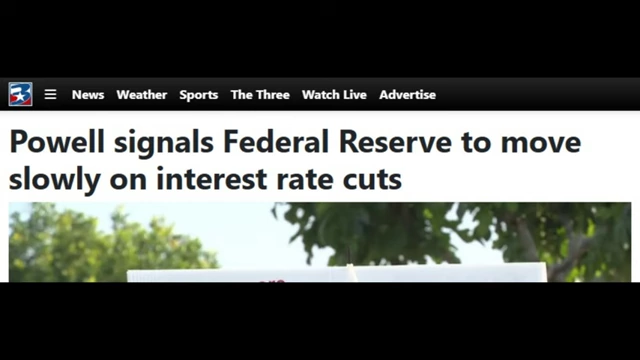
- Recent Interest Rate Cut: The Federal Reserve cut the Fed funds interest rate by a quarter point (0.25%) on September 17th, 2025, from 4.5% to 4.25% [2:02].
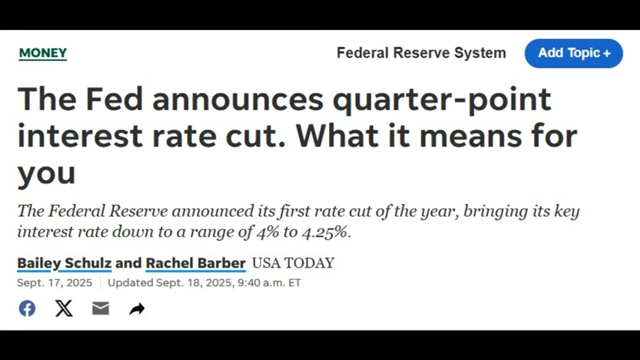
News headline announcing the Federal Reserve's quarter-point interest rate cut in September 2025 [ 00:02:00 ] - Future Projections: The Federal Reserve projects gradual interest rate cuts over the next three years [2:17].
- They aim to reduce the Fed funds rate to 3.0%-3.25% by the end of 2028 [2:31].
- For context, when mortgage rates were in the 3% range, the Fed funds rate was at 0%-0.25% [2:39].
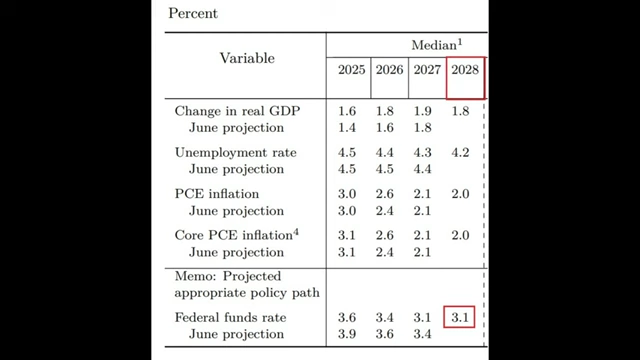
Table from the Federal Reserve showing economic projections including the Federal funds rate path through 2028 [ 00:02:25 ]
- Correlation with 10-Year Treasury Yield
- Mortgage interest rates are correlated with the interest rate on 10-year government Treasury notes [2:58].
- A previous Fed rate cut in 2024 did not lead to a drop in the 10-year yield; it remained rangebound or even increased, causing mortgage interest rates to go higher [3:21].
- Therefore, Fed interest rate cuts alone do not guarantee a significant drop in mortgage rates [3:45].
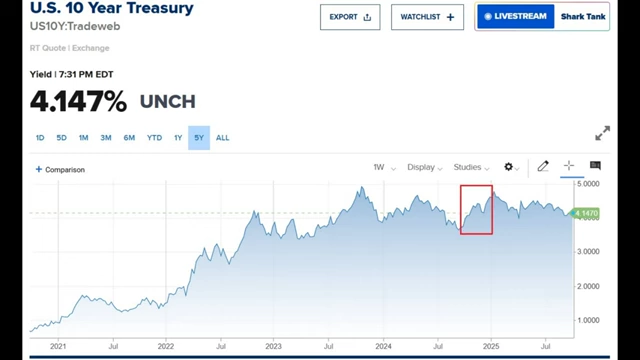
Graph of the U.S. 10-Year Treasury yield, showing its movement and a period of increase despite Fed rate cuts [ 00:03:23 ]
Speaker's Predictions for the Housing Market [4:29]
- Fed's Ability to Influence Mortgage Rates: The speaker believes the common saying that the Federal Reserve doesn't control mortgage rates is inaccurate. The Fed can significantly lower mortgage rates through quantitative easing (QE), expanding its balance sheet, and flooding the financial system with money if it chooses to [4:05].
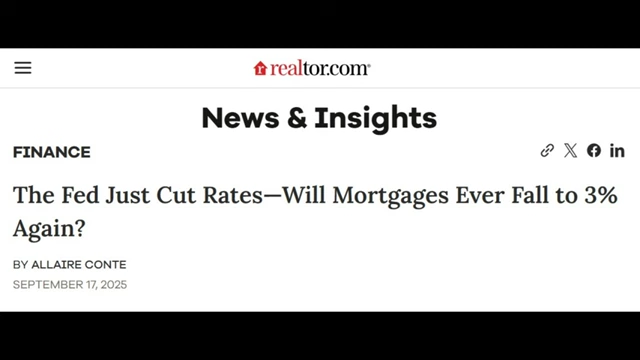
News headline questioning if mortgages will fall to 3% again after Fed rate cut [ 00:04:24 ] - Anticipated Economy Degradation and Fed Reaction: The speaker suspects the economy will degrade in 2026, forcing the Federal Reserve to implement aggressive monetary policy [4:29].
- Impact on Home Prices: This aggressive intervention is predicted to prevent a housing market crash [5:09].
- Home prices are expected to either remain flat or go up higher [5:10].
- If the Fed overdoes its rescue efforts, home prices could increase even more, similar to past interventions during the GFC or the pandemic [5:33].
- In a free market, home prices would likely be falling substantially, but the Fed's policy prevents a national deflationary collapse [5:42].
Current Market Dynamics: Buyers vs. Sellers [7:17]
- Retreating Market Participants: Both homebuyers and sellers have been retreating from the market over the past 12 years [7:20].
- From 2020 through 2022, there were significantly more buyers than sellers, creating a strong sellers' market and driving home prices up due to massive supply and demand imbalance [7:43].
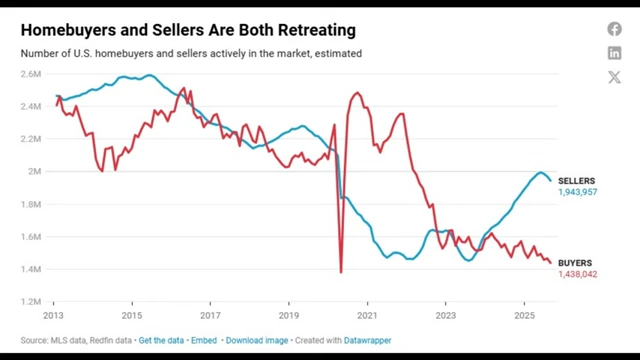
Graph illustrating the number of U.S. homebuyers and sellers actively in the market from 2012 to 2025 [ 00:07:20 ]
- From 2020 through 2022, there were significantly more buyers than sellers, creating a strong sellers' market and driving home prices up due to massive supply and demand imbalance [7:43].
- Shift to a Buyer's Market: The market has now shifted to a buyer's market [8:03].
- Conflicting Pressures: This buyer's market exerts downward pressure on home prices [8:26]. However, ongoing inflation and the record-high M2 money supply create upward pressure on home prices [8:33].
Mainstream Expert Predictions for 2026 [6:08]
- No Crash Expected: Experts generally predict no housing market crash in 2026, though affordability will remain a challenge [6:10].
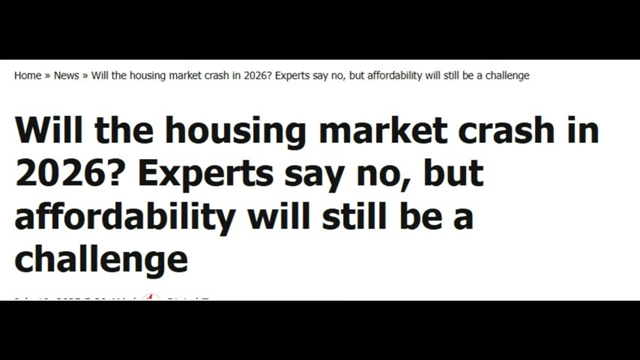
News headline confirming experts predict no housing market crash in 2026, but affordability remains a challenge [ 00:06:23 ] - Projected Home Price Increases:
- Overall Consensus: Predictions range from flat home prices to an increase of up to 4%, with potential for higher if monetary policy becomes very loose [6:31].