How to Save Thousands on Camera Gear: A Guide to Smart Buying, Selling, and Auditing
Summary:
- Avoid overspending on camera gear by employing strategic purchasing and selling methods.
- Prioritize buying used lenses and non-critical accessories like mics, bags, and tripods to bypass significant depreciation, aiming for 20-30% below retail.
- Utilize eBay sold listings to research market prices, but execute purchases on platforms like Facebook Marketplace or through personal networks for better deals.
- Focus on highly demanded focal lengths (e.g., 24-70mm, 16-35mm, 70-200mm, 35mm primes) to ensure easier resale.
- When buying new camera bodies, leverage price matching across major retailers and stack holiday promotions to maximize savings and acquire bundled accessories.
- Actively seek "quitting the hobby" listings on Facebook Marketplace, offering to buy entire bundles to secure desired items for free after reselling the rest.
- Conduct a gear audit every 90-180 days; if an item hasn't been used, sell it before its value depreciates further, or rent specialized equipment instead of owning it.
- Always borrow or rent gear to test its compatibility with your workflow before making a purchase.
- Embrace the "buy once, cry once" philosophy for essential gear, investing in quality to avoid frequent, costly upgrades, but be selective with buying accessories new (filters and OEM batteries are exceptions).
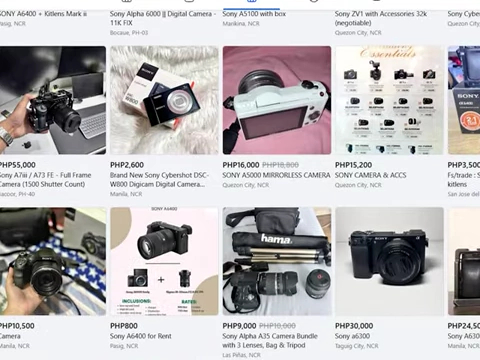
Facebook Marketplace listings showing various camera gear for sale, emphasizing bundles for quitting photographers. [ 00:06:53 ] 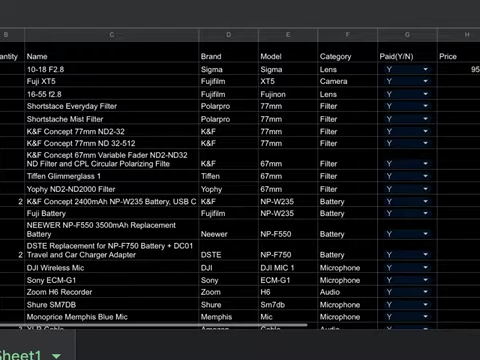
Spreadsheet showing camera gear inventory with columns for name, brand, model, category, paid status, and price. [ 00:08:32 ]
1. Introduction: Why Strategic Gear Acquisition Matters [00:00:00]
- Many new photographers overspend on bodies, lenses, and accessories.
- The goal is to save thousands by making informed purchasing decisions.
- Saved money can be reinvested into the business, workflow improvements, outsourcing, or acquiring additional beneficial gear.
2. Master Buying Used Gear [00:01:15]
- Skip the Depreciation Curve [00:01:47]: Used gear is typically 20-30% below retail, saving significantly on the initial depreciation hit.
- Example 1: Sony 24-105mm f/4 lens [00:01:28]: Purchased for $900 CAD (retail ~$1700 CAD) in immaculate, almost new condition.
- Example 2: Fujifilm 16-55mm f/2.8 lens [00:02:04]: Bought for $1100 CAD (retail ~$1800 CAD with tax); later sold for $890 CAD, effectively costing only $200 CAD for its usage.
- Example 3: Sennheiser mic [00:02:41]: Acquired for $40 (retail ~$100) from someone quitting.
- Tips for Buying Used [00:02:51]:
- Price Research [00:02:51]: Use eBay sold listings to determine market value, but prefer buying from Facebook Marketplace or personal networks.
- Avoid Rare Lenses (Unless Permanent) [00:03:08]: Rare lenses are harder to resell, so stick to popular focal lengths if you don't intend to keep them long-term.
3. Smart Strategies for Buying New Gear [00:04:00]
- When to Buy New [00:04:07]:
- Camera Bodies [00:04:07]: Often purchased new for manufacturer warranty, easier business write-offs, and peace of mind.
- Lenses [00:04:07]: Generally better to buy used.
- Price Threshold [00:04:26]: Consider buying used for cheaper bodies (e.g., APS-C bodies like Sony A6700), but new for higher-end bodies.
- Saving on New Gear [00:05:01]:
- Price Match Retailers [00:05:01]: Always try to price match between major retailers like Best Buy, Henry's, and Vist.
- Stack Holiday Promos [00:05:16]: Combine price matching with holiday sales (Black Friday, Boxing Day, back-to-school) for maximum savings.
- Bonus: Selling Included Accessories [00:05:35]: Retailer bundles often include free accessories (SD cards, chargers, extra batteries) that can be sold for additional savings.
- Example: Sony ZV1 deal [00:06:05]: Purchased for ~$2500 (retail $2800) by price matching and bundling, plus selling off included accessories.
- Bonus: Selling Included Accessories [00:05:35]: Retailer bundles often include free accessories (SD cards, chargers, extra batteries) that can be sold for additional savings.
4. Leverage "Quitting the Hobby" Deals [00:06:29]
- Facebook Marketplace Goldmine [00:06:35]: People quitting their photography hobby often list multiple items or entire kits at discounted prices because they want to sell quickly.
- Identify Opportunity [00:06:48]:
- Look for listings with multiple camera gear items (bodies, lenses, mics, bags).
- Search for keywords like "quitting" or "downsizing" in descriptions.
Facebook Marketplace listings showing various camera gear for sale, emphasizing bundles for quitting photographers. [ 00:06:53 ]
- The "Flip and Bundle" Strategy [00:07:06]:
5. Implement Regular Gear Audits [00:07:44]
- Review Every 90-180 Days [00:07:48]: If you haven't used a piece of gear in this timeframe, it's likely you won't. Sell it to prevent further depreciation.
- Maintain a Gear Log [00:08:49]: Use a Notion database or spreadsheet to track inventory and usage frequency.
A detailed spreadsheet outlining various camera gear, including filters, batteries, and microphones, with columns for quantity, name, brand, model, category, and paid status. [ 00:08:32 ] - List unused gear for sale promptly to retain its value.
6. Borrow Before You Buy [00:09:03]
- Test Drive Gear [00:09:06]: Before investing thousands, borrow from friends or rent from local gear rental places to test if it suits your workflow.
- Rental places (e.g., Camera Gear Base Gear Rental in Vancouver) are often accommodating.
- Friends can provide honest feedback on specific gear (e.g., Sony ZV1 overheating).
- Experiment with Brands [00:09:35]: Trying different camera systems (Canon, Fuji, Sony) helps determine the best fit without commitment.
- Initial experience with Canon, then Fuji, now Sony. Regrets not borrowing Fuji first to assess autofocus compatibility.
7. Embrace "Buy Once, Cry Once" [00:09:56]
- Invest in Quality Long-Term [00:09:58]: Not all budget gear is a good deal. Spending more on the right, high-quality gear upfront saves money and headaches in the long run.
- Avoid upgrading multiple times within a year due to dissatisfaction with cheaper alternatives.
- Future-Proof Your Purchases [00:10:20]: Ask if the gear will still be relevant and effective in 12 months. If not, reconsider the purchase.
8. Smart Spending on Accessories [00:10:28]
- Accessories Add Up [00:10:29]: Small, seemingly inexpensive accessories (under $200, $100, or even $50) accumulate quickly.
- Buy Used Accessories [00:10:46]:
- Mics, camera bags, tripods, plates, and cages can be bought used.
- Used camera bags are particularly slow-selling on Facebook Marketplace, allowing for lower negotiation.
- Buy New Accessories [00:10:52]:
- Value Your Time [00:11:31]: Don't waste excessive time trying to save minimal amounts ($10-$20) on small accessories; that time could be spent on more productive work.
9. Conclusion: Intentionality over Impulse [00:11:58]
- Saving money isn't about being cheap; it's about being intentional with investments.
- Avoid impulse buying every "cool" lens.
- Use existing gear to build skills and develop a unique style.
- Upgrades should be earned through need and mastery, not just bought on a whim.