How Saul Goodman's "Information Hygiene" Strategy Created a New Market for Cell Phones
- Saul Goodman, temporarily unable to practice law, found himself working at a dead-end cell phone store.

Exterior of the empty CC Mobile store where Saul initially worked. [ 00:00:29 ] - Instead of selling cell phone features, he shifted his focus to selling "privacy," creating a new demand for untraceable, single-use "burner phones."

Saul's hand-painted sign advertising "Privacy Sold Here." [ 00:02:38 ] - Realizing his lawyer appearance was a barrier, he changed his attire to connect better with his new demographic.

Saul Goodman in a casual tracksuit, ready to sell his phones. [ 00:08:00 ] - He actively brought his product to where his target customers were, selling from his car trunk at night to groups like biker gangs.

Saul selling phones from his car trunk to a customer at night. [ 00:08:13 ] - This approach exemplifies the "Blue Ocean Strategy" of moving from a highly competitive "red ocean" market to an uncontested new market by redefining the product's value and finding new customers.

Diagram illustrating the "Blue Ocean Strategy" with a single boat in an open ocean, away from crowded competitors. [ 00:11:08 ]
Introduction [0:00]
The video explores key principles of positioning, marketing, and sales using a specific scene from the TV series "Better Call Saul," highlighting how protagonist Saul Goodman (Jimmy McGill) innovated his sales approach.

From Dead Store to New Idea [1:33]
Saul, temporarily barred from practicing law, takes a job selling cell phones at a virtually empty store called CC Mobile.
- Lack of Demand: The store experiences zero customers, prompting Saul to call his boss who suggests bringing a book due to the usual slowness.
- The Need for Innovation: Faced with no sales, Saul, a marketing genius, realizes he needs to create a new idea to find customers.
- Creating a Customer: Drawing on Peter Drucker's quote about the purpose of business being to make a profit and create a customer, Saul decides to target a different type of customer by repositioning the existing product.
- Traditionally, cell phones were sold for mobile access and convenience.
- Saul aims to sell the same product by reframing its value to a new audience.

Repositioning the Product and Agitating the Problem [2:17]
Saul shifts from selling cell phone technology and features to selling "privacy."
- New Marketing Message: He paints a sign on the store window asking, "Is the man listening?" followed by "Privacy sold here."
- This strategy focuses on making people aware of a problem they might not have explicitly recognized.
Saul Goodman stands outside CC Mobile with his new hand-painted sign: "Is the man listening? Privacy sold here." [ 00:02:38 ]
- This strategy focuses on making people aware of a problem they might not have explicitly recognized.
- Artificial Demand and Demonstration: When a potential customer arrives, Saul performs a staged phone call, creating artificial scarcity by pretending that demand for "private phones" is high.
- He then dramatically smashes a phone, demonstrating its single-use, untraceable nature.
- Identifying the Customer's Pain Point: Saul avoids explicit questions, allowing the customer to infer their own need for privacy (e.g., from the IRS).
- He uses vague language to let the customer project their own fears and needs onto the product.
- Coining "Information Hygiene": Saul introduces the term "information hygiene" to describe the practice of using untraceable phones for sensitive conversations.
- He explains that buying with cash and using the phone once per private communication ensures privacy and untraceability.
- Definition of Positioning: The video defines positioning as the space you occupy in the heart and mind of the customer relative to your competitor. Saul needed to find a customer with a problem that his product (burner phones) perfectly solved, agitating the problem of privacy invasion rather than selling technology.
Adapting Appearance and Finding the Market [7:07] [9:13]
Saul realizes that his professional attire clashes with his new target demographic, leading to distrust.
- Image Transformation: His first attempt to sell "private phones" to a younger crowd at a laundromat results in him being mistaken for an undercover police officer ("narc").

Saul attempting to sell phones from his car to a skeptical group of young people at a laundromat. [ 00:07:34 ] - He changes into a tracksuit, a more casual and relatable look, to blend in with his new clientele.
Saul Goodman in his new casual tracksuit attire, walking away from his car. [ 00:08:00 ]
- He changes into a tracksuit, a more casual and relatable look, to blend in with his new clientele.
- Going Where the Customers Are: Instead of waiting for customers at the empty store, Saul takes his product directly to them, selling phones from his car trunk at a laundromat and later to a biker gang.
- Targeted Pitch to the Biker Gang:
- He leverages his past experience as a lawyer, emphasizing that he understands their need for private conversations, especially those with people in "correction facilities."
- He highlights the small size of the phones, subtly implying they can be easily smuggled.
- By speaking their language and addressing their specific pain points, the sale becomes effortless.

A biker gang gathered at the "Dog House" at night, Saul approaches them. [ 00:09:05 ] 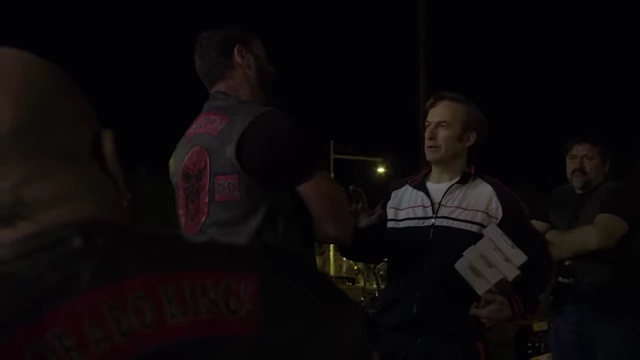
Saul pitching his phones to the biker gang, leveraging his past as a lawyer and understanding their specific needs. [ 00:09:44 ]
- Blue Ocean Strategy: This entire approach exemplifies the "Blue Ocean Strategy."
- Instead of competing in the "red ocean" of conventional cell phone sales, Saul creates a new, uncontested market space by offering a unique value proposition (privacy) to an underserved segment.
Diagram illustrating the "Blue Ocean Strategy" with a single white boat sailing in a clear blue ocean, distinct from many red boats in a crowded red ocean. [ 00:11:08 ] - The speaker provides a personal example of pivoting from making commercials (a "red ocean") to brand strategy and design, using the same skill sets for a different customer base.
- Instead of competing in the "red ocean" of conventional cell phone sales, Saul creates a new, uncontested market space by offering a unique value proposition (privacy) to an underserved segment.

Conclusion [12:02]
The video concludes by reiterating the profound lessons from Saul's entrepreneurial journey: identify a problem, create a specific solution, package it uniquely, and take it directly to the right customers, even if it means transforming your brand and market.