California's Economic Strength: How the State Became the World's 4th Largest Economy Despite Challenges and Population Decline
California has become the world's 4th largest economy, surpassing Japan, despite a significant population exodus and various criticisms. This economic growth is driven by:
- Dominant Tech Sector: Major tech giants like Apple, Google, Meta, Nvidia, and OpenAI remain headquartered in California, attracting nearly half of all US venture capital.
- Innovation Ecosystem: Top-tier universities like Stanford, Berkeley, and Caltech fuel a continuous stream of talent and innovation.
- Diversified Economy: While traditional sectors like Hollywood and agriculture face challenges, new growth in AI, biotech, and clean energy offsets these declines.
- Economic Resilience: The population outflow consists mainly of middle-income residents and remote workers, not the high-value individuals driving the state's leading industries.
However, California faces challenges such as high housing costs, crime, homelessness, and a large budget deficit, which could impact its long-term growth.

Global GDP ranking with California at $4.3 trillion [ 00:00:05 ]
California's Unprecedented Economic Growth [0:00:00]
California has solidified its position as the world's fourth-largest economy, surpassing India, the UK, and most recently, Japan, with a GDP of $4.3 trillion. This growth occurs despite a narrative of decline, including a loss of over 800,000 residents between 2020 and 2023, largely due to surging housing costs, rising crime, and a homelessness crisis. California's Governor Gavin Newsom highlights this economic strength as proof that progressive values can coexist with a booming economy.

- The state's GDP of $4.3 trillion places it behind only the entire United States, China, and Germany globally.
- This economic expansion happened while the state experienced a significant population decline, the largest since World War II.

California's population trend showing a decline between 2020-2023 [ 00:00:35 ] - Challenges such as high housing costs, increased crime, and a severe homelessness crisis have led to people moving out of the state.
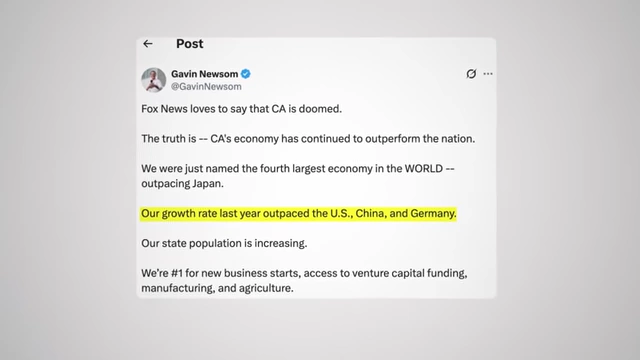
Governor Newsom's tweet highlighting California's economic outperformance [ 00:01:03 ]
The Dominant Tech Sector and Innovation Ecosystem [0:01:18]
The tech industry is by far California's largest economic engine, despite some high-profile companies like Oracle, HP, and Tesla relocating their headquarters. The core drivers of growth—Apple, Google, Meta, Nvidia, and OpenAI—remain in California, attracting a significant share of national venture capital. The state's leading universities play a crucial role in nurturing this innovation ecosystem.

- Key tech companies like Apple (valued over $3.5 trillion), Nvidia (adding $1 trillion in market value due to AI), and OpenAI (valued around $80-90 billion) are headquartered in California.

OpenAI's estimated valuation [ 00:01:51 ] - California startups received approximately $78 billion in venture capital funding in 2023, nearly half of all US VC money.
- The state benefits from deep talent pools, top-tier universities, and an unmatched innovation ecosystem.
- Stanford, Berkeley, and Caltech are all ranked among the top 15 universities worldwide.
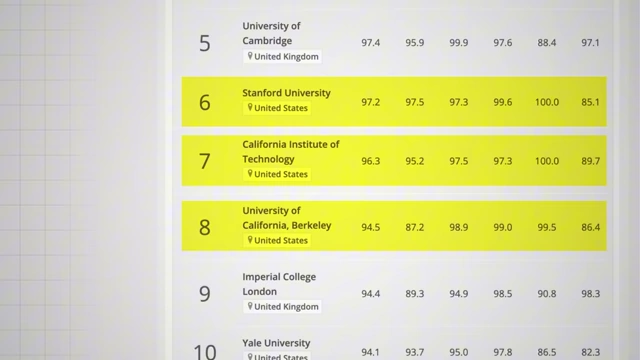
California universities ranked among the world's top 15 [ 00:02:20 ] - These universities have produced founders of major companies like Google and Netflix.
- The UC system files more patents than any other university system globally.
- Stanford, Berkeley, and Caltech are all ranked among the top 15 universities worldwide.
Hollywood's Changing Landscape [0:02:51]
California's film and TV industry, once a cornerstone of its economy, is rapidly shrinking. Its contribution to the state's GDP has dropped significantly, with fewer productions filmed in California and post-production moving abroad. The 2023 writers and actors strikes further exacerbated economic losses.
- In 2014, the film and TV industry contributed over $50 billion to California's GDP, making up nearly 5% of the state's economy.
- By 2023, only 18% of major film productions were shot in California, a sharp decline from 64% in the late 1990s.

Article highlighting the decline in major film productions in the Los Angeles area [ 00:03:28 ] - The 2023 Hollywood strikes caused an estimated $6.5 billion in economic losses in Southern California.

News report on estimated $6.5 billion economic losses in Southern California due to Hollywood strikes [ 00:03:39 ] - Studios are increasingly shifting production to other states and countries offering tax incentives and lower costs.
- The rise of AI-generated content poses a significant long-term threat to Hollywood's role as a global content engine.

Example of AI-generated video by Sora [ 00:04:03 ]
Agriculture's Shifting Importance [0:04:38]
While agriculture remains a significant economic sector, its overall contribution to California's GDP has declined over the past few decades. The sector faces long-term threats from water scarcity due to drought, unpredictable rainfall, and over-reliance on groundwater.
- Agriculture is worth over $50 billion annually and employs nearly 420,000 people.
- It contributes less than 3% to California's total economic output, down from a much larger role decades ago.
- Water access issues are leading to declining crop yields and some farmers moving operations out of state.
Leadership in Clean Energy and Climate Tech [0:05:53]
California is a global leader in clean energy and climate technology, with significant adoption of residential solar and electric vehicles. The state is also a hub for climate venture capital, focusing on solutions like carbon capture, battery storage, and hydrogen fuel. However, strict environmental regulations and lagging infrastructure present challenges.
- Over 40% of US residential solar is installed in California.
- One in four new cars sold in the state are electric, with a mandate for all new vehicles to be zero-emission by 2035.
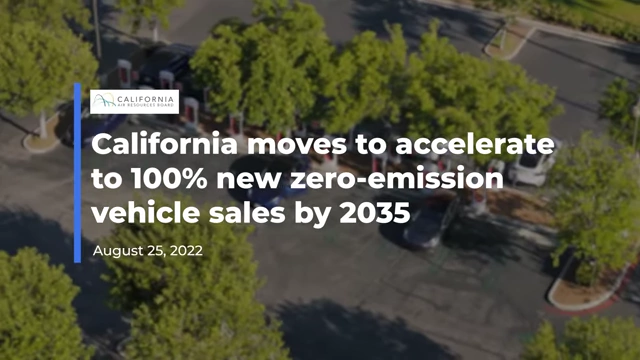
California's mandate for 100% new zero-emission vehicle sales by 2035 [ 00:06:10 ] - Startups in California are heavily invested in carbon capture, battery storage, hydrogen fuel, and grid infrastructure.
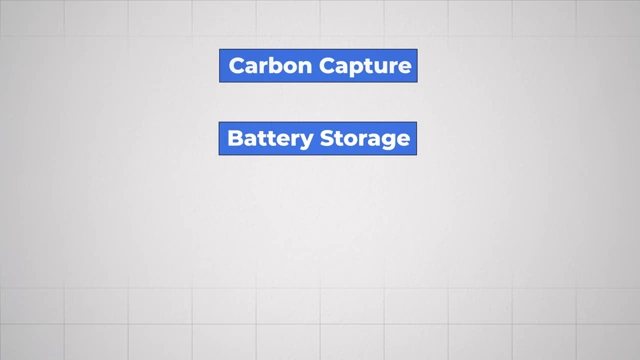
California's focus areas in climate technology [ 00:06:20 ] - High costs for building and manufacturing, lengthy permit processes, and grid infrastructure challenges are associated with these policies.
Population Outflows and Economic Resilience [0:06:46]
Despite a loss of residents to states like Texas, Florida, Nevada, and Arizona due to high costs and quality of life issues, California's GDP continues to rise. This is largely because the people leaving are primarily middle-income residents, remote workers, and retirees, while the high-value tech and innovation sectors remain robust.
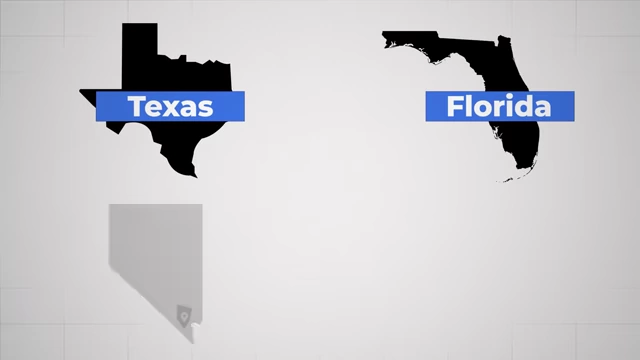
- San Francisco's office vacancy rate reached 35% in early 2024.

San Francisco's office vacancy rate reached a record 35% in early 2024 [ 00:07:02 ] - Over 350 major businesses relocated their headquarters out of California in two years.
- California's GDP increased by over $500 billion between 2021 and 2023, offsetting the population and business outflows.
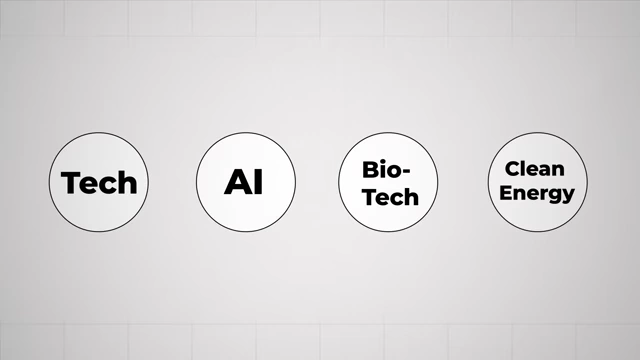
Key growth sectors boosting California's economy [ 00:04:29 ]
Future Outlook and Challenges [0:08:51]
California is rapidly closing the GDP gap with Germany, which faces its own economic headwinds. The state's continued growth is contingent on the sustained boom of its tech sector, profitable scaling of green energy, and addressing its internal issues.
- As of 2024, Germany's GDP is $4.5 trillion, while California's is $4.4 trillion, with the gap narrowing due to Germany's aging population, slowing exports, and energy crisis.
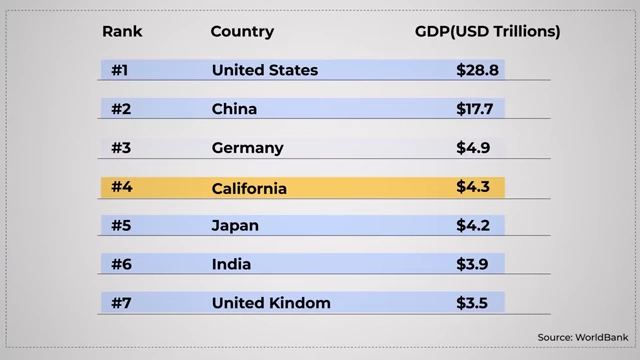
Global GDP ranking updated for 2024 comparison [ 00:08:57 ] - California's economic power is a key part of Governor Newsom's national image, who points to the state's GDP and green economy as proof of successful progressive policies.
- Despite its economic success, California still faces significant problems:
- A poverty rate 13% higher than the US average.
- Sharp income inequality, with the richest 1% earning over 20% of the state's income.
- Regulatory red tape that makes it less business-friendly.
- A budget deficit approaching $45 billion and an ongoing housing crisis.
Core Strengths: Diversity and Education [0:09:39]
California's economic resilience is attributed to its diverse industries and people. Unlike many countries that depend on one or two economic pillars, California boasts a variety of strong sectors including tech, media, agriculture, biotech, clean energy, and AI. Its demographic diversity and world-class research universities further fuel innovation and entrepreneurship.
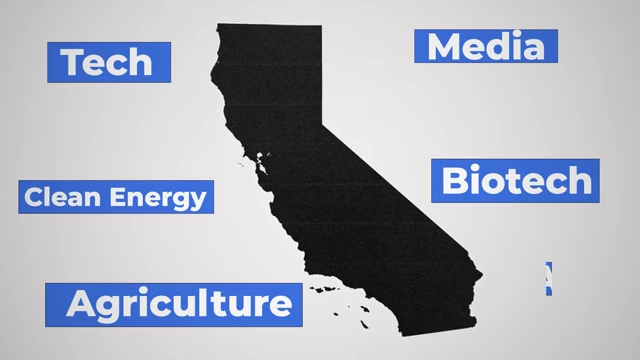
- The state's economic mix provides resilience against setbacks in individual sectors.
- California's diverse population fosters global connections and entrepreneurship.
- Home to nine of the top 25 research universities globally, consistently producing innovators and researchers.
- Despite being ranked 48th out of 50 states for business-friendliness, its desirable weather and perceived quality of life draw and retain talent, with many people prioritizing meaningful work-life balance over purely financial gains.

Report on millennials' willingness to take pay cuts for better work-life balance [ 00:10:31 ]