Understanding US Treasury Buybacks: Reasons, Impact, and Market Liquidity Concerns
The US Treasury is accelerating buybacks of its own debt, a process distinct from Federal Reserve actions. While the Federal Reserve sets interest rates and manages its balance sheet, the Treasury handles government finances, including collecting taxes and issuing debt. When the government spends more than it collects, it incurs a deficit, currently at $1.6 trillion this year. To finance this, it issues various debt instruments: short-term Treasury Bills, medium-term Notes, and long-term Bonds.
Treasury buybacks involve the government repurchasing its long-term bonds before maturity. This isn't funded by a surplus but by issuing new, shorter-term debt, effectively swapping long-term debt for short-term debt. The primary reasons for this strategy are:
- Capitalizing on currently lower short-term interest rates compared to long-term rates.
- Anticipating future Federal Reserve rate cuts, which would further reduce the cost of short-term borrowing.
- Most importantly, providing "liquidity support" to the long-term Treasury market. Demand for long-term bonds has decreased, making auctions challenging. By buying back these bonds, the Treasury aims to maintain market confidence and ensure these assets remain liquid and trustworthy.

Treasury buybacks, categorized by cash management and liquidity support, have been small but are rising year-to-date, indicating an increasing trend in government debt repurchase activity. [ 00:00:10 ]
Treasury Buybacks Explained [00:00]
The US government is currently engaged in accelerating treasury buybacks, a process where it repurchases its own issued debt.
- The rate of these buybacks has increased significantly, with more treasuries bought back year-to-date than in the entire previous year.
- This activity has generated considerable discussion and concern regarding its implications for the markets.
Treasury buybacks, categorized by cash management and liquidity support, have been small but are rising year-to-date, indicating an increasing trend in government debt repurchase activity. [ 00:00:10 ]
Fed vs Treasury – Key Differences [00:28]
It is crucial to distinguish between the Federal Reserve and the US Treasury, as their roles and operations are distinct.
- Federal Reserve (the Fed) [00:33]
- Led by Jerome Powell, the Fed is responsible for setting interest rates and implementing monetary policies like Quantitative Easing (QE) or Quantitative Tightening (QT).
- It manages a balance sheet of assets, buying or selling them to influence the money supply. When the Fed purchases assets, it effectively prints money; when debt is paid off to the Fed, those dollars cease to exist.

A chart illustrating the Federal Reserve's total assets over time, showcasing periods of Quantitative Easing (expansion) and Quantitative Tightening (contraction). [ 00:01:00 ]
- US Treasury [01:21]
- The Treasury, led by Scott Bessant, acts as the financial hub for the US government.
- It manages all incoming tax revenue and outgoing government expenditures (e.g., military, social security, government salaries).
- The Treasury operates under the executive branch and executes directives from Congress regarding government finances.
- The Treasury General Account functions as the US government's primary checking account, where all funds from taxes and borrowing are deposited, and all spending is withdrawn.
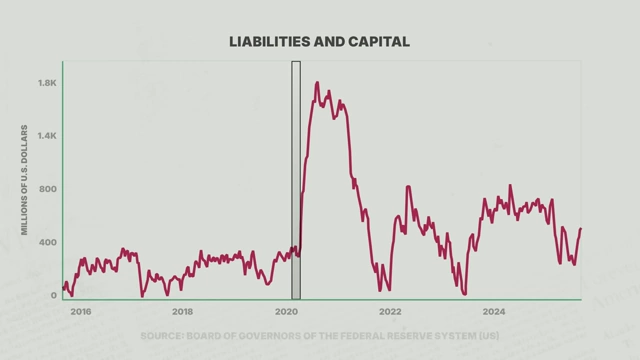
A chart displaying the balance in the Treasury General Account (TGA) from 2016 to 2024, representing the US government's primary checking account. [ 00:02:09 ]
- Treasury buybacks are operations specifically conducted by the Treasury Department and are not related to the Fed's actions.
Treasury Bonds, Notes, and Bills [02:20]
When the US government needs to borrow money, it issues debt instruments collectively known as Treasuries. These are categorized by their maturity periods:
- Treasury Bills (T-bills) [03:05]
- These are short-term securities with maturities ranging from 4 weeks to 52 weeks (approximately 1 month to 1 year).
- Bills are typically sold at a discount to their face value, and investors are paid the face value upon maturity.
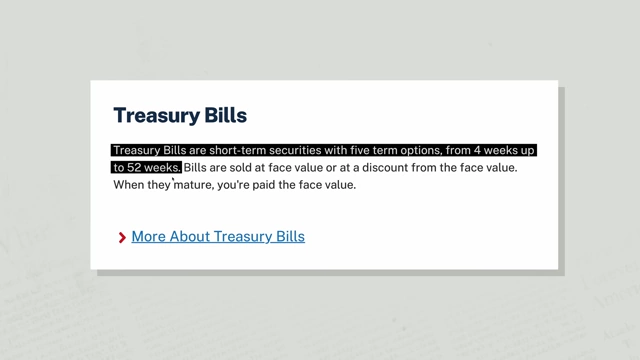
A definition of Treasury Bills, describing them as short-term securities with maturities from 4 to 52 weeks, sold at a discount to face value. [ 00:03:09 ]
- Treasury Notes (T-notes) [03:21]
- These represent government debt with medium-term maturities, typically ranging from 2 to 10 years.
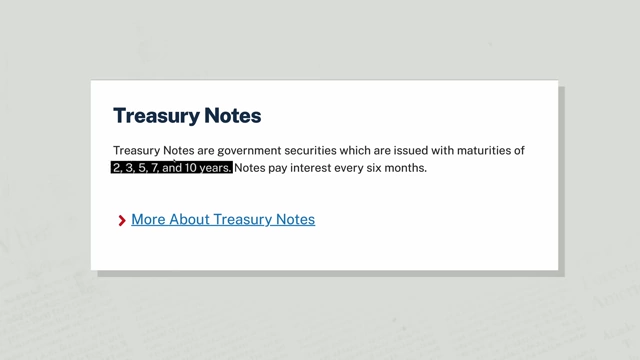
A definition of Treasury Notes, detailing their medium-term maturities of 2, 3, 5, 7, and 10 years, and semi-annual interest payments. [ 00:03:27 ]
- These represent government debt with medium-term maturities, typically ranging from 2 to 10 years.
- Treasury Bonds (T-bonds) [03:26]
- These are long-term debt instruments, historically 30-year investments, now also offered in 20-year terms.

A definition of Treasury Bonds, specifying them as long-term investments, historically 30-year, now also offered in 20-year terms, paying interest every six months. [ 00:03:29 ]
- These are long-term debt instruments, historically 30-year investments, now also offered in 20-year terms.
America’s Growing Deficit [03:40]
The US government incurs a deficit when its spending exceeds its tax revenue.
- The budget deficit for the current year to date is $1.6 trillion, which is 7% higher than the same period last year.
- This indicates a significant reliance on borrowing to cover government expenditures beyond tax income.
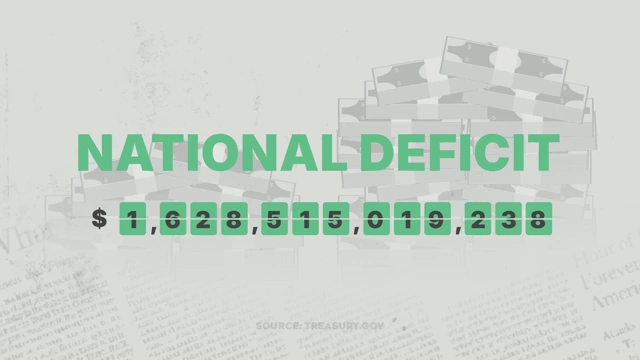
A dynamic display of the current US National Deficit at $1.6 trillion, represented by stacks of cash, highlighting the government's borrowing needs. [ 00:03:53 ]
How Treasury Auctions Work [04:17]
The process for the US government to borrow money involves auctions:
- The Treasury goes to the open market, seeking to borrow money for various durations (e.g., 1, 5, 10, 20, 30 years) at specific interest rates.
- Various entities, including banks, financial institutions, and even individuals, participate in these auctions by bidding to lend money to the government.
Buying and Selling Treasuries [05:01]
Treasury debt is known for its liquidity, meaning it can be bought and sold in a secondary market before its maturity date.
- Interest Rate Impact: The price of a Treasury bond is inversely related to interest rates. If interest rates fall after a bond is purchased, its price in the secondary market will rise, and vice versa.
- Liquidity: The US Treasury market is historically highly liquid, allowing investors to easily buy or sell treasuries from or to other market participants. However, holding treasuries involves interest rate risk; if rates rise, the bond's price falls if sold before maturity.
Why the Government Is Buying Back Debt [06:07]
The US government is increasingly engaging in Treasury buybacks, a practice that was historically rare.
- Definition: A Treasury buyback occurs when the Treasury itself purchases its own debt instruments from the market, effectively retiring and eliminating that specific debt.
- Functional Equivalence: Functionally, a treasury buyback is equivalent to paying off debt early, similar to an individual paying off a credit card, car loan, or mortgage ahead of schedule.
- The Problem: The government is not using a budget surplus to pay off debt; rather, it is currently running a deficit of $1.6 trillion. This means treasury buybacks are financed by issuing new debt, typically short-term.
- This is analogous to using a credit card (short-term debt) to pay off a mortgage (long-term debt). The net effect on the total amount of debt in the economy is zero, as one treasury in existence is replaced by another.
Why Short-Term Debt Is Replacing Long-Term Debt [08:11]
The Treasury's buyback strategy involves a deliberate shift from long-term to short-term debt.
- Targeted Buybacks: The treasuries being bought back and retired are predominantly longer-term instruments, such as 10, 20, and 30-year Treasury bonds. The tentative schedule for buyback operations shows a range of maturities, but heavily features longer terms.
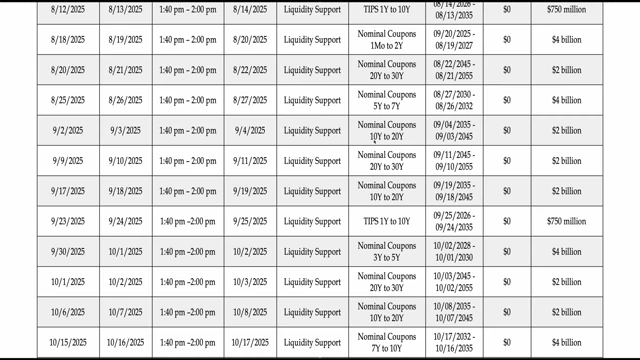
A tentative schedule of Treasury Buyback Operations, showing various security types and their maturity ranges for buybacks, with a focus on longer-term debt. [ 00:09:26 ] - New Borrowing: For most of its new borrowing, the Treasury is primarily issuing T-bills (short-term debt).
- Impact on National Debt: This strategy is shifting the entire weighted average maturity of the US national debt towards the shorter end of the curve, meaning debt will need to be refinanced more frequently.
What’s Really Driving Buybacks [10:22]
1. Minor Reason: Lower Interest Rates on Short-Term Debt [10:22]
- Yield Curve Inversion: Currently, interest rates on short-term T-bills are lower than those on longer-term bonds. For example, a 6-month yield might be around 3.96%, while a 30-year yield is 4.84%.
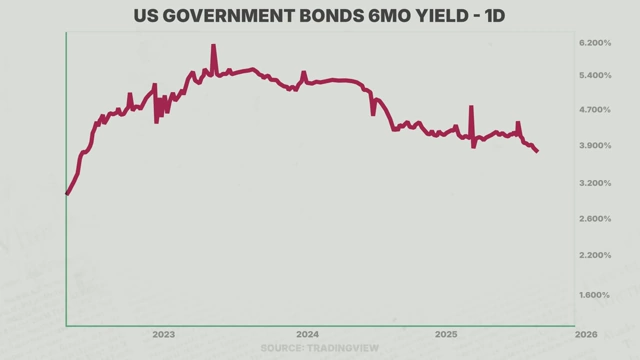
A chart showing the yield of US Government 6-month bonds over time, illustrating the currently lower short-term interest rates. [ 00:10:26 ] 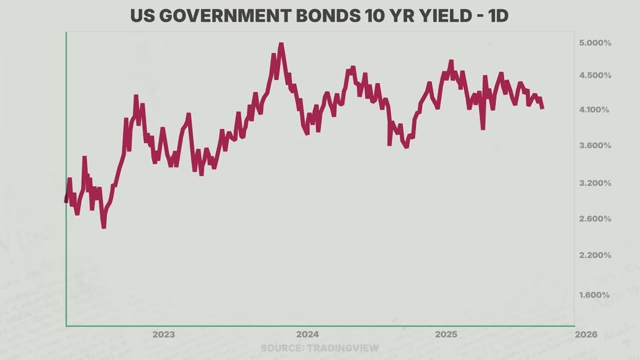
A chart showing the yield of US Government 10-year bonds over time, providing a comparison to longer-term interest rates. [ 00:02:50 ] - Cost Reduction: By buying back more expensive long-term debt and replacing it with cheaper short-term debt, the Treasury aims to slightly lower its overall borrowing costs.
- Limited Impact: However, the scale of these buybacks (e.g., $184 billion year-to-date) is a "drop in the bucket" compared to the $37 trillion national debt, making any significant impact on the overall budget negligible. Therefore, cost reduction is not the primary driver.
2. Minor Reason: Anticipation of Fed Rate Cuts [11:37]
- Market Expectation: The market strongly anticipates future rate cuts by the Federal Reserve, with a near-certainty (99.4%) for the next meeting.
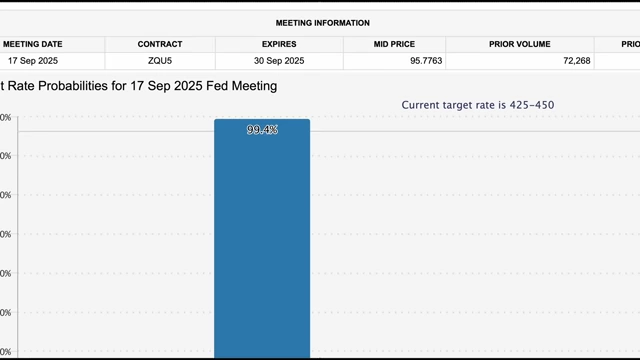
A bar chart displaying the "Fed Rate Probabilities for 17 Sep 2025 Fed Meeting," indicating a 99.4% market expectation for a rate cut. [ 00:11:44 ] - Fed's Influence: The Fed directly controls the overnight Federal Funds rate, which has a stronger and more direct influence on short-term debt instruments like T-bills and high-yield savings accounts than on long-term debt like mortgages or 30-year Treasuries.
- Strategic Positioning: By moving debt to the short end of the curve now, the Treasury positions itself to roll over this debt at potentially lower interest rates once the Fed implements its expected rate cuts.
- Limited Impact: Similar to the cost-reduction argument, the sheer volume of the national debt means this strategy will have only a marginal overall impact.
3. Primary Reason: Liquidity Problems in the Treasury Market [13:43]
- Decreased Demand for Long-Term Debt: There is significantly less demand for long-term US Treasuries (10, 20, 30-year bonds) today compared to the past.
- Auctions for these longer-term government bonds are not performing as well, leading the Treasury to pay higher interest rates than desired to attract buyers.
- High Demand for Short-Term Debt: Conversely, there remains high demand for short-term debt like T-bills.
- Investors prefer T-bills due to minimal inflation risk over short periods and their high liquidity, making them attractive for financial institutions.
- "Liquidity Support": The "operation type" for scheduled buybacks is explicitly listed as "Liquidity Support."
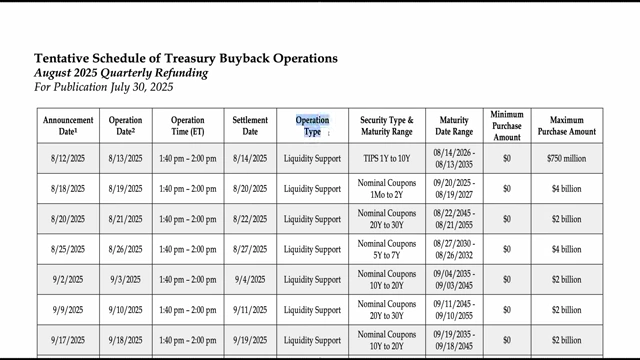
A segment from the tentative schedule of Treasury Buyback Operations, explicitly showing "Liquidity Support" as the operation type for many buybacks. [ 00:08:46 ] - Maintaining Confidence: The primary reason for Treasury buybacks is to provide liquidity support to the long-term Treasury market.
- By repurchasing these bonds, the government ensures that these instruments continue to trade with enough liquidity. This prevents a scenario where large institutional investors struggle to sell their long-term Treasuries, which could erode confidence in the market.
- This action is an attempt to instill confidence in the liquidity and safety of holding Treasuries, reassuring investors that they can always find a buyer, even if that buyer is the government itself. This is likened to a company buying back its own used products to prevent price drops and maintain market confidence.
Can This Game Keep Going? [16:22]
The need for the government to "manufacture" demand by buying back its own debt using newly borrowed funds raises fundamental questions about the true trustworthiness and liquidity of US debt.
- The speaker suggests that this strategy, despite its implications, can likely continue for longer than many people anticipate.