Lockheed CL-1201: A 1969 Nuclear-Powered Airborne Aircraft Carrier and Transport Concept
In 1969, Lockheed undertook a classified study to explore the largest feasible aircraft using contemporary technology, resulting in the CL-1201 concept.
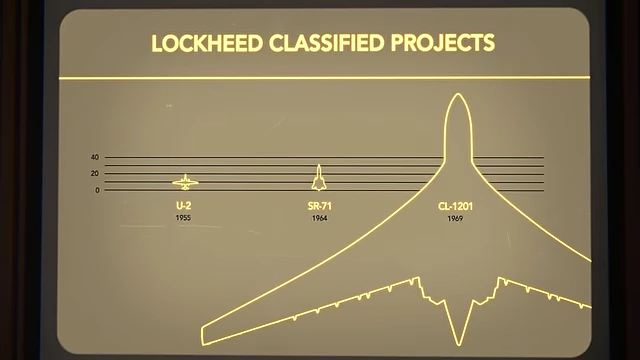
- This monumental project aimed to define the limits of aircraft size and its implications for U.S. air power during the Cold War.
- The CL-1201 proposed two main variants: an Airborne Aircraft Carrier (AAC) and a Logistic Support Aircraft (LSA), designed for rapid global deployment.
- Despite its significance, the original Lockheed study for the CL-1201 has vanished, with current information derived primarily from a 1982 AIAA conference paper.
- Both variants were designed to be nuclear-powered for extended loitering, feature Short Take-Off and Landing (STOL) capabilities via auxiliary turbofan engines, and utilize mid-air docking for troop and equipment transfer.
- The conceptual design highlighted the U.S. ambition for immediate crisis response in areas where conventional forces were inaccessible, proposing deployment from the continental U.S. to locations like the Mediterranean within hours.
- Unanswered questions remain regarding the practicalities of combat operations, such as fighter re-armament and docking stability amidst significant wake turbulence.
Introduction to the CL-1201 Concept [0:04]
The U.S. government funded an unusual aviation project in 1969 to determine the maximum size an aircraft could achieve and its potential impact on U.S. air power.
- This led to the Lockheed CL-1201, a project shrouded in mystery due to the disappearance of its original study.
- The CL-1201 was envisioned as an enormous aircraft, weighing nearly 6,000 tons and boasting an 1,100-foot wingspan.
- It was designed for dual roles: a military transport and an airborne aircraft carrier.
- Information about the project is largely pieced together from a 1982 report by the AIAA.
Cold War Context and the Need for Rapid Response [1:15]
The 1960s saw rapid aerospace advancements, with aircraft growing in size and capability, fueled by Cold War tensions between the U.S. and the Soviet Union.
- The U.S. pursued a strategy of containment, relying on carrier battle groups to respond to global crises.
- However, the intensification of the Cold War and potential blockades or denial of foreign bases necessitated new, radical technologies for rapid, decisive responses.
- Lockheed, known for its advanced and often classified projects like the C-5 Galaxy, F-104 Starfighter, U-2 Dragon Lady, and SR-71 Blackbird, was tasked with this study.
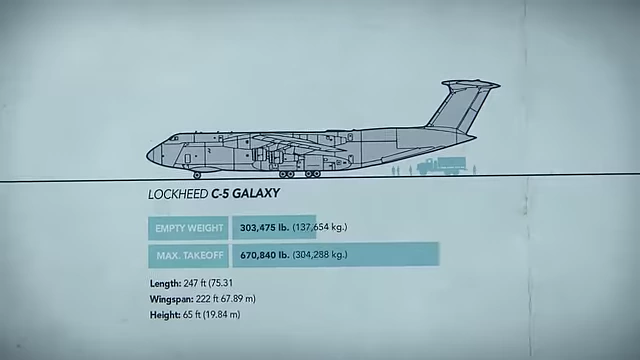
Specifications of the Lockheed C-5 Galaxy military transport aircraft [ 00:01:00 ]
Lockheed CL-1201 Design and Capabilities [3:26]
The CL-1201 concept represented a new class of aircraft, with a payload capacity in the millions of pounds, enabling deployment of hundreds of troops and armament worldwide within hours.
Two primary variants were outlined:
- Logistic Support Aircraft (LSA): Designed to transport a large amount of troops, mechanized equipment, armament, and supplies.
- Attack Aircraft Carrier (AAC): Tasked with providing air superiority, defensive functions, and serving as a central command post.
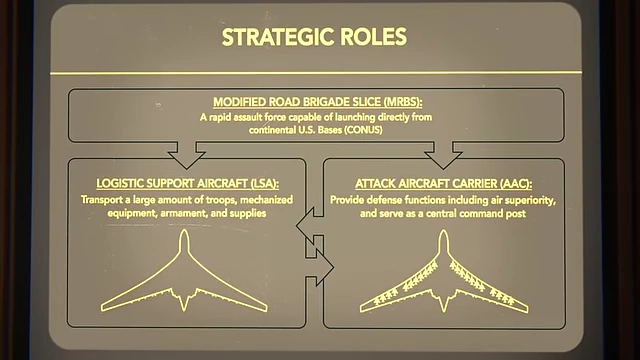
Diagram showing the strategic roles of the CL-1201 as a Logistic Support Aircraft and an Attack Aircraft Carrier [ 00:03:54 ]
Military Scenario [3:55]: Lockheed engineers envisioned a scenario where the CL-1201 would be vital in responding to a Soviet-instigated uprising, particularly if traditional naval routes (like the Mediterranean) and nearby foreign bases were inaccessible.
- The CL-1201 would be the sole means for a rapid strike force launched directly from the continental U.S.
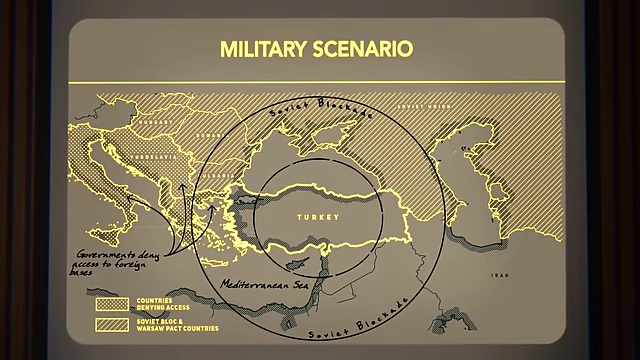
Map illustrating a military scenario in Turkey with Soviet influence, blockades, and denied access to foreign bases [ 00:04:14 ]
- The CL-1201 would be the sole means for a rapid strike force launched directly from the continental U.S.
Aircraft Components and Features [5:09]
- Attack Aircraft Carrier (AAC) [5:09]:
- Dispatched from a U.S. airbase to an aerial staging area.
- Armed with 24 aircraft and long-range cruise missiles.
- Role: Establish air superiority and act as a central command center.
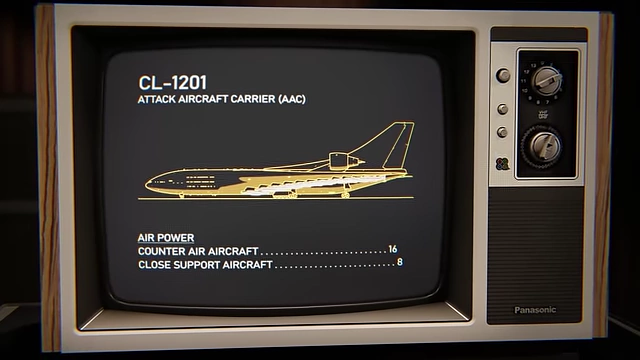
Diagram of the CL-1201 Attack Aircraft Carrier (AAC) showing air power distribution [ 00:05:24 ] - Logistic Support Aircraft (LSA) [5:30]:
- Seven LSAs would rendezvous with the AAC.
- Each LSA could carry up to 400 combat-equipped troops, 472 specialized crew, and over a thousand tons of supplies for 30 days.
- Equipped with conventional landing gear, operating from paved runways.
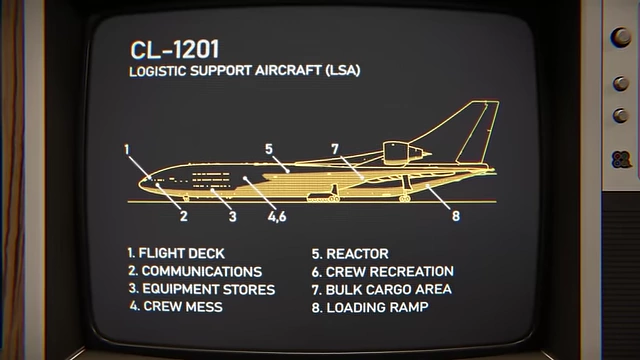
Diagram of the CL-1201 Logistic Support Aircraft (LSA) with labeled internal sections including flight deck, reactor, cargo area [ 00:05:49 ] - Short Take-Off and Landing (STOL) [6:02]:
- Both AAC and LSAs would be equipped for STOL operations to overcome massive runway requirements.
- Dozens of auxiliary turbofan engines housed in the wings and forward fuselage, each providing 82,000 pounds of vertical thrust.
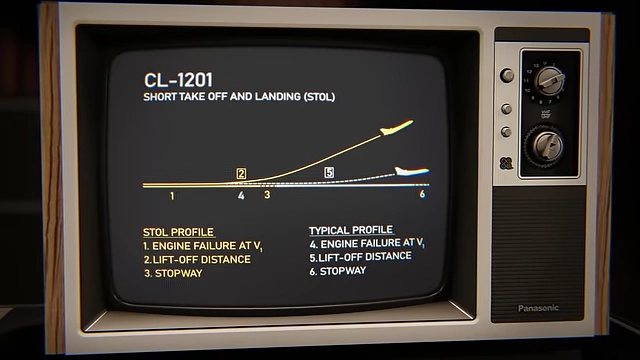
Graph comparing the STOL profile with a typical take-off profile for the CL-1201 [ 00:06:14 ] - Auxiliary Engines [6:15]:
- Four enormous high-bypass turbofans would provide an additional 600,000 pounds of thrust, allowing cruising speeds comparable to modern jet transports.
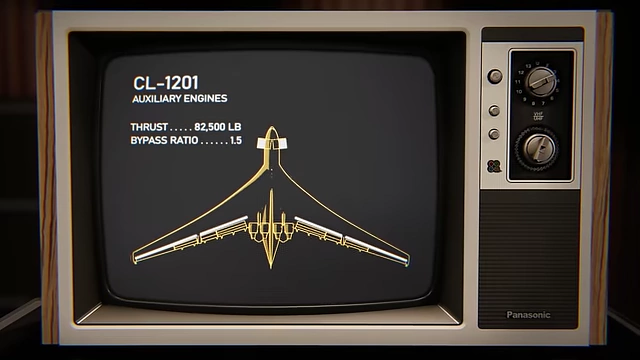
Diagram illustrating the layout and thrust specifications of the CL-1201's auxiliary engines [ 00:06:24 ] - Nuclear Propulsion [6:58]:
- Each CL-1201 would feature an 18,000-megawatt nuclear reactor (larger than those in nuclear submarines) for extended loitering of up to 30 days.
- Engines would operate on standard jet fuel during takeoff and landing, switching to nuclear power above 16,000 feet.
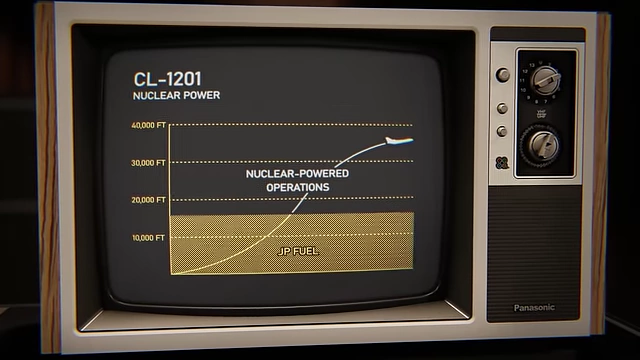
Graph showing the CL-1201's operational altitude for JP fuel and nuclear-powered flight [ 00:07:33 ] - Heat exchangers and coolant loops within a containment vessel would transfer heat while safely containing radioactive materials.
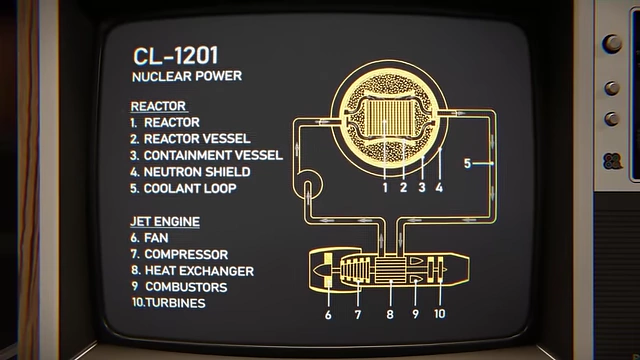
Diagram detailing the CL-1201 nuclear power system, including reactor, containment vessel, coolant loop, and jet engine components [ 00:07:48 ] - Radiation exposure was to be limited by shielding, and the reactor containment vessel housed in an impact-absorbing structure, designed to be fail-safe even in a head-on impact given a 20-second shutdown warning.
Operational Profile [8:25]: - LSAs would be joined by Medium Inter-theatre Transports (MITs) for mid-air docking to transfer troops, weaponry, and supplies. - The MITs would then connect via tow lines to the LSAs and remain on standby.
- Combat operations would commence with carrier-based attack aircraft clearing defenses for a secure airfield. - MITs would shuttle troops and equipment between LSAs and the airfield, protected by carrier-based fighter aircraft. - CL-1201s would operate at 30,000 feet and at least 600 nautical miles from enemy forces to avoid engagement, relying on counter-air aircraft, missiles, and laser weapons if necessary.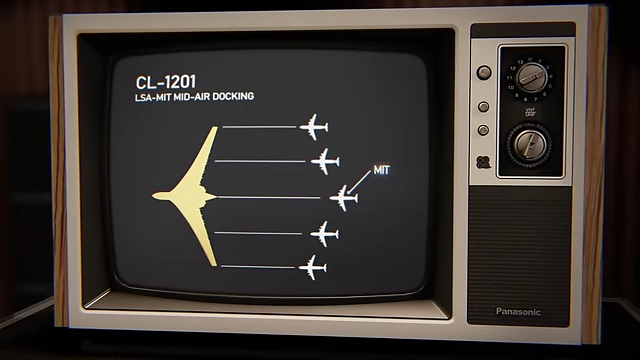
Diagram illustrating the mid-air docking and transfer operations between the CL-1201 LSA and MIT aircraft [ 00:08:58 ] - The mission aimed to stabilize the situation within 30 days and reopen the Mediterranean Sea for conventional naval forces.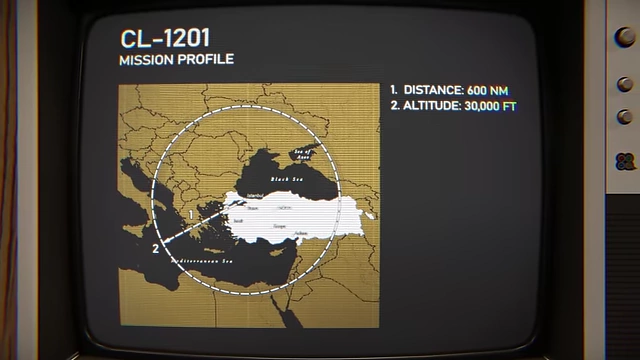
Map showing the CL-1201's mission profile with operational distance and altitude from enemy forces [ 00:09:43 ]
Unanswered Questions and Project Legacy [10:32]
Despite the detailed study, many technical and engineering questions about the CL-1201 remain unanswered, partly due to the missing original report.
- Key questions include how fighters would be re-armed during combat and how they would dock with the carrier given the massive wake turbulence from its wings.
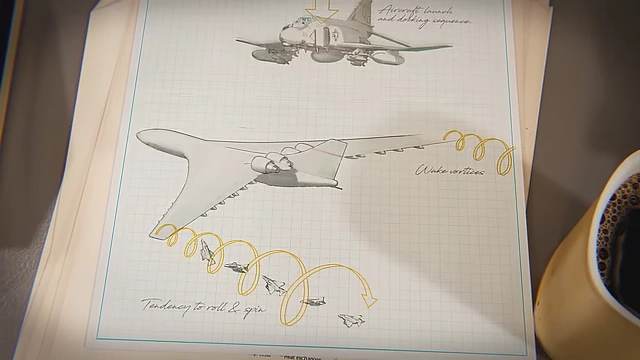
Illustrative diagram of the potential issue of docking fighter aircraft with the CL-1201 amidst wake turbulence [ 00:11:02 ] - The CL-1201, like many other speculative designs of the Cold War era, aimed to explore the limits of technology and identify future challenges, rather than provide definitive solutions.