This talk by Martin Jonasson and Petri Purho defines "juiciness" in video games as elements that make the game feel alive, responsive, and satisfying with minimal user input, encompassing visual, auditory, and even textual feedback. They demonstrate various techniques using a simple Breakout clone, transforming it into an engaging experience. Key methods include:
Color: Adding varied colors for visual distinction.
Tweening/Easing: Smoothly animating properties like position, scale, and rotation using different mathematical curves, including adding random delays for organic feel.
Squeezing & Stretching: Making elements like the paddle and ball deform and react dynamically to interactions.
Sound Effects & Music: Highlighting the profound impact of audio on perceived interaction and immersion.
Particles: Incorporating smoke, debris, and trails to enhance hits and movements.
Screen Shake: A powerful, low-effort effect to emphasize impacts.
Personality: Adding simple features like eyes and a mouth to game elements to convey emotion and character.
These elements, when combined, transform a basic game into a rich, engaging experience, proving that adding juiciness consistently improves game feel.
The fully "juicy" Breakout game in action, showcasing numerous visual and auditory effects, including particles, trails, screen shake, and the expressive paddle.
[
00:14:39
]
"Juice" in video games refers to elements that make the game feel alive and responsive, providing tons of cascading action and response for minimal user input. [0:00:53]
These elements often involve things that wobble, squirt, bounce, or make cute noises. [0:00:35]
The term originated from the Gamasutra article "How to prototype a game in under 7 days." [0:00:46]
While typically visual or auditory, "juice" can also apply to text-based games, where it manifests as fun and unexpected narrative responses to player actions. [0:01:03]
Adding juiciness is presented as a universally beneficial game development technique, guaranteed to improve a game 100% of the time. [0:01:56]
Tweening, also known as easing, involves generating "in-between" frames or values for smooth animation. [0:02:49]
Different easing curves, showing linear, ease-in, ease-out, overshoot, and a complex bouncing curve.
[
00:03:00
]
In programming, it means transitioning a property from a start point to an end point over a specified duration using a mathematical equation. [0:03:31]
A simple implementation involves moving a value 10% towards its target each frame, resulting in an initial fast movement that slows down as it approaches the target. [0:03:51]
A simple equation for easing `x += (target - x) * .1;`, demonstrating movement of a value 10% towards its target each frame.
[
00:04:00
]
Blocks falling into place upon level reset can be tweened for a more dynamic entrance. [0:04:23]
Various easing equations can be applied to control the motion, such as slowdown, overshoot (going slightly past the target), and bouncing. [0:04:33]
Beyond position, other properties like rotation and scaling can also be tweened. [0:05:07]
Adding a random delay to the tweening of each block makes their appearance feel more organic and less uniform. [0:05:19]
Enhancing Interaction with Squeezing and Stretching [0:05:34]
"Squeezing and stretching" is a non-programming term used to describe effects that dynamically alter the shape or size of game elements in response to interactions. [0:05:34]
Sound is one of the most cost-effective and crucial additions to make a game juicier, yet it's often overlooked. [0:07:50]
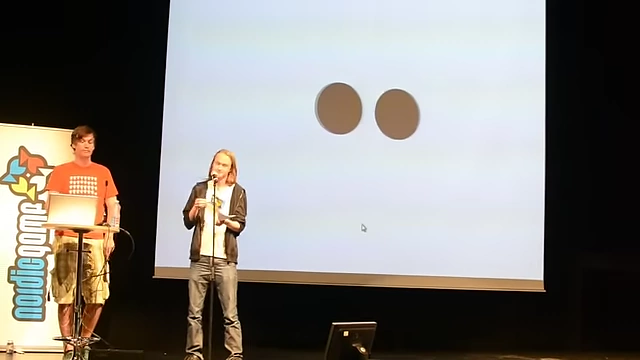
A simple demo shows two circles passing through each other. [0:08:00]
Without sound, they appear to merely pass through. [0:08:05]
Two brown circles moving towards each other, appearing to merely pass through without sound.
[
00:07:59
]
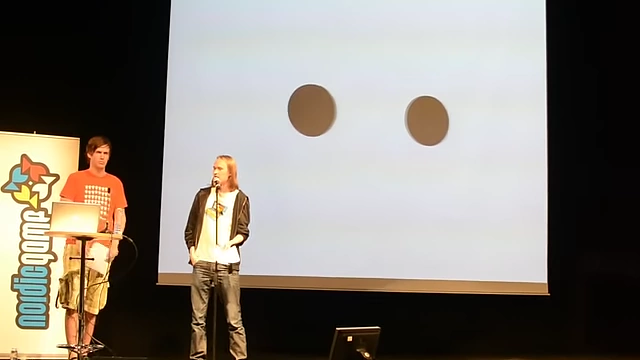
With a sound effect at the moment of overlap, they appear to bounce off each other, demonstrating sound's profound impact on perceived interaction. [0:08:13]
Two brown circles appearing to bounce off each other, with sound enhancing the perceived interaction.
[
00:08:19
]
A side-by-side comparison shows the dramatic transformation from the original, basic Breakout clone to the fully "juicy" version with all effects enabled. [0:14:10]
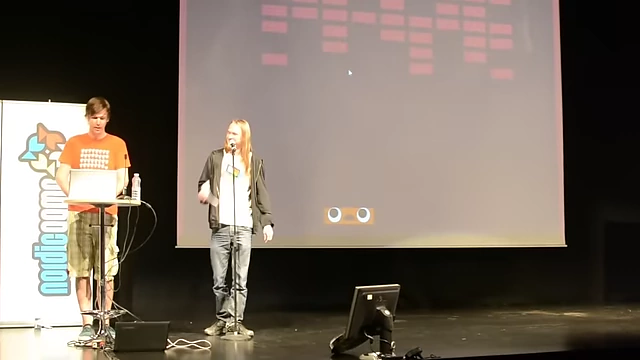
The final game, with all visual, auditory, and personality effects combined, feels significantly more engaging and alive. [0:14:21]
The fully "juicy" Breakout game in action, showcasing numerous visual and auditory effects, including particles, trails, screen shake, and the expressive paddle.
[
00:14:39
]