The Neurological Impact of Digital Media and AI on Human Cognition
The video discusses the concerning influence of the digital world and AI on human brains and psychology, particularly highlighting risks of cognitive decline and mental health disorders. Drawing from the book "Reader, Come Home" by Maryanne Wolf, the speaker explains how reliance on digital content, as opposed to physical books, diminishes critical thinking, empathy, and attention span due to rapid task switching and constant overstimulation. A study on ChatGPT use further illustrates this, showing significantly less brain activity for meaning-making and memory recall in AI-reliant individuals.
The speaker also warns about the severe developmental consequences of excessive screen time for children, leading to attention deficits and underdeveloped crucial brain networks, referencing American Academy of Pediatrics guidelines. To mitigate these risks, recommendations include:
- Regularly reading physical books without distractions.
- Protecting children from smartphones and AI tools.
- Limiting screen time for all ages.
- Engaging in handwriting activities like journaling or summarizing book chapters to preserve cognitive skills.
- Resisting the temptation to let AI think for you, using it only for intentional, slow information gathering.
- Emphasizing the humanities to foster deeper thinking.
Introduction and Concerns about the Digital World and AI [0:00]
The speaker, a neurologist, expresses deep concern about the digital world's influence on human brains and psychology, citing data on AI's effects. She mentions "Reader, Come Home" by Maryanne Wolf, a book by a neuroscientist that details changes to our brains since the digital age began.

- Growing Reliance on AI: Since ChatGPT and other AI tools were introduced, there's been an "insidious creep" towards increased reliance on artificial intelligence.
- While AI taking jobs is a concern, the speaker emphasizes a more dangerous aspect: the risk of AI contributing to cognitive decline and increasing mental health disorders.
- This is presented as a hypothesis based on current literature, urging for awareness before widespread damage occurs.
- Lack of Safety Testing: Unlike medications that undergo rigorous FDA testing for safety and efficacy before public release, powerful new technologies like AI are being released without such testing.
- This release is primarily driven by profit motives from a small technocracy, affecting entire populations, including children, without assessing potential massive negative consequences.
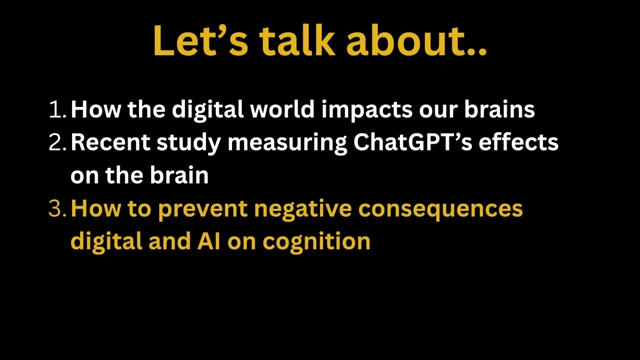
Outline of the video's discussion points [ 00:04:40 ]
- This release is primarily driven by profit motives from a small technocracy, affecting entire populations, including children, without assessing potential massive negative consequences.
Impact of the Digital World on Brain and Cognition (Based on "Reader, Come Home") [4:47]
The video delves into the insights from Maryanne Wolf's book, highlighting how the transition from physical books to digital content has detrimentally altered brain function.
- Detrimental Effects of Digital Reading:
- Decreased Critical Thinking and Empathy: Digital consumption leads to a reduced ability for critical analysis and understanding others' perspectives.
- Importance of "Deep Reading" Physical Books:
- Reading physical books activates specific neural networks in the brain.
- These networks promote prolonged focus, sustained attention, and robust memory formation.
- They also involve areas crucial for empathy, allowing individuals to mentally "put themselves in someone else's shoes" [5:35].
- Deep reading skills are essential for:
- Negative Effects of Digital Reading Habits:
- Increasing reliance on the digital world weakens the neural networks necessary for empathy and critical thinking [6:29].
- Digital mediums lead to constantly divided attention, minds flooded and overstimulated with too much information [6:54].
- Decline in Attention Span and Memory:
- Rapid Task Switching and Novelty Bias:
- Digital reading promotes rapid task switching, where attention rapidly shifts between numerous stimuli [7:53].
- This results in high stimulation and a low boredom threshold, leading to a constant seeking of more stimuli [8:09].
- Novelty bias, an evolutionary attraction to new things, now overloads the brain, causing habituation and a desire for faster rates of novel stimuli, which can lead to addiction tendencies [8:22].
Specific Impact on Children [8:55]
The author discusses unforeseen costs at younger ages due to screen time.
- Consequences of Excessive Screen Time in Children:
- Decreased Boredom Thresholds: Children accustomed to constant digital stimulation struggle with boredom when devices are removed, often leading to tantrums [9:02].
- Environmentally Induced Attention Deficit: Excessive screen time directly reduces attention span [9:13].
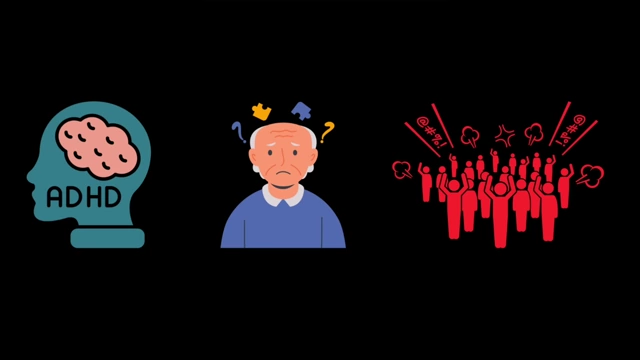
- Altered Brain Development: Leads to overdevelopment of visual networks and underdevelopment of critical networks, including:
- American Academy of Pediatrics Guidelines: The AAP recommends no screen time for children under 18 months to 2 years due to its crucial role in early brain development [9:55].
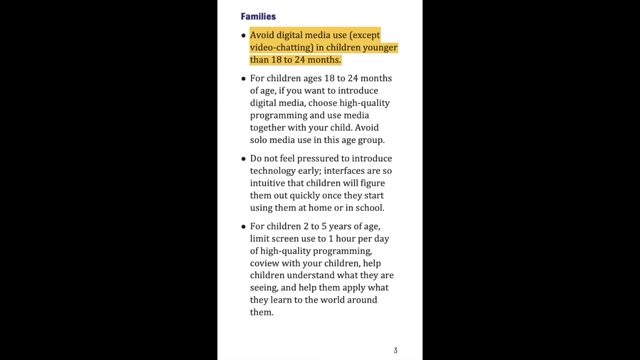
American Academy of Pediatrics guidelines highlighting avoiding digital media for children younger than 18-24 months [ 00:09:59 ] - The speaker emphasizes that this information is to be helpful, acknowledging the difficulties parents face.
- Effects on Older Children and Adolescents:
- The lack of deep reading stunts the growth of neural networks vital for critical thinking, preventing students from deeply pondering and building knowledge, instead leading to rapid skimming and superficial processing [10:30].
- Social media data indicates it destroys childhood, social development, and mental health in adolescents (referencing Dr. Jonathan Haidt's work, particularly "The Anxious Generation") [17:15].

Dr. Jonathan Haidt, psychologist specializing in social media's impact on children [ 00:17:31 ] 
Book cover for "The Anxious Generation" by Jonathan Haidt [ 00:17:38 ]
How ChatGPT and AI Affect Brain Activity (Recent Study) [12:44]
The discussion shifts to a recent study measuring brainwave activity during essay writing tasks, demonstrating AI's direct impact on cognitive processes.
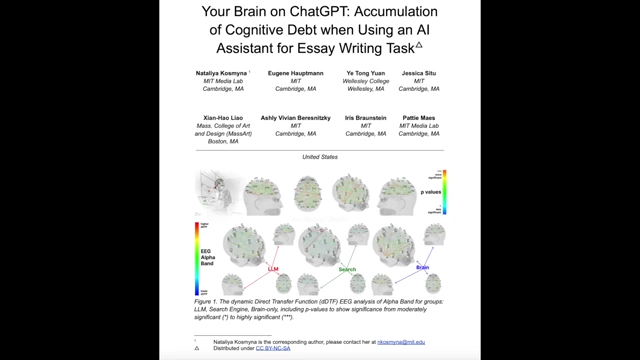
- Study Design: Participants were tasked with writing essays using either:
- ChatGPT (Large Language Model / LLM)
- A search engine (Google)
- No external resources ("Brain only")

Diagram showing the three groups in the essay writing study: ChatGPT, Search Engine, and Brain Only [ 00:12:56 ]
- Key Findings:
- "Brain Only" Group: Showed stronger activation of specific neural networks, with significant connectivity between brain nodes [12:57]. This indicates high brain activity between connected regions.
- Numerous nodes in the left hemisphere (detail-oriented, reductionistic thinking) converged onto key nodes in the right hemisphere (visual-spatial processing, big picture understanding, meaning, context) [13:28].
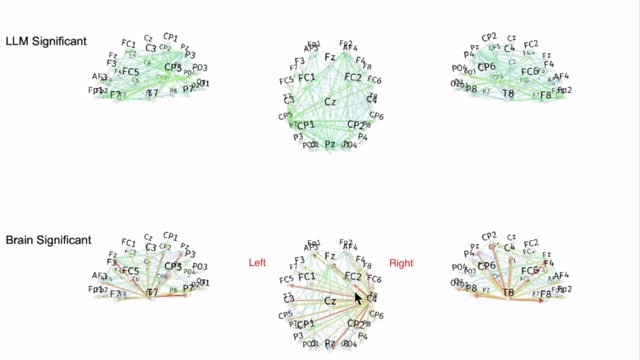
Diagram comparing brain activity connectivity for LLM significant (less activity) and Brain significant (more activity) [ 00:13:10 ] 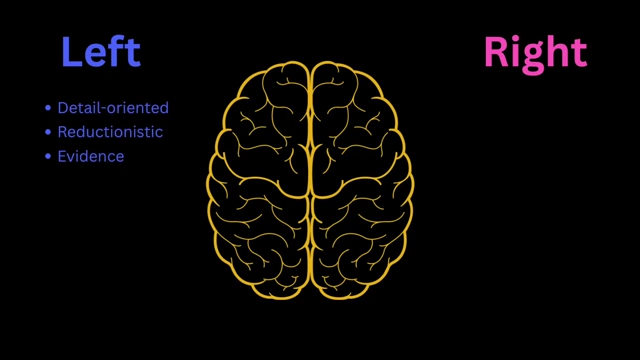
Infographic illustrating the lateralized functions of the Left brain (detail-oriented) and Right brain (big picture, meaning) [ 00:13:55 ] - This signifies activation of networks required to recall details, integrate them, and create a big-picture understanding or "meaning" [14:11].
- Numerous nodes in the left hemisphere (detail-oriented, reductionistic thinking) converged onto key nodes in the right hemisphere (visual-spatial processing, big picture understanding, meaning, context) [13:28].
- ChatGPT Group: Showed significantly fewer strong connectivities, indicating less activation of critical networks for memory recall, detail processing, and assigning meaning [13:17][14:28].
- The "Use It or Lose It" Principle: The brain operates like a muscle; non-activated networks weaken and are eventually lost [14:57].
- Outsourcing cognitive skills, especially creativity, through AI leads to a loss of these essential neural networks.
- Hypothesized Consequences of Cognitive Outsourcing: The speaker hypothesizes that this outsourcing will contribute to:
- Socrates' historical concern that written word would decrease memory capacity is brought up as a parallel to current AI fears [15:27].
- "Brain Only" Group: Showed stronger activation of specific neural networks, with significant connectivity between brain nodes [12:57]. This indicates high brain activity between connected regions.
Mitigating Digital Health Risks [16:25]
The speaker provides actionable steps individuals and parents can take to counteract the negative effects of the digital world and AI.
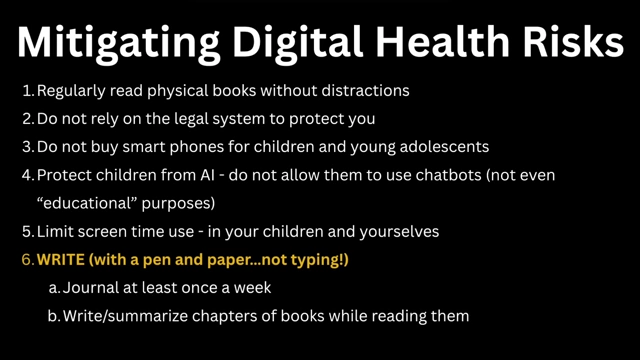
- Regularly Read Physical Books Without Distractions [16:28]: Re-engage with the deep reading process that stimulates essential brain networks.
- Do Not Rely on the Legal System for Protection [16:37]: While hoping for policy changes (e.g., making smartphones/AI illegal for children), individuals must take personal responsibility.
- Do Not Buy Smartphones for Children and Young Adolescents [16:58]: Restrict access until their frontal lobes are sufficiently developed to understand the implications and consequences of these devices.
- Protect Children from AI [17:03]: Do not allow children to use chatbots, even for "educational" purposes.
- Limit Screen Time Use [17:44]: For both children and adults.
- Write (with a Pen and Paper…not Typing!) [17:45]:
- Journal at least once a week: This cultivates networks that organize identity and critical thinking skills [18:11].
- Write/summarize chapters of books while reading them: This method, proven effective for memory and deeper conceptual understanding, helps ingrain information into long-term memory and build upon learned knowledge [18:26].
- Resist the Temptation to Let AI Think for You [19:00]:
- Use AI strictly as an information-gathering source, and do so intentionally and slowly.
- The brain processes and integrates information slowly, and consuming too much at once hinders learning and memorization [19:17].

An image showing a brain interacting with a microchip, representing AI processing [ 00:19:20 ]
- Emphasize the Importance of Humanities [19:34]: Promote philosophy, art, and classic literature, as appreciation for humanity and these fields historically led to technological advancement in enlightened periods.