5 Benefits of Painting Without a Sketch for Digital Artists
Marc Brunet advocates for painting directly with values and colors instead of starting with a sketch, emphasizing five key benefits. This approach helps artists overcome canvas paralysis by immediately creating an image, fosters flexibility as nothing feels "precious," develops a deeper understanding of 3D forms over mere outlines, builds genuine confidence in creative abilities, and provides greater control over a piece's level of finish.
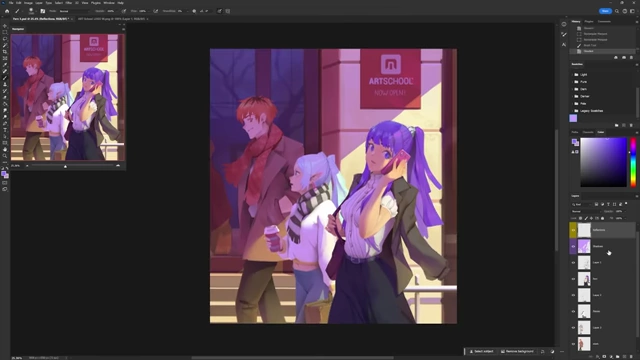
Introduction: Challenging the Traditional Sketch-First Approach [0:00]
Marc Brunet discusses a common misconception among artists, including his past self, that a detailed sketch is a necessary "solid foundation" before coloring. He challenges this idea, suggesting that painting without a preliminary sketch offers significant, often overlooked, benefits.
- Traditional belief: A perfect sketch is essential, otherwise the art will "look like garbage."
- Counter-argument: Painting without a sketch has "crazy benefits" that can surprise artists.
- Purpose of the video: To show why ditching the sketch, at least sometimes, can be highly advantageous.
- The video will demonstrate this process live, starting a painting without any initial line art.

Comparison of a character from a traditional sketch to a digitally painted version, showcasing the 'before' (sketch) and 'after' (rendered) without the sketch step. [ 00:00:15 ]
- The video will demonstrate this process live, starting a painting without any initial line art.
1. Get Started Faster and Reduce Anxiety [0:53]
Skipping the sketch phase significantly accelerates the initial steps of a painting and alleviates common creative anxieties.
- Overcoming Paralysis:
- Avoids staring at a blank canvas, paralyzed by indecision.
- Eliminates the endless cycle of erasing and redrawing lines trying to achieve perfection.
- Immediate Engagement:
- By blocking in rough silhouettes with values and colors from the start, an "image" emerges almost immediately.
- This provides a quicker "dopamine hit," boosting motivation and engagement.
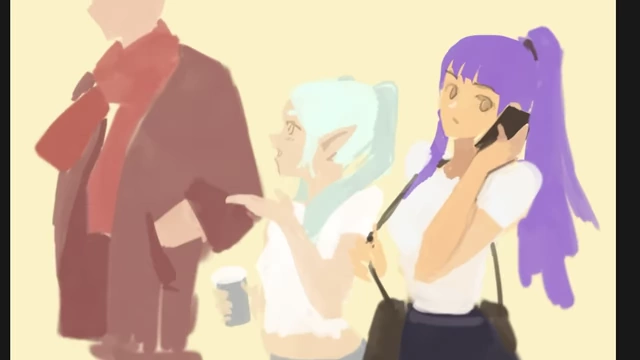
Early stage of a digital painting, blocking in multiple characters with rough values and colors. [ 00:01:50 ]
- Lower Stakes, More Exploration:
- No commitment to specific proportions, poses, or composition early on.
- Encourages exploration and experimentation, reducing the pressure to be perfect.
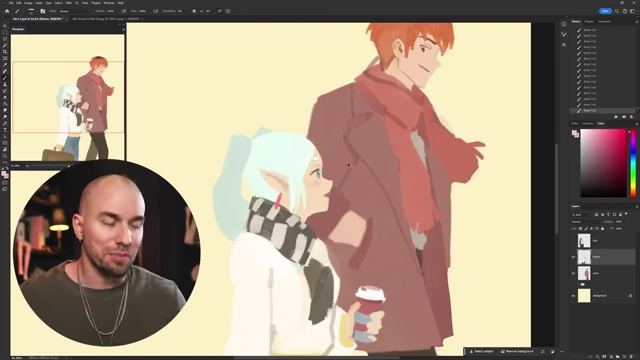
Adjusting the composition and character placement during the early stages of a no-sketch painting. [ 00:02:16 ]
- Momentum through Action:
- "Action creates momentum": Once colors are on the canvas, the brain shifts from "perfect planning" to "making this work."
- This mirrors the advice: "Just make it exist first, then you can make it good."
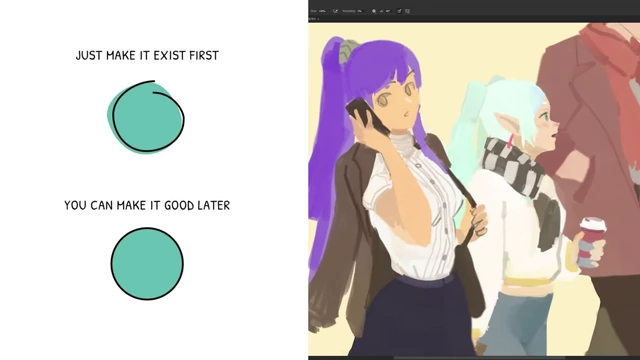
The principle of 'Just make it exist first, you can make it good later' illustrated next to a work-in-progress digital painting. [ 00:02:44 ]
2. Nothing is Precious (More Forgiving) [2:47]
The absence of a detailed sketch makes the painting process more flexible and less emotionally rigid.
- Avoiding Emotional Investment in Line Art:
- A detailed line art can lead to psychological and emotional lock-in, making artists hesitant to change elements they've already spent time on.
- Changes feel like "throwing away good work" or "destroying hours of detailed line work."
- Fluid and Adaptable Workflow:
- Rough shapes blocked in without a sketch are not "precious."
- Easily shift, resize, or repaint entire sections without guilt or resistance.
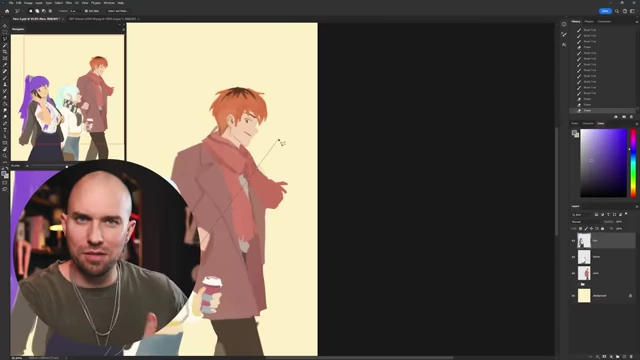
Demonstrating the flexibility of removing an entire character from the composition without loss, as nothing is 'precious' in a no-sketch workflow. [ 00:03:09 ]
- Sculpting in 2D:
- The process feels like "sculpting shapes in 2D" or "playing with mud," promoting a more experimental approach.
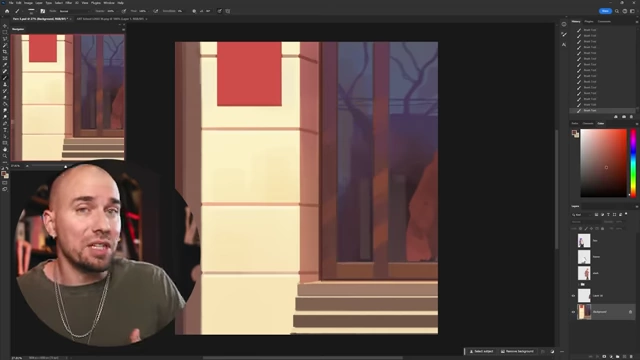
Blocking in background elements with broad shapes and colors, demonstrating the ease of alteration without a rigid sketch. [ 00:04:08 ]
- The process feels like "sculpting shapes in 2D" or "playing with mud," promoting a more experimental approach.
- Encourages Error Correction:
- Artists are more likely to fix mistakes as they appear rather than trying to work around them.
- This workflow leads to less emotional attachment to any single part, reducing hesitation to rework.
- Personal Discovery:
- The speaker discovered this benefit through speed painting, finding it transformed his comfort with painting over non-final elements.
3. Think in Form, Not Lines [4:53]
Painting without a sketch fundamentally shifts an artist's perception from two-dimensional outlines to three-dimensional forms.
- Understanding Natural Forms:
- Lines do not exist in nature; they are an artistic shorthand.
- Relying on line art encourages thinking in "edges and outlines."
- Building with Values and Volumes:
- Without a safety net, artists must consider how forms occupy space, using shapes, lights, and shadows, and how volumes overlap.
- This approach builds a deeper understanding of form through values, rather than merely "filling between the lines."

An arrow points to a shaded area of a character, illustrating how painting without a sketch forces an understanding of form and values. [ 00:05:34 ]
- Edges as Transitions:
- Edges are perceived as "transitions between values" rather than fixed boundaries.
- Sculpting with Light and Dark:
- The mental shift is from "coloring inside the lines" to "sculpting with darkness and lights."
- Practical Application (Grayscale First):
- Beginners can start with black and white values, then add colors later using techniques like gradient maps.
- Enhanced Skill Transfer:
- This fundamental understanding improves all future drawing, even when sketches are used.
- It allows for more three-dimensional drawing without heavy reliance on lines.
- Analogy: Riding a bike without training wheels – harder initially, but unlocks greater possibilities and makes one a "better rider."
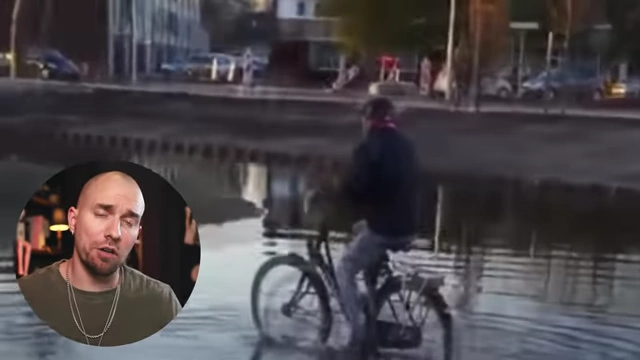
An analogy of learning to ride a bike without training wheels, representing the advanced skill development from painting without a sketch. [ 00:06:23 ]
4. Build Real Confidence [7:39]
Ditching the sketch fosters genuine self-assurance in an artist's creative abilities.
- Removing the Crutch:
- The sketch acts as "training wheels"; removing them allows artists to experience the true freedom of creation.
- It proves the ability to create something from nothing, without needing a "crutch."
- Mindset Transformation:
- Shifts the internal dialogue from "I hope this works out" to a more proactive "I'll make this work."
- This confidence permeates every new piece.
- Personal Growth through Experience:
- The speaker gained significant confidence after years of painting without lines, moving from disappointment with line art to assuredness.
- Increased Adaptability:
- Develops professional adaptability for quick concepts or client work.
- Enables artists to quickly get ideas onto the canvas when inspiration strikes, without getting bogged down in preliminary stages.
- More Enjoyable Process:
- There's excitement in watching an image emerge from loose shapes and colors, embracing the unknown.
- It's a process of "discovering the painting as you make it" rather than executing a rigid, predetermined plan.
5. More Flexibility in Finishing a Piece [9:29]
Painting without a sketch provides greater control over the level of detail and refinement in the final artwork.
- Avoiding Premature Commitment:
- Sketching first often commits artists to a certain level of finish early on, even if the idea isn't fully solidified.
- Sketches, even if initially loose, tend to be refined multiple times before moving to colors, investing considerable time.
- Deciding on the Fly:
- By starting with shapes, colors, and values, artists can decide "on the fly" how far to push the rendering.
- If a section (e.g., background) isn't working, minimal time is wasted, allowing for easy iteration.
- If a section is promising, it can be continuously pushed with more details.

Applying ambient lighting and atmospheric effects to the scene, demonstrating the ability to refine and enhance details on the fly. [ 00:10:11 ]
- Problem-Solving and Faster Development:
- This workflow encourages continuous problem-solving, forcing artists to think about adjustments throughout the process.
- This constant engagement leads to faster artistic development, akin to an intensive workout that unlocks potential.
Conclusion and Recommendation [10:55]
While sketches still have their place for complex pieces, client work, or beginners, painting without a sketch offers invaluable benefits for artists with decent fundamentals.
- Summary of Benefits:
- Faster start
- Easier iteration
- Better form understanding
- Real confidence building
- Incredible workflow flexibility
- Call to Action:
- Artists are encouraged to try painting without a sketch regularly, starting with simple subjects like a portrait, character, or quick scene.
- Use references or imagination, but block in with paint and "no lines" to experience the "freeing" sensation.
The final rendered digital painting, showcasing a complete scene created without an initial line art sketch. [ 00:10:32 ]