This video explores the evolution and modern features of JavaScript, emphasizing its transformation into a powerful and respectable language. It covers essential topics like variable declaration (let and const replacing var), rest parameters for handling variable arguments, and the spread operator for concise data manipulation, especially for immutable object updates. The speaker also demonstrates default parameters for flexible function arguments and the power of destructuring (array and object) combined with enhanced for...of loops for cleaner code. A crucial warning is given about the semantic differences in this and arguments scoping in arrow functions compared to regular functions.
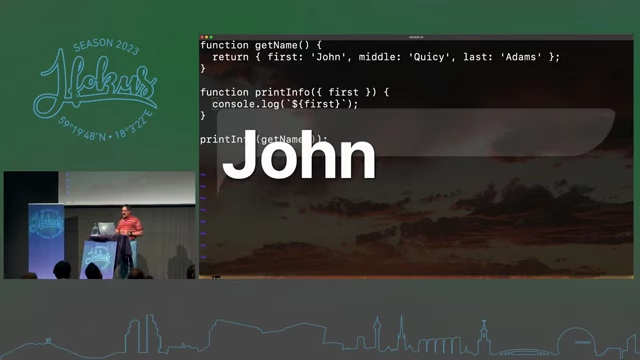
Combining the for...of loop with array destructuring for concise iteration over entries
[
00:33:38
]
JavaScript has evolved significantly from its earlier, often-feared state, becoming a modern and respectable programming language.
Many wonderful features have been introduced in modern versions (ES6, ES7, ES8) that make programming a pleasant experience.
Unlike other languages, JavaScript cannot deprecate old features, meaning older, less desirable syntax still exists but newer alternatives offer better solutions.
Variable Declaration: var, let, and const [00:02:40]
The var keyword in JavaScript has several problematic behaviors:
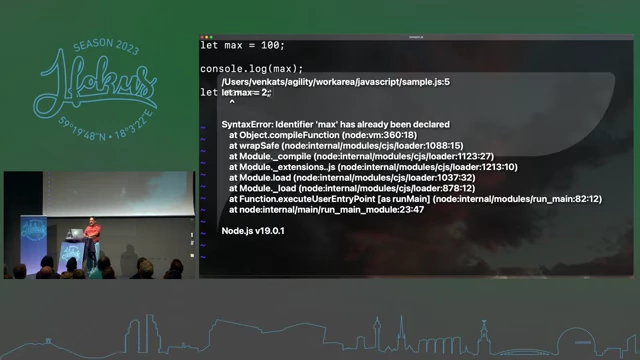
It allows re-declaration of variables within the same scope, leading to unexpected overwrites.
It has function-level scope, not block-level scope, which can cause variables to "leak" outside intended blocks.
let was introduced to address var's shortcomings:
- It provides block-level scoping, restricting variable visibility to the block where it's defined.
- It prevents re-declaration within the same scope, catching potential errors.
const enforces immutability for variable references:
- It also provides block-level scoping.
- It prevents re-assignment of the variable after its initial declaration.
- Recommendation: Prefer const as much as possible, then let if re-assignment is necessary, and avoid var moving forward.
Tooling: Tools like ESLint can help enforce best practices by flagging var usage or suggesting const where variables are not re-assigned.
JavaScript 'let' keyword preventing re-declaration with a SyntaxError
[
00:04:50
]
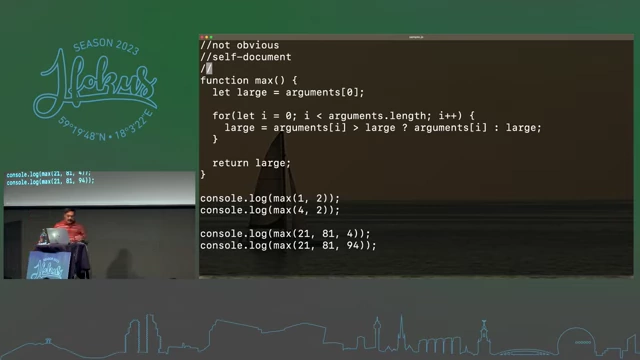
Traditional JavaScript functions implicitly behave as "var-arg" functions (variadic functions), meaning they can accept any number of arguments regardless of definition.
The arguments object provides access to all arguments passed to a function.
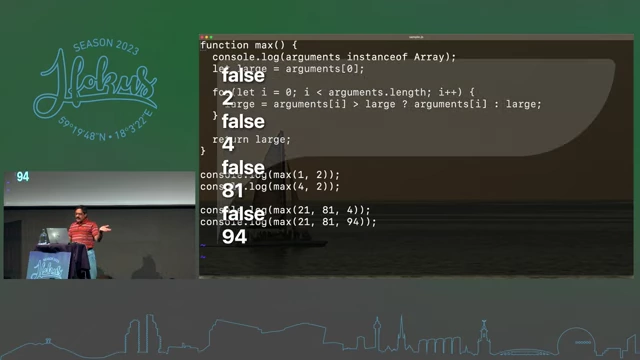
Problem: The arguments object is not a true JavaScript array, limiting the use of array-specific methods (like map, filter, reduce).
Code example illustrating the verbosity and lack of clarity when using the 'arguments' object
[
00:10:17
]
Demonstrating that the 'arguments' object is not a true Array instance
[
00:11:28
]
Rest Parameters (...variableName) [00:11:15]
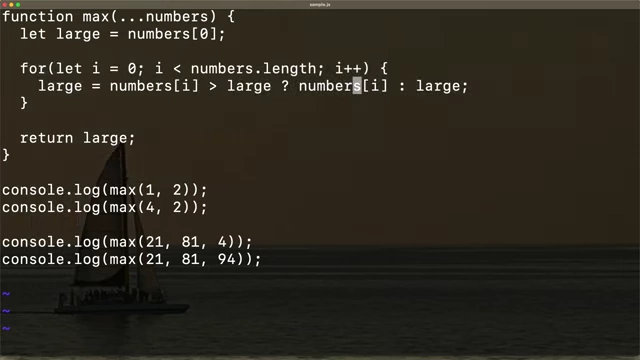
- Introduced in ES6, rest parameters collect all remaining arguments into a single array.
- This makes the function signature more explicit and self-documenting regarding variable arguments.
- Crucially, the variable created by the rest parameter is a true Array instance, allowing the use of all array methods.
Using the rest parameter (...numbers) to collect function arguments into a true array
[
00:12:32
]
The Spread Operator (...) is used on the "sending side" to expand an iterable (like an array or object) into individual elements.
Distinction between Rest and Spread: Rest collects elements into an array (on the receiving end), while Spread expands elements (on the sending side). They share the same ... syntax but have different functionalities based on context.
Use Cases:
Passing array elements as individual arguments to a function: Instead of max(arr[<a href="https://youtube.com/watch?v=IhmQt82onfo&t=0">0</a>], arr[<a href="https://youtube.com/watch?v=IhmQt82onfo&t=1">1</a>], ...), you can use max(...arr).
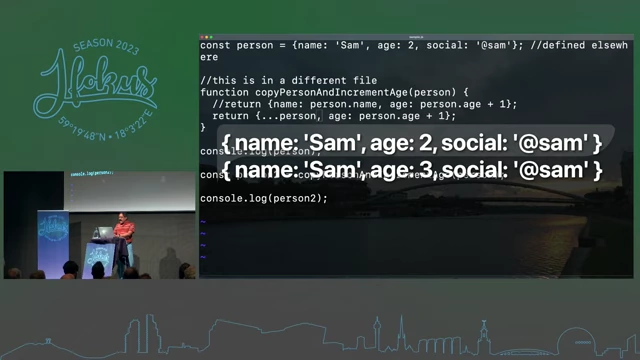
Immutably copying and modifying objects: Allows creating a new object with all properties of an existing object, plus any modifications, without mutating the original. This adheres to the Open/Closed Principle and DRY (Don't Repeat Yourself) principle.
Immutably copying and updating an object's properties using the spread operator
[
00:22:49
]
JavaScript now supports Default Parameters, allowing functions to have default values for arguments if they are not provided or are undefined.
This provides a cleaner alternative to function overloading (which JavaScript does not natively support) or manually checking for missing arguments.
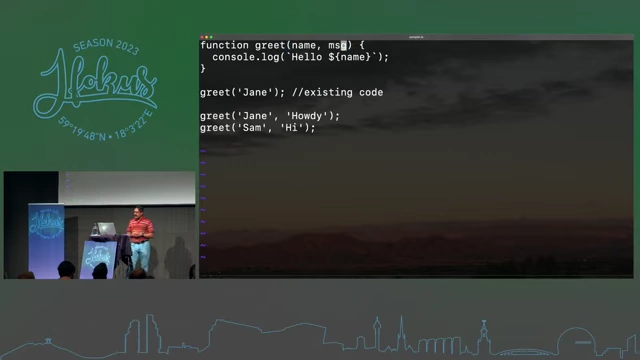
Initial function definition before adding default parameters
[
00:25:58
]
Behavior with undefined vs. null: A default value is used when an argument is undefined, but not when it is explicitly null (as null is considered a valid value).
Expressions as Defaults: Default values can also be expressions, allowing for dynamic calculation of the default based on other parameters.
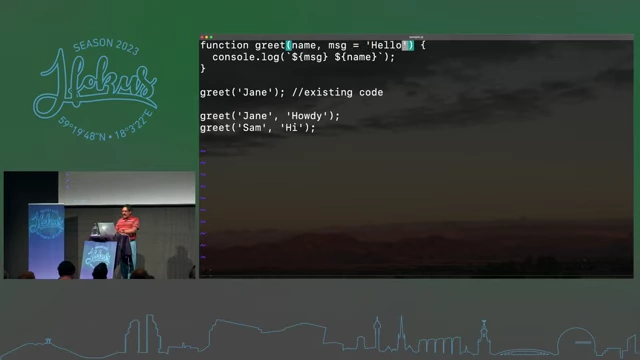
Defining a default value for a function parameter
[
00:26:08
]
Looping & Extraction: Enhanced For Loop and Destructuring [00:29:17]
The for...of loop provides a more concise and readable way to iterate over iterable objects (like arrays) compared to traditional for loops.
It simplifies accessing values directly, but getting the index requires additional steps (e.g., using names.entries()).
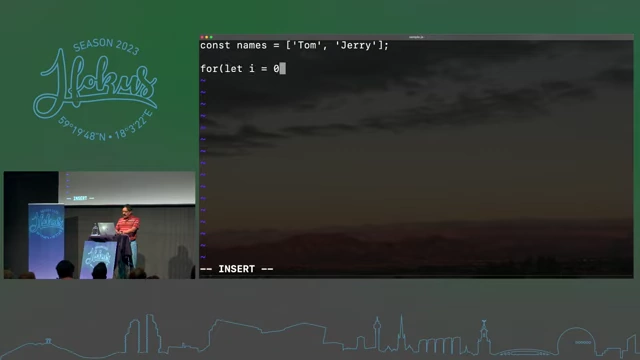
A traditional for loop used for iterating over an array
[
00:29:50
]
Destructuring [00:32:05]
- Definition: The opposite of construction; it involves extracting values from arrays or properties from objects into distinct variables.
- Array Destructuring: Extracts values from an array based on their position. Can also use rest syntax to capture "the rest" of the array.
Array destructuring with rest syntax to capture multiple elements
[
00:37:36
]
- Object Destructuring: Extracts properties from an object based on their names. Can assign to variables with different names and provide default values for missing properties.
- Combining with for...of: Destructuring can be directly applied in the for...of loop, allowing for elegant extraction of both index and value (e.g., for (const [index, name] of names.entries())).
Combining the for...of loop with array destructuring for concise iteration over entries
[
00:33:38
]
Destructuring in Function Arguments [00:40:38]
- Allows direct extraction of properties from an object passed as an argument into local variables within the function signature.
- This makes function signatures clearer about what properties they rely on and simplifies accessing those properties.
- It can be combined with default parameters for even more robust function definitions.
Object destructuring directly in function parameters, including default values
[
00:41:57
]
Template Literals (using backticks `) offer a powerful way to create strings:
They allow for easy string interpolation using ${expression}.
They support multi-line strings without needing newline characters.
Evaluated expressions within the string make them more dynamic than traditional string literals.
Object Literal Shorthand: Simplifies object creation when property names are the same as variable names.
- Instead of property: variable, you can just write property.
Advanced Functionality: Caution with Arrow Functions [00:42:40]
Arrow Functions provide a more concise syntax for writing functions.
If a function does not have a variable defined, the runtime needs to find that variable.
- Lexical Scoping: The variable is known in the defining scope; its value can be determined by examining the code. This is considered a "kind" language behavior.
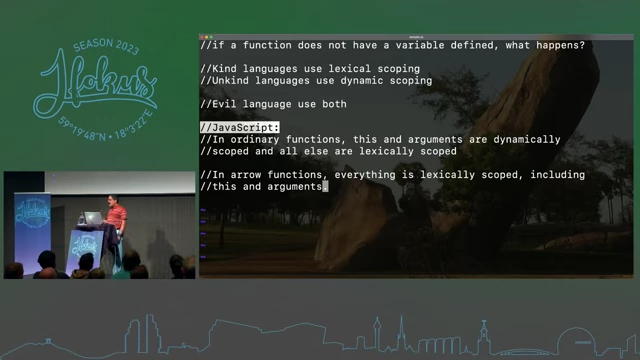
Visual explanation of lexical vs. dynamic scoping in programming languages
[
00:44:55
]
- Dynamic Scoping: The variable's value depends on the caller. This is powerful but harder to reason about by just looking at the code. This is considered an "unkind" language behavior.
Crucial Semantic Difference in JavaScript:
- Unlike regular functions, arrow functions do not create their own this context or arguments object.
- Regular Functions: this and arguments are dynamically scoped, meaning their values depend on how the function is called, while all other variables are lexically scoped.
- Arrow Functions: this and arguments are lexically scoped, meaning they inherit these values from their enclosing scope (the scope where the arrow function was defined).
This difference is critical and can lead to unexpected behavior if not fully understood, especially when migrating from regular functions to arrow functions in existing codebases.
A summary of lexical vs. dynamic scoping for 'this' and 'arguments' in JavaScript's ordinary vs. arrow functions
[
00:47:41
]
Modern JavaScript has introduced numerous features that significantly improve code quality, readability, and conciseness.
Despite JavaScript's backward compatibility constraints (inability to deprecate old features), new syntax and paradigms provide a much better development experience.