Understanding Brazil's Diplomatic Crisis, Trump's Global Tariffs, and Bitcoin's Inevitable Adoption
This video discusses key economic and political topics concerning Brazil and the global stage. It covers:
- The Magnitsky Act's financial sanctions against Brazilian official Alexandre de Moraes, viewed as a consequence of actions against individual freedoms.

A question on screen asks if the Magnitsky Law on a high-ranking Brazilian official is an exaggeration or a consequence of attacks on individual freedoms. [ 00:01:30 ] - Donald Trump's global tariffs, including a 50% tariff on Brazil, with crucial exemptions for products like Embraer planes and orange juice.
- The speaker's three-pronged concern for Brazil (legal, institutional, economic) and how another PT term would lead him to consider alternatives.
- Bitcoin's growing market depth making price manipulation harder, and the importance of self-custody as a responsibility rather than a disadvantage.
- Economic comparisons between Brazil's stagnant growth and Argentina's volatile but potentially improving economy under Milei.
- The inherent duality of the speaker's perspective: a strong belief in free markets versus skepticism about political interference.
Introduction [00:00]
The speaker introduces the episode, stating it will answer viewer questions, with a focus on recent significant events involving Trump, tariffs, the Magnitsky Law, and Brazil's Supreme Court Justice Alexandre de Moraes.
Magnitsky Act: Consequence of Attacks on Freedoms [01:20]
The Magnitsky Law imposed on Alexandre de Moraes is seen as a direct consequence of his actions over the past few years, which involved restricting the freedom of expression of American citizens and companies.
- Nature of the sanction: It's a financial sanction making him a "financial pariah" globally.
- Motivation: While political alignment or influence from certain individuals might play a role, the core motivation is a broader geopolitical stance, particularly Brazil's alignment with less democratic regimes and an anti-American sentiment from the current Brazilian government.
- Escalation: The issue escalated significantly due to repeated actions against free speech and American entities, attracting international attention and culminating in this unprecedented measure.
Congressional Reaction to STF's Excesses [03:49]
The speaker notes a lack of a strong, effective reaction from the Brazilian Congress, especially the Senate, against the perceived excesses of the Supreme Federal Court (STF).
- Reason for inaction: Mutual interests and a desire for "harmony" between powers rather than the necessary "separation of powers" and "checks and balances."
- Call to action: Emphasizes the need for continued public pressure on senators and electing better representation in future elections to counterbalance any branch of power.
STF and Central Bank Autonomy [04:52]
The concern is raised about the STF potentially ending the Central Bank's autonomy and its implications for Brazil.
- Historical context: Brazil historically suffered from high and hyperinflation due to lack of Central Bank autonomy.
- Venezuela comparison: While ending autonomy could move Brazil closer to Venezuela's economic disaster, the speaker clarifies that Brazil is still far from becoming Venezuela overnight due to its size and existing checks and balances. The concern is the increased probability of such interference.
Trump's Global Tariffs and Brazilian Impact [06:08]
Donald Trump's imposition of a 50% tariff (10% global minimum + 40% for Brazil) is analyzed, along with its implications for Brazil.
- Justification: The main justification cited by Trump for the Brazil-specific tariff was the persecution of the right, censorship of American companies, and restrictions on American citizens' freedom of expression.
- Broader motivations: Beyond Bolsonaro's trial, Trump's tariffs serve multiple objectives: reducing the US trade deficit and punishing countries for geopolitical alignments (e.g., India's oil trade with Russia, Brazil's stance against the US).
- Brazilian exemptions: Significant exemptions were granted for products like Embraer planes, orange juice, and petroleum/derivatives, which represent almost half of Brazil's exports to the US. This suggests Trump's practical economic considerations.
- Non-exempt products: Coffee, meats, cocoa, fish, furniture, agricultural, and industrial machinery remain subject to the 50% tariff, causing significant concern and desperation in these sectors.
- Negotiation challenges: The Magnitsky sanction further complicates dialogue and negotiation between the Brazilian and US governments, reducing hope for significant relief for affected sectors.
Argentina vs. Brazil: Economic Oscillations [11:09]
A comparison of the economic trajectories of Argentina and Brazil is made, focusing on their distinct patterns of growth and stagnation.
- Brazil's stagnation: Characterized by "mediocre growth," "chicken flights," and no sustainable growth, attributed to a bloated state, high tax burden, and bureaucracy.
- Argentina's volatility: Historically marked by extreme oscillations (from "Chinese growth" to "Zimbabwean depression") due to macroeconomic and political populism, leading to recessions, high inflation, and inequality.
- Milei's efforts: Milei is currently working to fix the economic foundations and bring stability, but risks of regression remain until reforms are solidified and reserves replenished.
Concerns for Brazil and a Potential PT Mandate [13:20]
The speaker expresses comprehensive concerns about Brazil's future, encompassing legal, institutional, and economic aspects, noting their interconnectedness.
- Impact of another PT term: While not a definitive reason to leave Brazil, another PT or left-wing mandate would strongly prompt the consideration of alternatives due to the perceived negative impact on the country's future.
US-European Union Agreement on Tariffs [14:08]
An agreement between the US and the European Union is discussed, characterized by Europe's "surrender" to US tariffs, albeit at a reduced rate (15% instead of 25-30%).
- Additional commitments: Europe also committed to purchasing US energy and gas, highlighting a shift in economic and political power dynamics.
Bitcoin Price Manipulation and Custody [18:00]
The discussion shifts to Bitcoin, addressing concerns about price manipulation and the perceived disadvantages of self-custody.
- Reduced manipulation risk: Price manipulation is becoming increasingly difficult due to the growing size of the Bitcoin market, significant institutional investment (e.g., BlackRock's IBIT ETF), and the deepening of derivatives markets, making Bitcoin a much more liquid asset.

A question on screen asks if Bitcoin price manipulation is currently occurring via institutions and individuals linked to Trump. [ 00:17:58 ] - Custody as responsibility: The "disadvantage" of potentially losing wealth if private keys are lost is reframed as a fundamental "responsibility" that comes with the freedom and financial independence Bitcoin offers. It's argued that people should learn secure self-custody methods rather than delegate this responsibility to third parties.
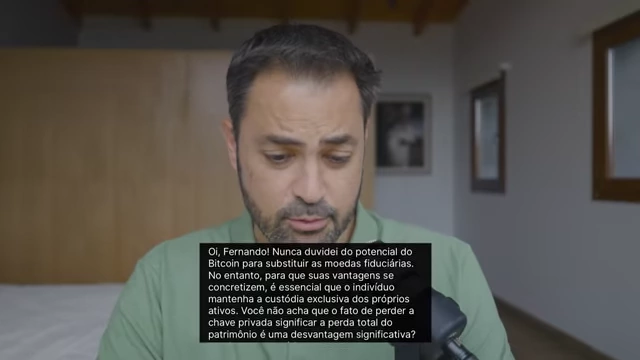
A question on screen asks if losing one's private key in Bitcoin is a significant disadvantage. [ 00:23:07 ]
Magnitsky Sanctions and Brazilian Banks [20:41]
The speaker addresses the impact of Magnitsky sanctions on Brazilian banks and the potential for a systemic banking crisis.
- Impact on sanctioned individuals: Financial sanctions affect accounts, assets, and transactions of sanctioned individuals like Alexandre de Moraes. Brazilian banks are indeed consulting legal teams regarding continued service.
- No systemic risk for banks: The speaker asserts that expulsion from SWIFT (a messaging system for international remittances) would make international operations difficult, but it would not break Brazilian banks or cause a systemic risk to the Brazilian financial system, as their operations are predominantly domestic. Examples of Russia, Iran, and China not having their banks collapse after SWIFT expulsion are cited.
Investment Theses: Oil, Dollarization, Uranium [25:54]
Various investment theses are briefly discussed.
- Oil thesis: The speaker is positive on Marcelo's offshore oil drilling thesis and intends to build a position in the future.
- Dollarizing assets: The speaker questions why one would not dollarize a significant portion of their assets, implying it's less "crazy" than keeping over 90% in Brazilian Reais.
- Uranium thesis: The "uranium thesis" has lost much of its "convexity" (asymmetrical upside) because much of the positive news and potential for growth has already been priced into the stocks. While the nuclear energy sector is experiencing a renaissance, the margin of safety for investment in uranium stocks is now much smaller.
Bitcoin as a Means of Payment [26:29]
The speaker believes Bitcoin is progressively becoming a more viable and effective means of payment, though this is a long-term process that won't happen overnight.
Trump's Tariff Policy [27:12]
The speaker believes Trump will maintain tariffs, even with some exemptions. He doesn't see tariffs as inherently "helping" Brazil, and political analysis suggests they might even inadvertently aid the current government.
Roads in Brazil: A Problem of Public Management [28:02]
The poor quality of Brazilian roads compared to developed countries like Japan and Germany is attributed to issues within state-managed public works.
- Milton Friedman's concept: References Milton Friedman's four ways of spending money, where public spending of "other people's money for other people" results in little concern for cost or quality.
- Corruption and quality: Highlighting corruption, overbilling, and the use of inferior materials as primary reasons for poor construction and short maintenance cycles.
Italian Citizenship and Family Planning [29:46]
A brief personal suggestion to continue the Italian citizenship process and have children abroad, encouraging enjoyment of Italy.
Addressing Viewer Discouragement and Personal Philosophy [33:14]
The speaker addresses viewer comments about his perceived discouragement, explaining his underlying philosophy.
- Duality of perspective: He lives with a duality:
- Optimism for the private sector: An unshakable belief in the private sector and free competition to find optimal solutions for humanity's problems, supported by economic understanding.
- Pessimism for politics: A understanding that politics, due to perverse incentives, rarely brings the best solutions and often hinders progress, leading to misery.
- Channel focus: Expresses a desire to shift channel focus more towards private sector solutions, innovation, and technology, and less on government interference.
- Unwavering optimism: Despite political challenges, he remains optimistic about humanity's potential when operating in an environment of free initiative, private property, and competition, rather than under imposed bureaucratic solutions.
Moraes and Bitcoin: Inevitable Adoption [36:04]
The speaker expands on the idea that Bitcoin will be adopted by everyone, even figures like Alexandre de Moraes, due to its technological superiority.
- Censorship resistance: Bitcoin is a superior monetary and financial technology that offers freedom, autonomy, and protection against all forms of censorship and restriction, regardless of the user's intentions (good or bad).
- Ubiquitous adoption: Just like the internet, mobile phones, or cryptography, Bitcoin's superior technology means it will eventually be adopted universally due to its inherent benefits.
Recommended Series [37:29]
The speaker recommends the Italian series "Generation 56K" (Geração 56K), praising it for being lighter and reflective, contrasting it with heavier shows like "Breaking Bad."