Hilary Price, a comic strip creator, and Sean Campbell, a 2D animation major, conducted an experiment to animate Hilary's original characters (an inchworm and an ant) using six different AI video generators.
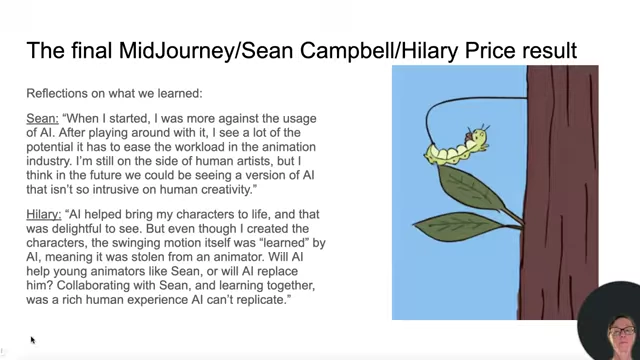
An animated inchworm character swinging on a silk thread from a tree branch, with an ant on its back, showcasing the final refined animation.
[
00:08:20
]
The Challenge: To animate custom characters swinging around a tree, going beyond simple text-to-video prompts, requiring dynamic, multi-dimensional motion.
AI Models Tested: Google's Veo, Luma, Wan, ChatGPT's Sora, RunwayML, and Midjourney.
Common Issues: Most AI models struggled with maintaining character consistency, unintended "talking" mouths (even when explicitly instructed not to), and precise motion, often requiring multiple iterations or revisions.
Specific Model Performance:
Veo produced mixed results, showing the "talking mouth" problem.
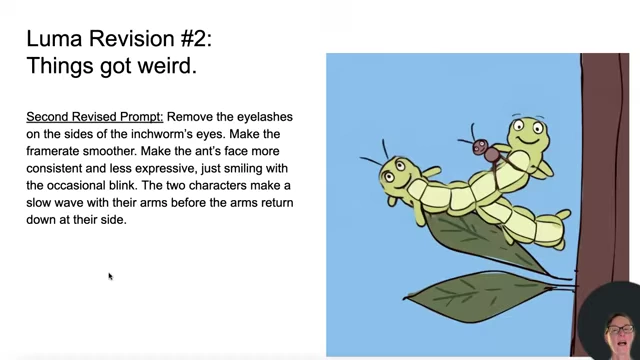
Luma allowed revisions but eventually led to distorted characters.
Wan, despite its AI prompt revision, took hours and had character inconsistencies.
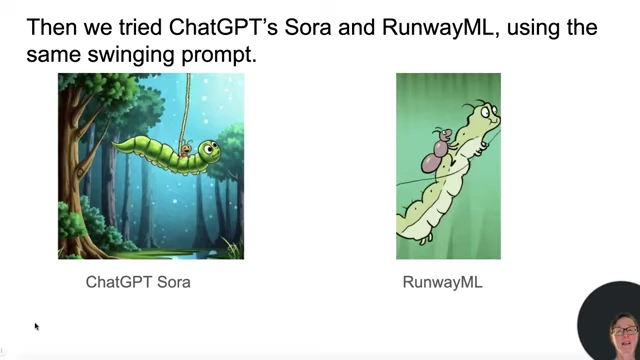
Sora and RunwayML were deemed more suitable for image generation than robust image-to-video animation for custom characters.
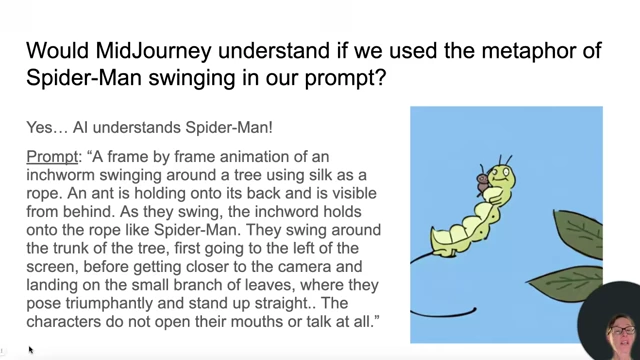
Midjourney provided the best starting point, even understanding metaphors like "Spider-Man swinging."
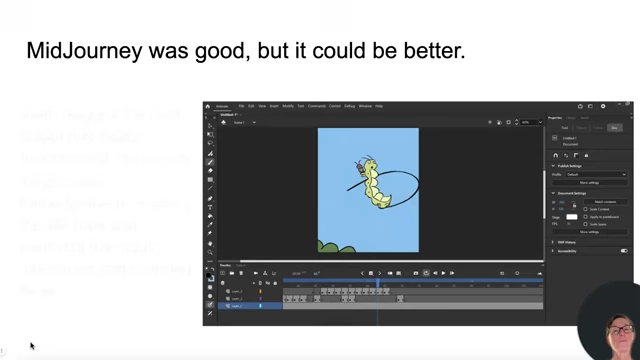
Human Intervention: Midjourney's output still required significant manual cleanup and frame-by-frame revision in Adobe Animate to achieve a polished result, including correcting distorted faces and removing unwanted mouth movements.
Reflections: The project highlighted AI's potential to reduce animation workload but also its current limitations and the ethical implications of "learned" animation styles. Collaboration between human artists and AI proved most effective.
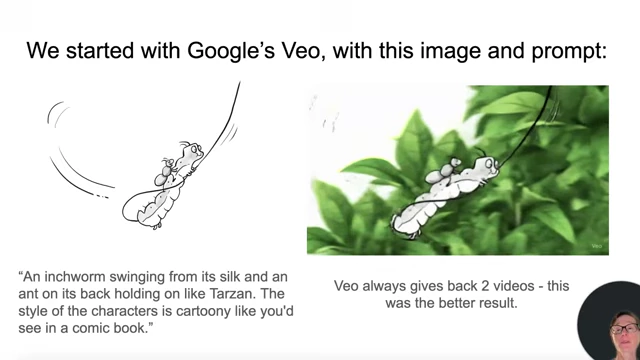
Prompt: "An inchworm swinging from its silk and an ant on its back holding on like Tarzan. The style of the characters is cartoony like you'd see in a comic book."
Result: Veo provided two videos, with one being a slightly better result, but still struggled with accurate character representation and motion.
A simple sketch of an inchworm swinging is presented alongside Veo's generated video, which shows the inchworm and ant on a leaf rather than swinging.
[
00:01:30
]
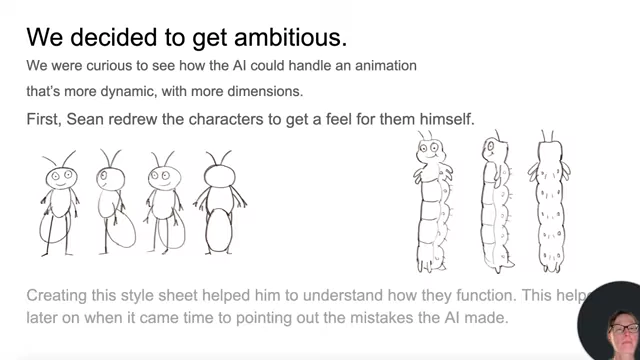
Sean redrew the characters from multiple angles to create a style guide, helping him understand their functionality and identify AI mistakes later on.
Sean Campbell's character stylesheet for the inchworm and ant, showing them from different perspectives to understand their functionality for animation.
[
00:01:50
]
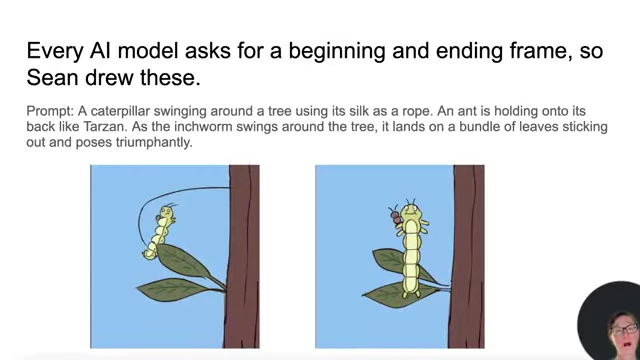
He also drew specific beginning and ending frames required by AI models for dynamic animation.
Beginning and ending frames created by Sean Campbell for the animation prompt of the inchworm and ant swinging around a tree.
[
00:02:07
]
Prompt: "A caterpillar swinging around a tree using its silk as a rope. An ant is holding onto its back like Tarzan. As the inchworm swings around the tree, it lands on a bundle of leaves sticking out and poses triumphantly."
Veo's First Result [2:22]: The AI frequently made the characters' mouths open and close, despite no instruction for them to talk, a common issue observed across several models.
Veo's Second Result [2:41]: Similar to the first, demonstrating the persistent "talking mouth" problem.
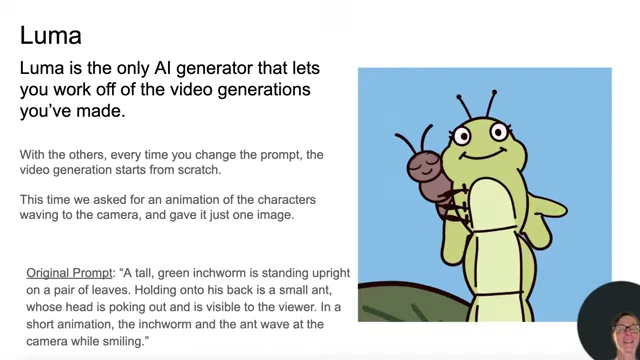
Prompt: "A tall, green inchworm is standing upright on a pair of leaves. Holding onto its back is a small ant whose head is poking out and is visible to the viewer. In a short animation, the inchworm and the ant wave at the camera while smiling."
Luma's initial generated animation of the inchworm and ant waving and smiling to the camera.
[
00:03:25
]
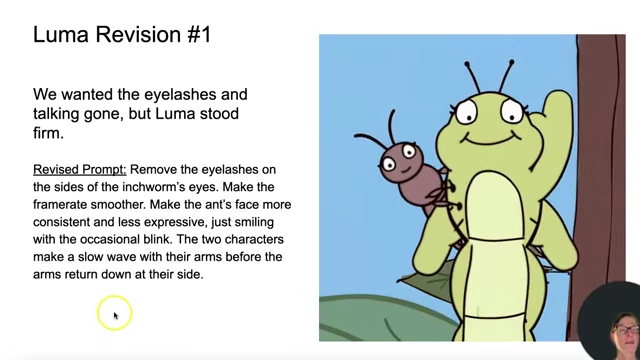
Revised Prompt: Instructions to remove eyelashes, eliminate talking, smooth the frame rate, make the ant's face more consistent and less expressive, and depict a slow, controlled wave.
Result: Luma "stood firm," largely ignoring the revision requests, especially regarding the eyelashes and talking.
Luma's first revision attempt showing the inchworm and ant waving, but still with eyelashes and talking mouths, indicating the AI ignored specific prompt instructions.
[
00:03:46
]
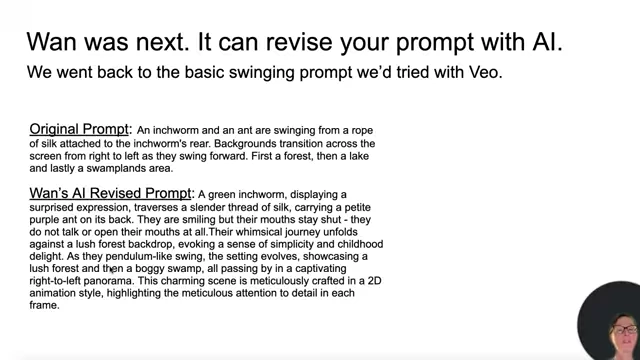
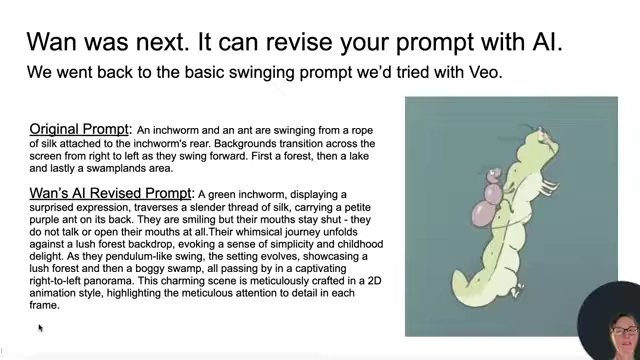
Original Prompt: "An inchworm and an ant are swinging from a rope of silk attached to the inchworm's rear. Backgrounds transition across the screen from right to left as they swing forward. First a forest, then a lake, and lastly a swamplands area."
Wan's AI Revised Prompt: This automatically generated a much longer, more descriptive prompt, including details like "surprised expression," "petite purple ant," "mouths stay shut," and specific background transitions.
Wan's AI-revised prompt, automatically generated from a shorter original prompt, includes detailed descriptions like character expressions and specific background transitions.
[
00:05:10
]
Result: Wan took hours to generate a video, which ultimately showed inconsistent character appearance and animation, falling short of expectations.
Wan's generated animation of the inchworm and ant swinging, illustrating inconsistencies in character appearance and motion.
[
00:05:45
]
Both models were tested using the basic swinging prompt.
Evaluation: While these AI models are highly capable of generating high-quality images from scraped internet content, their current image-to-video tools were not considered "up to speed" for animating custom characters with the desired consistency and motion.
Generated images from ChatGPT Sora (left) and RunwayML (right) depicting the inchworm and ant swinging, showing their current image generation capabilities.
[
00:06:05
]
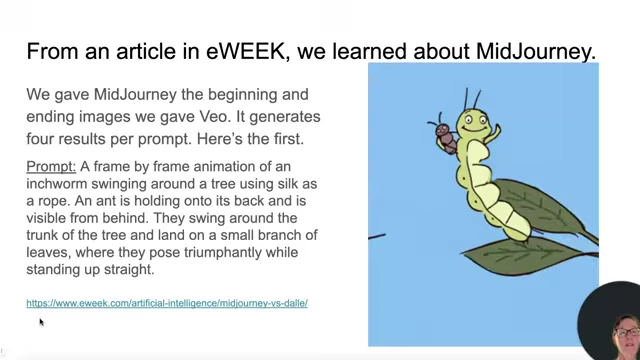
Prompt: "A frame by frame animation of an inchworm swinging around a tree using silk as a rope. An ant is holding onto its back and is visible from behind. They swing around the trunk of the tree and land on a small branch of leaves, where they pose triumphantly while standing up straight."
Results (Versions 1-4): The generated animations often depicted the inchworm "surfing" on its silk rather than swinging naturally, but overall, Midjourney produced better outputs than the other models.
Midjourney's first version of the swinging animation, showing the inchworm and ant on a silk rope near a tree.
[
00:06:35
]
The team wondered if AI would understand a metaphor for the swinging motion.
Prompt: Modified to include "the inchworm holds onto the rope like Spider-Man," along with instructions for camera movement and a specific command: "The characters do not open their mouths or talk at all."
Result: Midjourney understood the "Spider-Man" metaphor for the swinging action, improving the motion. However, the persistent problem of characters opening their mouths and "talking" still occurred.
Midjourney's animation result after incorporating the "Spider-Man" swinging metaphor into the prompt, showing improved swinging action but still with unintended mouth movements.
[
00:07:30
]
Sean took the best output from Midjourney into Adobe Animate for post-processing.
Manual Revisions: He meticulously revised the rough spots frame by frame, which involved erasing the extraneous silk rope, removing unwanted mouth movements, and correcting distorted faces that the AI produced.
Sean Campbell manually editing the AI-generated animation in Adobe Animate, showing the process of refining frames and correcting AI mistakes.
[
00:08:00
]
Final Result: The combination of AI generation and human artistic refinement resulted in a much cleaner, more accurate, and polished animation.
Sean's Perspective: Initially skeptical of AI, he now acknowledges its potential to alleviate workload in the animation industry. He remains on the side of human artists but anticipates future AI versions that are less intrusive on human creativity.
Hilary's Perspective: She found it delightful that AI could bring her characters to life. However, she raised concerns that the "learned" swinging motion by AI might be derived from existing human-created animations, questioning whether AI will genuinely assist or eventually replace young animators. She emphasized that the collaborative learning experience with Sean was a rich human interaction that AI cannot replicate.
The final, refined animation of the inchworm and ant swinging, showcasing the combined efforts of AI generation and human editing.
[
00:08:20
]