This video critically examines common misconceptions about covered call funds, asserting they are detrimental to long-term wealth despite their psychological appeal for income. [0:00:38] Historical data demonstrates that while they might slightly buffer initial declines, they severely cap upside participation, leading to significantly lower overall wealth compared to underlying equities. [0:04:21]
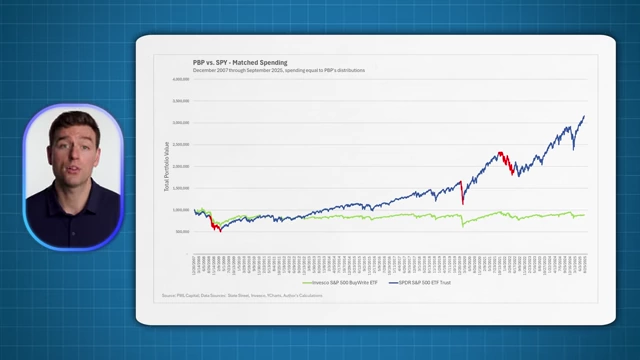
Covered Call ETF (PBP) vs. S&P 500 ETF (SPY) performance from December 2007 to September 2025, with matched spending.
[
00:05:08
]
An extended example comparing JEPI to an S&P 500 index fund illustrates that even when avoiding selling shares in a downturn, the index fund investor still accrues substantially more wealth. [0:07:09] The video also analyzes several US and Canadian covered call ETFs, including SPYI, QQQI, JAPQ, DIVO, HYLD, and HDIV, consistently showing their underperformance against properly benchmarked underlying assets, even with leverage or reinvested distributions. [0:09:47] This underperformance stems from reduced expected returns due to option premiums limiting growth. The speaker warns against the rising promotion of these high-fee products, highlighting that their perceived benefits often mask hidden costs and lower sustainable spending for long-term investors. [0:01:12]
The Misguided Appeal of Covered Call Funds and Systemic Issues [0:00:00]
New covered call products are frequently launched in Canada, leading investors to make serious errors in their assessments of them [0:00:07].
Covered calls are fundamentally destructive to long-term wealth, even for investors seeking income from their portfolios [0:00:38].
The financial product landscape has shifted from actively managed mutual funds to new high-fee products like covered call funds [0:00:47].
These new products are often promoted by unlicensed financial content creators, carrying similar issues to traditional high-fee funds [0:01:12].
Investor behavior is driven by perceived benefits rather than actual benefits, as highlighted by a quote from John Campbell's "Fixed" [0:01:34].
Capitalists supply products based on demand, which is often influenced by exaggerated benefits and hidden costs, leading to an oversupply of such products in the market [0:01:36].
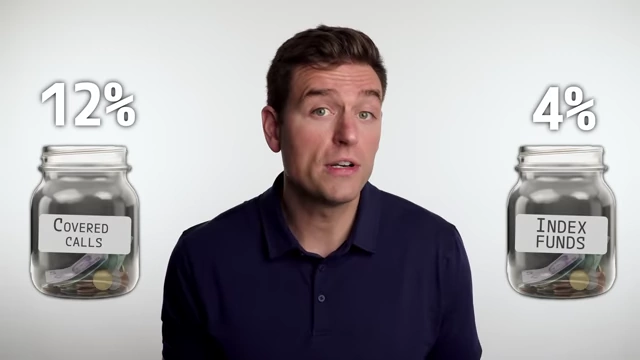
Covered call funds capitalize on investors' psychological attachment to "income," even when the overall financial package makes them worse off [0:02:22].
Visual illustrating the psychological appeal of high "yields" from covered calls (12%) versus lower expected returns from index funds (4%).
[
00:08:47
]
The regulation of financial markets and advice is crucial, and taking advice from unregulated content creators with limited financial backgrounds is risky [0:03:04].
A key issue is that these products are marketed and sold on their "yields" as if they were returns, when in reality, yields are at best irrelevant and more likely have a negative relationship with expected returns [0:03:27].
Debunking Covered Call Protection in Down Markets [0:03:41]
Covered calls offer some protection in a falling market due to option premiums but significantly limit upside participation during recoveries [0:04:47].
Historical comparisons of covered call funds against underlying equities, assuming constant monthly withdrawals, show that while covered calls slightly reduce downside, they quickly fall behind as equities recover [0:03:41].
For instance, over the full history of an Invesco S&P 500 BuyWrite ETF, including major downturns like the Great Financial Crisis, COVID crash, and 2022 decline, an investor in the underlying S&P 500 fund would have ended with 3.88 times more wealth [0:04:55].
Covered Call ETF (PBP) vs. S&P 500 ETF (SPY) performance from December 2007 to September 2025, with matched spending.
[
00:05:08
]
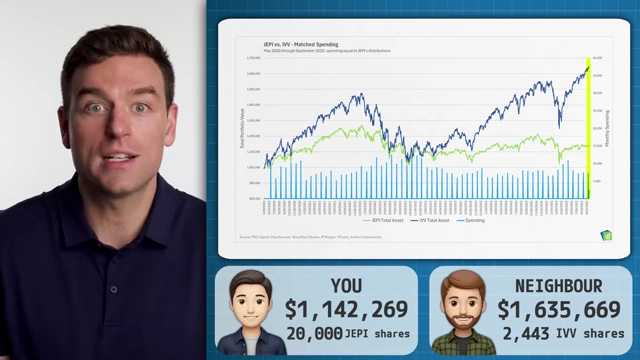
A detailed side-by-side comparison of a $1 million investment in JEPI (a covered call fund) versus IVV (an S&P 500 index fund) illustrates this point [0:05:20].
Both investors spend the same monthly dollar amount, matched to JEPI's distributions; the JEPI investor maintains a constant number of shares, while the IVV investor sells shares as needed [0:05:47].
During the September 2022 downturn, the JEPI investor receives distributions without selling shares, while the IVV investor must sell shares at a depressed price [0:06:31].
By September 2025, despite the IVV investor having sold shares in a downturn, the value of their remaining shares has increased significantly, leading to substantially more overall wealth compared to the JEPI investor whose shares barely appreciated [0:07:29].
The essential factor is the total value of the portfolio (shares multiplied by price), not merely avoiding selling shares in a downturn or maintaining a fixed share count [0:07:32].
Comparison of total wealth for investors in JEPI (covered call fund) vs. IVV (S&P 500 index fund) by September 2025, with matched spending.
[
00:07:27
]
The perceived benefit of living off income in a down market through covered calls comes at the cost of missing out on expected returns, both before and, crucially, after a stock price decline, which ultimately increases the risk to future spending ability [0:07:52].
Covered calls behave similarly to holding a large portion of a portfolio in cash, which might look favorable during market downturns but is expected to be very expensive in the long run [0:08:07].
Reinvesting Distributions and Sustainable Spending [0:08:21]
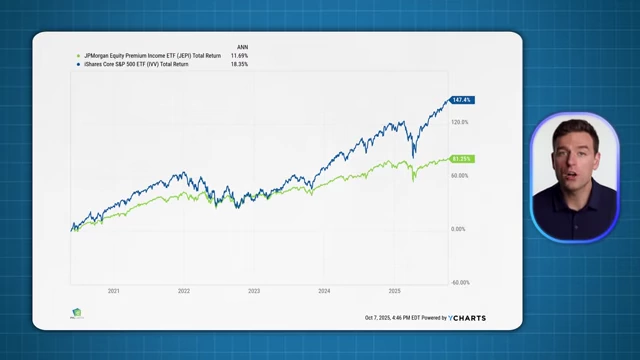
Reinvesting distributions from covered call funds, rather than spending them, does not provide a "magical advantage" or change the general story of underperformance [0:08:21].
When both covered call funds and underlying equities are left to accumulate and reinvest their distributions, covered calls continue to dramatically underperform [0:08:30].
Total return comparison of JPMorgan Equity Premium Income ETF (JEPI) and iShares Core S&P 500 ETF (IVV) with dividends reinvested, showing JEPI's underperformance.
[
00:08:35
]
It is a common mistake to believe that covered calls enable higher sustainable spending in retirement or allow for earlier retirement with less savings [0:08:43].
Psychologically, if an investor can only spend money provided as "income," covered calls might seem appealing, but financially, they reduce expected returns [0:08:52].
Consequently, covered calls lead to lower, not higher, sustainable spending for long-term investors due to their inherent reduction in expected returns [0:08:59].
Performance Analysis of Specific Covered Call Funds [0:09:07]
Many investors are largely unaware of their actual investment returns, making it challenging to make informed financial decisions [0:09:33].
This observation is supported by academic research, indicating a widespread lack of knowledge regarding personal investment returns [0:09:40].
Analysis of US-listed Covered Call ETFs [0:09:47].
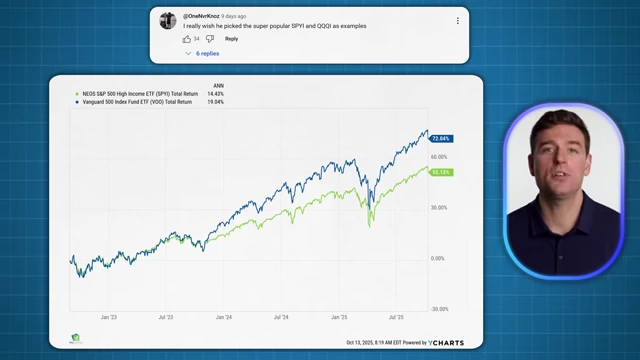
SPYI (NEOS S&P 500 High Income ETF): Has trailed the Vanguard 500 Index Fund by an annualized 4.61% since August 2022 [0:09:50].
Total return comparison of NEOS S&P 500 High Income ETF (SPYI) and Vanguard 500 Index Fund (VOO), showing SPYI's underperformance.
[
00:09:56
]
QQQI (NEOS NASDAQ 100 High Income ETF): Has trailed the Invesco NASDAQ 100 ETF by an annualized 2% since January 2024 [0:10:03].
JAPQ (JP Morgan NASDAQ Equity Premium Income ETF): Has trailed the Invesco NASDAQ 100 ETF by an annualized 4.36% since May 2022 [0:10:15].
While JAPQ performed better than its underlying in the 2022 downturn, any advantage was short-lived as it gave up the upside in the subsequent recovery [0:10:27].
DIVO (Amplify CWP Enhanced Dividend Income ETF): Has underperformed the Vanguard Dividend Appreciation Index Fund ETF by an annualized 51 basis points since December 2016, a reasonable comparison given their holdings overlap and return correlation [0:10:37].
DIVO performed even worse against the S&P 500 benchmark [0:11:10].
Analysis of Canadian-listed Covered Call ETFs (often with leverage) [0:11:25].
HYLD (Hamilton Enhanced US Covered Call ETF): Includes a modest 25% cash leverage and aims for higher yield with similar volatility to the S&P 500 [0:11:33].
It has underperformed an S&P 500 ETF (CAD-hedged) by 0.9% annualized since February 2022 [0:11:46].
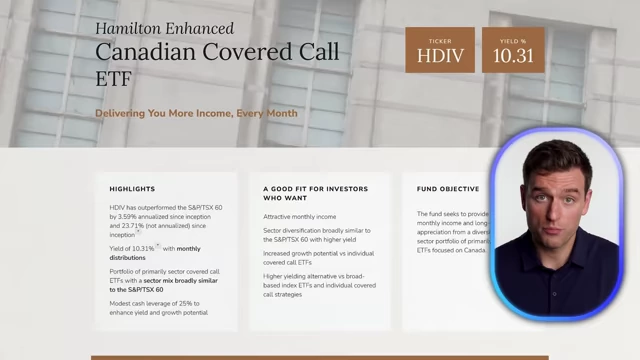
HDIV (Hamilton Enhanced Multi-Sector Covered Call ETF): While its website claims it has beaten the S&P TSX60, a proper comparison to a reconstructed index fund portfolio matching its underlying equities (including its 25% cash leverage and US equity exposure) shows that the model without covered calls outperforms HDIV since inception [0:11:55].
Hamilton Enhanced Canadian Covered Call ETF (HDIV) website highlighting claimed outperformance against the S&P TSX60.
[
00:12:05
]
This indicates that HDIV is leveraging up for increased downside volatility without achieving superior performance [0:12:32].
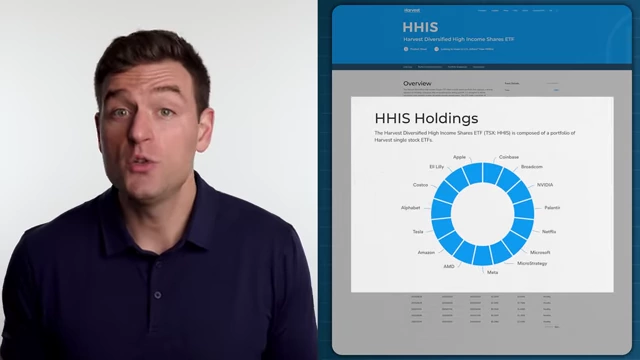
HHIS (Harvest Diversified High Income Shares ETF): An equally weighted portfolio of 15 trending companies employing covered calls and 25% leverage [0:13:09].
Holdings overview of the Harvest Diversified High Income Shares ETF (HHIS), showing its concentrated portfolio of 15 trending companies.
[
00:13:15
]
The underlying stocks without leverage and covered calls performed about the same as the fund over its relatively short history [0:13:30].
If 25% leverage is applied to the underlying stock portfolio without covered calls, it significantly outperforms HHIS, consistent with the expected detrimental effects of covered calls [0:13:47].
While HHIS has beaten broad market indexes like the NASDAQ 100 and S&P 500 in its short existence, this is characteristic of concentrated, actively managed portfolios of attention-grabbing stocks, which are exceptionally rare to deliver long-term outperformance [0:14:00].
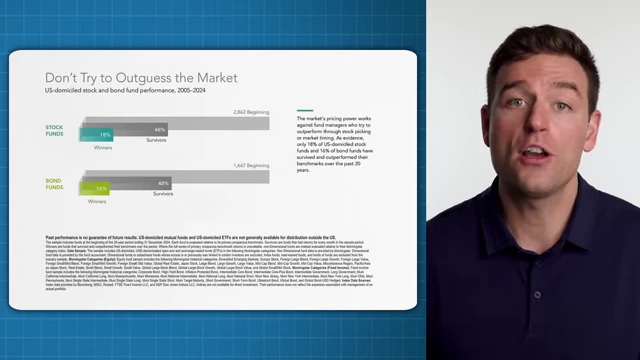
The vast majority of professional active managers consistently underperform index funds in the long run, making such short-term outperformance a risky proposition [0:14:20].
Chart showing the percentage of US-domiciled stock and bond funds that outperformed and survived over a 20-year period (2005-2024).
[
00:14:14
]
The speaker reiterates his motivation for creating these videos on covered calls [0:14:50].
He has no financial incentive, personally or professionally, as his advice encourages investing in low-cost total market index funds, which he is not affiliated with [0:14:54].
As Chief Investment Officer at PWL Capital, understanding complex financial products is part of his job, and explaining concepts to others helps strengthen his own knowledge [0:15:11].
His altruistic goal is to foster a financial product marketplace in Canada that is less overwhelming, intimidating, and dangerous, especially for new investors [0:15:33].
Covered calls are particularly challenging because they exploit the strong mental accounting bias many investors have by focusing on "income" [0:15:53].
By providing fundamental information and objective performance comparisons, the videos aim to help people make better investment decisions and ask more insightful questions, ultimately encouraging a more rational approach to investing [0:16:01].
Fundamentally, a covered call alters the distribution of expected returns in a manner detrimental to long-term investors, a fact clearly evident in financial data [0:14:41].
Covered Call Payoff Diagram illustrating the profit/loss profile of a covered call strategy compared to holding long stock.
[
00:15:14
]