Journaling: Practices and Prompts to Enhance Self-Reflection and Personal Growth
This video offers effective journaling practices and prompts to foster self-awareness and personal development.
- Everything List: A method to manage overwhelm by jotting down all tasks, then scheduling them for completion.
- Unique Affirmation Writing: Involves repeatedly writing an affirmation, then explicitly addressing and countering any doubts that arise to build genuine belief.
- Bad to Good List: A practice for reframing negative experiences by identifying lessons learned and positive outcomes.
- Gratitude for "Slow Weeks": Filling journal space on quiet days with things to be grateful for, promoting a positive mindset.
- Convenience in Journaling: Strategies like carrying a compact, customized journal and always having a pen make daily writing easier.
- Seasonal Check-ins: Prompts to reassess goals and intentions with each changing season, adapting to shifts in mood and motivation.
- Synchronicity Tracking: Noting coincidental events that align with personal passions or callings, reinforcing a sense of purpose.
- Addressing Blocks: Using prompts to explore areas of life that feel stagnant or challenging, encouraging deep reflection.
- Targeted Prompts: Specific journaling questions are provided for different personal challenges, including self-knowledge, insecurity, self-sabotage, self-centeredness, and emotional suppression.

Example journal prompts for self-discovery to dig deeper into self-understanding. [ 00:18:25 ]
Introduction to Journaling and its Evolution [0:00]
The speaker shares her lifelong journey with journaling, which began at eight years old, evolving from diaries with lockets and invisible ink to bullet journals, scrapbooks, and now a simpler, text-filled planner. She emphasizes that journaling is universally beneficial.

Favorite Journal Practices [0:41]
The "Everything List" [1:04]
This practice helps manage feelings of overwhelm when too many things demand attention.
- Purpose: To dump every task or thought onto paper, regardless of importance or relation, to prevent forgetting.
- This helps alleviate the mental load of constantly reminding oneself of tasks.
- Process:
- Write down every single item that needs to be done or remembered.

An example of an "Everything List" with various tasks like "groceries," "edit video," "file taxes," and "clean my apartment." [ 00:01:10 ] - Review the list and add a checkmark next to items that have been assigned a specific day/time for completion.

The "Everything List" showing tasks marked with red checkmarks and assigned days like "today," "next week," or "tomorrow." [ 00:02:25 ]
- Write down every single item that needs to be done or remembered.
- Benefits:
- Reduces anxiety about forgetting tasks.
- Aids in prioritizing tasks by making everything visible, then allocating time for completion.
- Allows for a clear overview of all commitments.
Affirmation Writing That Actually Makes Sense [2:50]
Inspired by "The Artist's Way," this method helps build genuine belief in affirmations for cynical individuals.
- Critique of Traditional Affirmations: Simply repeating "I am pretty" or "I am successful" can feel ridiculous and insincere if not genuinely believed.
- Process:
- Write an affirmation (e.g., "I, [your name], deserve to live a creative life") ten times.
- As doubts or questions arise during this writing, immediately jot them down next to the affirmation. These can be internal doubts or external voices (e.g., "Who says?" or "Where's the proof?").

A whiteboard illustrates an affirmation "I, xyz, deserve to live a creative life" with a direct "DOUBT: Who says?" and an arrow pointing to a section for countering the doubt. [ 00:04:39 ] - After writing the affirmation ten times with all associated doubts, go back and systematically address and counter each doubt with evidence, reasons, or self-justification.

An affirmation is written with corresponding doubts like "Who says?" and "How will I be able to support myself?" and handwritten counters next to each doubt. [ 00:06:04 ]
- Benefits:
- Transforms skepticism into conviction by directly confronting and resolving internal resistance.
- Provides solid reasons to believe the affirmation, making it feel truthful and achievable.
- Builds confidence in areas where external evidence might be lacking.

The book cover for "The Artist's Way: A Spiritual Path to Higher Creativity" by Julia Cameron, which inspired the affirmation practice. [ 00:03:03 ]
Bad to Good List [7:17]
A practice adopted from TikTok to process negative experiences without forced optimism.
- Purpose: To acknowledge unfortunate events, learn from them, and identify any positive outcomes.
- Process:
- Create a list with three lines for each entry:
- The bad thing, disappointment, or unfortunate event.
- What was learned from that event.
- A good thing that came of it.
- The second and third lines can be filled out later when insights or positive shifts emerge.

A handwritten list titled "UNFORTUNATE EVENT" with space for "what I learned" and "a good thing to come of it," showing an example entry about leaving a toxic corporate job. [ 00:08:02 ]
- Create a list with three lines for each entry:
- Benefits:
- Allows for a realistic processing of negative events.
- Encourages reflection on growth and hidden benefits rather than dwelling on the negative.
- Reinforces the idea that good can emerge from bad situations over time.
Filling "Slow Weeks" with Gratitude [8:27]
This practice helps maintain consistent journaling even on days with minimal external activities.
- Purpose: To fill the planner pages and cultivate gratitude during less busy periods.
- Process:
- On days where there isn't much to write about in terms of tasks or events, fill the space with something good that happened that day or something one is grateful for.
- Benefits:
- Creates a satisfying sense of accomplishment by filling the journal.
- Shifts focus from a lack of activity to an appreciation of daily positives.
- Reinforces a habit of gratitude.
Tracking Planners [9:14]
A simple organizational method for managing multiple journals over time.
- Process:
- On the front cover of each planner, write the start month and year.
- On the back cover, write the end month and year.
- Benefits:
- Provides a quick reference for the timeline and contents of each journal.
- Helps keep track of a collection of journals.
Carrying Journal Everywhere [10:01]
Prioritizing convenience to ensure journaling is a consistent and accessible practice.
- Journal Customization: The speaker combines three different planners/journals into one using binder clips, creating a compact and personalized system.
- Accessibility:
- The journal's size is designed to fit in the smallest bag.
- A pen is kept in every bag she owns, eliminating the need to search for one.
- Benefits:
- Removes barriers to journaling by making it always available.
- Integrates journaling seamlessly into daily life.
How to Start Journaling and Stick with It [10:57]
For beginners, journaling can be overwhelming due to a blank page and self-judgment.
- Solution: Use journal prompts as a guided starting point.
- Prompts act as "third-party guidance," providing a specific task for the page.
- Prompts help break the monotony of personal reflection, forcing new perspectives and preventing repetitive thought patterns.
- Source of Prompts: The speaker utilizes prompts from "We're Not Really Strangers," a company known for a card game designed to deepen connections, which also released a journal. Many of these prompts are publicly available.

A "We're Not Really Strangers" card game with a prompt that says "Finish the sentences: Strangers would describe me as: ______ Only I know that I am ______." [ 00:12:02 ] 
An open journal from "We're Not Really Strangers" showing a prompt on a page. [ 00:12:12 ]
My Favorite Journal Prompts [12:57]
Seasonal Check-in Prompts [13:00]
These prompts help realign goals and intentions with the natural flow of time.
- Rationale: Yearly plans can be hard to stick to due to changing moods and mindsets throughout the year (e.g., summer vs. winter).
- Questions (examples):
- What am I expecting this season?
- What do I want to do better for this season?
- What do I want to have changed by the end of this season?
- Benefit: Provides quarterly re-evaluation, making goals more adaptable and achievable.

A whiteboard displays "Seasonal Check-In Prompts" with various questions related to seasonal changes, learning, and future expectations. [ 00:13:06 ]
Synchronicity Prompt [14:05]
Also from "The Artist's Way," this practice involves noticing meaningful coincidences.
- Definition: Moments of coincidences that strongly align with one's passions or callings, making it feel like the universe is supporting one's path.
- Process: Journal these instances by writing "Synchronicity" followed by a dash and a description of the event.
- Examples:
- A colleague discussing pursuing a calling shortly after the speaker secretly decided to leave her corporate job for a creative path.
- Meeting numerous people interested in sewing or knitting right after developing an interest in seamstressing, even without telling anyone.
- Benefit: Reinforces a sense of purpose and direction by highlighting aligned external events.
"Where Do I Feel Blocked?" Prompt [16:07]
A prompt for self-exploration when feeling directionless or stagnant.
- Purpose: To uncover hidden issues or areas of life that feel stuck.
- Process:
- Ask: "Where do I feel blocked in my life? What area of my life feels kind of stagnant or strange?"
- Write continuously, letting thoughts flow without judgment, even if they initially feel like "junk."
- Benefit: Helps clear mental clutter, allowing deeper insights and the "real meat of the matter" to surface.
Journal Prompts for Self-Discovery [18:24]
For those seeking to understand themselves beyond the surface.
- A gut feeling you might have ignored.
- A secret that you've kept even from yourself.
- Something you didn't understand at the time.
- What feelings are you too familiar with?
- Admit something to yourself.
A whiteboard displays "If you want to get to know yourself better / Prompts to dig a little deeper" with prompts like "a gut feeling you might have ignored," "something you didn't understand at the time," and "admit something to yourself." [ 00:18:25 ]
Journal Prompts for Insecurity or Comparison [18:50]
Aids in shifting perspective from external comparison to internal uniqueness.
- The last time you felt jealous and why.
- A small, unique detail that you wish someone would notice about you.
- What your younger self would be proud of seeing today.
- Rationale: Focusing on unique, incomparable aspects of oneself reduces the need to compare with others.

A whiteboard lists "If you're feeling insecure / comparing yourself to others" with prompts such as "last time you felt jealous & why" and "what your younger self would be proud to see today." [ 00:18:55 ]
Journal Prompts for Self-Sabotage [19:44]
Helps identify and understand patterns of self-sabotage.
- Something you said or did that didn't feel like you.
- Something you said that wasn't exactly true, and why you might have said it.
- A lie you've told yourself for a long time.
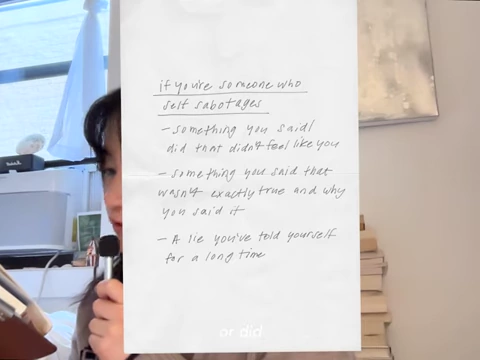
A whiteboard shows "If you self-sabotage" with prompts like "something you said or did that didn't feel like you" and "a lie you've told yourself for a long time." [ 00:19:51 ]
Journal Prompts for Self-Centeredness and Community Engagement [20:03]
Encourages a shift from self-focus to greater connection and contribution.
- One way you're contributing to the problem (encourages humility).
- One thing that matters so much that you're scared to ruin it.
- Who you owe a thank you to.
- A person that shocked you or maybe scared you for being the way that they were.
- Rationale: Self-focus can stem from a fear of others; understanding this helps in building community, accepting that benefits come with cons.

A whiteboard displays prompts for those feeling self-centered or wanting more community, including "one way you're contributing to the problem" and "who you owe a thank you to." [ 00:20:13 ]
Journal Prompts for Suppressed Feelings [21:17]
Aids those who are holding in a lot of emotions and feel close to "exploding."
- Things that you downplay.
- Write a letter forgiving somebody.
- A conversation that is overdue.
- Something that hurt that you didn't let yourself feel.
- A feeling you wish there was a word for.

A whiteboard displays "If you're carrying a lot / bottling in your feelings" with prompts like "things you downplay," "write a letter forgiving somebody," and "a feeling you wish there was a word for." [ 00:21:24 ]
High Low Buffalo [22:00]
A segment for sharing personal updates: the good (high), the bad (low), and the weird (buffalo).
- High (Good): Positive random interactions with strangers.
- A USPS guy playfully thanking her for flowers she was carrying for a friend.
- Little girls on a school bus waving at her in New York.
- A viewer recognizing her at a museum in Dallas, Texas.
- Low (Bad): Frustration with her slow reading pace.
- Despite successfully finishing a 450-page book in a month and starting another political essay, she feels she reads too slowly.
- Finds it difficult to track progress on a Kindle compared to a physical book.
- Wants to read more but struggles with time and reading speed.
- Buffalo (Weird): Her brain's selective memory for dance choreography.
- In individual dance classes, her brain struggles to remember choreography because it perceives it as short-term.
- However, on a seasonal dance team, where the goal is a performance, she easily remembers the same or even more choreography, finding it strange how the brain's "long-term" knowledge affects memory.