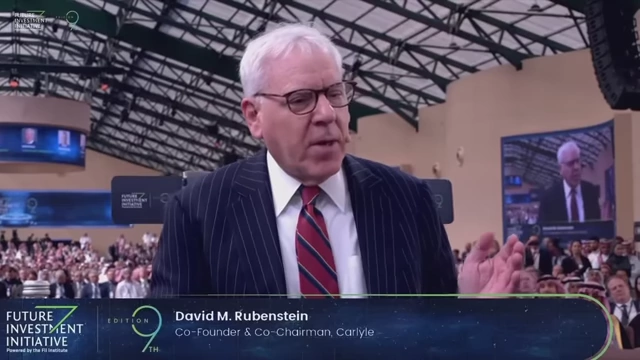
The 9th Future Investment Initiative in Riyadh gathered global finance leaders to discuss geoeconomics, addressing critical topics from AI's transformative impact to global debt concerns and investment opportunities in emerging markets.
David Rubenstein moderating the panel discussion on geoeconomics.
[
00:01:20
]
Introduction to the Future Investment Initiative Summit [0:00:00]
The 9th edition of the Future Investment Initiative (FII) in Riyadh gathers global financial leaders for a panel discussion on geoeconomics, moderated by David Rubenstein.
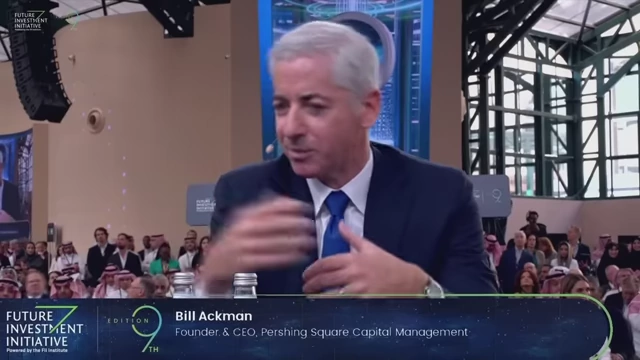
Bill Ackman: Advocacy and New York Politics [0:01:12]
Bill Ackman, Founder & CEO, Pershing Square Capital Management, speaking at the Future Investment Initiative.
[
00:02:00
]
Social media activity and free speech
Ackman finds his active presence on social media helpful, driven by a desire for independence and free speech.
His advocacy for viewpoint diversity, against discrimination and terrorism, and in favor of capitalism aligns with his partners' values.
Concerns about New York City's mayoral election
Views New York as the most important financial capital in the world.
Believes a socialist mayor would be catastrophic for the city.
Suggests that while affordability is a key issue, the proposed solutions are incorrect.
Encourages collective action from the panel's associates to vote, deeming it a critically important election for New York.
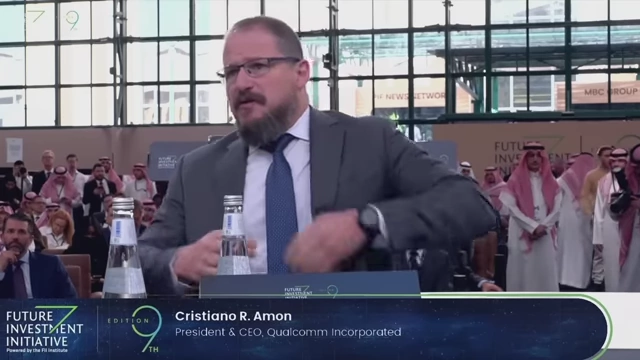
Cristiano Amon: Qualcomm's AI Transformation [0:03:33]
Cristiano R. Amon, President & CEO, Qualcomm Incorporated, speaking at the Future Investment Initiative.
[
00:03:50
]
Repositioning Qualcomm for the AI era
Qualcomm is leveraging mobile industry technologies, realizing their disruptive potential for other sectors.
Views AI as a new form of computing and software that will transform every computer, including phones, PCs, cars, and industrial machines.
Compares AI's impact to the combination of computing and the internet for consumers and enterprises, expecting massive opportunities and transformations within 12-24 months.
Investment advice in AI
Advises investors to focus on companies deeply connected to consumers and those that understand human intentions, as well as those embracing agent-type experiences for enterprises.
Highlights Qualcomm's partnership with Saudi Arabia's national AI company, Humane, for enterprise aging.
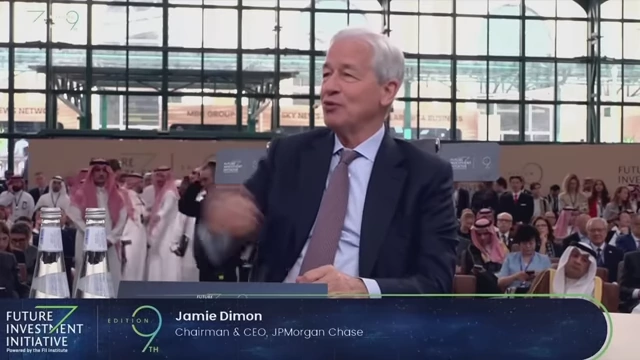
Jamie Dimon: In-Person Work and Global Debt [0:06:08]
Jamie Dimon, Chairman & CEO, JPMorgan Chase, speaking at the Future Investment Initiative.
[
00:06:39
]
Importance of in-person collaboration
Justified building a new, luxurious JPMorgan Chase building in New York City to compete for talent and foster a great work environment.
Emphasizes that in-person collaboration is crucial for society, creativity, and cohesion, leading to JPMorgan's full-time office work policy.
Argues that remote work leaves younger people behind, deteriorates social lives, and hinders honest conversations and accidental collaboration (as noted by Steve Jobs).
Concerns about global deficits and policy
Expresses worry about high global deficits, with governments often spending for consumption rather than future growth.
Stresses the importance of "good policy" (education, healthcare, infrastructure, proper taxation, foreign investment) as a free and effective driver of growth, contrasting it with devastating "bad policy."
Believes the US dollar's recent decline is a short-term fluctuation, reaffirming the dollar's long-term supremacy due to US technology innovation and strong capital markets.
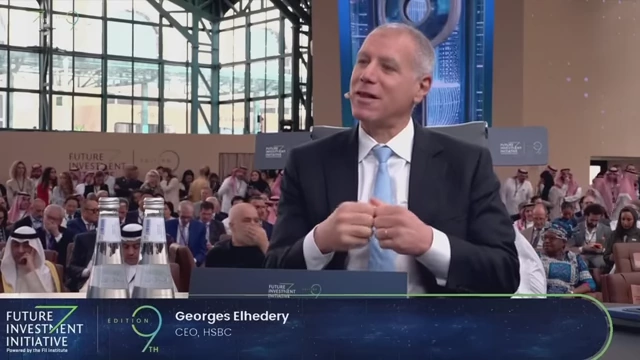
Georges Elhedery: HSBC's Global Connectivity and China Relations [0:08:47]
Georges Elhedery, CEO, HSBC, speaking at the Future Investment Initiative.
[
00:09:38
]
HSBC's global presence and strategy
Highlights HSBC's deep historical roots in Asia and the Middle East, with a continuous presence in Saudi Arabia for over 70 years.
Emphasizes building connectivity through trust, relationships, and understanding local needs and cultures.
Aims to supplement American financial services to ensure the world is fully served.
Navigating national assets
Acknowledges increasing difficulty in navigating national requirements, as more assets (code, chips, cloud data) become national assets in various jurisdictions, including China.
Stresses the importance of understanding these national asset definitions to find opportunities for connectivity, supply chains, consumers, and trade flows.
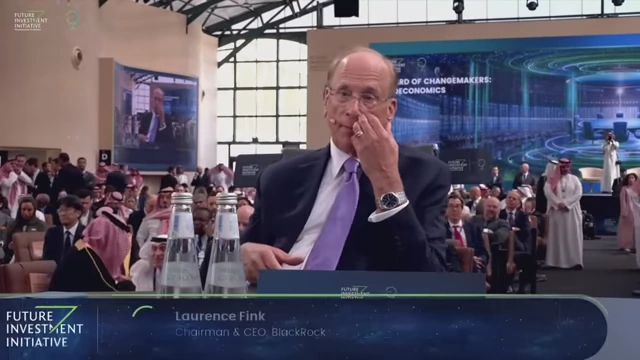
Laurence Fink: Capital Flows and Digitalization [0:10:56]
Laurence Fink, Chairman & CEO, BlackRock, speaking at the Future Investment Initiative.
[
00:11:28
]
Investment trends
Notes record-level interest in investing in Saudi Arabia and the GCC region, highlighting a project with 5x demand as an indicator of regional transformation.
Observed a modest movement out of dollar-based assets at the beginning of the year, but capital is now flowing back into the United States.
Attributes significant US economic growth (over 40% of Q2 GDP) to capex in technology, especially AI, a trend not as pronounced in Europe.
Central bank concerns: Tokenization and digitization
Identifies central bankers' biggest concern as the role and speed of tokenization and digitization of currencies, and its implications for the dollar and payment companies.
Argues that tokenization of financial assets and digital wallets are rapidly approaching, and most countries are ill-prepared.
US national debt and growth
Expresses concern about the US national debt of $38 trillion, growing by $2 trillion annually.
Believes growth is the solution: 3% annual growth, unlocked by private capital, would cause debt-to-GDP to fall.
Highlights the US's unusual dependency on foreign buyers for 30-35% of its treasury sales, which poses a risk if investor sentiment changes.
Describes crypto assets and gold as "assets of fear," acquired due to worries about currency debasement and financial/physical insecurity.
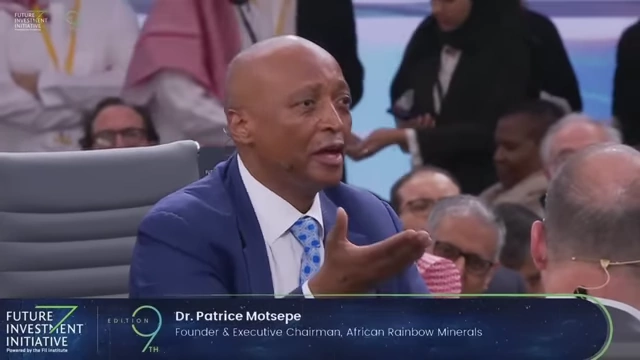
Dr. Patrice Motsepe: Gold and African Investment [0:15:04]
Dr. Patrice Motsepe, Founder & Executive Chairman, African Rainbow Minerals, speaking at the Future Investment Initiative.
[
00:15:27
]
Gold as a reliable asset
Identifies gold as a reliable source of wealth, particularly during difficult times, a sentiment reflected by central banks.
Investing in Africa
Views Africa as the "most exciting place to be" for investment, despite its challenges, offering competitive returns.
Calls for Africa to become a globally competitive destination for investment, ensuring safety, welcoming environment, and good returns to attract more private equity (which currently accounts for only 1% of global private equity dollars).
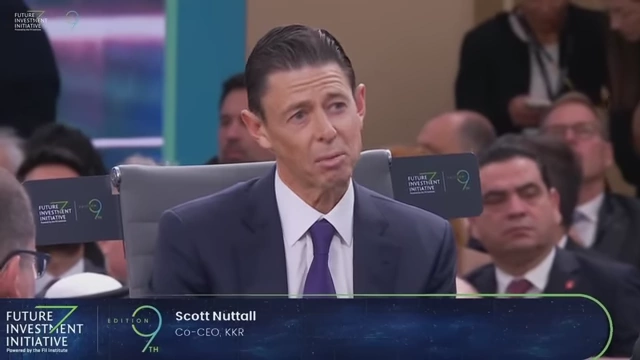
Scott Nuttall: Private Equity Cycles and Opportunities [0:17:15]
Scott Nuttall, Co-CEO, KKR, speaking at the Future Investment Initiative.
[
00:17:56
]
Private equity market conditions
Acknowledges the current difficulty in raising private equity dollars due to the industry's cyclical nature.
Attributes this to overdeployment in years like 2021 at potentially high valuations, leading to longer monetization periods.
Notes that infrastructure, private credit, and real estate are less impacted than traditional private equity.
Attractive investment areas
Recommends investing where capital supply-demand imbalances exist.
Highlights infrastructure as an area of significant need, with governments increasingly seeking private partnerships for balance sheet solutions due to increased debt-to-GDP ratios.
Sees opportunities across private credit, private equity, and real estate globally as market bottoms are returning.
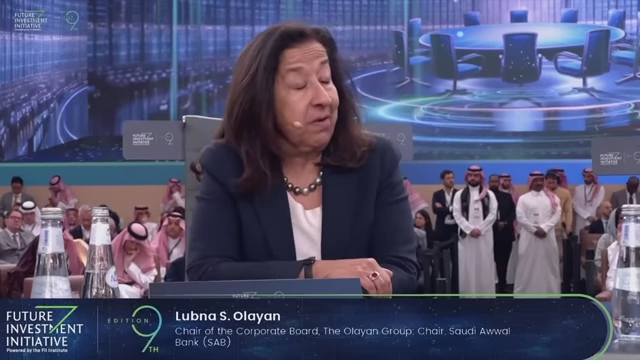
Lubna Olayan: Saudi Arabia's Economic Transformation [0:19:31]
Lubna S. Olayan, Chair of the corporate Board, the Olayan Group; Chair, Saudi Awwal Bank (SAB), speaking at the Future Investment Initiative.
[
00:20:15
]
Saudi Arabia's investment appeal
Expresses pride in Saudi Arabia's tremendous changes, making it a highly attractive market for investment.
Cites a 24% growth in investment and $34 billion in foreign investment as indicators of this appeal.
Points to improved ease of doing business, easier visa processes, and enhanced lifestyle as key factors.
New investment law and key sectors
Highlights a new investment law, effective this year, which grants foreign and Saudi owners equal footing in terms of capital access, real estate ownership, disposal of investments, and money repatriation.
Recommends investment in selectively strong real estate markets (especially data centers), technology, quality healthcare and pharmaceuticals, and renewable energy.
Affirms that there has been no discrimination against women in business in Saudi Arabia, despite increased visibility.
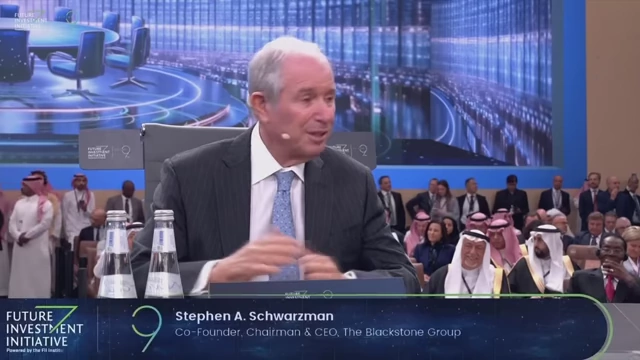
Stephen A. Schwarzman: US-China Relations and Power Infrastructure [0:22:42]
Stephen A. Schwarzman, Co-Founder, Chairman & CEO, The Blackstone Group, speaking at the Future Investment Initiative.
[
00:23:15
]
US-China relations
Expresses optimism for a positive outcome in US-China relations, predicting a significant lowering of temperatures between the two countries on trade issues, leading to a more functional relationship.
Investment in data centers and power
Identifies the data center/AI complex, with a particular emphasis on power infrastructure, as the most interesting investment area.
Highlights the critical shortage of electricity supply in developed countries like the US, where the electric grid has stagnated for 20 years but now faces 4-5% annual growth due to data centers.
Notes that Blackstone is the world's largest developer and owner of data centers, emphasizing the acute need for significant capital investment in power infrastructure, which promises very high returns.
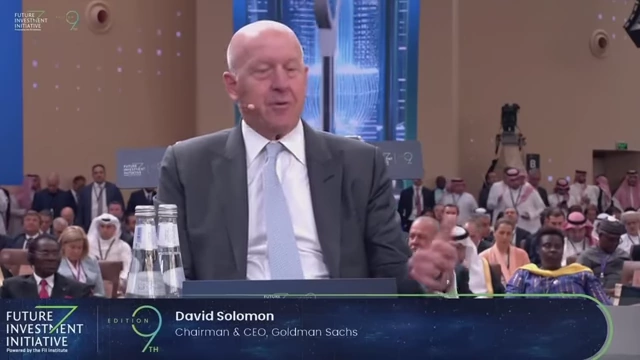
David Solomon: M&A, IPOs, and Economic Outlook [0:26:49]
David Solomon, Chairman & CEO, Goldman Sachs, speaking at the Future Investment Initiative.
[
00:27:24
]
M&A and IPO market acceleration
Notes a clear acceleration in M&A and IPO activity, expecting it to continue through 2026 and 2027.
Attributes previous headwinds to regulatory uncertainty, but now, strategic deals are more likely to be considered.
States the IPO market is "wide open" for appropriately priced, good businesses.
Observes that 60-70% of M&A activity targets or acquirers are US-based, and the US holds deeply embedded advantages in capital markets and innovation.
Mentions Europe's slower pace for M&A and IPOs due to regulatory burdens.
Economic outlook
Sees no compelling evidence for an imminent US economic slowdown in the next 6-12 months.
Cautions that economic slowdowns often occur due to unforeseen "exogenous events" that quickly change confidence.
Reiterates the US's strong position in technology innovation and capital formation as reasons for continued dollar dominance.
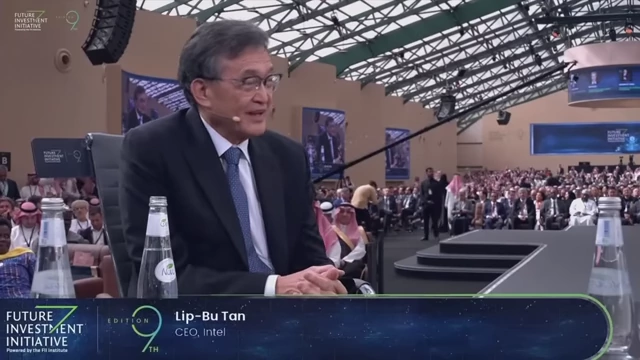
Lip-Bu Tan: Intel's Turnaround and US Semiconductor Manufacturing [0:30:02]
Lip-Bu Tan, CEO, Intel, speaking at the Future Investment Initiative.
[
00:31:13
]
Addressing past conflicts and securing partnerships
Shares his approach to address the "appearance of conflict" regarding past investments in China by allocating his carry interest to a charitable trust.
Recounts securing the US government as a 10% shareholder in Intel, viewing it as an essential partner for critical infrastructure like semiconductors.
Cites TSMC as an example where government shareholding in semiconductor companies in respective countries provides resilience for supply chains.
Intel's revitalization strategy
Attributes Intel's past struggles to complacency and excessive management layers.
His strategy focuses on cleaning up operations and refocusing Intel as an engineering-driven company.
Identifies tremendous opportunities in AI/machine learning (agentic and physical AI) and re-establishing Intel as a reliable semiconductor foundry in the US with a global footprint.
Concluding Discussion: US Debt and Economic Growth [0:32:54]
The panel addresses the concern regarding the United States' national debt of approximately $38 trillion, with an annual addition of $2 trillion.
Bill Ackman's perspective
Not worried about US solvency due to significant unlisted assets on the government's balance sheet (e.g., ability to adjust corporate and income tax rates).
Advocates for growing the asset side of the balance sheet rather than solely focusing on liabilities, though prefers slower growth in liabilities.
Laurence Fink's perspective
States that 2% annual growth would overwhelm the US with deficits, but 3% growth, achieved by unlocking private capital, would cause debt-to-GDP to fall.
Expresses concern about the US's dependency on foreign buyers for 30-35% of its treasury sales, noting this is unusual for a nation with high debt-to-GDP, where domestic savings usually cover deficits.
Emphasizes that unlocking trillions of dollars in private capital (currently in savings/money market funds) into investment accounts is key to solving the debt issue without tax adjustments.
Jamie Dimon's perspective
Views the debt issue as global, with many governments spending for consumption rather than future growth.
Reiterates that good policies—focused on education, healthcare, infrastructure, taxation, and foreign investment—are crucial for helping citizens and preventing national decline.
David Solomon's perspective
Dismisses the recent 11% decline in the dollar's value against the Euro as a short-term trend.
Reaffirms dollar dominance due to US strength in technology innovation and leading capital markets, predicting that the vast majority of capital allocation will continue to favor dollar-based assets.
Final thoughts on cryptocurrencies
Laurence Fink categorizes crypto assets and gold as "assets of fear," bought by those concerned about currency debasement and financial insecurity.
Jamie Dimon clarifies that "crypto is real" in terms of blockchain, stablecoins (like JPM Coin), and smart contracts, which will be used to facilitate transactions and customer service, but remains skeptical of speculative cryptocurrencies.