Achieving Complex Goals: A 5-Step Reverse Goal Setting Framework
This video introduces a 5-step "Reverse Goal Setting" framework, designed to help individuals achieve complex goals more effectively than conventional methods. It critiques conventional goal setting for its lack of clear plans and demotivating uncertainty. Reverse Goal Setting, however, offers clarity, actionable steps, maintained motivation, and increased success rates.
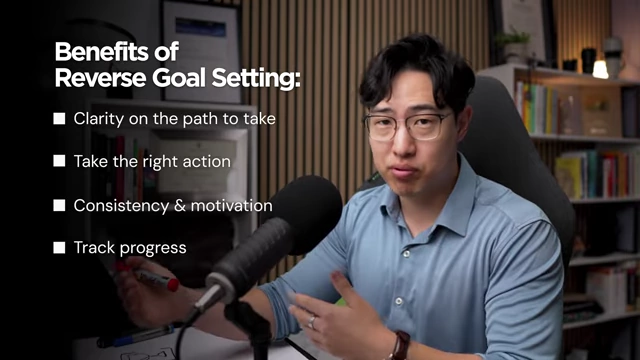
- 1. Set the Goal: Focus on the desired underlying outcome, allowing for goal modification as understanding evolves.
- 2. Assess Goal Level: Identify specific skills, attributes, and habits (SAH) needed to overcome challenges, rating their required proficiency on a 0-10 scale. These become "meta-goals."
- 3. Assess Current Level: Rate your current SAH to pinpoint the gaps between your present ability and the target level, creating a personalized progression plan.
- 4. Force Field Analysis: Visually map out barriers hindering progress and the drivers/resources available to overcome them.
- 5. Action Plan: Prioritize 1-2 key actions based on the analysis, focusing on bridging SAH gaps or eliminating critical barriers.
The framework emphasizes continuous, iterative re-evaluation of action plans (daily), force field analysis (weekly), current SAH levels (bi-weekly), and the main goal itself (monthly), ensuring adaptability and building true confidence.
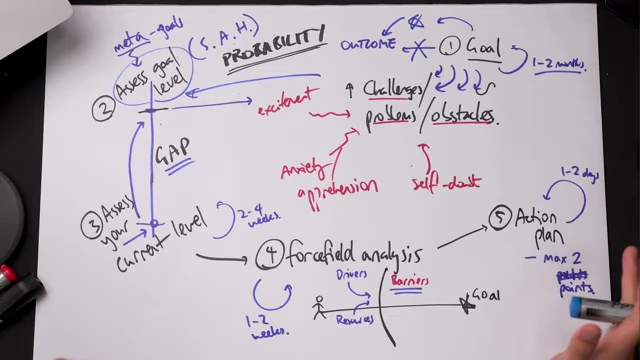
A comprehensive diagram showing the 5 steps of Reverse Goal Setting, with iterative feedback loops for continuous improvement at different frequencies. [ 00:28:02 ]
Speaker's Personal Journey and Critique of Conventional Goal Setting [00:00:00]
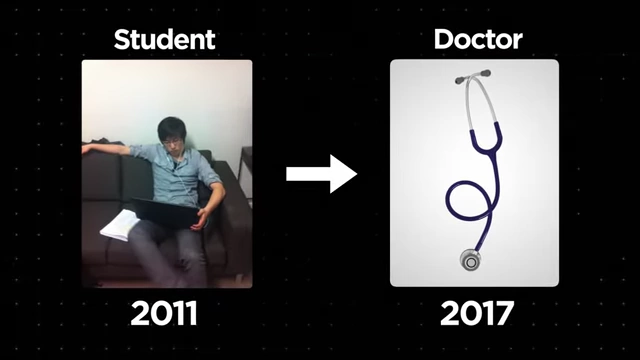
The speaker, Justin Sung, shares his personal experience of achieving his childhood dream of becoming a doctor, only to resign 18 months later due to dissatisfaction and unfulfillment. He now runs a business teaching learning skills and finds his current work much more fulfilling. This experience led him to question conventional goal setting.
- Limitations of Normal Goal Setting:
- People often focus solely on defining the goal without creating a clear, detailed plan to achieve it [00:01:26].
- Plans are usually vague (e.g., "study hard" or "try and get the job") [00:01:34].
- The path to complex goals is rarely linear; it's often winding and uncertain, making it hard to track progress [00:02:08].
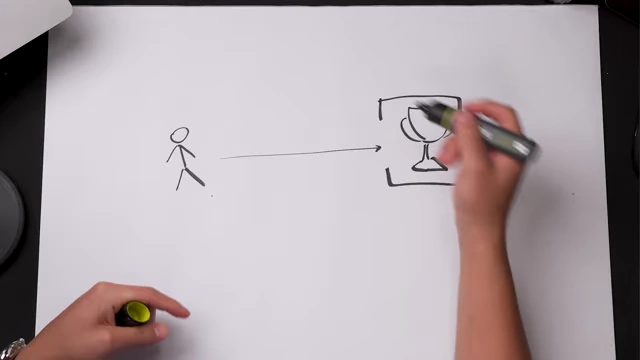
A simple diagram showing a person aiming for a goal (trophy). [ 00:01:11 ] 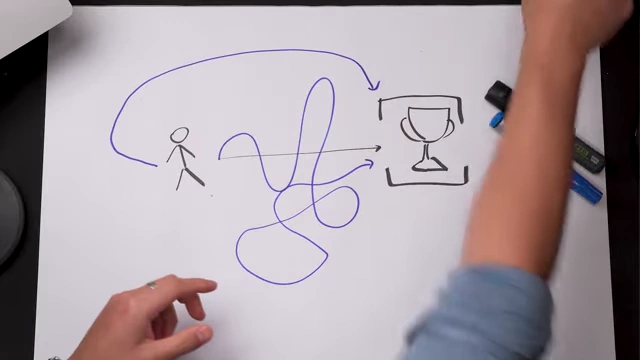
A diagram illustrating the typical winding and uncertain path a person takes towards a goal, highlighting unpredictability. [ 00:02:20 ] - Lack of visible progress and unknown paths can be highly demotivating, leading many to give up even if they are on the right path [00:02:31].
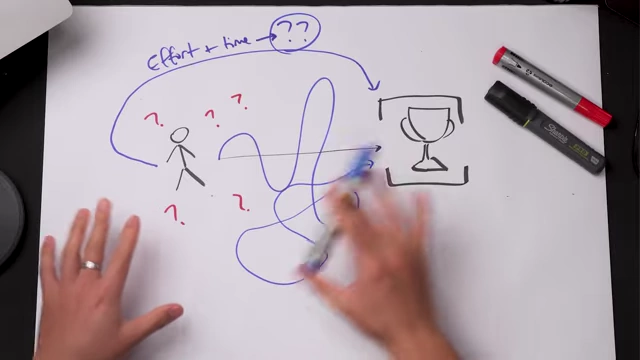
A diagram highlighting the uncertainty of conventional goal setting with question marks surrounding the path, effort, and time. [ 00:02:53 ] - Success can feel random or dependent on luck, leading to frustration and doubt about the value of goal setting itself [00:03:10].
Benefits of Reverse Goal Setting [00:03:46]
Reverse goal setting offers a more structured and predictable approach:
- Clarity on the Path: Provides a clear roadmap of actions needed.
- Take the Right Action: Helps in identifying and taking the most effective actions.
- Consistency & Motivation: Facilitates sustained effort and keeps motivation high by showing progress.
- Track Progress: Allows for clear monitoring of development towards the goal.
- Increased Success Rate: Ultimately, it significantly boosts the likelihood of achieving complex goals [00:04:11].
The 5-Step Reverse Goal Setting Framework
1. Set the Goal [00:04:26]
The first step is to establish your goal, but with an open mindset.
- Focus on the True Outcome: Understand that the goal itself is a means to an end; the real objective is the feeling or position you expect to gain (the "outcome") [00:05:15].
![A diagram illustrating that the "Goal" [<a href="https://youtube.com/watch?v=LTaCZRsVIB0&t=1">1</a>] is a means to achieve a desired "Outcome."](https://storage.googleapis.com/summarizer-images/images/LTaCZRsVIB0/sc0032_t00.05.21.webp)
A diagram illustrating that the "Goal" [<a href="https://youtube.com/watch?v=LTaCZRsVIB0&t=1">1</a>] is a means to achieve a desired "Outcome." [ 00:05:21 ] - Be Open to Change: Recognize that your understanding of the goal and its alignment with your desired outcome may evolve as you gather more information. Be willing to modify the goal to stay true to the underlying outcome [00:05:05].
- Personal Example: The speaker's journey to becoming a doctor illustrated how the initial goal didn't deliver the anticipated fulfillment, leading him to pivot his career path while staying aligned with his core desire for impactful work [00:06:26].
A diagram showing that while the "Outcome" remains constant, the specific "Goal" can be shifted or modified. [ 00:20:42 ]
- Personal Example: The speaker's journey to becoming a doctor illustrated how the initial goal didn't deliver the anticipated fulfillment, leading him to pivot his career path while staying aligned with his core desire for impactful work [00:06:26].
2. Assess the Goal Level [00:11:17]
Once a goal is set, identify the challenges, problems, and obstacles it entails.
- Identify Necessary Attributes: Determine the specific skills, attributes, and habits (SAH) a person would need to easily overcome these challenges and achieve the goal [00:11:42].
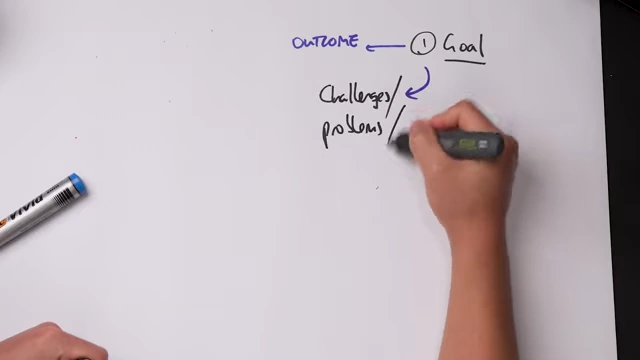
A diagram outlining the first step of setting a goal, which then entails a bundle of challenges, problems, and obstacles. [ 00:09:45 ] - Quantify Required Levels: Rate the ideal proficiency for each SAH on a scale of 0-10. This makes the required capabilities explicit and tangible.
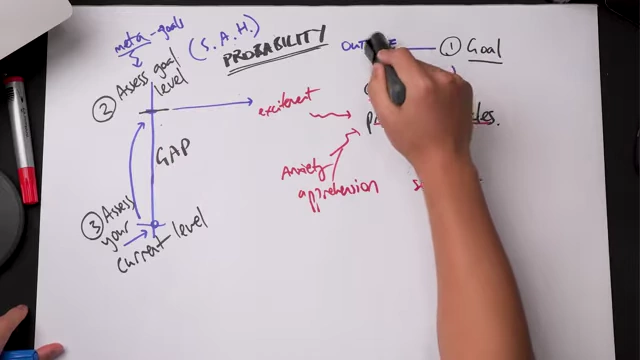
- Define Meta-Goals: These required SAH become your "meta-goals"—the prerequisites to achieve your ultimate goal [00:13:14].
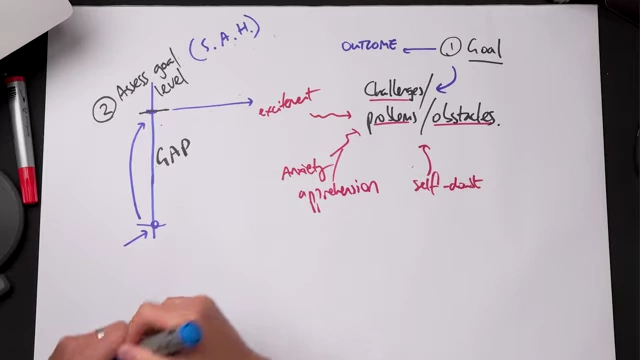
A diagram showing the gap between current ability and the assessed goal level, indicating that overcoming challenges requires improving skills, attributes, and habits (SAH) or "meta-goals." [ 00:13:15 ] - Control Probability, Not Outcome: The process focuses on controlling your skills, attributes, and habits to maximize your probability of success.
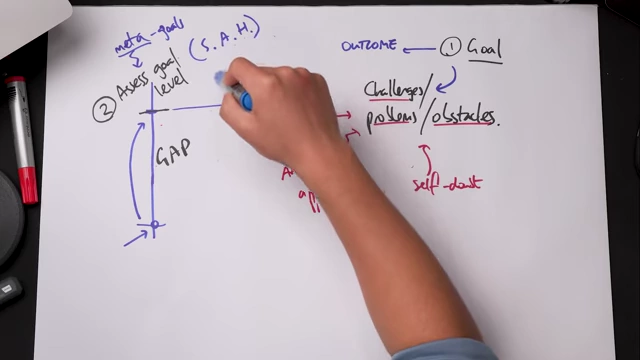
A diagram emphasizing that developing skills, attributes, and habits (SAH) increases the "PROBABILITY" of achieving the outcome, not directly controlling the outcome itself. [ 00:14:20 ] 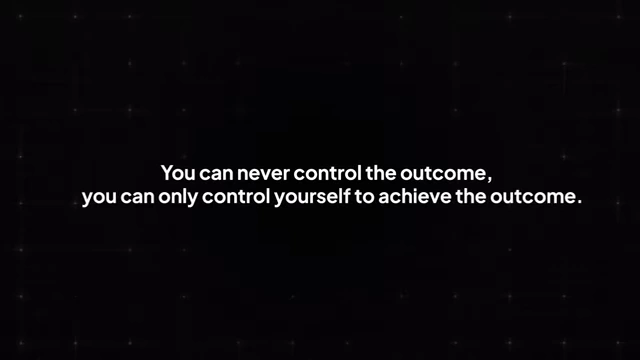
A text slide stating, "You can never control the outcome, you can only control yourself to achieve the outcome." [ 00:14:32 ]
3. Assess Your Current Level [00:15:00]
Compare your current capabilities against the required goal level.
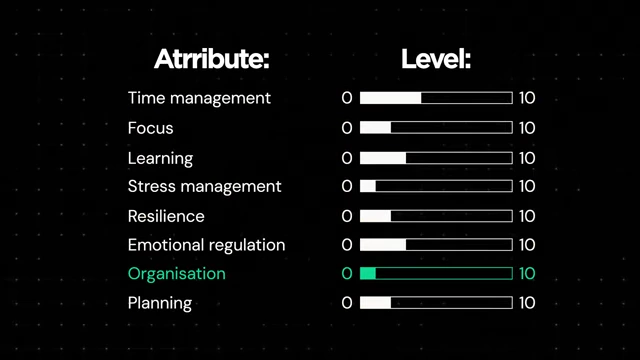
- Self-Rate Current SAH: Evaluate your present proficiency for each identified SAH using the same 0-10 scale.
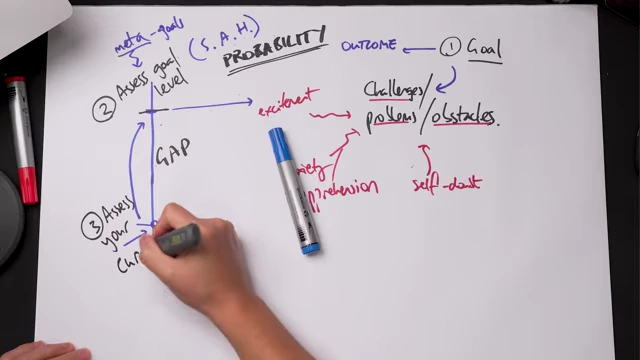
A diagram showing the three initial steps of Reverse Goal Setting: setting the goal, assessing the goal level (SAH and meta-goals), and assessing your current level, highlighting the "GAP." [ 00:15:08 ] - Identify the Gap: This comparison reveals the "gap" between your current ability and the level needed, creating a personalized progression plan [00:15:31].

A visual comparison of current skill levels versus target skill levels for various attributes (e.g., Time management, Focus, Learning), highlighting the gaps to be addressed. [ 00:15:26 ] - This quantification turns vague anxieties into concrete areas for development.
- Prioritize Development: Focus on the 2-3 SAH with the widest gaps and highest importance first, as they represent the most significant areas for improvement [00:18:35]. Avoid trying to improve too many things simultaneously due to cognitive overload [00:19:07].
Benefits of this Iterative Approach [00:19:42]
This continuous, iterative process offers significant advantages:
- Win No Matter What: Even if the ultimate goal isn't achieved, you will have developed valuable skills, attributes, and habits, increasing your probability of success in future endeavors [00:19:50].
A speaker with an overlay stating "Benefit #1: Clarity on what to do." [ 00:19:47 ] - Protection Against Changing Goals: The focus on developing personal capabilities makes you adaptable. If the original goal proves misaligned with your desired outcome, the developed skills remain transferable to new, more aligned goals [00:20:56].
- True Confidence: By actively addressing challenges and improving capabilities, you build genuine confidence, transforming instability and anxiety into self-assurance and opportunities [00:21:38].
4. Force Field Analysis [00:21:55]
Visually map the forces influencing your ability to achieve the goal.
- Identify Barriers: List all internal and external factors hindering your progress towards the goal [00:22:38].
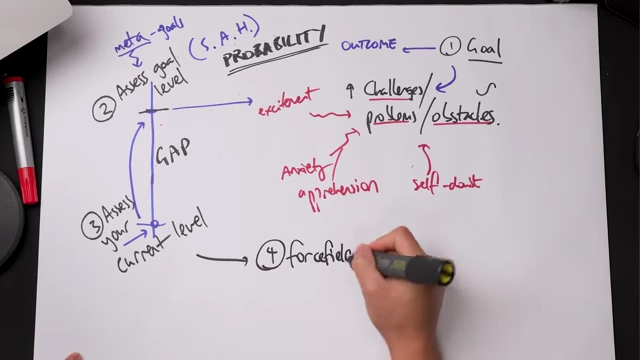
A diagram indicating the fourth step, "Force Field Analysis," in the overall Reverse Goal Setting framework. [ 00:22:02 ] - Identify Drivers and Resources: List your personal strengths, existing skills, and available external resources (e.g., network, financial support) that can help overcome the barriers [00:22:56].
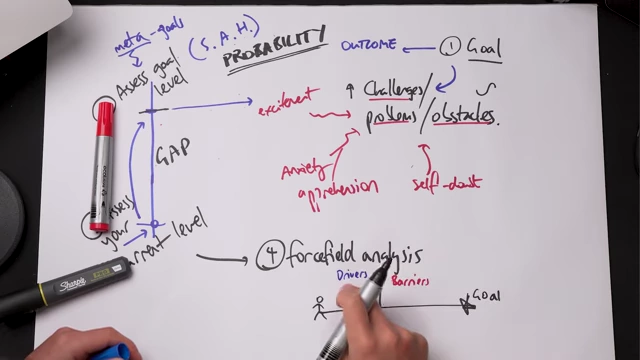
A force field analysis diagram showing "Drivers" and "Resources" on one side, and "Barriers" on the other side, impacting the ability to reach a "Goal." [ 00:23:03 ] - Develop a Battle Plan: Use your drivers and resources to strategically address and mitigate each barrier, enhancing problem-solving and agency [00:23:34].
- Consider holistic barriers that might not be directly goal-related (e.g., childcare responsibilities) [00:23:54].
5. Action Plan [00:25:05]
Distill all the insights into a focused, actionable plan.
- Focus on 1-2 Priorities: Select a maximum of two top priority actions based on the preceding steps. These actions should either bridge a significant SAH gap or eliminate a critical barrier [00:25:54].
![A diagram showing the five steps of Reverse Goal Setting, with the "Action Plan" [<a href="https://youtube.com/watch?v=LTaCZRsVIB0&t=5">5</a>] as the final step leading to iterative improvements.](https://storage.googleapis.com/summarizer-images/images/LTaCZRsVIB0/sc0097_t00.25.19.webp)
A diagram showing the five steps of Reverse Goal Setting, with the "Action Plan" [<a href="https://youtube.com/watch?v=LTaCZRsVIB0&t=5">5</a>] as the final step leading to iterative improvements. [ 00:25:19 ] - Iterative Evaluation:
- Action Plan: Review and refine your action plan every 1-2 days [00:26:27].
- Force Field Analysis: Re-evaluate barriers and drivers every 1-2 weeks [00:26:41].
- Current Level Assessment: Re-assess your current SAH levels every 2-4 weeks to track progress and reprioritize [00:26:56].
- Goal Re-evaluation: Revisit the main goal and its challenges every 1-2 months, incorporating new insights and adjusting as needed to stay aligned with your desired outcome [00:27:19].
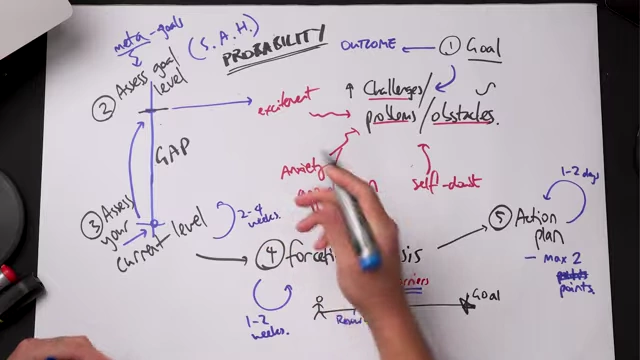
A detailed diagram of the Reverse Goal Setting framework, illustrating the iterative feedback loops and recommended frequencies (1-2 days, 1-2 weeks, 2-4 weeks, 1-2 months) for re-evaluation. [ 00:27:01 ]
By following this reverse goal setting flow and re-evaluating things frequently enough in the right way, we make sure that we give ourselves the best chance of success, which means achieving the outcome that we truly want.