Mastering Time Management: The Budget Rule, Leverage Lens, and Friction Formula Explained
Summary:
This video explains effective time management by reframing it as managing choices, not time itself. It introduces three core principles:
- The Budget Rule: Treat time like a bank account, valuing every minute to avoid procrastination, stress, and burnout. This involves addressing "inflation tasks" immediately as they become more costly over time, and assigning "time price tags" to all tasks for better prioritization.

The speaker explains that time management is about managing choices, not time. [ 00:00:05 ] - The Leverage Lens: Focus on tasks with high return on investment (ROI), adhering to the 80/20 rule. This means identifying and prioritizing "leverage index tasks" (LITs) that prevent burnout, drive results, and save time, while eliminating low-impact activities.

The 80/20 Rule states that 80% of the work you do accounts for just 20% of the results. [ 00:05:52 ] - The Friction Formula: Overcome procrastination by reducing the "setup cost" of tasks. Make tasks so easy to start that momentum takes over, emphasizing systems over willpower to increase discipline and efficiency.
Intro [0:00]
The video begins by asserting that effective time management is not about managing time itself, but rather about managing choices.
PART I - The Budget Rule [0:49]
The first principle is to treat time like a bank account, valuing it as much as money.
- If you wouldn't throw away money, you shouldn't throw away time.
- Undervaluing time leads to procrastination, stress, and burnout, similar to how overspending money leads to a negative bank balance.
- Every minute should be spent either working towards goals or genuinely recovering.
STRAND I - Inflation Tasks [1:28]
- These are tasks that become more "expensive" the longer you delay them.
- They are described as "open loops" that continue to drain time and energy in the background, like unpaid bills, unfinished conversations, or household chores.
- Delaying these tasks increases friction and anxiety, making them harder to complete.
- Everything in life is interconnected; disrupting one thing can affect the harmony of others.
- The key is to act on identified tasks as soon as possible to prevent building up resistance.
- Procrastination stems from these open loops draining mental and physical energy.
- Time is more valuable than money; we would exchange wealth for more time, so we should treat it with utmost importance.
STRAND II - Time Price Tags [3:55]
- Most people don't value time because they don't assign explicit "price tags" to tasks.
- The concept involves quantifying the time each task takes in minutes.
- Example: Reply to emails: 10 minutes; Clean the kitchen: 14 minutes; Scroll Instagram: 40 minutes; Start editing: 7 minutes.

An example of assigning a time price tag to scrolling Instagram, estimated at 40 minutes. [ 00:04:26 ]
- Example: Reply to emails: 10 minutes; Clean the kitchen: 14 minutes; Scroll Instagram: 40 minutes; Start editing: 7 minutes.
- Assigning price tags provides a value reference, helping to identify what is most valuable, what takes the most or least time, and what to prioritize.

A visual question asking what tasks take up the most time to prompt prioritization. [ 00:04:38 ] - Relentless tracking of how time is spent is crucial to identify and eliminate wasted time.

A notebook with a detailed grid for tracking time or habits, illustrating the concept of relentless tracking. [ 00:03:00 ]
PART II - The Leverage Lens [5:00]
This section focuses on the idea that not all tasks yield equal results; some tasks are more leveraged than others.
- One hour spent on the right tasks can return 10 hours later.
- Days should be organized by Return on Investment (ROI), not just urgency.
- If you only had 2 hours a week to achieve your goals, you'd prioritize very differently, likely cutting out 80% of current activities.
- The 80/20 Rule (Pareto Principle): 20% of effort produces 80% of results, and conversely, 80% of effort produces 20% of results.
The speaker clarifies that 80% of the work you do accounts for just 20% of the results, highlighting the importance of the 80/20 rule. [ 00:05:52 ] - Focus on "needle-moving tasks"—the few things that genuinely make a difference in your work or life and bring the highest ROI.
- Productivity should be measured by results and success, not by hours worked, to avoid burnout.
CONCEPT I - Leverage Index Tasks (LIT) [6:42]
- Create a list of tasks and rate them from 1 (best) to 10 (worst) based on their return on time investment, rather than emotional appeal.
- Top-priority tasks (e.g., #1): Tasks that prevent burnout, deliver results, remove friction, build momentum, foster creativity, save time, and increase efficiency.
- Low-priority tasks (e.g., #10): Tasks that are unproductive, bloated, or simply waste time.
- The recommendation is to focus on the top 3 prioritized tasks and remove the rest.
CONCEPT II - The 20x Setup Rule [7:40]
- Setting something up correctly once can save hours and time indefinitely.
- This involves investing initial effort to create systems, templates, or workflows that streamline future tasks.
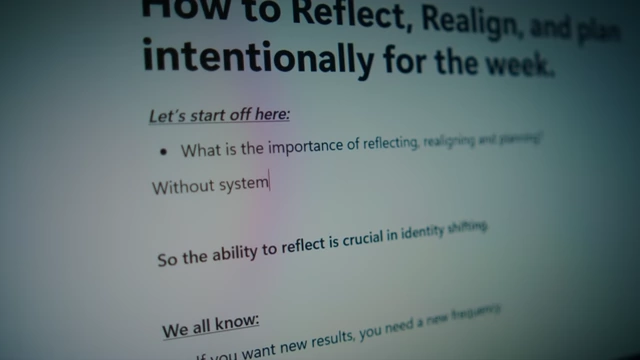
A document titled 'How to Reflect, Realign, and plan intentionally for the week,' serving as an example of creating systems and templates. [ 00:07:46 ] - Examples:
- Bulk filming videos: Setting up equipment once to record multiple videos saves repeated setup time (e.g., 5 minutes setup for 10 videos vs. 50 minutes).
- Automating workflows: Creating templates, pre-packing gym bags, batch scheduling, and pre-building systems for tasks.
- Organizing editing assets: Pre-color-grading footage and organizing text and b-roll for drag-and-drop editing.
- Initial effort in setting up efficient systems is highly compensated by long-term time savings.
- Cleaning your room, while seemingly a low emotional reward task, saves time by fostering a productive environment and enhancing self-image.
PART III - The Friction Formula [9:32]
The final concept addresses overcoming the barrier to starting tasks.
- Lack of motivation is often perceived as too much friction. It's not that one can't do the task, but that the "setup cost" is too high.
- The solution is to make tasks incredibly easy to start, almost impossible not to get going.
- Breaking tasks down into the simplest possible steps reduces friction, allowing momentum to build.
- Systems beat willpower: Reducing friction directly increases discipline because relying on willpower alone is unsustainable.
- The goal is to become focused, efficient, and consistent by creating systems that support good habits and deter bad ones.
- It's essential to understand your personal efficiency peaks (morning vs. evening) and adapt strategies accordingly.
- Relentlessly track inputs versus outputs: Focus on controlling high-quality, valuable inputs, which will naturally lead to valuable outputs and desired results.
- This holistic approach to time management, goal setting, and system creation leads to a productive and fulfilling life.