Understanding Retatrutide's Heart Rate Increase: Potential Dangers, Mechanisms, and Safety Data
Summary:
- Retatrutide in its Phase 2 trial showed a significant increase in resting heart rate (+9 beats per minute), roughly triple that of other GLP-1 medications like Wegovy and Zepbound.
- Population data suggests a correlation between higher resting heart rate and increased mortality risk, but this is an association, not direct causation.
- The heart rate elevation from Retatrutide is persistent over time and may have mechanical and rhythm implications, especially for individuals with pre-existing heart conditions.
- While Retatrutide improves other cardiovascular risk factors like weight, blood pressure, and lipids, the elevated heart rate presents a "surrogate paradox."
- The GLP-1 SELECT trial for semaglutide showed a modest heart rate increase (+3.1 bpm) was compatible with improved cardiovascular outcomes, but Retatrutide's triple agonist action (GLP-1, GIP, Glucagon) and larger HR spike make direct comparisons difficult.
- Glucagon receptor agonism is suspected to be a key driver of the higher heart rate increase, potentially compounded by a baroreflex response to lowered blood pressure.
- The definitive answer regarding Retatrutide's cardiovascular safety and outcomes will come from the ongoing large-scale TRIUMPH-Outcomes Phase 3 trial, expected in 2029.

Comparison of Retatrutide, Wegovy, and Zepbound Heart Rate Increases [ 00:00:10 ]
Introduction to Retatrutide and Heart Rate [00:00:00]
- Retatrutide's Phase 2 trial indicated a resting heart rate (HR) increase of approximately +9 beats per minute (bpm).
- This is significantly higher than other GLP-1 drugs like Wegovy (+1 to +4 bpm) and Zepbound (+1 to +3 bpm).
Comparison of Retatrutide, Wegovy, and Zepbound Heart Rate Increases [ 00:00:10 ]
- This is significantly higher than other GLP-1 drugs like Wegovy (+1 to +4 bpm) and Zepbound (+1 to +3 bpm).
- Key questions regarding this HR increase:
- Is it merely a risk marker?
- Is there a specific drug mechanism causing it?
- Does it impact long-term cardiovascular outcomes?
- Sources of evidence to address these questions include general resting heart rate literature, the Retatrutide Phase 2 paper, the SELECT trial for semaglutide, and the ongoing TRIUMPH-Outcomes trial.
- Initial assessment suggests Retatrutide may be tolerable for many individuals, but might be a "different conversation" for those with:
- Pre-existing rhythm history.
- Heart failure.
- High baseline heart rate.
- Uncontrolled systolic blood pressure.
- It is crucial to note that Retatrutide is currently investigational and not approved for clinical use outside of trials.
Significance of Resting Heart Rate Elevation [00:01:15]
- Physiology Refresher: Normal adult resting heart rate is 60-100 bpm; above 100 bpm is considered tachycardic.
- A baseline of 80 bpm plus a 9-10 bpm increase puts an individual around 90 bpm, close to the tachycardic range.
- Population Data: Meta-analyses show an association between higher resting HR and increased mortality.
- Every +10 bpm above baseline associates with a ~9% higher risk of all-cause mortality and ~8% higher risk of cardiovascular death.
- Caveat: This is an association, not proof of causation. High HR can be a marker of other issues like lower fitness, untreated sleep apnea, thyroid issues, anemia, or stimulant use.
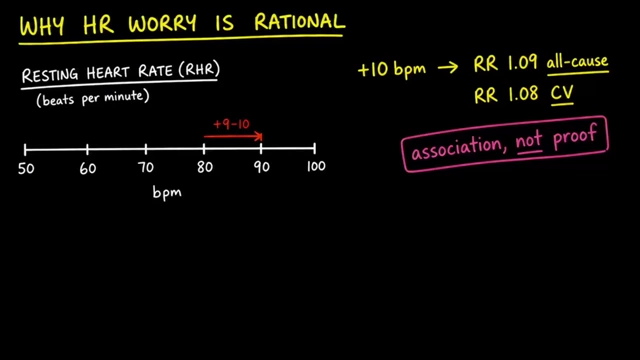
Correlation between Resting Heart Rate and Mortality Risk [ 00:01:50 ]
- Mechanical Cost of Faster Heart Rate:
- A sustained +9 to +10 bpm increase means approximately 14,400 extra beats per day, or about 5 million extra beats per year.
- Increased heart rate shortens diastole (the heart's refilling phase).
- Less filling time is generally not an issue for healthy individuals.
- However, it can be problematic for those with stiff ventricles or coronary artery disease, where there is less margin for error.
- This chronic mechanical stress matters over years, disproportionately straining vulnerable hearts.
- Rhythm Considerations:
- Higher sympathetic tone (fight-or-flight response) combined with a faster atrial rate could create a substrate for atrial fibrillation (AFib).
- While Retatrutide doesn't necessarily cause AFib in healthy hearts, it may exacerbate existing rhythm issues, such as paroxysmal AFib or supraventricular tachycardia (SVT).
- Patients with existing rhythm history or heart failure might have less "room for error" when taking Retatrutide.
- Duration of Elevation: The heart rate elevation is not transient; in Phase 2, the high-dose group was still ~6-7 bpm above baseline at week 48.
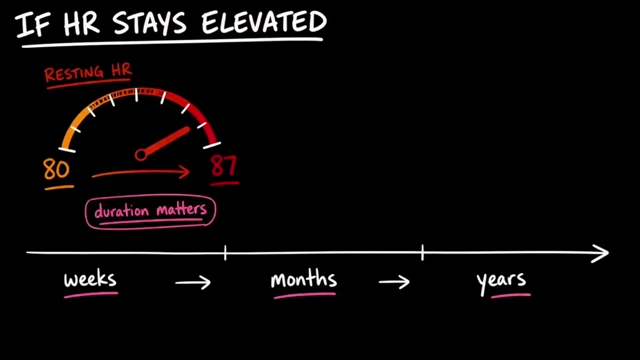
Heart Rate Gauge Showing Sustained Elevation Over Time [ 00:04:19 ]
Retatrutide Phase 2 Heart Data [00:09:18]
- Trial Design:
- N=338 adults with obesity but no type 2 diabetes.
- Randomized to placebo or Retatrutide (1, 4, 8, or 12 mg weekly subcutaneous injection).
- Duration: 48 weeks.
- Seven published curves due to different titration schemes for 4mg and 8mg arms.
- Weight Loss Efficacy: At 12 mg, mean weight loss was 24.2% at week 48 (vs. ~2% for placebo).
- Heart Rate Curve:
- Climbed for ~24 weeks during dose escalation.
- Peaked around +9 to +10 bpm at week 24.
- Drifted down slightly but remained elevated at week 48 (~+6 to +7 bpm vs. +0.4 for placebo).
- This indicates a real, persistent HR elevation.
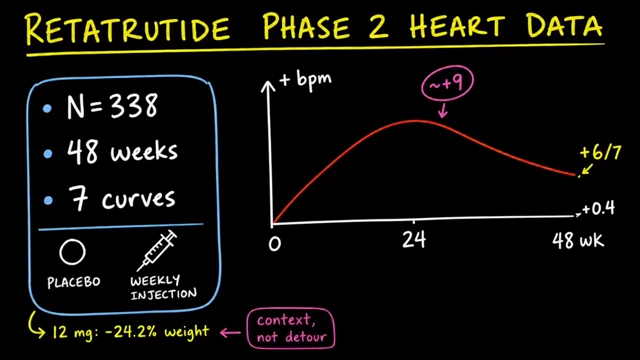
Retatrutide Phase 2 Heart Rate Curve [ 00:10:18 ]
- 24-Hour Ambulatory Blood Pressure Monitoring (ABPM): Confirmed HR elevation at home, ranging from +0.9 to +9 bpm across doses.
- This helps rule out "white coat hypertension" and confirms the persistent elevation in a non-stressful environment.
- Other Cardiovascular Markers:
- Systolic Blood Pressure (SBP) dropped significantly across active doses (ranging from -2.3 to -12.1 mmHg).
- Lipids improved: LDL cholesterol down to -24.3 mg/dL (highest dose), triglycerides down to -54.6 mg/dL.
- The "Surrogate Paradox":
- Most cardiovascular surrogate markers (weight, BP, lipids, A1C) improve significantly with Retatrutide.
- However, heart rate, another surrogate marker, increases.
- The key question is whether the overall cardiovascular benefits outweigh the negative signal from the elevated heart rate.
Rhythm Signal from Phase 2 Trial [00:12:55]
- Arrhythmia-Related Adverse Events (AEs):
- Placebo arm: 2.9%
- Active Retatrutide arms: Ranged from 0% to 14.3%
- 12 mg arm: 11.3%
- Note: These are small numbers (approx. 80 patients per arm), leading to a "noisy signal," and not a clear dose-response relationship.
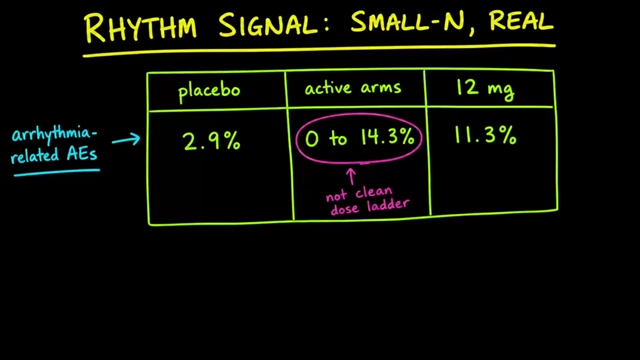
Arrhythmia-Related Adverse Events in Retatrutide Phase 2 [ 00:13:07 ]
- Severity: Out of 21 events in 19 people, 13 were mild, 7 moderate, and 1 severe.
- Most patients (17/19) continued treatment. Two discontinued in the 12 mg group.
- Severe Case (QT Prolongation): This patient was also vomiting, on ondansetron, and experienced low potassium and dehydration, which are known causes of QT prolongation. It's difficult to attribute this directly and solely to Retatrutide.
- Trial Exclusions - Crucial Context: The Phase 2 trial excluded individuals with:
- Resting pulse > 100 bpm.
- Existing atrial fibrillation (AFib), SVT, or POTS.
- NYHA Class III/IV heart failure.
- Uncontrolled hypertension, recent heart attack, or stroke.

Exclusion Criteria for Retatrutide Phase 2 Trial [ 00:15:16 ] - This means the observed rhythm signals apply only to a relatively healthier, selected patient population without major pre-existing cardiac issues. The trial does not provide data on the effects of Retatrutide in high-risk cardiac patients.
Reassurance from SELECT Trial (Semaglutide) [00:16:32]
- SELECT Trial Design:
- N=17,604 patients with established cardiovascular disease (CVD) but no type 2 diabetes, BMI ≥ 27.
- Semaglutide 2.4 mg weekly (a pure GLP-1 receptor agonist).
- Mean follow-up: 40 months.
- Primary Endpoint (3-point MACE): Cardiovascular death, non-fatal MI, or non-fatal stroke.
- Semaglutide arm: 6.5%
- Placebo arm: 8.0%
- Hazard Ratio (HR) = 0.80, indicating a 20% relative reduction in major cardiovascular events. This was a significant positive outcome.
- Heart Rate Measures in SELECT:
- Semaglutide patients had an average HR increase of +3.1 bpm above placebo at week 104.
- Systolic Blood Pressure dropped by 3.3 mmHg.
- Conclusion from SELECT: A modest heart rate increase on a pure GLP-1 drug (semaglutide) was compatible with significant cardiovascular outcome benefits.
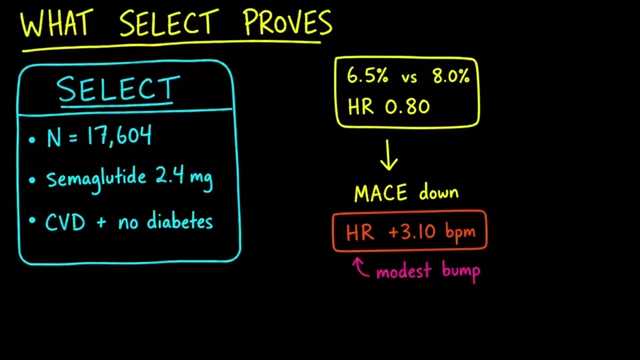
SELECT Trial Outcomes: MACE and Heart Rate [ 00:17:35 ] - Limitations for Retatrutide:
- Retatrutide's peak HR increase (+9 bpm) is roughly triple that of semaglutide (+3.1 bpm).
- Retatrutide is a triple agonist (GLP-1 + GIP + Glucagon receptor activity), unlike semaglutide (GLP-1 only).
- Therefore, SELECT reassures for the GLP-1 class and modest HR rises but does not directly settle the question for Retatrutide's higher HR increase and multi-receptor profile.
The Third Receptor Problem: Glucagon Receptor Agonism [00:19:05]
- Retatrutide is a triple agonist, activating:
- GIP receptor (GIPR)
- GLP-1 receptor (GLP-1R)
- Glucagon receptor (GCGR)
- Receptor Potencies (EC50 values from preclinical pharmacology):
- GIPR: 0.0643 nanomolar (most potent)
- GLP-1R: 0.775 nanomolar (~12 times less potent than GIPR)
- GCGR: 5.79 nanomolar (~90 times less potent than GIPR)
- This means Retatrutide is a GIP-potent triple agonist with real glucagon activity.
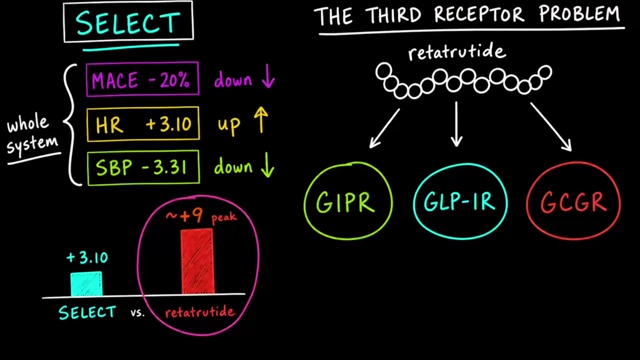
Retatrutide's Triple Agonism and Receptor Potencies [ 00:19:05 ]
- GLP-1 and Heart Rate:
- GLP-1 receptors are present at the sinoatrial (SA) node, the heart's natural pacemaker.
- GLP-1 binding directly causes a chronotropic effect (increased heart rate) by shortening the action potential cycle in pacemaker cells. This likely contributes to part of the HR rise in any GLP-1 containing drug, including Retatrutide.
- GIP and Heart Rate:
- Tirzepatide (Zepbound), a GIP + GLP-1 agonist without glucagon activity, has a reported HR increase of +1 to +3 bpm, similar to semaglutide (GLP-1 only).
- This suggests that GIP agonism is not a significant driver of heart rate increase.
- Glucagon and Heart Rate:
- Studies show high-dose glucagon increases heart rate. For example, in healthy volunteers, high-dose glucagon led to a +13 bpm increase (range 8-18 bpm) compared to saline, which is highly significant.
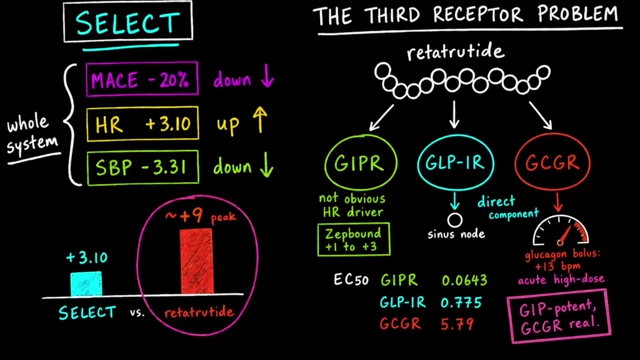
Glucagon's Effect on Heart Rate [ 00:21:54 ] - This indicates that glucagon receptor agonism can increase heart rate.
- However, whether human heart muscle has direct, working glucagon receptors is disputed. Ex vivo studies on human heart tissue have not found direct receptor expression or chronotropic/inotropic effects.
- Therefore, the heart rate increase from glucagon may be entirely indirect (e.g., sympathetic stimulation, splanchnic, or metabolic effects).
- Studies show high-dose glucagon increases heart rate. For example, in healthy volunteers, high-dose glucagon led to a +13 bpm increase (range 8-18 bpm) compared to saline, which is highly significant.
- Summary of Receptor Problem: A plausible biological story exists for why Retatrutide's HR rise is larger (due to glucagon activity), but the direct cardiac mechanism of glucagon is still debated. Ultimately, outcomes data is needed.
Blood Pressure Drop and Heart Rate Reflex [00:24:49]
- Another plausible mechanism contributing to the HR increase is the baroreflex response to a drop in blood pressure.
- Mechanism:
- Systolic Blood Pressure (SBP) Drop: Retatrutide significantly lowers SBP.
- Less Wall Stretch: Lower SBP leads to less stretch on arterial walls.
- Baroreceptor Firing Down: Baroreceptors (stretch sensors in carotid sinus and aortic arch) detect this reduced stretch and fire fewer signals.
- NTS Activity Down: These signals travel via cranial nerves (IX and X) to the Nucleus Tractus Solitarius (NTS) in the brainstem, leading to reduced NTS activity.
- Autonomic Imbalance: This shifts the autonomic balance:
- Sympathetic (fight-or-flight) outflow increases.
- Vagal (rest-and-digest, parasympathetic brake) tone decreases.
- Faster SA Node Firing: Both effects combine at the SA node, causing it to fire faster, increasing heart rate.
- Cardiac Output Support: This reflex aims to maintain cardiac output and perfuse tissues despite lower blood pressure.
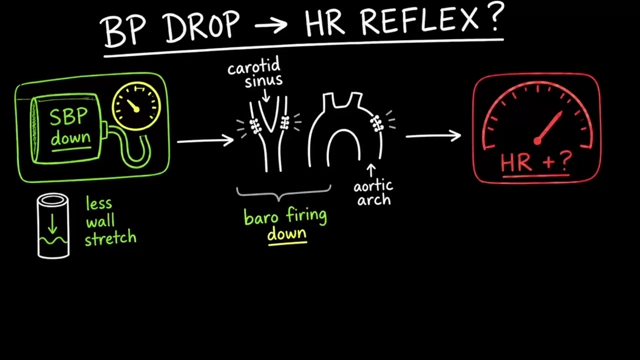
Baroreflex Pathway: Blood Pressure Drop Leading to Heart Rate Increase [ 00:25:23 ]
- This baroreflex is a plausible contributing pathway that can coexist with the direct GLP-1 receptor effect and any glucagon receptor contribution.
TRIUMPH-Outcomes: The Definitive Trial [00:27:39]
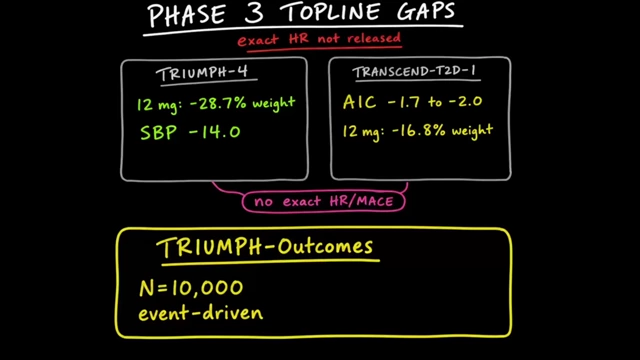
- Phase 3 topline data for Retatrutide in TRIUMPH-4 (obesity + knee osteoarthritis) and TRANSCEND-T2D-1 (type 2 diabetes) shows strong efficacy (e.g., up to -28.7% weight loss, -14.0 mmHg SBP drop), but exact heart rate or rhythm numbers have not yet been released.
- TRIUMPH-Outcomes Trial: This is the critical, large-scale trial that will provide definitive answers.
- Design: Phase 3, randomized, double-blind, placebo-controlled, event-driven trial.
- Population: 10,000 patients, age 45+, BMI ≥ 27, with established atherosclerotic cardiovascular disease (ASCVD), chronic kidney disease (CKD), or both. This includes patients with significant pre-existing cardiovascular risks.
TRIUMPH-Outcomes Trial Design and Endpoints [ 00:27:52 ] - Primary Endpoints:
- Cardiovascular composite: non-fatal MI, non-fatal stroke, cardiovascular death, or heart failure hospitalization/urgent visits.
- Kidney composite: end-stage kidney disease, significant GFR decline.
- Timeline: Started April 2024; estimated primary completion February 2029 (248 weeks), but it's event-driven, so results could be earlier or later.
- This trial will provide crucial long-term safety and efficacy data, specifically addressing cardiovascular outcomes and the impact of heart rate changes.
Heart-Rate Ledger: Worry vs. Counterweight [00:29:25]
- Worry Side:
- Persistent +9 to +10 bpm heart rate increase on Retatrutide.
- Small but real rhythm signal (e.g., 11.3% arrhythmia-related AEs in 12mg arm vs. 2.9% placebo in Phase 2, though in a selected, healthier population).
- Unresolved exact mechanism for glucagon receptor's contribution to HR increase (direct vs. indirect).
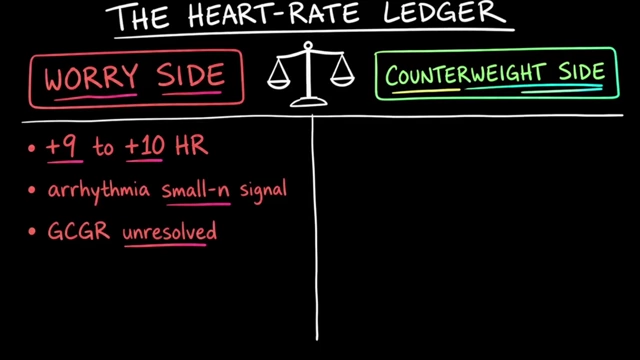
Heart-Rate Ledger: Worry Side [ 00:29:32 ]
- Counterweight Side:
- Significant weight loss (e.g., -24.2% at high dose). Obesity is a major cardiovascular risk factor.
- Improved blood pressure and lipid profiles.
- Precedent from GLP-1 CVOTs (like SELECT) where a modest heart rate rise (+3.1 bpm) was compatible with overall cardiovascular benefits.
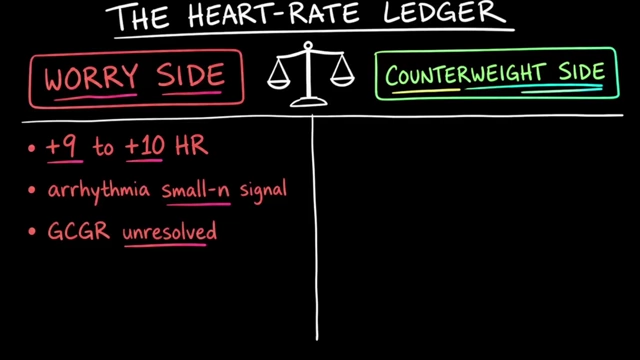
Heart-Rate Ledger: Counterweight Side [ 00:30:02 ]
- Important Caveat: None of the existing data definitively proves that Retatrutide will behave the same as other GLP-1s, especially with its higher HR increase and triple agonist profile.
- Practical Advice: If you have a history of AFib/SVT/POTS, heart failure, high resting heart rate, uncontrolled blood pressure, or conditions like vomiting/low potassium, it is crucial to discuss these concerns with your doctor before considering Retatrutide.
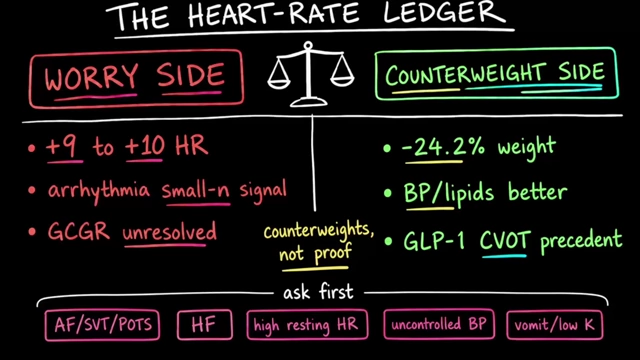
Heart-Rate Ledger: Practical Advice [ 00:30:32 ]