Understanding and Overcoming Psychophysical Retardation to Improve Body Control and Posture
Delsarte, Alexander, Masoero, You
This video discusses "psychophysical retardation," a term describing the common inability to consciously control one's body movements, often leading to poor posture, pain, and limited physical capabilities. It highlights how people frequently execute unintended or even opposite movements when attempting to control specific body parts. The speaker shares personal anecdotes and student examples, emphasizing the deep-seated nature of these habitual patterns. The Alexander Technique, particularly the "initial Alexander Technique," is presented as a remedial system that, through visual feedback and conscious effort, helps individuals re-establish accurate control over their movements, leading to improved posture, pain alleviation, and enhanced overall physical skill.
- Many people are unaware they lack precise control over body parts like the sacrum or elbows, often moving other body parts instead.
- The speaker shares personal anecdotes and examples of students attempting movements but executing unintended or opposite actions.
- This lack of control stems from deeply ingrained habitual movements, making it difficult to perform new or corrective actions.
- The Alexander Technique, particularly the "initial Alexander Technique," is introduced as a remedial system to re-establish conscious control.
- Visual feedback, such as video recording, is emphasized as crucial for identifying and correcting unintended movements.
- Overcoming this "retardation" allows individuals to move with intent, alleviate pain, and enhance overall physical skill, seeing their body as an instrument rather than a source of frustration.

A graphic illustrating the spine and skeletal structure in different postural states, emphasizing areas of shortening and bending [ 00:04:15 ]
The Problem of Psychophysical Retardation [0:00]
The video begins by introducing the concept of "psychophysical retardation," defined as a technical term for impeded and underdeveloped psychophysical capabilities, essentially a lack of conscious control over one's body movements.

- Personal Experience [0:00]
- The speaker shares his past experience of being profoundly "psychophysically retarded," emphasizing it's a common issue among most people he has taught.
- His own journey involved years of conventional Alexander Technique lessons before discovering the "initial Alexander Technique," which directly addresses this disconnection.
Illustrative Examples of Disconnection [0:22]
To clarify this concept, the speaker provides specific examples of how individuals, including himself and students, fail to execute intended movements, often performing the exact opposite or an entirely different action.
Student's Pelvic Movement Attempt [0:24] - A student was asked to move their sacrum (upper end faster than the lower end to rotate the pelvis) to lengthen the back.
- Initial Attempt: The student moved their rib cage instead of their pelvis, pulling the upper torso back. [0:52]
- This demonstrates how deeply ingrained habits can prevent access to specific body parts. [1:31]

A black silhouette of a torso, showing the student's initial attempt to move their sacrum resulted in a backward pull of the upper torso. [ 00:01:08 ] 
A black silhouette of a torso with red arrows pointing to the upper torso and abdomen, indicating an incorrect backward and downward movement. [ 00:06:38 ]
- This demonstrates how deeply ingrained habits can prevent access to specific body parts. [1:31]
- Second Attempt: The student moved the lower end of the sacrum faster than the upper end, performing the opposite of the intended movement. [4:43]
- This highlights a complete disconnect between intention and physical execution. [4:50]

A black silhouette of a torso, illustrating the student's second attempt where the lower sacrum moved faster than the upper, opposite to the intention. [ 00:04:43 ] - The speaker notes this is a very common issue among new students, not an anomaly. [5:03]
- This highlights a complete disconnect between intention and physical execution. [4:50]
- Initial Attempt: The student moved their rib cage instead of their pelvis, pulling the upper torso back. [0:52]
Speaker's Elbow Movement Attempt [2:04] - In his first lesson with Jean de Sławomir, the speaker was asked to point his elbow out to the side.

Consequences of Psychophysical Retardation [5:11]
The inability to control one's movements has far-reaching implications, extending beyond just poor posture to affect various aspects of physical and mental well-being.
Impact on Physical Health and Skill [5:11] - Leads to chronic issues like breathing problems or lower back pain, as corrective exercises might be performed incorrectly. [5:11] - A diagram shows incorrect (left) and correct (right) pelvic movements with corresponding forces and directions, illustrating how incorrect movements can exacerbate problems.
- Limits development in complex activities such as playing music, singing, or sports, where precise control is crucial. [5:43] - Entraps individuals in painful habitual movements because they cannot consciously choose alternatives. [5:54] - An X-ray image paired with a side profile photo highlights severe spinal curvature, illustrating the physical impact of unaddressed postural issues.
A diagram comparing incorrect (left) and correct (right) pelvic movements, showing how intended actions can be contradicted by actual body mechanics. [ 00:05:22 ] 
An X-ray showing severe spinal curvature (Cobb 1, 61°) alongside a side profile photo of a person with a pronounced forward head and rounded back. [ 00:08:17 ] Prevalence and Misconception [6:06] - Even athletic individuals or those with seemingly good posture can suffer from psychophysical retardation. [6:06] - People can mask these issues in habitual movements but reveal deep confusion when asked to perform unfamiliar actions. [6:15] - Many adults operate with the psychophysical capabilities of a toddler due to undeveloped motor skills. [6:53] - Images show common instances of people leaning on objects or displaying awkward postures, underscoring the widespread nature of poor standing habits.

People standing in a kitchen, one leaning on a counter, the other standing with relaxed posture, illustrating common relaxed standing habits. [ 00:03:54 ] 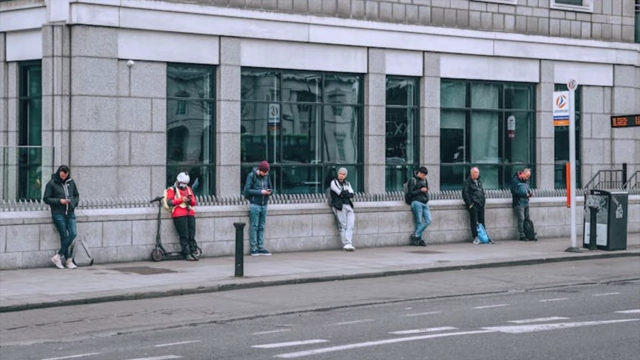
A row of people standing on a sidewalk, many leaning against a wall or other objects, demonstrating widespread poor standing habits. [ 00:03:57 ] - A diagram of skeletal posture illustrates typical human posture (left) versus a stooped, shortened posture (right), highlighting the issues of spinal curvature and bodily compression.
A woman leaning against a bookshelf with one leg crossed over the other, showcasing an awkward but common habitual standing posture. [ 00:04:04 ] - A diagram illustrates different degrees of neck curvature, showing how poor posture can specifically affect the cervical spine.
A side-by-side comparison of a human skeleton, showing on the left an example of typical posture and on the right, a more stooped, shortened posture, emphasizing spinal curvature. [ 00:04:15 ] - Another diagram shows the alignment of the legs and pelvis, indicating how imbalances can contribute to overall postural deformation.
A diagram illustrating the curve of the neck and upper back, with numerical scales showing different angles of curvature. [ 00:08:27 ] 
A frontal view of a human skeleton highlighting the pelvis and leg bones, with a comparative diagram showing baseline measurements for proper alignment. [ 00:09:33 ]
The Solution: A Reasoned System and Conscious Control [7:08]
Overcoming psychophysical retardation requires a structured approach that re-establishes the mind-body connection.
Building Skill and Communication [7:08] - It involves building the skill to "psychophysically communicate" with oneself.
- This means being able to conceive of a desired movement and successfully direct that intention to the correct body part.
- The goal is to make movements exactly as intended. [7:27]
- A diagram shows a person's upper body with arrows indicating directions of movement for the arm and spine, demonstrating how conscious control can lead to correct posture.

A diagram illustrating the human spine and arm movements, with arrows indicating directions of movement for specific vertebrae and the overall kinetic chain, from an image by Jeando Masoero. [ 00:07:19 ]
- This means being able to conceive of a desired movement and successfully direct that intention to the correct body part.
Importance of Visual Feedback [7:31] - Video recording oneself is presented as crucial for self-correction.
- It allows individuals to see if their actual movement matches their intention or if they are doing the opposite. [7:31]
- The student who initially struggled with pelvic movement was able to make the correct movement by the next lesson, demonstrating the effectiveness of this feedback. [7:43]
- This led to a straightened back, showcasing immediate positive results. [7:54]

A side profile of a torso with blue arrows indicating the sacrum moving back, leading to a lengthened green-highlighted spine, illustrating proper pelvic movement. [ 00:07:55 ] 
A black silhouette of a torso with a green vertical line highlighting a straightened back, representing the positive outcome of correct pelvic movement. [ 00:07:58 ]
- It allows individuals to see if their actual movement matches their intention or if they are doing the opposite. [7:31]
The Path to Reconnection [9:07] - While complete postural change takes time, overcoming psychophysical retardation and moving with intent can happen relatively quickly. [9:10] - This process helps individuals see their body as an ally, not an enemy, correcting the belief that their body is inherently deformed. [9:23]
- The body isn't asymmetric or deformed; rather, it's the asymmetric movements that cause the deformation. [9:30]
- Learning to move rationally is likened to playing oneself like an instrument, unlocking inherent power. [9:38]
- A sequence of skeletal diagrams illustrates the mechanics of sitting and standing, showing how conscious control can improve these fundamental movements.

A series of diagrams illustrating the human skeleton's posture during various phases of sitting and standing, with measurements and angles indicating proper alignment. [ 00:03:42 ] 
A four-panel sequence showing skeletal diagrams of a person moving from a deep squat to standing, with postural lines and angles to illustrate proper mechanics. [ 00:10:17 ] - A diagram of the torso with internal arrows illustrates subtle, orchestrated movements that can lead to overall postural improvement.

A diagram of the torso and ribs with curved green arrows indicating expansive and lengthening movements, alongside specific points on the body, to illustrate internal coordination. [ 00:10:31 ] - Historical images with posture analysis demonstrate how coordinated movements are essential for various activities and complex gestures.

A side-by-side comparison of historical figures: on the left, a man using a tool with posture analysis overlays; on the right, individuals sitting, showcasing how posture influences complex gestures. [ 00:10:39 ]
- The body isn't asymmetric or deformed; rather, it's the asymmetric movements that cause the deformation. [9:30]
The Choice for Growth [9:53] - All human activities involve movement. The video challenges viewers to choose between performing movements at a "toddler's level" or consciously growing their control. [9:53] - This channel aims to provide the theory and practice to gain this control. [10:11]