How Christian Creatives Can Overcome Fear and Find Purpose with Faith: Insights from Joshua Luke Smith & Cephas Azariah
Summary:
This video features a conversation with Cephas Azariah and Joshua Luke Smith on integrating faith with creativity.
- Cephas discusses his journey from drawing and forced piano lessons to overcoming fear of sharing his music at 29, emphasizing that creativity is inherent in all as we are made in God's image.
- He highlights that perfectionism and comparing one's art to others are major barriers, suggesting that embracing uniqueness and creating structure can help overcome fear.
- Joshua shares his path as a poet, inspired by storytellers, and defining his artistry as a vocation driven by passion for Jesus rather than just a job or financial gain.
- Both emphasize that true creative validation comes from God's calling, not external approval or payment.
- The session concludes with a guided 4 minutes and 33 seconds of silence, inspired by John Cage, to encourage listeners to connect with their inner thoughts and the Holy Spirit for deeper creative inspiration.
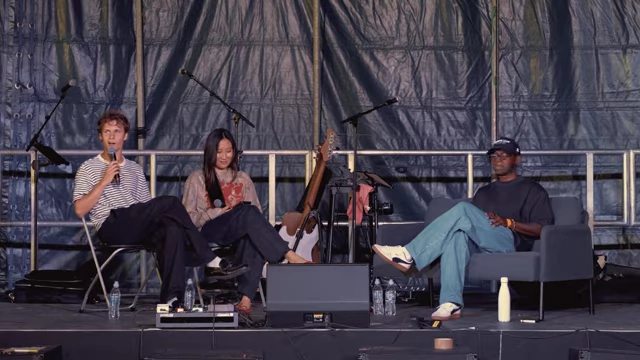
Panelists on stage discussing faith and creativity [ 00:04:10 ]
Introduction to Faith and Creativity [0:00]
The podcast hosts open the session from Wildfires Festival, introducing guests Cephas Azariah and Joshua Luke Smith to discuss the intersection of faith and creativity.
- The goal is to explore:
- Why we create.
- How God is involved in our creative process.
- What it means to live as a Christian creative today. [0:06]
- An opening spoken word piece by Cephas raises questions for creatives: [0:22]
- The purpose of creation.
- Fear of adding to the noise.
- Pressure of perfection.
- Whether to release unpolished work.
- How to get ideas from concept to reality.
- The piece suggests that to break creative barriers, one must listen. [1:34]
- A visual interlude of nature and abstract scenes accompanies instrumental music, encouraging listening. [1:44]
Cephas Azariah's Creative Journey and Insights [3:33]
Cephas Azariah, the composer of the opening music, shares his personal history with creativity and faith.
- Early Creative Experiences [4:29]
- As a child, he loved drawing cars, finding it liberating compared to schoolwork. [4:29]
- Piano lessons were initially a chore, leading him to hide from his teacher. [4:54]
- Growing up in a Christian home, faith was an inherent part of his environment, and his creativity was explored within and outside the church framework. [5:37]
- Overcoming Fear in Sharing Music [7:18]
- The Importance of Creativity for Christians [8:40]
- Making is innate in all humans because we are created in the image of God, the ultimate Creator. [8:40]
- Creativity is broadly defined, encompassing: [9:04]
- Traditional arts like songs, pictures, and videos.
- Structured activities like school schedules or financial spreadsheets.
- Actions that improve neighborhoods, schools, or society as a whole. [10:01]
- We are commissioned to make something, realizing our gifts with God's help. [9:46]
- Addressing Perfectionism and Fear [10:47]
- Like trees in nature, no two creative works are identical; there's no need to conform to a template or cookie-cutter perfection. [10:59]
- Fear of comparison or creating something that already exists is a primary barrier to making. [11:35]
- Cephas admits masking his fear as "waiting" to avoid potential negative reception. [12:52]
- Strategies for overcoming fear include: [13:46]
- Reducing time spent consuming content on social media to focus on creating.
- Adding structure to the creative process, bringing order to potential chaos, much like God brought order to the earth. [14:24]
- Surrounding oneself with people who genuinely appreciate one's work, including mentors, but not those who offer uncritical praise. [17:37]
Joshua Luke Smith's Poetic Path and Vocational Calling [22:10]
Joshua Luke Smith shares his journey into poetry and his perspective on vocational creativity.
- Inspiration and Early Challenges [22:53]
- Grew up immersed in his father's music, listening to storytellers like Tracy Chapman, Genesis, Tom Petty, Cat Stevens, and Simon & Garfunkel. [23:04]
- At 13, he discovered hip-hop (Fugees, Eminem), which ignited his desire to write bars and tell stories. [23:32]
- His first performance at a school talent show was a "bomb," as he forgot his lyrics. [24:42]
- This failure, surprisingly, solidified his resolve to continue and improve. [24:50]
- Honesty and Faith in Creativity [25:02]
- Navigating the Creative Industry: Vocation vs. Job [28:36]
- He experienced a shift in thinking about creative work: the distinction between a "creative job" (paid work) and a "creative vocation" (one's calling). [29:07]
- Acknowledges that many historical artists were supported by "patrons" who valued their work, not necessarily its marketability. [29:30]
- He realized he could be his own "patron," working other jobs to fund his true calling as a poet. [30:00]
- Emphasizes that there isn't always room for everyone to earn a living from their art, but the vocational calling remains. [31:10]
- Living with a vocational creative heart fosters excellence. [31:35]
- He cites Exodus 31, where God filled Bezalel with the Spirit for craftsmanship, highlighting that divine validation doesn't depend on a paycheck. [31:57]
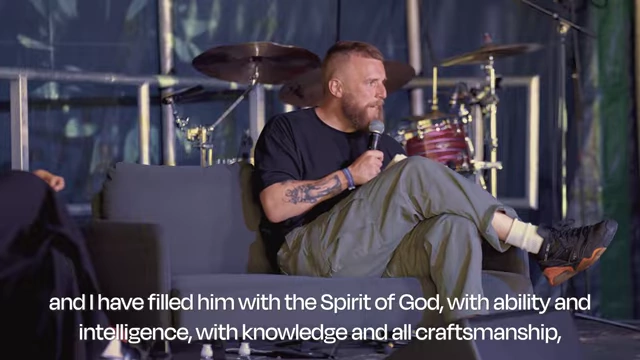
Joshua Luke Smith reads from Exodus 31, emphasizing divine validation for craftsmanship. [ 00:32:08 ] - Prioritizing one's calling can make one seem "strange" to peers but leads to deep satisfaction and authentic expression. [33:33]
- Faith's Impact on Creativity [34:09]
- Drawing from C.S. Lewis, Joshua states that faith illuminates everything in his life, allowing him to see and articulate pain, joy, and prayers in his creative work. [34:34]
- It's important to remember that creation doesn't always require joy; it can also stem from sadness and other emotions. [35:25]
Concluding Thoughts and Guided Stillness [35:54]
The hosts reiterate the session's purpose and lead the audience into a reflective exercise.
- The aim of the session was to stir a desire within individuals to create with God, inspiring them to pursue their artistic passions freely. [36:33]
- God delights in our creative exploration and our inclusion of Him in the process, recognizing the innate desire to create within all of us. [37:08]
- Guided Stillness: The 4'33" Practice [37:30]
- Joshua introduces John Cage's experimental musical piece "4'33"," where a pianist performs 4 minutes and 33 seconds of silence. [38:05]
- Cage's inspiration came from an anechoic chamber where he heard the sounds of his own body, illustrating that true silence reveals what is already present. [38:13]
- Applying this to faith, spending silent time before God allows one to hear the "murmurs of our hearts," our thoughts, and God's voice (Psalm 139: "Search me and know me, God"). [39:05]
- The audience is guided through a 4-minute, 33-second moment of silence, encouraged to close their eyes and listen to their surroundings and inner thoughts, embracing any fears or joys. [39:34]
Countdown timer during the 4'33" guided silence exercise [ 00:42:41 ]
- The session concludes with a prayer for authentic expression, encouragement, and empowerment by the Holy Spirit in creative endeavors, whether in happiness or sorrow. [44:56]