Gen Z's Shifting Work Ethic: A Data-Driven Analysis of Disengagement and Changing Perceptions of Work
The video explores the prevalent notion that Gen Z lacks work ethic, providing historical context and modern data. It highlights a significant decline in young people's willingness to work overtime and their intrinsic desire to work, as shown by the "Monitoring the Future" survey. Despite working more full-time, Gen Z faces higher debt and loneliness, suggesting financial strain. The video also reveals a broader trend of disengagement across all age groups in the U.S. and globally, attributed to a lack of clarity on job expectations, feeling uncared for by employers, and a disconnect from purpose. Social media's role in validating these frustrations has made younger generations more aware of workplace realities, leading to phenomena like "quiet quitting" and "task masking." Ultimately, the video argues that Gen Z's approach reflects a fundamental re-evaluation of work's role in life, where progression isn't solely tied to hard work, and energy is prioritized for other life aspects.
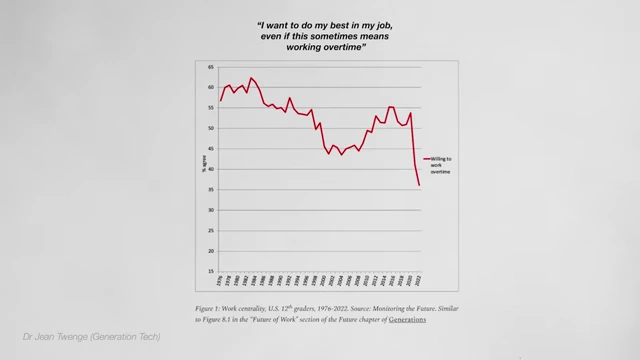
Historical Context of Generational Criticism [0:00]
- Throughout history, older generations have commonly criticized the younger ones.
- A 1925 quote from "The Conduct of Young People, Hull Daily Mail" describes young folk as "grossly thoughtless, rude, and utterly selfish" [0:15].
- A 1771 letter republished in "Paris Fashion: A Cultural History" questioned the "manly vigor and athletic appearance" of the current generation compared to their forefathers [0:32].
- Aristotle, in the 4th century BC, stated that young people are "high-minded because they have not yet been humbled by life" and "think they know everything" [0:53].
- While this pattern is old, the current situation might be different due to supporting data.
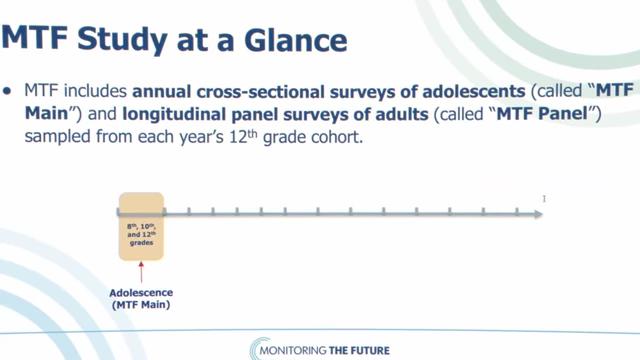
A diagram illustrating the timeline and survey methods of the Monitoring the Future (MTF) study [ 00:01:28 ]
Declining Work Ethic and Financial Realities of Gen Z [1:14]
- Data from the "Monitoring the Future" (MTF) survey provides insight.
- MTF is an annual survey of 17-18-year-olds in the US, running since 1975, collecting data on beliefs and attitudes [1:20].
- One question assesses willingness to work overtime ("I want to do my best in my job, even if this sometimes means working overtime").
- Responses show a significant decline, indicating less work ethic among the youth [1:38].
- Acknowledges that no generation is a monolith, but a clear shift is evident.
- Financial aspects contribute to this trend.
- Young adults today are more likely to be employed full-time than 30 years ago [2:21].
- Despite increased full-time employment, they are more likely to be in debt, single, and spend more time alone [2:28].
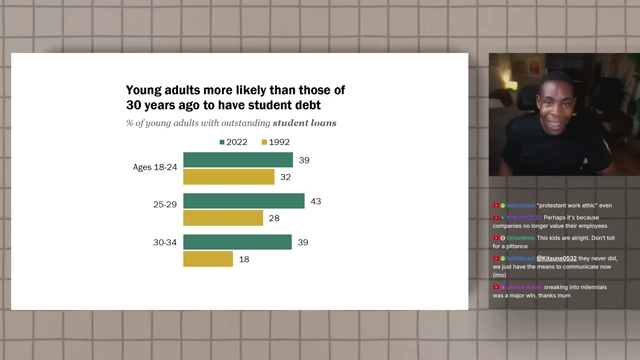
A bar chart comparing the percentage of young adults with outstanding student loans in 2022 versus 1992 across different age groups [ 00:02:30 ] - They are also less likely to have achieved traditional markers of adulthood compared to previous generations.
- Labor force participation rate is at a significant low for Gen Z.
- Those who are working, work longer hours than previous generations [2:42].
- Those not working are entirely dropping out of the labor force [2:46].
- A rise in disability disproportionately affecting young people is a large part of this drop [3:08].
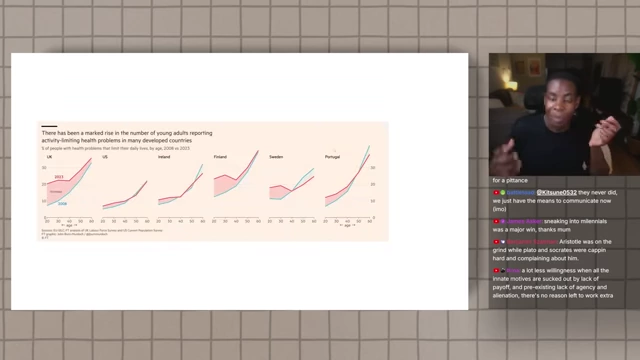
A series of line graphs showing the marked rise in young adults reporting activity-limiting health problems in multiple developed countries from 2008 to 2023 [ 00:03:11 ] - This creates two distinct groups: those working but disengaged, and those who have given up on the workforce.
Intrinsic Desire to Work and Overall Disengagement [3:20]
- The MTF survey reveals a deeper issue beyond finances.
- A key question: "If you were to get enough money to live as comfortably as you'd like for the rest of your life, would you want to work?" [3:31].
- This question removes the financial incentive, aiming to gauge intrinsic work desire.
- While the majority still want to work, the percentage is at an all-time low since the survey began in the 1970s [3:52].
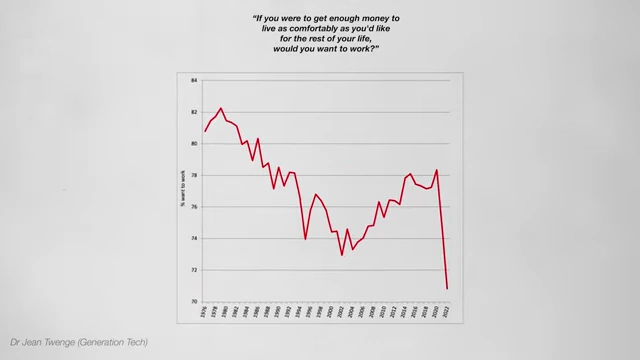
A line graph illustrating the declining percentage of young people who would want to work even if they had enough money to live comfortably for the rest of their lives, from 1979 to 2022 [ 00:03:56 ] - This indicates a fundamental change in desire to work, irrespective of pay.
- Broader employee disengagement across all age groups.
- Gallup's annual survey of US employee engagement shows a 10-year low [4:27].
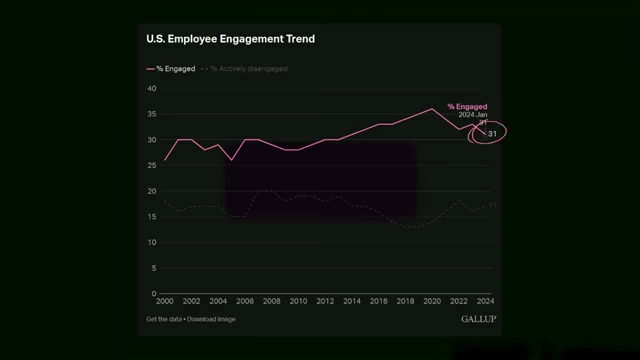
A line graph showing the declining trend of U.S. Employee Engagement from 2000 to 2024 [ 00:04:40 ] - Less than one in three (31%) US employees report feeling engaged at work [4:37].
- Globally, engagement rates are also low: Canada (21%), Mexico (32%), China (20%) [4:47].
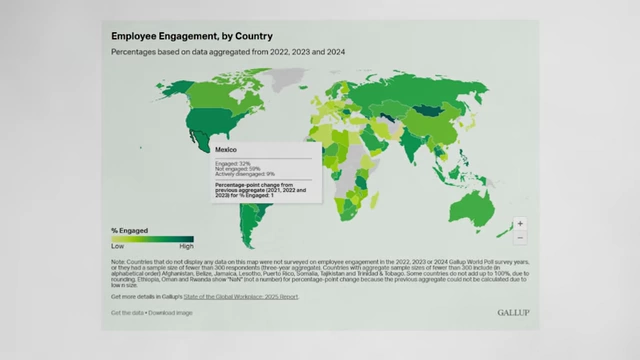
A world map illustrating employee engagement percentages by country based on data aggregated from 2022, 2023, and 2024 [ 00:04:54 ]
- Gallup's annual survey of US employee engagement shows a 10-year low [4:27].
Reasons for Workplace Disengagement [5:04]
- Gallup's 12 questions for engagement reveal specific issues.
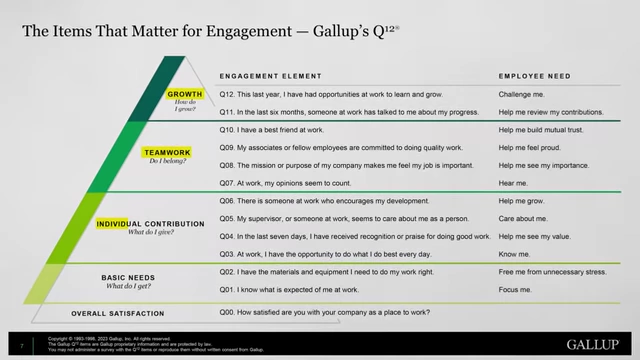
A pyramid diagram titled "The Items That Matter for Engagement — Gallup's Q12," outlining engagement elements and corresponding employee needs [ 00:05:14 ] - Lack of Clarity on Expectations: Less than half of US employees know what's expected of them at work [5:31].
- Employees without clear expectations are more likely to feel confused, frustrated, disengaged, and have lower morale and productivity.
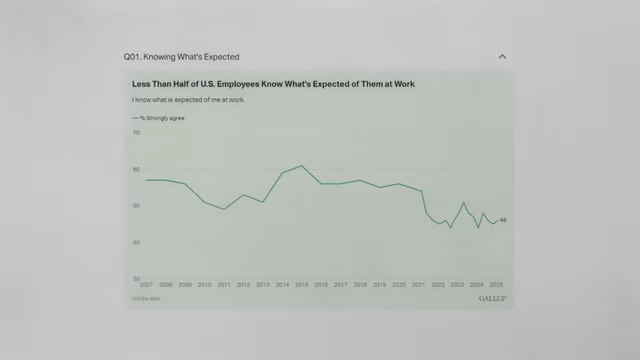
A line graph showing the percentage of U.S. employees who strongly agree that they know what is expected of them at work, from 2007 to 2025 [ 00:05:34 ] - Feeling Uncared For: US employees feel significantly less cared for at work since the pandemic [5:51].
- Factors include pandemic-related layoffs and time away from work, which allowed employees to re-evaluate how they are treated.
- This realization often leads to disengagement.
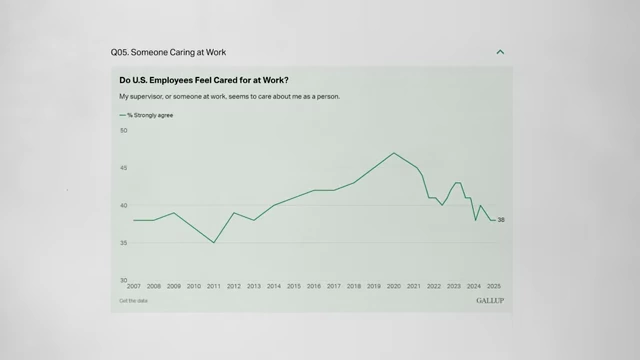
A line graph showing the percentage of U.S. employees who strongly agree that their supervisor or someone at work seems to care about them as a person, from 2007 to 2025 [ 00:05:54 ] - Disconnect from Mission and Purpose: There's an increasing disconnect between employees' jobs and a sense of mission or purpose, particularly post-pandemic [6:26].
- Before the pandemic, people might have identified more with company goals during stable times.
- The pandemic made many realize that companies primarily exist to make money [7:01].
- This "neither pay nor purpose" scenario significantly lowers motivation.
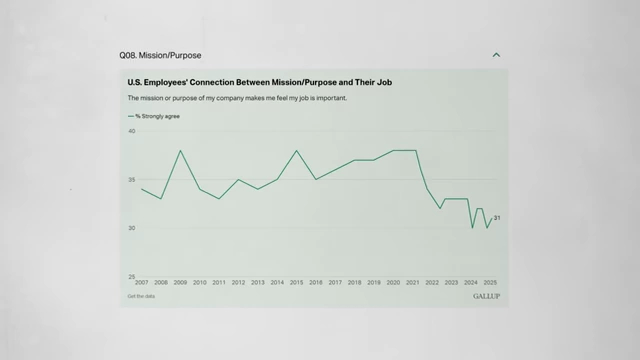
A line graph showing the percentage of U.S. employees who strongly agree that the mission or purpose of their company makes them feel their job is important, from 2007 to 2025 [ 00:06:28 ]
Social Media's Influence and Redefining Work Ethic [7:20]
- Social media amplifies disengagement and shifts perceptions.
- New workplace phenomena like "quiet quitting" and "task masking" emerge.
- Lack of power and declining worker rights.
- Positive shifts for workers, like remote work, are often quickly revoked (e.g., return-to-office mandates) [9:50].
- This reinforces the power imbalance between employer and employee, further diminishing motivation.
- Changing perception of progress in the workplace.
- A survey question asked: "Do you think that not wanting to work hard will be an obstacle to getting your chosen job?" [10:38].
- Responses show a sharp decline in agreement, implying that young people no longer believe hard work is the primary driver of career progression [10:45].
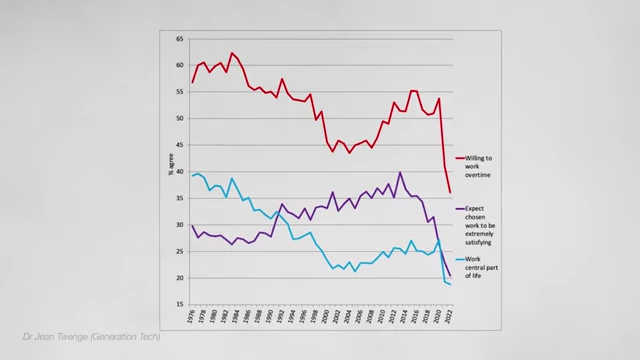
A line graph showing three declining trends among U.S. 12th graders from 1976 to 2022: willingness to work overtime, expectation for work to be extremely satisfying, and work being a central part of life [ 00:08:29 ] 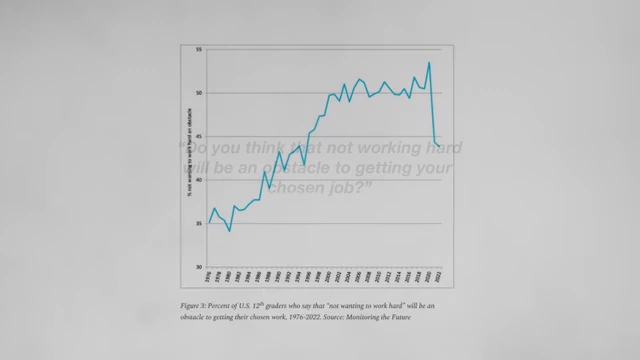
A line graph showing the declining percentage of U.S. 12th graders who believe that not wanting to work hard will be an obstacle to getting their chosen job, from 1976 to 2022 [ 00:10:44 ] - This suggests an awareness that networking, being liked, and other extrinsic factors are equally important [11:17].
- Work ethic is more complex than just effort in the workplace.
- People might be reserving their energy and "work ethic" for other crucial aspects of life, such as maintaining romantic and family relationships [11:36].
- In an environment where jobs offer neither sufficient money nor purpose, workers rationally seek to gain as much as they can while expending minimal effort.