Mastering Entity Framework for Object-Oriented Programming: Beyond Simple DTOs
Summary:
- The video challenges the common practice of using Entity Framework (EF) primarily as a Data Transfer Object (DTO) provider, arguing it often leads to spreading business logic and validation across multiple service classes.
- The speaker advocates for a more object-oriented programming (OOP) and Domain-Driven Design (DDD) approach, where EF is used as an Object-Relational Mapper (ORM) to persist rich domain objects.
- Key EF Core features demonstrated include: using shadow properties for internal IDs,
HasConversionfor mapping value objects (like a Vehicle Identification Number - VIN),HasComplexPropertyfor composite value objects (like Name), and discriminators for inheritance mapping. - The presentation shows how to encapsulate business logic and validation directly within domain entities, making code more cohesive and readable.
- Best practices are shared for query optimization (projections,
AsNoTracking, split queries) and for managing database migrations outside of application startup, recommending theEF migrations bundletool for deployment. - The core message is to design your domain objects first with proper encapsulation and behavior, then configure EF to map to these rich objects, rather than letting database structure dictate your code.
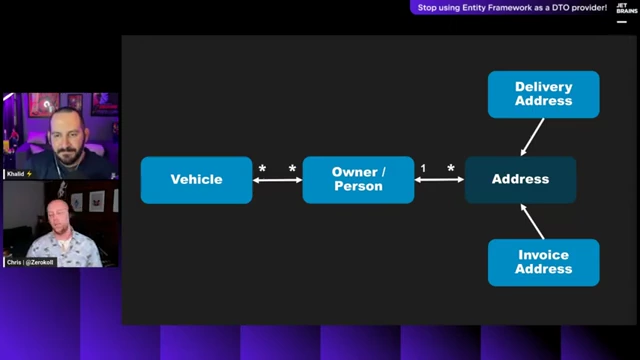
DMV Domain Model [ 00:12:10 ]
Introduction & Context [00:00:00]
- Speaker Introduction [00:01:17]
- Chris Klug, a developer with over 20 years of experience and a Microsoft MVP for 13 years, working at Active Solution in Stockholm.
- Talk Title Clarification [00:03:06]
- The original title "Stop using Entity Framework as a DTO provider" was updated to "Stop using Entity Framework as just a DTO provider" due to community feedback, acknowledging that EF can be used for DTOs in certain contexts, but shouldn't be limited to it.
- Importance of Context and Trade-offs in Code [00:03:52]
- All code is written within a specific context and involves trade-offs. It's crucial to accept different opinions and approaches in coding.
- Speaker's Opinionated Architecture [00:04:51]
- The presented code is heavily influenced by Object-Oriented Programming (OOP) and Domain-Driven Design (DDD), focusing on creating truly object-oriented code.
Understanding DTOs and Their Misuse [00:05:37]
- Definition of Data Transfer Object (DTO) [00:05:43]
- According to Wikipedia, DTOs are simple objects that carry data between processes and should not contain business logic. Their primary purpose is to shift data in expensive remote calls.
- Example: A
public class Vehicle { public int Id { get; set; } ... }is a typical DTO with no logic or encapsulation.
- Where DTOs should be used [00:06:52]
- DTOs are suitable for transferring data between different processes, such as between a web app and a database server (though often handled by EF internally).
- They are acceptable for returning data from an application to a client (e.g., API response).
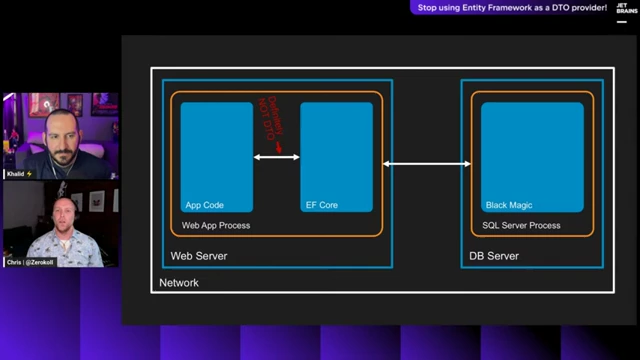
Diagram illustrating the interaction between App Code, EF Core, and SQL Server Process, arguing against DTOs between EF Core and App Code [ 00:07:24 ]
Problems with DTO-centric EF Usage [00:07:32]
- "What's wrong with that?" - Common Developer Perspective [00:07:32]
- Many developers use simple objects (DTOs) with EF Core for database access because it's often shown in "getting started" guides (e.g., Microsoft Learn's EF Core page).
- The problem arises when these simple examples are adopted as the entire data access strategy for complex applications.
- Issues with Spreading Business Logic [00:08:48]
- When entities are just DTOs, business logic often gets spread across "services" or "commands," making it difficult to find and maintain specific business rules for an entity.
- Issues with Data Validation [00:09:32]
- Without encapsulation in entities, validation logic also gets scattered across services or separate "validator" classes. This creates a risk of forgetting to call validation, leading to invalid data.
- Limitations of Setters for Validation [00:11:01]
- Using setters for validation often requires throwing exceptions, which many developers don't expect or handle with
try-catchblocks, as setters are typically assumed to just work.
- Using setters for validation often requires throwing exceptions, which many developers don't expect or handle with
Example Domain: DMV System [00:11:36]
- Domain Model Overview [00:12:06]
- The example domain is a simple DMV system managing vehicles, their owners (persons), and addresses.
- Relationships:
- Many-to-many between Vehicle and Owner/Person.
- One-to-many between Owner/Person and Address.
- An Address can be a Delivery Address or an Invoice Address.
DMV Domain Model showing relationships between Vehicle, Owner/Person, and different Address types [ 00:12:10 ]
- Database Schema [00:12:32]
- The database schema includes
Vehicles,VehicleOwners(coupling table withFromandTodates),People(FirstName, LastName), andAddresses(withTypeandIsCurrentcolumns).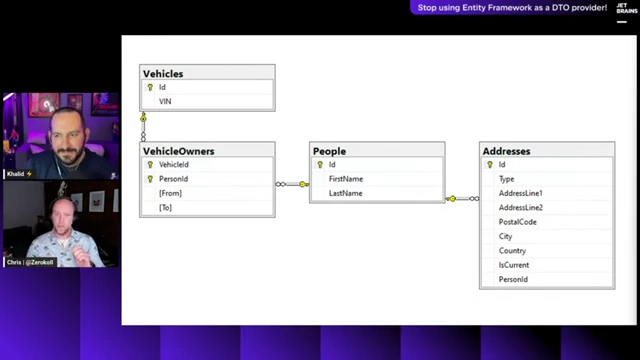
DMV Database Schema for the DMV system, including tables for Vehicles, VehicleOwners, People, and Addresses [ 00:12:40 ]
- The database schema includes
Traditional DTO and Service Approach (Critique) [00:13:03]
- Code Example: DTO Models [00:13:11]
- Models like
Address.csandPerson.csare shown with publicget; set;for all properties, including[Required]and[StringLength]annotations directly on them, illustrating the typical DTO approach.
- Models like
- Code Example: Services with Embedded Logic [00:13:41]
PersonServicedemonstrates validation logic (e.g., checking for null/whitespace in address fields) and business rules (e.g., limiting to three addresses, settingIsCurrent) directly within service methods likeSetAddress.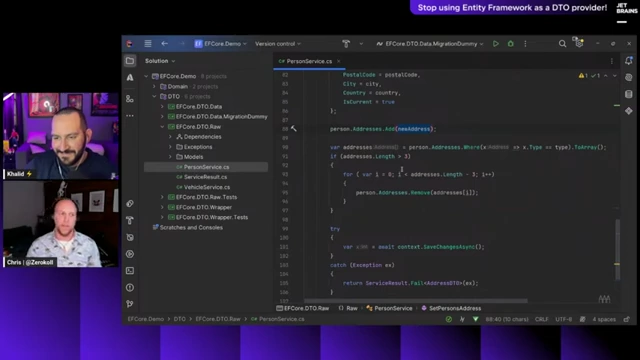
Code snippet from `PersonService.cs` demonstrating validation and business logic spread across service methods in a DTO-centric approach [ 00:14:49 ] VehicleServiceshows similar scattering of business rules (e.g., settingTodate for previous owner) in methods likeSetCurrentOwner.
- Critique: Spreading logic, violating OOP principles [00:16:09]
- This approach spreads business logic and validation across services, making it hard to understand an entity's rules and violating OOP principles of encapsulation.
Proposed Solution: Wrapping EF Objects in OOP Entities [00:16:47]
- Concept of OOP-y Wrapper Objects [00:16:52]
- The idea is to wrap the simple DTOs that Entity Framework maps to (often called "models" or "entities" by EF users) within more object-oriented classes.
- These wrapper classes would contain the business logic and validation, using the internal DTOs for data storage.
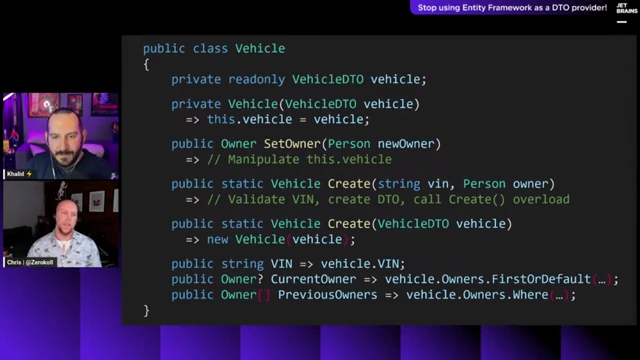
Example code showing a 'wrapper' `Vehicle` class encapsulating a private `VehicleDTO` and exposing object-oriented methods [ 00:17:13 ]
- Benefits: Encapsulation, centralized logic, improved readability [00:17:29]
- This approach centralizes business and validation logic within the domain objects themselves, making the code more readable and maintainable.
- It ensures that the domain objects are truly object-oriented, with methods that enforce business rules.
- Code Example: Wrapper entities (Person, Vehicle) [00:18:02]
- Demonstrates a
Personentity that takes aPersonDTO(the dumb EF object) in its constructor and exposes methods likeSetDeliveryAddressorSetInvoiceAddress, which contain the business logic.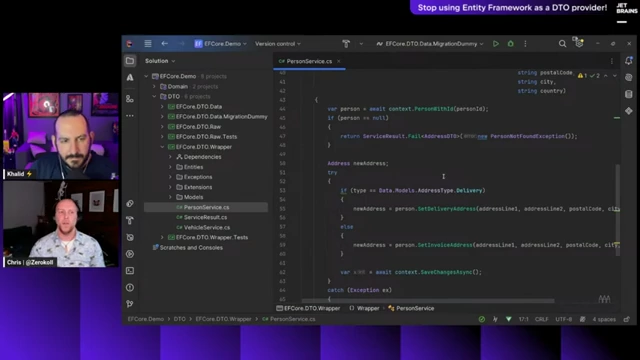
Refactored `PersonService` code, demonstrating how services interact with richer domain objects through clear, intention-revealing methods [ 00:19:31 ] - This effectively hides the EF-specific DTO behind a richer domain object.
- Demonstrates a
Leveraging EF Core for True OOP (Demo) [00:23:00]
- Domain Refinement with Bounded Contexts [00:23:31]
- To better align with DDD, the domain is split into two bounded contexts:
Vehicle Management(handlingVehicleandOwner) andPeople Management(handlingPersonandAddress). This addresses the conceptual difference between an "owner" in the context of a vehicle and a "person" with an address.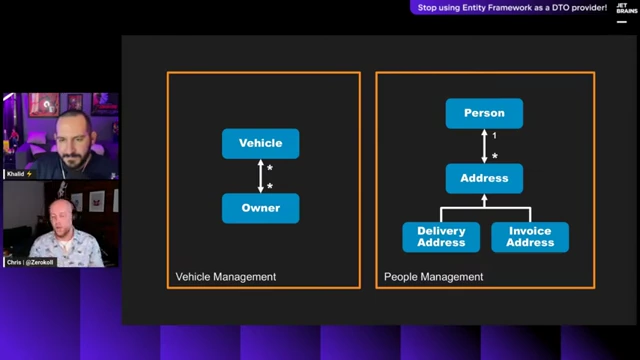
Domain split into two Bounded Contexts: Vehicle Management (Vehicle, Owner) and People Management (Person, Address, Delivery Address, Invoice Address) [ 00:23:40 ]
- To better align with DDD, the domain is split into two bounded contexts:
- Database Mapping Strategies [00:24:12]
- Discusses
Table SplittingandMultiple DbContextsas ways to map different entities to the same database table. Table Splittingallows oneDbContextto map multiple entity types to the same table, useful for representing different domain concepts that share underlying storage.
- Discusses
- Added Benefit: Might not need Lazy Loading [00:25:54]
- By using well-defined aggregate roots (from DDD), entities are designed to be smaller and load all necessary data eagerly, potentially eliminating the need for lazy loading, which can have performance downsides.
- Demo: Mapping the Domain OOP-style [00:26:38]
- Setting up Entities (Vehicle, Vin, Owner) [00:29:06]
Vehicleclass designed with a private list ofOwnersand aVin(Vehicle Identification Number) property.- Using Value Objects (Vin, Name) [00:29:48, 00:31:09]
Vinis implemented as arecord(value object) that encapsulates VIN validation logic.Ownerhas anIDandName(also a value object for First/LastName), andFrom/Todates for ownership periods.
- Manual Migrations [00:31:39]
- Emphasizes creating manual C# migrations for better control, rather than relying solely on auto-generated ones.
- Demonstrates creating
Vehicles,People,VehicleOwners, andAddressestables with appropriate columns, primary keys, foreign keys, and indexes.
- Mapping Entities to Database [00:37:02]
- All EF mapping is done explicitly in
OnModelCreatingto avoid data annotations and adhere to clean domain objects. - Vehicle Mapping:
- Uses a
Shadow propertyforID(HasKey("ID")) so the entity doesn't need a publicIDproperty, asVinis the natural identifier. HasConversionis used forVinto tell EF how to convert theVinvalue object to a string for the database and vice-versa.AutoInclude()is used forOwnersto ensure they are always loaded with theVehicle, assuming the collection isn't excessively large.
- Uses a
- Owner Mapping:
- Maps
Ownerto theVehicleOwnerstable, usingPersonas a private field mapped to thePeopletable throughHasOne().WithOne().HasForeignKey(). - A
Composite key(VehicleId,PersonId) is defined.
- Maps
- Person Mapping:
HasComplexPropertyis used for theNamevalue object, mapping itsFirstNameandLastNameproperties to corresponding database columns.- Uses
IEntityTypeConfiguration<T>to separate mapping logic into dedicated classes (PersonTypeConfiguration,AddressTypeConfiguration) for better organization.
- Address Mapping:
- Uses a
Discriminatorto mapDeliveryAddressandInvoiceAddress(inherited from an abstractAddressbase class) to the sameAddressestable based on aTypeshadow property. This allows EF to understand the inheritance hierarchy in the database.
- Uses a
- All EF mapping is done explicitly in
- Implementing Services [00:43:46]
- Shows how services interact with these rich domain objects.
GetVehicleByVinuses a custom extension method (VehicleWithVin) onDbContextto query for theVehicleentity using theVinvalue object.GetVehicleByIddemonstrates querying by ashadow property(EF.Property<int>(x, "ID")) not explicitly present on the entity.GetCurrentOwnerWithVinillustrates using LINQprojectionsto select only specific data needed for a DTO, avoiding loading entire objects for read operations.AddVehicleandSetCurrentOwnermethods are simplified as the business logic is now encapsulated within theVehicleentity, making the service code clean and focused on orchestration.
- Refining Person Entity with ID Interface for controlled access [01:06:51]
- The
Personentity implements anIHasId<int>interface, allowing controlled access to itsIDproperty without making it publicly mutable or visible by default. This maintains encapsulation while enabling ID-based operations when explicitly cast.
- The
- DTO Extension Methods [00:47:36]
- Simple extension methods (
ToModel) are created to convert domain entities into DTOs for returning data from services, avoiding external mappers like AutoMapper for basic cases.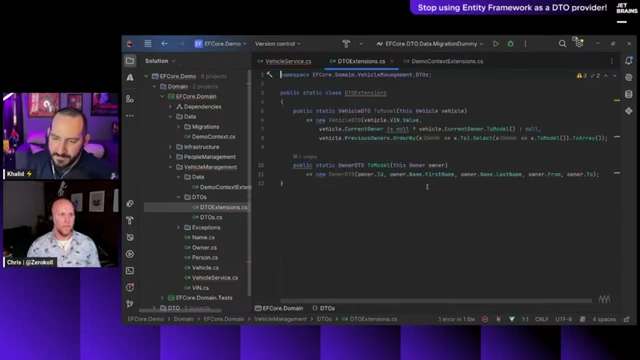
Extension methods for converting domain entities (Vehicle, Owner) to DTOs for read operations [ 00:47:35 ]
- Simple extension methods (
- Running Tests [01:01:49]
- The speaker demonstrates running unit tests that successfully validate the OOP-style entity mappings and service interactions.
- IDesignTimeDbContextFactory for EF Tools [01:13:22]
- The
IDesignTimeDbContextFactoryis used to provide a context for EF Core tools (like migrations bundle) without needing a full application startup.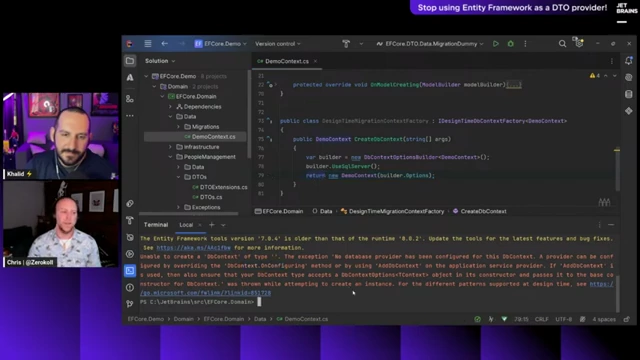
Code for `IDesignTimeDbContextFactory` to enable EF Core tools to create a `DbContext` for design-time operations [ 01:13:51 ]
- The
- Setting up Entities (Vehicle, Vin, Owner) [00:29:06]
Key Takeaways and Best Practices [01:08:26]
- Map to objects that look like you want them to look (OOP First) [01:08:32]
- Design your domain entities with full OOP principles (encapsulation, rich behavior), then use EF's mapping capabilities to persist them. This is especially important for commands (write operations). For queries (read operations), mapping to simpler DTOs is acceptable.
- Use aggregates and
AutoInclude()instead of lazy-loading [01:09:00]- Design DDD aggregates to be small enough that
AutoInclude()can load all necessary data without performance issues, reducing the need for potentially problematic lazy loading.
- Design DDD aggregates to be small enough that
- Use read-specific queries (projections or raw SQL) if performance is a problem [01:09:13]
- For highly optimized read scenarios, use LINQ
projectionsto select only the necessary columns into a DTO or even write raw SQL queries mapped to non-mapped entities if EF's LINQ translation is insufficient (EF Core 8+ supports this).
- For highly optimized read scenarios, use LINQ
- Consider split queries for complex joins [01:09:48]
- If a query with many
Include()statements generates a Cartesian product and pulls too much redundant data, useAsSplitQuery()to tell EF to send multiple, simpler queries to the database.
- If a query with many
- Use directional navigation instead of bi-directional [01:10:06]
- Avoid bi-directional navigation properties in your domain models to prevent accidental loading of entire graph databases into memory, which can happen with deep traversing.
Recommendation to use directional navigation properties to prevent accidental loading of entire database graphs [ 01:10:20 ]
- Avoid bi-directional navigation properties in your domain models to prevent accidental loading of entire graph databases into memory, which can happen with deep traversing.
- Do not map ID and entity when mapping relationships; choose one! [01:10:40]
- When defining relationships, either map the foreign key ID or the navigation property (entity), but not both, to prevent confusing behavior where setting one implicitly affects the other.
- Do not migrate your database as part of your application setup [01:11:22]
- Migrating the database on application startup (
Program.cs) is problematic in load-balanced environments, as multiple instances trying to migrate simultaneously can lead to failures and application downtime. - Instead, generate an
EF migrations bundleexecutable (dotnet ef migrations bundle -o migration.exe) and run this tool as a separate step in your deployment pipeline.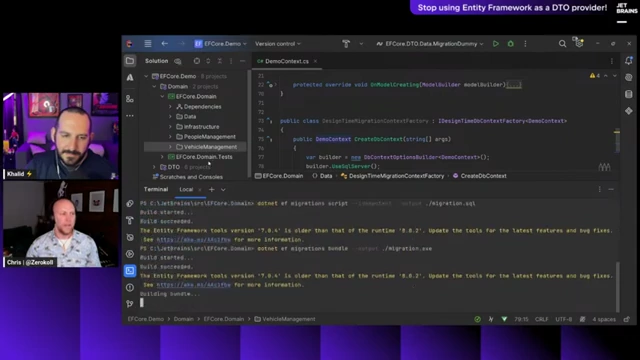
Command `dotnet ef migrations bundle -o migration.exe` to create a self-contained executable for database migrations [ 01:14:40 ]
- Migrating the database on application startup (