The Restructuring of Global Trade: An Analysis of Trump's Tariff Policies and Their Economic, Geopolitical, and Legal Impact
Donald Trump's tariff policies have significantly restructured the global trading system. The August 1st deadline saw new tariffs imposed on various countries like Taiwan, Canada, India, and Switzerland, leading to an effective 18.2% tariff rate for U.S. consumers, the highest since 1934, projected to cost households $2,400 by 2025. These "deals" are not traditional trade agreements but executive arrangements, lacking Congressional approval, creating legal uncertainty. The US-UK deal included supply chain security conditions aimed at excluding China. The US-EU deal was notably one-sided, reflecting the EU's fragmented decision-making and free-trade principles. These tariffs, which are paid by American consumers, cause inflation and disruption, affecting industries like automotive, semiconductors, and pharmaceuticals. China is responding by boosting domestic self-sufficiency and seeking alternative trade partnerships. Critics argue this protectionist approach undermines global trade principles, stifles innovation, and transforms trade into a tool for geopolitical alignment and personal loyalty, rather than economic policy.
Trump's Tariff Policy and Deadline Chaos [0:00]
Donald Trump's August 1st deadline for trade negotiations caused market uncertainty, with new tariffs announced for countries that did not secure deals.
- Initial Announcements and Tariffs:
- The initial list of "Liberation Day" tariffs was announced on April 2nd.
- Taiwan, a major semiconductor exporter, faced a 20% tariff.
- Canada's tariffs increased to 35%, India to 25%, and Switzerland to 39%.
- US Customs and Border Protection began charging new duties ranging from 10% to 50% on various imports.
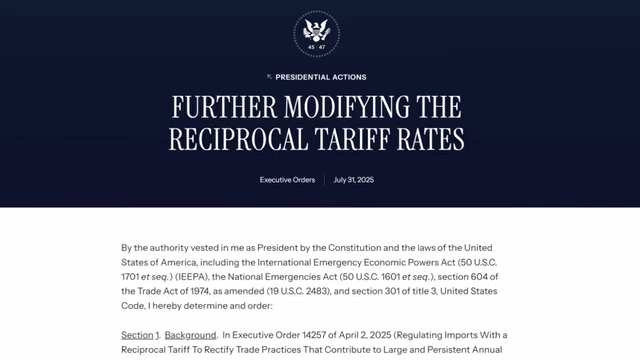
Executive Order further modifying reciprocal tariff rates [ 00:00:13 ] 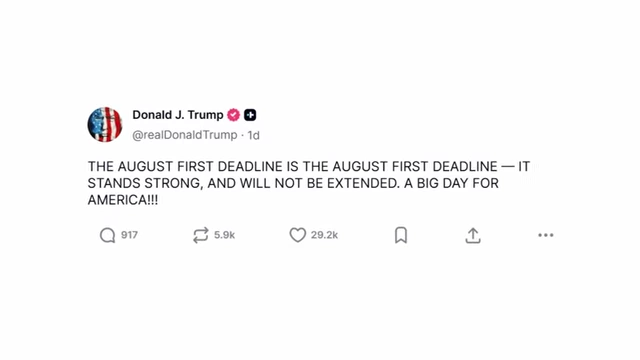
Donald Trump's tweet confirming the August 1st deadline [ 00:01:36 ] 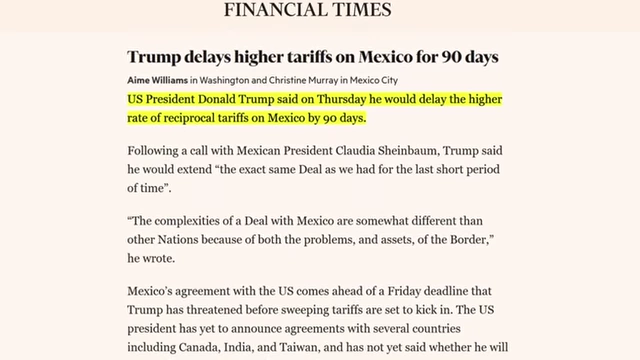
Financial Times headline reporting the 90-day delay for higher tariffs on Mexico [ 00:01:56 ]
- Unfulfilled Promises and Delays:
- Trump claimed "over 200 deals" and advisor Peter Navarro stated "90 deals in 90 days" were possible, but only eight deals were struck in 120 days.
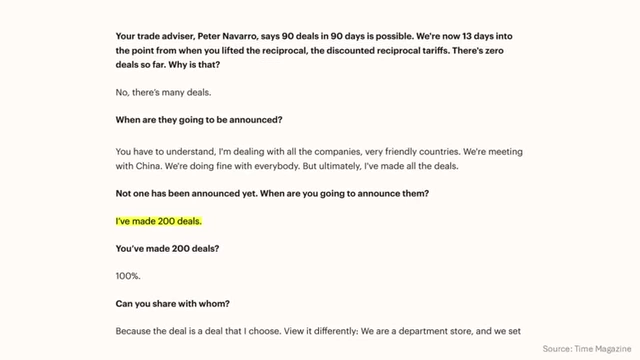
Snippet from Time Magazine interview with Peter Navarro's quote on the possibility of "90 deals in 90 days" [ 00:03:08 ]
- Trump claimed "over 200 deals" and advisor Peter Navarro stated "90 deals in 90 days" were possible, but only eight deals were struck in 120 days.
- Economic Impact on US Consumers:
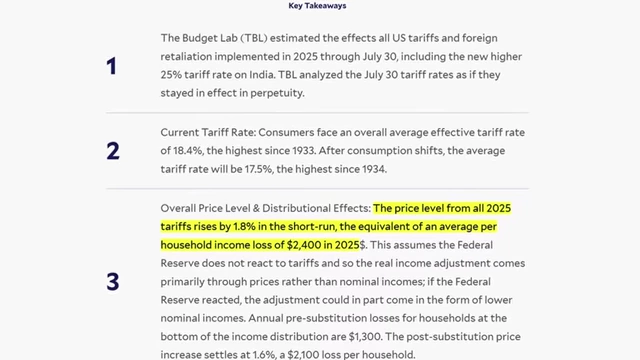
- The Yale University Budget Lab estimated an effective tariff rate of 18.2% for US consumers, the highest since 1934.
- This is projected to result in an average household income loss of $2,400 in 2025.
- The analysis was made before additional tariffs on India and the delay for Mexico.
Yale Budget Lab estimated effects of US tariffs on consumers [ 00:02:30 ]
The US-UK Trade Deal and China's Reaction [3:19]
The UK was the first country to strike a deal with Trump, agreeing to a 10% flat tax on most goods, but it included conditions that upset China.
- Details of the UK Deal:
- The deal kept a 10% tax on most British imports, including cars up to a quota of 100,000 units annually.
- Vehicles beyond this quota face a 25% tax, discouraging increased sales.
- Trump's 2025 Trade Policy Agenda emphasizes a "production economy," prioritizing manufacturing, agriculture, and energy.
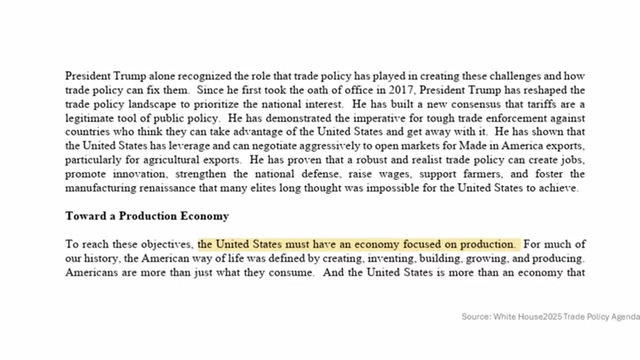
White House 2025 Trade Policy Agenda emphasizing a "production economy" [ 00:03:59 ] - The UK runs the third-largest trade deficit globally, behind India and the United States.
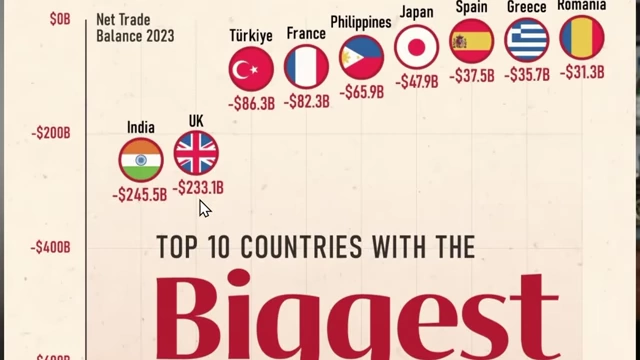
Bar chart showing Top 10 Countries with the Biggest Trade Deficit in 2023 [ 00:04:20 ]
- Security Conditions and China's Concerns:
- The deal's tariff relief for steel and cars included conditions requiring the UK to meet US demands on "security of the supply chains" and "ownership of relevant production facilities."
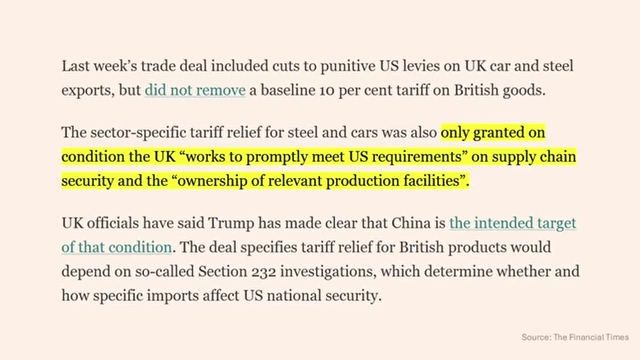
Financial Times article snippet highlighting UK-US trade deal conditions on supply chain security and ownership of production facilities [ 00:07:09 ] - China's Foreign Ministry criticized this, stating agreements should not target third nations, fearing exclusion from British supply chains that serve the US.
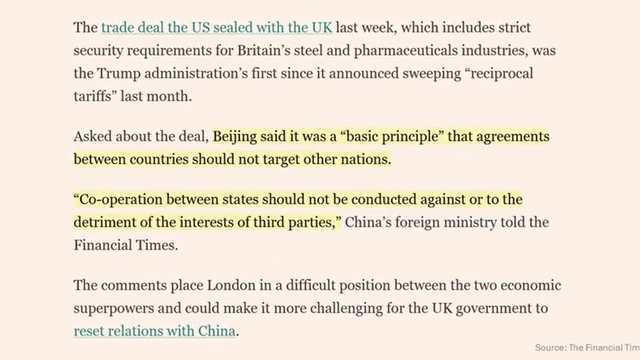
Snippet from Financial Times article detailing China's criticism of the UK-US trade deal, stating agreements should not target third nations [ 00:04:40 ] - This was interpreted as targeting British Steel, which was owned by China's Jingye Group, potentially requiring ownership restructuring for tariff relief.
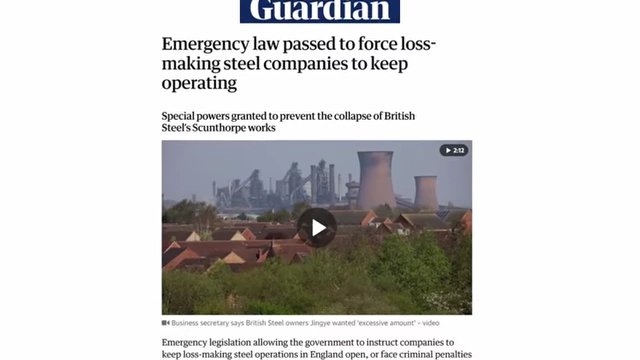
Guardian headline reporting emergency law to force British Steel to operate, related to its ownership [ 00:08:15 ]
- The deal's tariff relief for steel and cars included conditions requiring the UK to meet US demands on "security of the supply chains" and "ownership of relevant production facilities."
- Broader US Trade Policy Shift:
- Tariffs are now being used as a mechanism for enforcing geopolitical alignment, rewarding compliance with US strategic objectives and penalizing economic entanglement with China.
China's Strategic Response [9:01]
Beijing reacted strongly to the UK deal, accelerating efforts to reduce reliance on foreign components and strengthening diplomatic ties elsewhere.
- Boosting Domestic Self-Sufficiency:
- China intensified efforts to remove foreign components from domestic supply chains.
- This aligns with China’s "dual circulation" policy to boost domestic consumption and technological self-sufficiency.
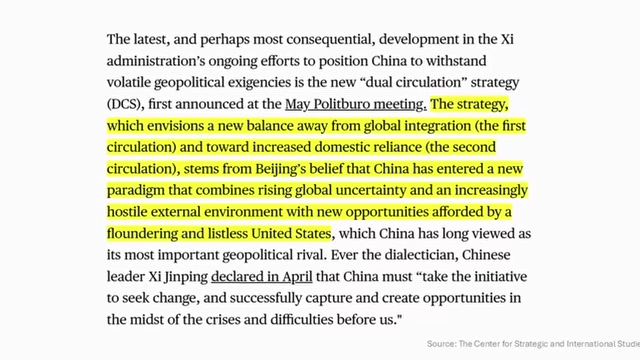
Article snippet describing China's "dual circulation" strategy for increased domestic reliance [ 00:09:39 ]
- Diplomatic Engagement:
- China increased engagement with countries in Southeast Asia, the Global South, and the BRICS bloc, offering alternative trade and investment partnerships.
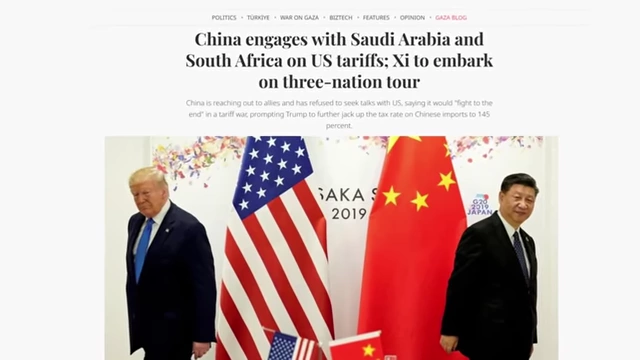
CNN Business headline on China engaging with Saudi Arabia and South Africa on US tariffs [ 00:10:05 ] - Chinese investment abroad surged 28% as Trump launched the trade war.
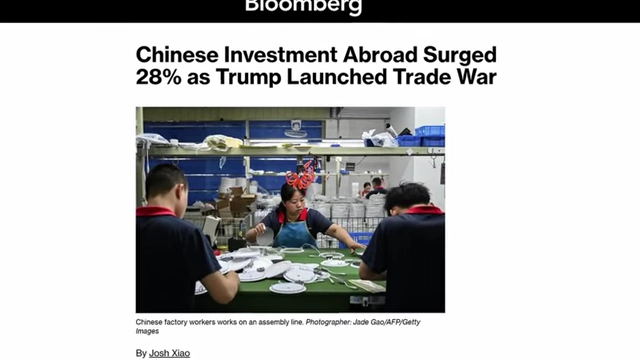
Bloomberg headline stating Chinese investment abroad surged 28% as Trump launched the trade war [ 00:11:09 ]
- China increased engagement with countries in Southeast Asia, the Global South, and the BRICS bloc, offering alternative trade and investment partnerships.
- Fragile US-China Truce:
- Trade talks with the US led to a 90-day truce, temporarily reducing tariffs on Chinese goods from 145% to 40%.
- However, the truce is fragile, with further reductions tied to unrelated issues.
The One-Sided US-EU Trade Deal [11:14]
The EU finalized a broader, but one-sided, agreement with Washington, imposing tariffs on EU exports while the EU applied none on US goods.
- Deal Specifics:
- A 15% tariff was imposed on about 70% of EU exports to the US (pharmaceuticals, semiconductors, cars).
- The EU pledged to buy $750 billion in US energy and invest $600 billion in American industry.

Reuters article snippet showing EU plans to invest $600 billion in the United States and increase energy purchases [ 00:11:39 ] - Steel and aluminum exports were capped, with excess volumes facing a 50% tariff.
- In return, the EU imposed no tariffs on US goods, reflecting the deal's asymmetry.
- Reasons for Asymmetry:
- The EU's founding ethos promotes free trade, making it reluctant to impose tariffs.
- Fragmented decision-making within the EU, with divergent national interests (e.g., France on agriculture, Germany on cars, Eastern Europe on security), hindered unified action.
Unhedged Podcast title card on "The EU folds on tariffs" [ 00:12:08 ]
- Criticism and Interpretation:
- Critics in Paris and Berlin called the deal a "capitulation," with the FT describing it as "rubber stamping the U.S. president’s new world order."
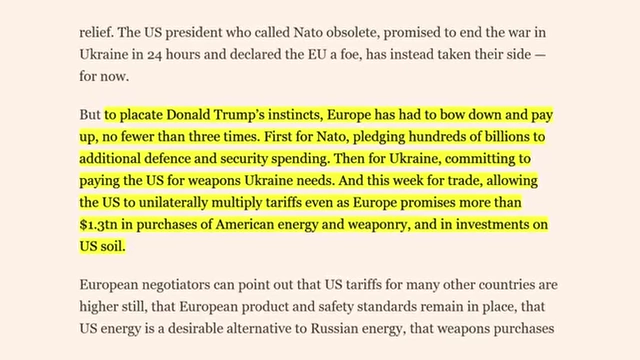
Financial Times editorial highlighting Europe's "capitulation" to placate Donald Trump's instincts [ 00:13:02 ] - The Economist offered a pragmatic view, highlighting parity with Japan’s terms and EU’s retention of regulatory autonomy over digital services, blaming Europe’s internal frictions instead.
- Critics in Paris and Berlin called the deal a "capitulation," with the FT describing it as "rubber stamping the U.S. president’s new world order."
Corporate and Economic Impact of Tariffs [14:07]
The corporate response to Trump's tariffs has been mixed, with significant costs and uncertainty across various sectors.
- Corporate Responses:
- Ford reported an $800 million quarterly loss due to tariffs, expecting a $2 billion annual hit.
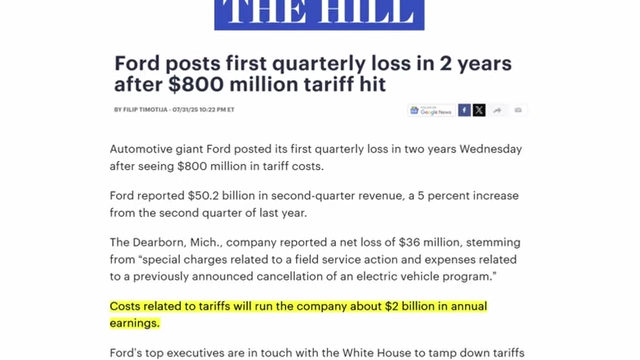
The Hill article reporting Ford's $800 million quarterly loss due to tariffs [ 00:14:18 ] - BMW, with a large US production base, was partially shielded.

Financial Times headline where BMW downplays the fallout from Trump tariffs [ 00:14:29 ] - Apple saw boosted sales early in the quarter as customers bought ahead of tariffs but lost significant market cap since the initial tariff announcement.
- Ford reported an $800 million quarterly loss due to tariffs, expecting a $2 billion annual hit.
- Supply Chain Disruptions and Uncertainty:
- Semiconductor and pharmaceutical firms are reassessing sourcing strategies due to tariffs and export controls.
- Trade associations express concern over opaque "national security" reviews tied to tariff relief, leading businesses to delay investment decisions.

Grant Thornton document on the costs of trade disruption, noting that uncertainty leads businesses to delay investment [ 00:15:39 ]
- Inflationary Consequences:
- Tariffs push up prices for US consumers, contrary to claims that foreign countries pay them.
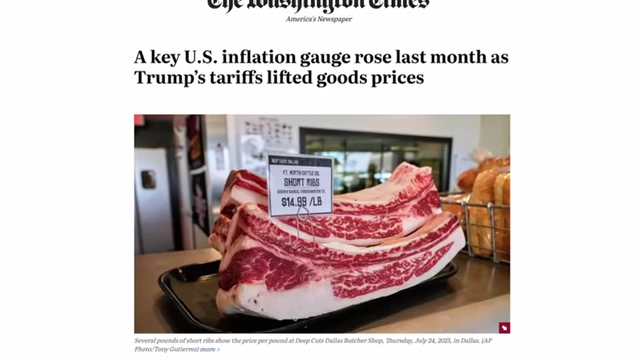
The Washington Times article linking Trump's tariffs to higher goods prices [ 00:19:01 ] - Fed Chair Jay Powell resisted calls for aggressive rate cuts, citing uncertainty over tariffs' inflationary impact.
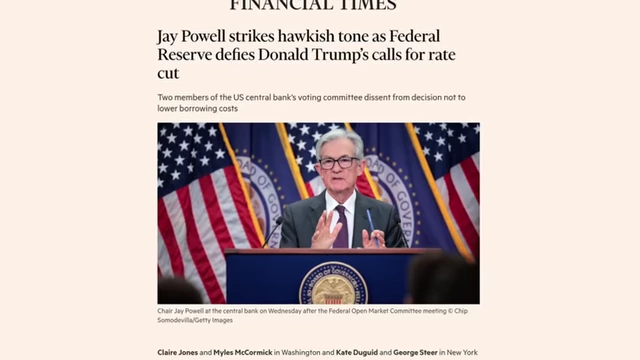
Financial Times headline reporting Jay Powell's hawkish stance as the Federal Reserve defies Trump's calls for rate cuts [ 00:19:56 ] - JPMorgan and Citigroup analysts warn of softening consumer spending as businesses pass on higher input costs.
- European central banks, including the ECB, are also monitoring the situation for global price spillover.
France 24 article indicating the ECB is holding rates due to US tariffs [ 00:20:42 ]
- Tariffs push up prices for US consumers, contrary to claims that foreign countries pay them.
The Broader Geopolitical and Legal Implications [20:47]
Trump's tariffs serve not just economic but also fiscal and geopolitical aims, undermining traditional trade principles and facing legal challenges.
- Tariffs as Revenue and Geopolitical Tools:
- Tariffs generate tens of billions in revenue, acting as a tax on imports, offsetting income tax cuts by shifting the burden to consumers of imported imported goods.
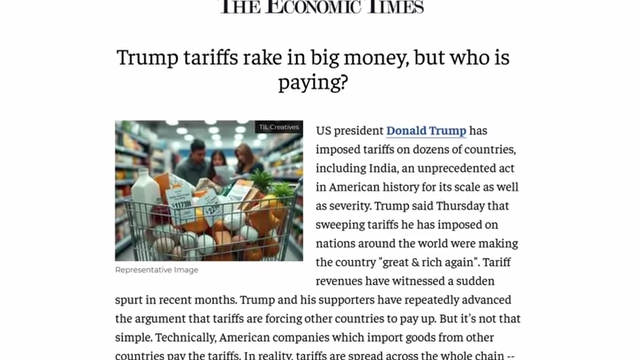
The Economic Times article discussing tariffs as revenue generators, asking "who is paying?" [ 00:21:14 ] - Deals are structured to enforce geopolitical alignment, with market access contingent on distancing from China.
- Tariffs on Mexico and Canada were seen as demonstrations of power.
- The 50% tariff on Brazilian aluminum and agricultural exports was retaliation for Brazil's prosecution of former president Bolsonaro, highlighting tariffs as instruments of ideological alignment and personal loyalty.
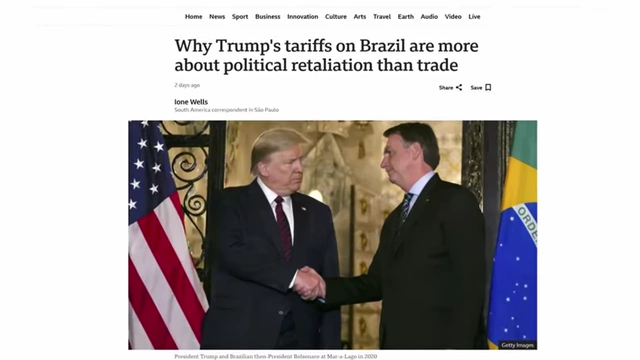
Article headline stating Trump's tariffs on Brazil are more about political retaliation than trade [ 00:22:19 ]
- Tariffs generate tens of billions in revenue, acting as a tax on imports, offsetting income tax cuts by shifting the burden to consumers of imported imported goods.
- Undermining Global Trading System:
- This approach undermines the WTO’s most-favored-nation principle, which requires equal treatment of trading partners.
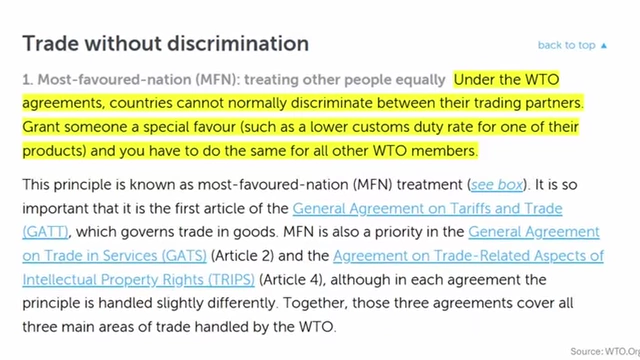
WTO explanation of the Most Favoured Nation (MFN) principle [ 00:22:57 ] - Multilateralism is replaced with a confusing array of bilateral deals.
- This approach undermines the WTO’s most-favored-nation principle, which requires equal treatment of trading partners.
- Legal Challenges and Provisional Deals:
- Legal experts argue Trump's arrangements are not binding trade agreements, as only Congress can regulate foreign commerce and approve treaties.
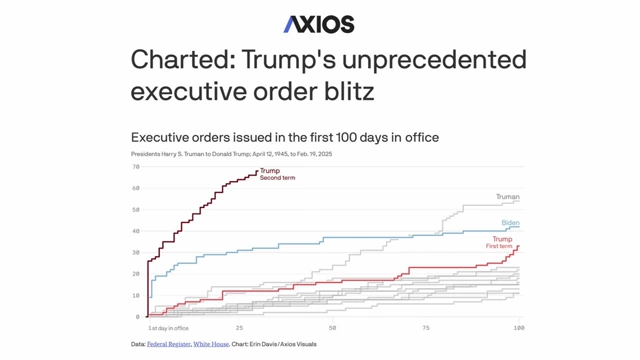
Axios chart showing Trump's "unprecedented executive order blitz" [ 00:16:09 ] - The administration relies on executive agreements and emergency powers, which critics say lack legal standing.
- Senator Ron Wyden affirmed Congress's sole authority over trade and duties, warning of legal challenges.
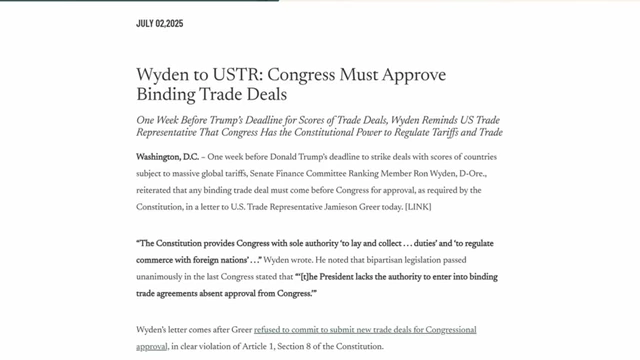
Snippet from Senator Ron Wyden's letter affirming Congress's sole authority over trade and duties [ 00:16:47 ] - Many trading partners treat these as provisional, politically contingent arrangements rather than ratified treaties.
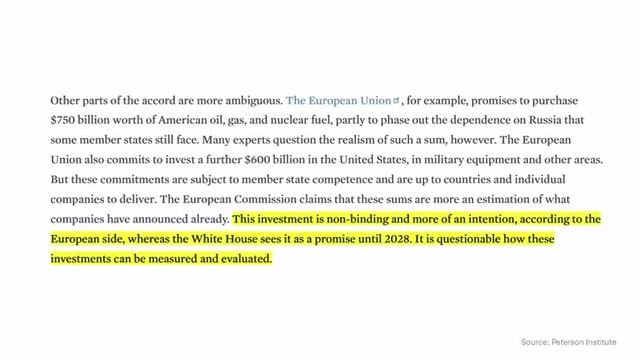
Peterson Institute analysis stating EU investment pledges are "non-binding and more of an intention" [ 00:17:24 ] 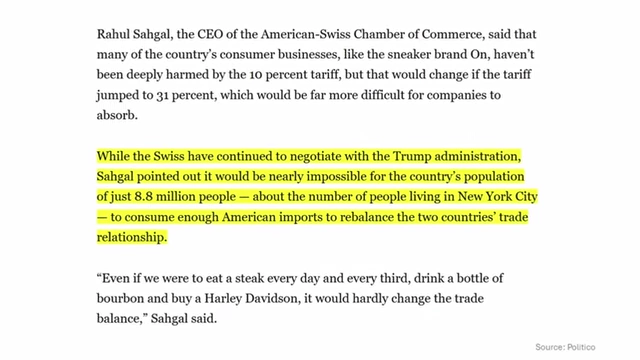
Politico article highlighting the challenge for Switzerland to rebalance trade due to its small population [ 00:17:47 ] 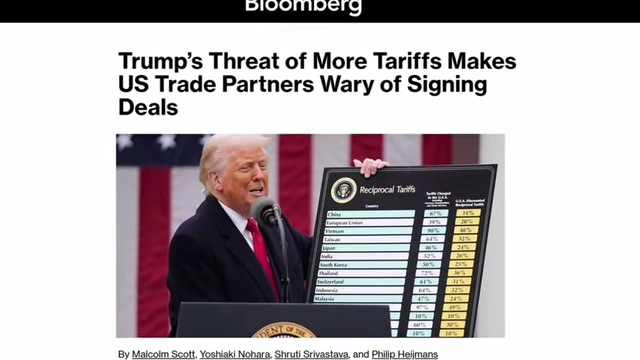
Bloomberg article with a chart illustrating reciprocal tariffs imposed by Trump on various countries [ 00:18:15 ] - A federal appeals court is reviewing the legality of Trump’s use of emergency powers, raising concerns that deals may be ruled "illegal."
- Countries are hedging bets, accepting temporary agreements while preparing for future volatility, with one trade lawyer calling them "ceasefires."
- Legal experts argue Trump's arrangements are not binding trade agreements, as only Congress can regulate foreign commerce and approve treaties.
Conclusion: Effectiveness and Future of US Trade Policy [25:04]
While addressing trade imbalances and promoting onshore manufacturing might be valid goals, the current tariff-heavy approach has significant drawbacks.
- Criticism of the Current Approach:
- Tariffs are a blunt instrument that distort prices, disrupt supply chains, and create uncertainty.
- Unpredictable tariff rates make planning difficult for importers.
- Economists argue tariffs are a distortionary and regressive form of taxation.
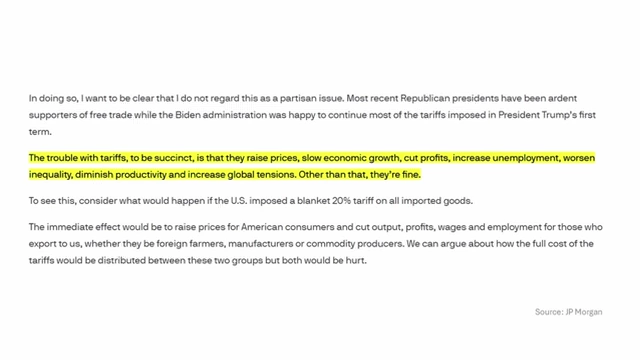
JPMorgan document outlining the economic drawbacks of tariffs, including raising prices and slowing economic growth [ 00:24:01 ]
- Uncertainty of Manufacturing Revival:
- It's unclear if tariffs will revive American manufacturing, given China's vast workforce (over 220 million) compared to the entire US labor force.
- Low US unemployment limits the capacity for large-scale reshoring.
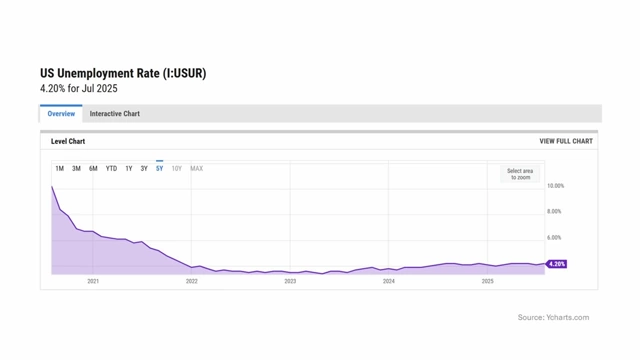
Graph showing the US Unemployment Rate [ 00:26:15 ] - History suggests protectionism leads to lower productivity and stifles innovation, inviting rule-bending rather than competition.
- Outlook:
- The era of frictionless global trade is over, with supply chains being redrawn and business costs rising.
- These deals are not set in stone and may be constantly renegotiated.
- The long-term consequences of this approach for strengthening the US economy remain uncertain.