How Duolingo Uses Gamification to Make Language Learning Engaging and Accessible
Summary:
- Luis von Ahn, Duolingo's co-founder, shares his motivation to combat educational inequality by providing free, accessible language learning via smartphones.
- He explains why language learning was chosen, citing its massive global audience (around 2 billion people) and its direct potential to significantly increase income, especially for English learners.
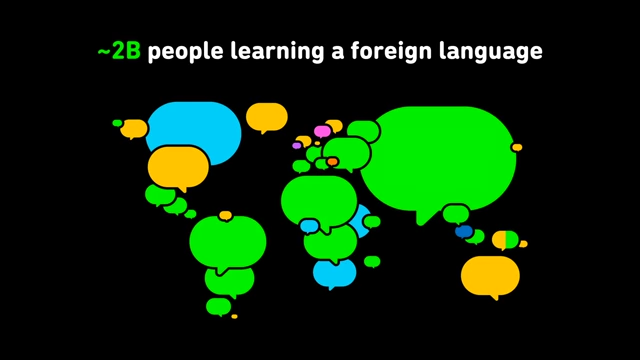
Global map illustrating ~2 billion people learning foreign languages, with green regions indicating a prevalence of English learners. [ 00:02:45 ] - Duolingo employs a freemium business model where paying subscribers, typically from wealthier nations, fund the free education for users in poorer countries, effectively redistributing wealth.
- To keep users engaged, Duolingo harnesses psychological techniques commonly used by social media and mobile games, such as "streaks" to encourage daily practice and sophisticated, sometimes passive-aggressive, AI-driven notifications.
- Von Ahn argues that while educational apps may not be as "addictive" as pure entertainment, the inherent meaning and satisfaction derived from learning provide a crucial compensatory factor.
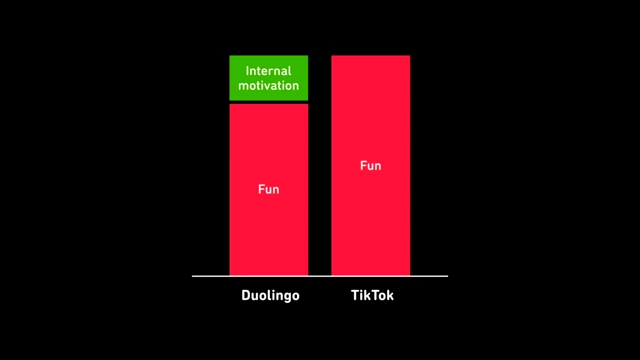
A bar chart comparing Duolingo and TikTok, showing that both primarily offer "Fun" (red bar), but Duolingo also includes "Internal motivation" (green bar) on top of its fun. [ 00:10:40 ] - This approach has enabled Duolingo to reach a vast user base, with more people learning languages on the platform in the US than across all US high schools combined.
- He envisions a future where similar gamified methods can be applied to other subjects, transforming screen time into a positive force for global education.
Background and the Problem of Educational Inequality [00:00:04]
- Luis von Ahn, from Guatemala, highlights the stark educational inequality prevalent in poor countries.
- Wealthy individuals can afford quality education, perpetuating their financial status.
- Those without resources struggle to gain even basic literacy, limiting their economic prospects.
- He recounts his personal experience of receiving a good education thanks to his single mother's sacrifices, which enabled him to pursue a PhD in computer science in the US.
Founding Duolingo: Mission and Strategic Choices [00:01:36]
- The Mission: Equal Access to Education [00:01:41]
- About 10 years ago, von Ahn, then a professor at Carnegie Mellon, decided to create a platform for universal access to education with his PhD student, Severin.
- Choosing the Subject: Foreign Languages [00:02:26]
- Initially considered math and computer science, but ultimately settled on foreign languages.
- Reasons for Choosing Languages:
- Huge Audience: Approximately two billion people worldwide are learning a foreign language [00:02:35].
- Roughly 80% of these learners are learning English.
- Direct Economic Impact: Knowledge of English can significantly increase income potential in most countries [00:02:54].
- Example: A waiter learning English can work in a hotel and earn more, unlike math where knowledge often requires further application (e.g., learning physics to become a civil engineer) [00:03:13].
- Huge Audience: Approximately two billion people worldwide are learning a foreign language [00:02:35].
- Mobile-First Approach [00:03:36]
- Realized that mobile phones were the most effective way to reach a vast global audience, as building physical schools is too expensive.
- The number of people with smartphone access continues to grow.
Duolingo's Freemium Model: A Form of Wealth Redistribution [00:04:09]
- Duolingo was designed to be accessible to everyone, regardless of wealth.
- Model Details:
- Users can learn as much as they want for free [00:04:16].
- Free users may see ads at the end of lessons.
- Users can pay for a subscription to remove ads.
- Wealth Redistribution:
- The majority of Duolingo's revenue comes from subscriptions paid by well-off users in rich countries (e.g., US, Canada) [00:04:30].
- This revenue subsidizes the free education for users in poorer countries (e.g., Brazil, Vietnam, Guatemala) [00:04:49].
- Von Ahn views this as a small form of wealth redistribution, where the rich effectively pay for everyone's education.
Making Learning Engaging: Psychological Techniques [00:05:13]
- The Challenge: Delivering education on smartphones means competing with highly addictive apps like TikTok, Instagram, and mobile games.
- Analogy: Asking people to eat broccoli when delicious dessert is right next to it [00:05:29].
- Solution: Gamification [00:05:48]
- Duolingo makes "the broccoli taste like dessert" by using the same psychological techniques as addictive entertainment apps to keep users engaged with education [00:05:51].
- Key Techniques:
- 1. Streaks: Daily Engagement [00:06:11]
- A streak is a counter showing consecutive days of product usage.
- Users are motivated to return daily to avoid losing their streak, as it resets to zero if a day is missed.
- Power of Streaks: Over three million daily active Duolingo users have streaks longer than 365 days [00:06:53].
- Country Statistics: Japan has the longest average streaks, while Latin America has the shortest [00:07:07].
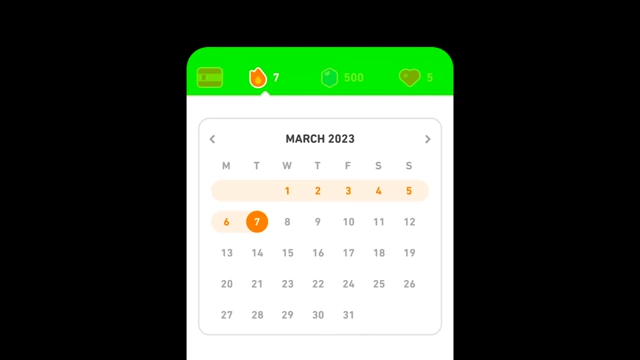
A screenshot of the Duolingo app showing a calendar for March 2023 with a "7" streak icon next to the date. [ 00:06:15 ]
- 2. Smart Notifications: Gentle Reminders [00:07:26]
- While often considered spammy, educational app users appreciate reminders to learn.
- Duolingo uses a sophisticated AI to determine optimal notification timing and messaging for maximum user return [00:07:38].
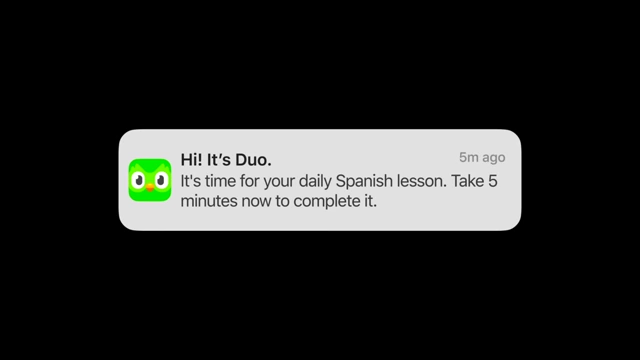
A standard Duolingo notification reminding the user for their daily lesson. [ 00:07:32 ] - Optimal Timing: The best time to send a notification is 24 hours after the user's last session, assuming their availability remains consistent [00:08:00].
- Passive-Aggressive Notifications: After seven days of inactivity, Duolingo sends a notification stating, "Hey, these reminders don't seem to be working. We'll stop sending them for now." [00:08:37]
- This often prompts users to return, as they feel their green owl mascot (Duo) has given up on them.
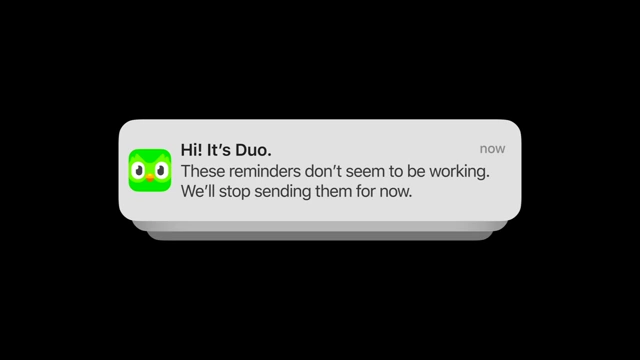
A mobile notification from Duolingo's mascot, Duo, reads: "Hi! It's Duo. These reminders don't seem to be working. We'll stop sending them for now." [ 00:08:40 ]
- This often prompts users to return, as they feel their green owl mascot (Duo) has given up on them.
- Duo Mascot Memes: Duo's pushy and passive-aggressive persona in notifications has led to numerous internet memes and pop culture references (e.g., SNL skits) [00:09:11].
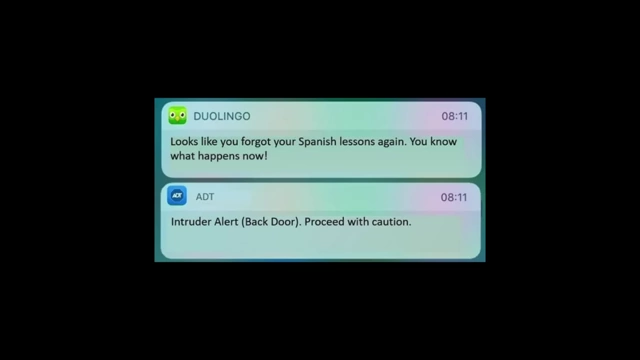
A meme showing two mobile notifications: the top one from Duolingo threatening a user for missing lessons, followed by an "Intruder Alert" notification. [ 00:09:30 ]
- 1. Streaks: Daily Engagement [00:06:11]
Educational Apps vs. Pure Entertainment: The Role of Meaning [00:10:02]
- Von Ahn acknowledges that educational apps may never be as engaging as TikTok or Instagram because learning inherently requires teaching something, which is harder to compete with "cats and celebrities" [00:10:02].
- Intrinsic Motivation: Educational products benefit from users' internal motivation and the meaning derived from learning [00:10:23].
- Unlike scrolling social media for hours, which often leaves users feeling like they've wasted time, learning provides satisfaction.
- Balancing Fun and Purpose: It's acceptable for an educational product to be 80-90% as engaging as entertainment, as the remaining 10-20% is covered by the user's internal motivation [00:10:32].
A bar chart comparing Duolingo and TikTok, showing that both primarily offer "Fun" (red bar), but Duolingo also includes "Internal motivation" (green bar) on top of its fun. [ 00:10:40 ]
Duolingo's Impact and Future Vision [00:11:02]
- Significant Impact: In the United States, more people are learning languages on Duolingo than in all US high schools combined [00:11:04]. This trend is global.
- Future Vision: Gamification for All Subjects [00:11:21]
- Hopes to apply Duolingo's success in language learning to other subjects like math and physics.
- Envisions a future where "screen time" is not a negative term, but a means to deliver high-quality education to everyone, regardless of socioeconomic status [00:11:34].
- Final Reminder: Luis von Ahn concludes with a humorous plea for everyone to "do your language lessons today" [00:11:47].
Q&A: Expanding Gamification to Other Subjects [00:12:05]
- When asked about applying these methods to other subjects, von Ahn explains:
- Repetition-Based Learning: Subjects learned through thousands of repetitions, such as reading or elementary math, are ideal candidates for gamification [00:12:22].
- Challenges with Explanations: More complex topics requiring deep explanations might need different approaches, possibly involving high-quality videos (like Sal Khan's work) [00:12:40].